The CSR Newsletters are a freely-available resource generated as a dynamic complement to the textbook, Strategic Corporate Social Responsibility: Sustainable Value Creation.

To sign-up to receive the CSR Newsletters regularly during the fall and spring academic semesters, e-mail author David Chandler at david.chandler@ucdenver.edu.

Showing posts with label Disney. Show all posts

Tuesday, October 24, 2023

Strategic CSR - Ben & Jerry's

The article in the url below presents a different take on the debate around the extent to which companies should engage in discussions around social issues:

"Companies ranging from Anheuser-Busch to Disney and BlackRock have recently lost loyal customers and billions of dollars in market capitalization and assets after wading into controversial political issues. The reason customers left and investors bailed is simple: These companies failed to carry out what they had promised in their mission statements."

In essence, the argument is that companies should, first and foremost, stay true to their founding mission, and that it is when they diverge that confusion is caused. Anheuser Busch's mission, for example, is to "Dream Big to Create a Future With More Cheers," while BlackRock promises to "to help more and more people experience financial well-being," both of which suggest a more neutral foundation:

"Clear mission statements are critical for company success. A 2016 Harvard Business Review study found that companies that clearly establish their purpose innovate more successfully and increase revenue faster than companies that don't. That's because clear mission statements explain why a company exists and what it hopes to achieve. They also identify its present—and, ideally, future—customers. This aligns internal employees and external investors in pursuit of a common goal: delivering great products and services to increase shareholder value."

Disney is another example of a company that has gotten itself into trouble, of late, with what some see as a confounding of its guiding purpose:

"[Disney's] stated mission is 'to entertain, inform and inspire people around the globe through the power of unparalleled storytelling, reflecting the iconic brands, creative minds and innovative technologies that make ours the world's premier entertainment company.' Creating movies like 'The Lion King' and 'Star Wars' is on mission. Less so is public criticism of such legislation as Florida's Parental Rights in Education Act, which prohibits the state's educators from teaching about sexual orientation and gender identity in classes from kindergarten through third grade. When Disney announced its opposition to the bill in 2022, the majority of its customers disagreed. Disney's public approval rating cratered to 33% in 2022 from 77% in 2021. Customers spoke with their wallets. The company's streaming service, Disney+, saw canceled memberships, and attendance at Disney theme parks suffered. The company's stock remains depressed even after it swapped in new leadership."

Ultimately, the author is arguing that there should be alignment between mission and behavior. Stakeholders engage with a company based on an understanding of what it is that the company does. If the company suddenly diverges from that, however well-intentioned, then it will confuse stakeholders who had been engaging based on alternative assumptions:

"Anheuser-Busch, Disney and BlackRock could learn about proper mission control from Ben & Jerry's. The ice-cream company has been aligning customers and shareholders behind a progressive and social mission for decades. Its mission states: 'We believe that ice cream can change the world. We have a progressive, nonpartisan social mission that seeks to meet human needs and eliminate injustices in our local, national, and international communities by integrating these concerns in our day-to-day business activities.' When Ben & Jerry's supports returning to Native Americans what it claims is stolen land, when it advocates overturning voter-integrity laws, or when it favors defunding the police, its customers aren't surprised. This is because Ben & Jerry's has been advocating such change since two Vermont hippies founded the company in 1972. When they sold the business to multinational conglomerate Unilever in 2000, they maintained an independent board to make decisions on the company's social mission. Their customers expect this activism and buy such ice-cream flavors as 'Save our Swirled' and 'Empower Mint' to support social causes."

For me, the takeaway is that companies need to be founded based on a strong set of values, and those values should be conveyed to stakeholders clearly, from day 1. That authenticity is what binds stakeholders to companies, because the relationship is based on transparency and trust. It is when companies diverge, often for superficial reasons because they feel pressured to comment/act on the topical issue of the day, that problems arise. A company staying true to its values means refusing to engage in certain issues unless they are consistent with what the firm has believed and how it has acted, all along.

Take care
David

David Chandler
© Sage Publications, 2023

Instructor Teaching and Student Study Site: https://study.sagepub.com/chandler6e 
Strategic CSR Simulation: http://www.strategiccsrsim.com/
The library of CSR Newsletters are archived at: https://strategiccsr-sage.blogspot.com/


Why Woke Works for Ben & Jerry's
By Anson Frericks
August 9, 2023
The Wall Street Journal
Late Edition – Final
A17
 

Monday, May 4, 2020

Strategic CSR - Disney

The article in the url below says something interesting about our society. At least, it says something about Disney, the company, and the place it holds in people's minds (and hearts):
 
"At 7:30 in the morning on a recent Saturday, 14 people gathered on the 10th floor of Disney's Riviera Resort in Orlando, Fla. … These 14 adults — a mix of stay-at-home moms, young professionals without children and middle-aged parents from across the country — aren't just Disney fans. They are now considered experts."
 
They are experts because they had been selected and trained for part-time jobs helping holidayers plan their vacations with Disney. But, they are not only experts – these people are serious fans. Given the current shut-down of, essentially, the whole vacation industry, Disney will need fans like this when everything starts back up again:
 
"During breakfast, Mickey Mouse walked into the restaurant and most members of the group rushed to give him a hug and take photos. When Minnie Mouse arrived, others got up, complimented her dress, hugged her and asked for pictures. Group shots, selfies and posed photos were all taken. By 8:15 a.m., when Donald and Daisy Duck arrived, the panelists were too excited to contain themselves — they clapped and danced to the music as the characters put on a performance."
 
And, because there are so many fans out there, this was not an easy job to get. First, there was the training:
 
"The group had been together in Orlando since Wednesday, receiving training about how to be panelists. They learned how to ask each other for help, how to answer a question politely, how to urge someone to try something new."
 
But before that, there was the application process:
 
"They beat out more than 10,000 other applicants to become members of the 2020 Disney Parks Moms Panel, a website where people planning to go on a Disney cruise, or visit a Disney park or Disney Vacation Club in the United States, can ask questions and get responses from these experts. The company will announce the panelists on Wednesday morning. Eleven of this year's new panelists are women, three are men and two are not parents. The panel also has an additional 28 panelists returning from previous years."
 
OK, that's a little weird but, so far, so good, right? Or, maybe it gets weirder. What is interesting about this particular job is not so much what is expected of each employee, but their compensation package:
 
"The panelist position, while a Disney contractor role with an intensive application process, is not paid. In exchange for answering these questions every week, the panelists get a free stay at a Disney park or vacation club of their choice for five nights and can bring three people along. For this group, the trip is more than enough payment."
 
The idea that avid 'fans' would work for Disney for free reminded me of a Southwest case that I teach in my strategy class where the firm's passengers routinely take paid holidays from their jobs to help Southwest recruit new flight attendants. When asked why in the case, one respondent says, "Well, this is my airline, too." I am always left amazed that you just can't buy an endorsement like that. Who would do that for United, American, or Delta? And, what does it say about Southwest (and Disney for that matter) that that is the case? At some level, it has to speak to the culture the organization has created, combined with the meaningfulness that we crave in our lives. Those firms that can create significant overlap between the way we work and the way we live are doing something special:
 
"For [the] panelists, who like Dr. Chlon work full-time, working for Disney in this capacity is something of an honor. It's also an opportunity to contribute to a company that has sentimental and nostalgic meaning."
 
And that enthusiasm is conveyed through these volunteers:
 
"This is why the panelists aren't paid, according to [Leanne O'Regan, director of public relations for Disney Parks, Experiences and Products]. There is an 'authenticity of getting advice from someone who isn't being paid to give you advice,' she said. 'We want them to be honest when they answer questions.'"
 
On the other hand, however, this story also reminded me of the AoM meeting that was held a few years ago in Orlando at Disney World, and what an unmitigated disaster it was. Disney is, if nothing else, a company created by management consultants. And their attempts to get us to part with more money than we would otherwise voluntarily do was so transparent as to be insulting. Maybe it is the cynic in me, but every time someone at Disney told me to have "a wonderful Disney day," my heart sank. Clearly, however, many people out there are not management professors and simply love what it is that Disney does:
 
"This year, Disney put out the call for applications in August and kept the application portal open for one week in September. Many people apply for years before becoming panelists. Tamela Hansen, 45, finally made it onto the panel after 12 years of applying. Ms. Hansen said that she feels like she has been preparing to be a panelist for her whole life; she knew her time would eventually come. After all, she has been to Disney World from Alabama, where she grew up and currently lives, at least 100 times."
 
My question, therefore: Is Disney different from Southwest, or are they both tapping into something similar and fundamental? If so, why do I (largely) enjoy interacting with Southwest (apart from some of those annoying safety videos on YouTube), while Disney makes me feel weird?
 
Take care
David
 
David Chandler
© Sage Publications, 2020
 
Instructor Teaching and Student Study Site: https://study.sagepub.com/chandler5e 
Strategic CSR Simulation: http://www.strategiccsrsim.com/
The library of CSR Newsletters are archived at: https://strategiccsr-sage.blogspot.com/

Work for Disney without Pay? 10,000 Applied
By Tariro Mzezewa
January 19, 2020
The New York Times
Late Edition – Final
TR1, TR8
 

Tuesday, April 17, 2018

Strategic CSR - Carbon pricing

This week's Newsletters will focus on our consumption of carbon, either directly (via emission levels) or indirectly (via market pricing). To begin, the article in the url below discusses the range of efforts being implemented to tackle climate change in the way recommended by most economists – to price carbon emissions. At some level, this is gaining traction among some governments that are finally beginning to take climate change policy seriously:
 
"A total of 41 OECD and G20 governments have announced either a carbon tax or a cap-and-trade scheme, or both. Add state and local schemes, and they cover 15% of the world's emissions, up from 4% in 2010."
 
While impressive on the surface, such schemes (cap-and-trade, in particular) are not comprehensively exposed to market forces and, as such, are subject to distorting political influences. Seeing the day when carbon taxes are coming, however, companies are not waiting to be told what to do:
 
"Companies are moving faster than many governments on carbon pricing. Nearly 1,400 firms globally with combined revenues of $7trn already use, or soon will, 'internal carbon prices.'"
 
This is happening at a pace that is not widely recognized:
 
"Of the 6,100-odd firms which report climate-related data to CDP, a British watchdog, 607 now claim to use 'internal carbon prices.' The number has quadrupled since CDP first began posing the query in its annual questionnaire three years ago. Another 782 companies say they will introduce similar measures within two years. Total annual revenues of these 1,389 carbon-price champions amount to a hefty $7trn. Most come from rich countries, but more developing-world firms are joining them."
 
In most cases, firms charge departments internally for the amount of carbon they use (whether in production or executives flying to meetings overseas), with the goal of reducing the firm-level total. Microsoft and Disney are both mentioned in the article as early adopters. Shell is also a proponent:
 
"In his day job as chief executive of Royal DSM, Mr Sijbesma has made the Dutch food producer examine all proposed ventures to check whether the sums still add up if a ton of carbon dioxide cost €50 ($60), well above the going rate of €6 or so in the European Union's emissions-trading system, which is kept low by an oversupply of permits. Where they do not, alternative feedstocks or cleaner energy suppliers must be found. If a project still looks unprofitable, it could be discarded altogether."
 
What I found interesting in the article, however, is the extent to which firms are differentiating between the short and long term in their planning:
 
"Besides assessing capital projects at €30 per ton of carbon dioxide, Saint-Gobain, a French maker of building materials, factors in a higher price of €100 per ton when choosing between long-term research-and-development projects. AkzoNobel, a Dutch chemicals giant, uses €50 per ton for most investments, but double that for those with lifetimes of 30 years or more."
 
Needless to say, implementation is inconsistent across firms. Nevertheless, the fact that so many firms are innovating in this area suggests there is support for governments to introduce a carbon tax, which immediately exposes all carbon-pricing schemes to market forces and all firms to the full costs of production. When (not if) this happens, those firms that are being the most creative and experimental today will see the largest and quickest benefit.
 
"Such voluntary steps will not stop the planet sizzling. But they help firms prepare for when governments do bring in pricing schemes. In December China launched a market for trading carbon emissions which is the world's largest. The clearest sign of progress would be for similar policies elsewhere to render internal exercises redundant."
 
Take care
David
 
 
Instructor Teaching and Student Study Site: https://study.sagepub.com/chandler4e
Strategic CSR Simulation: http://www.strategiccsrsim.com/
The library of CSR Newsletters are archived at: https://strategiccsr-sage.blogspot.com/
 
 
Low-carb diet
January 13, 2018
The Economist
58
 

Wednesday, March 23, 2016

Strategic CSR - Children's TV

The article in the url below tackles an important subject -- the extent to which disabled characters are represented in children's TV programs. Although disabled people are integrated throughout society, they generally do not appear in children's TV shows in most countries:
 
"Fireman Sam and How to Train Your Dragon feature the only disabled characters currently on long-running children's television franchises. Other characters crop up here and there – the Disney Channel introduced double-amputee Aussie explorer, Wildlife Will to its Doc McStuffins show, and it featured wheelchair user Johnny McBride … in The Proud Family – but both appeared for one episode only. The BBC has a history of disabled characters, from Grange Hill's Rachel Burns with cerebral palsy, … to Balamory's wheelchair user Penny Pocket. The broadcaster also has its visual impairment show Melody, and sign-language show, Magic Hands."
 
In the UK the BBC takes this seriously, partly due to its remit as a public broadcaster. That same sense of responsibility does not appear to extend to the commercial channels:
 
"Camilla Arnold, creative director of Flashing Lights Media, the deaf-led company behind Magic Hands, argues that while the BBC is fulfilling its duties, no other channels are matching this. '[It's] shocking – we're in the 21st century! The other channels need to catch up as there's a definite lack of representation.'"
 
This is important because, apart from the purpose of educating people more generally about various disabilities, it is essential that children are educated using media that reflect the society in which they live and are growing up:
 
"… the Disney Channel, Zodiak Kids and Nickelodeon do not have a single current children's show with a prominent disabled character. FremantleMedia however, (responsible for the likes of The X Factor), does have its comedy series Strange Hill High which is aired on CBBC and includes Samia Speed (witty and in a wheelchair), school caretaker Murdock (with a bionic hand) and hero Mitchell Tanner (living with ADHD). But given that one in 20 children in the UK have a disability, this is pretty scant representation."
 
It is easy to see how the issues that are raised in addressing this imbalance can apply to other consequences of our infatuation with perfection:
 
"The need for better representation, says Philip Connolly, policy and communications manager at Disability Rights UK, comes from 'seeing people like ourselves on-screen. "It is like an acknowledgement or recognition that we are all human. We need to get away from this idea of 'perfection', the handsome prince and beautiful princess – these stories have a powerful grip on the imagination and how children come to see the world.'"
 
Take care
David
 
David Chandler & Bill Werther
 
Instructor Teaching and Student Study Site: http://www.sagepub.com/chandler3e/
Strategic CSR Simulation: http://www.strategiccsrsim.com/
The library of CSR Newsletters are archived at: http://strategiccsr-sage.blogspot.com/
 
 
Children's TV pretends disability doesn't exist
By Tim Smedley
July 28, 2015
The Guardian Sustainable Business
 

Sunday, January 26, 2014

Strategic CSR - Carbon price

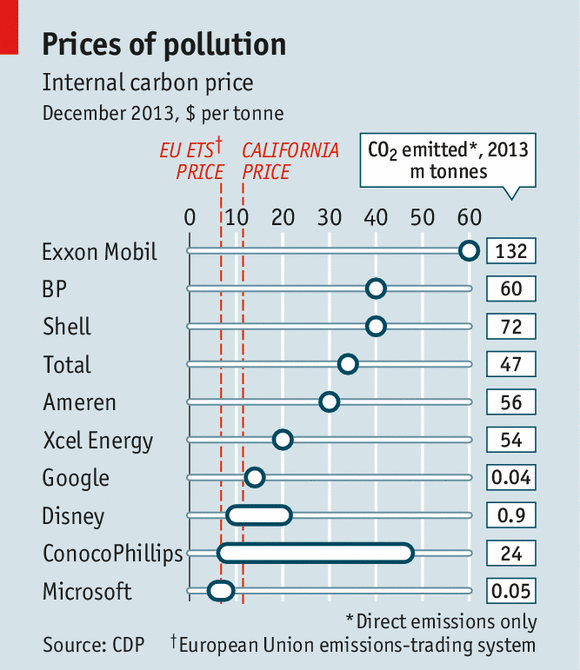
While carbon markets at the governmental level are floundering (think Europe's low cost of carbon and Australia reversing course on legislation to introduce a cap-and-trade scheme), the article from The Economist in the url below shows that most of the innovation on this issue is coming from the private sector. Firms are increasingly developing a cost for carbon that they are then using to plan future projects and investments:
 
"A study by CDP, a research group, asked large firms based or operating in America what tools they had for managing risk; 29 said they used an internal carbon price. Anecdotally, more apply such a price but did not mention it as a risk-mitigation measure."
 
Because firms are doing this on a firm-by-firm basis and they range across vastly different industries, the prices they are allowing for a ton of carbon vary widely—primarily because carbon is relevant to their operations in different ways:
 
"The prices range from $6-7 a tonne of carbon dioxide at Microsoft to $60 a tonne at Exxon Mobil. … As a rule, those whose assets have a long productive life and which might be affected by green policies far into the future (such as oil companies) use higher prices than consumer-goods firms whose products are mainly influenced by current policies."
 
The companies are pushing ahead with this for two basic reasons: first, although it is hard to understand why they think so based on recent performance, firms anticipate politicians will eventually get their act together and impose a carbon price:
 
"For many companies the aim is to prepare themselves for future environmental legislation. AEP, a power supplier, says it uses the system because 'it assumes a price of carbon…will begin in the US by roughly 2020.' Delta Air Lines says it uses a price for evaluating flights to Europe 'in anticipation of compliance with EU ETS.'"
 
Second, it allows firms, such as ConocoPhillips and Disney (see: Strategic CSR – Carbon tax), to better understand the present value of future projects and investments:
 
"ConocoPhillips, an oil firm, requires that capital projects worth over $75m calculate the cost of emissions based on a price of between $8 and $46 a tonne, depending on the life of the project. The forecast value of a new oilfield would be: estimated output multiplied by the estimated future oil price minus development costs and carbon emissions. … Disney, a media conglomerate, goes further still. It invests in schemes to offset or reduce carbon emissions and charges the cost of these to business units in proportion to how much they contribute to the company's overall emissions. In effect, this works like an internal carbon tax."
 
The result of these varied approaches is a range of prices among firms. As the article notes, however, the surprising (and encouraging) thing is how high some of the prices are—much higher than any of the failing government experiments:
 
"The market price of carbon is €4.90 ($6.70) per tonne of CO2 in the EU, $11.50 in California. Big oil companies charge $34 or more. That is closer to the 'social cost of carbon'—the damage from an extra tonne of CO2—than to the market price. … the sort of carbon price some companies are using for planning would, if it became a market price, have a much bigger impact than any of the policies that governments are now talking about."
 
The graphic that accompanies the article demonstrates the extent of the differences in internal carbon price among firms:
 
 
Take care
David
 
David Chandler & Bill Werther
 
Instructor Teaching and Student Study Site: http://www.sagepub.com/chandler3e/
Strategic CSR Simulation: http://www.strategiccsrsim.com/
The library of CSR Newsletters are archived at: http://strategiccsr-sage.blogspot.com/


Carbon copy
Some firms are preparing for a carbon price that would make a big difference
December 14, 2013
The Economist
70
 

Wednesday, October 16, 2013

Strategic CSR - Carbon tax

In the absence of meaningful political action to curb carbon emissions, the article in the url below reports that some companies are imposing carbon taxes on themselves. Some of the firms, such as Disney, are surprising in that they normally are the target of CSR activists for their non-CSR-type behavior:
 
“It's not just Disney. Although most of the world's governments have declined to put a price on carbon emissions, a handful of global companies, including Microsoft and Shell, have chosen to act on their own. They have established internal carbon prices in an effort to reduce emissions, promote energy efficiency and encourage the use of cleaner sources of power, just as a government tax or cap-and-trade program would.”
 
The advantage to the firm of doing this is internal pressure toward greater efficiency. At Disney, for example:
 
“Since 2009, when the tax was imposed, the company's engineers have changed thermostat set points, installed light sensors and efficient bulbs, increased the efficiency of chillers, heat exchangers and pumps, and shut down the lights on park icons like Cinderella's Castle and Spaceship Earth when the parks are closed.”
 
And, the revenues generated by the premium that is paid above market prices is collected in what Disney calls the Climate Solutions Fund, which it uses to offset emissions elsewhere in the value chain:
 
“The tax, the price of which depends upon the costs of offsets and the volume needed by Disney to reach its emissions targets, has been set at between $10and $20 a ton and has raised about $35m so far. That has enabled Disney to invest in a variety of certified forest-carbon projects in Inner Mongolia, China, Peru, and the Democratic Republic of the Congo, as well as in Virginia, Mississippi and its home state of California. Taking those carbon offsets into account, Disney's 2012 emissions have been cut in half from a 2006 baseline. The company has set a long-term goal of zero net emissions.”
 
In addition, all three firms are publicly supporting “an international framework that puts a price on CO2,” while also benefitting from the efficiencies created by such an innovative approach to operations. Primarily, however, these firms and others like them will be best placed when the global political class finally gets around to acting (Chapter 1: A Rational Argument for CSR, p16):
 
“Why bother with these voluntary carbon taxes? Partly to prepare for government regulation of emissions, if and when they arrive. Rob Bernard, Microsoft's chief environmental strategist, explains: ‘I think it's likely that over time society is going to move in this direction. It's hard work. We should get to it now.’”
 
Take care
David
 
David Chandler & Bill Werther
 
Instructor Teaching and Student Study Site: http://www.sagepub.com/chandler3e/
Strategic CSR Simulation: http://www.strategiccsrsim.com/
The library of CSR Newsletters are archived at: http://strategiccsr-sage.blogspot.com/
 
 
Disney, Microsoft and Shell opt for self-imposed carbon emissions taxes
By Marc Gunther
March 26, 2013
The Guardian
 

Friday, April 27, 2012

Strategic CSR - U.S. and China

The articles in the two urls below, together, constitute an interesting snapshot of the relative positions and trajectories of U.S. and Chinese societies. The article in the first url below is titled, “Chinese Warriors Coming to New York …” and reports on an exhibition that will open today of China’s Terracotta soldiers in New York:

The new exhibition … will also include a set of gates from an ancient Han burial chamber, never before publicly displayed, and 20 other artifacts that will be shown in the United States for the first time, among dozens of other pieces.

The article in the second url below, in contrast, is titled “… And ‘Iron Man’ is Going to China” and reports on the recent decision by the Disney-owned Marvel Studios to partner with the Chinese media company, DMG Entertainment, to make Iron Man 3:

Disney, which acquired Marvel Entertainment in 2009, plans to release “Iron Man 3” — starring Robert Downey Jr. as the superheroic industrialist Tony Stark — in May 2013. Filming is expected to take place in China late summer. Disney declined to say how much DMG would invest or how the “Iron Man 3” plot would involve China.

The juxtapositioning of the two articles (on the same page in the New York Times, one on top of the other), reminded me of quote I saw a while ago from the Commerce Department about the leading exports between the U.S. and China. I wrote about that quote in a prior Newsletter and saw it repeated recently in a separate article in the Wall Street Journal (http://online.wsj.com/article/SB10001424052702304444604577337702024537204.html):

Trash has become America's leading export: mountains of waste paper, soiled cardboard, crushed beer cans and junked electronics. China's No. 1 export to the U.S. is computers, according to the Journal of Commerce. The United States' No. 1 export to China, by number of cargo containers, is scrap.

I am not entirely sure what all this says about both countries’ cultures and economies, but the contrast struck me as interesting.

Have a good weekend
David


Instructor Teaching Site: http://www.sagepub.com/strategiccsr/
The library of CSR Newsletters are archived at: http://strategiccsr-sage.blogspot.com/


Chinese Warriors Coming to New York …
By Randy Kennedy
The New York Times
April 17, 2012

… And ‘Iron Man’ Is Going to China
By Brooks Barnes
The New York Times
April 17, 2012