The CSR Newsletters are a freely-available resource generated as a dynamic complement to the textbook, Strategic Corporate Social Responsibility: Sustainable Value Creation.

To sign-up to receive the CSR Newsletters regularly during the fall and spring academic semesters, e-mail author David Chandler at david.chandler@ucdenver.edu.

Wednesday, February 19, 2014

Strategic CSR - The Pope

In very general terms, I am not a fan of organized religion (the Church and the institutions that accompany it). Any large bureaucracy, especially one anchored in absolute doctrine, often does more to cause harm in the world than alleviate it.
 
Starting from this point, it has been fascinating to watch the papacy of Pope Francis unfold. His revolutionary impact on the entrenched interests in the Catholic Church has done much to bring the Church’s actions more in line with the teachings it purports to follow. To this end, the Pope’s recent apostolic exhortation, ‘The Joy of the Gospel,’ is an important document. In the context of this newsletter, the Pope’s teachings have much to say that is relevant to the CSR debate. Here is a comment, for example, criticizing trickle-down economic theories:
 
“Some people continue to defend trickle-down theories, which assume that economic growth, encouraged by a free market, will inevitably succeed in bringing about greater justice and inclusiveness in the world. This opinion, which has never been confirmed by the facts, expresses a crude and naive trust in the goodness of those wielding economic power and in the sacralized workings of the prevailing economic system.”
 
Here is another one that focuses on the damaging influence of money:
 
“One cause of this situation is found in our relationship with money, since we calmly accept its dominion over ourselves and our societies. The current financial crisis can make us overlook the fact that it originated in a profound human crisis: the denial of the primacy of the human person! We have created new idols. The worship of the ancient golden calf (cf. Ex 32:1-35) has returned in a new and ruthless guise in the idol­atry of money and the dictatorship of an imper­sonal economy lacking a truly human purpose. The worldwide crisis affecting finance and the economy lays bare their imbalances and, above all, their lack of real concern for human beings; man is reduced to one of his needs alone: con­sumption.”
 
Commentary on the Pope’s thoughts can be found by E.J.Dionne in the article in the first url below. As Dionne notes, there has been a history of anti-authoritarian thought in the Church:
 
"Christianity has been used over the centuries to prop up the powerful. But, from the beginning, the Christian message has been subversive of political systems, judgmental toward those at the top and demanding of all who take it seriously."
 
Francis’ criticism, however, is leveled not only at the centers of power in capitalism, but also at the consumer ethos that drives the system:
 
"And in light of the obsessive shopping on Cyber Monday and Black Friday, here is a pope who paints consumerism in the darkest of hues. 'We are thrilled if the market offers us something new to purchase,' he writes. 'In the meantime all those lives stunted for lack of opportunity seem a mere spectacle; they fail to move us.'"
 
While Dionne notes that Francis is not the first Pope to criticize the unequal consequences of capitalism, he suggests that he is the first to combine that critique with such a powerful message of empowerment among the poor:
 
"The difference is that a concern for the poor and a condemnation of economic injustice are at the very heart of Francis’s mission. 'In this system, which tends to devour everything which stands in the way of increased profits,' he writes, 'whatever is fragile, like the environment, is defenseless before the interests of a deified market, which become the only rule.' Can you imagine an American liberal who would dare say such things?"
 
In contrast to the support the Pope received from Dionne (who didn’t miss an opportunity to insert his political bias into his column), the Pope’s comments prompted a spirited rebuttal by The Wall Street Journal in the article in the second url below:
 
“I'm glad the only economics ministry the pope runs is the Vatican's. The trickle-down theories he simplistically denounces have done more to bring people out of poverty than any government program or charitable institution in history, including the Church.”
 
Take care
David
 
David Chandler & Bill Werther
 
Instructor Teaching and Student Study Site: http://www.sagepub.com/chandler3e/
Strategic CSR Simulation: http://www.strategiccsrsim.com/
The library of CSR Newsletters are archived at: http://strategiccsr-sage.blogspot.com/
 
 
Heart of Pope Francis’ mission
By E.J. Dionne Jr.
December 1, 2013
The Washington Post
 
Of Jane Fonda and Pope Francis
By Bret Stephens
The Wall Street Journal
Late Edition – Final
A15
 

Monday, February 17, 2014

Strategic CSR - Amazon

The article in the url below poses an interesting question that results from the interaction of the Holiday season and a higher percentage of shopping done online – Which is greener, shopping online or shopping at the store? (Chapter 8, Paper or Plastic? pp. 486-489). Apparently, the answer is not as straightforward as you might think:
 
“Going to a physical store often involves driving, which consumes fossil fuels. But that is offset by the fact that people tend to pick up multiple items each trip. Online shopping creates packaging waste and consumes energy for shipping, especially when purchases are made one item at a time or with expedited delivery. In the end, ‘the trade-off is pretty much the same,’ said H. Scott Matthews, an engineering professor at Carnegie Mellon University who has studied the issue.”
 
Either way, the holiday season generates a lot of trash – Amazon’s success and our convenience come with an environmental cost:
 
“The end of the year is peak trash season across America, a superlative earned by all the eating, parties and gift giving that people do in the final weeks of the year. Americans produce around 25% more waste around the holidays than other periods, estimates the Environmental Protection Agency. The additional garbage—which adds up to over one million tons of waste—includes food scraps, cutlery, wine bottles, wrapping paper and Christmas trees. People also toss furniture, television sets, microwaves and other appliances after receiving new ones as gifts.”
 
Perhaps the main effect of more ecommerce is just a different kind of trash, rather than any more or less:
 
“Online sales add a thickening layer of refuse. In recent years, as more consumers have taken to buying online, the volume of corrugated cardboard boxes, air-filled plastic pockets and Styrofoam pellets in trash has grown. Much of it is recycled, but some people discard the items with other household waste, which ends up in landfills.”
 
And that is a trend that does not look like it will change anytime soon:
 
“Online sales in the U.S. this year are forecast to grow 15% to $78 billion, according to technology researcher Forrester Research Inc. United Parcel Service Inc. earlier predicted an 8% rise in the daily volume of package delivery during the holidays, thanks to growth in online shopping. Last year, UPS delivered more than 500 million packages during peak season. The U.S. Postal Service expects to ship a record 420 million packages between Thanksgiving and New Year’s, an increase of 12% from last year. Both are used by large retailers including Amazon.com Inc. and Wal-Mart Stores Inc. to deliver their products.”
 
Take care
David
 
David Chandler & Bill Werther
 
Instructor Teaching and Student Study Site: http://www.sagepub.com/chandler3e/
Strategic CSR Simulation: http://www.strategiccsrsim.com/
The library of CSR Newsletters are archived at: http://strategiccsr-sage.blogspot.com/


The Last Christmas Present: Lots of Trash
By Serena Ng
December 26, 2013
The Wall Street Journal
Late Edition – Final
B8
 

Friday, February 14, 2014

Strategic CSR - Subway

Reassuring news from Subway, one of the world’s largest sandwich chains:
 
“That footlong loaf baking in your local Subway’s oven could contain an ingredient called azodicarbonamide. It’s an additive the U.S. Food and Drug Administration permits for use in restricted amounts to strengthen dough and to increase the shelf life of bread, and as a bleaching ingredient in cereal flour—it also happens to be used in plastics and rubber. After a petition launched this week, the ubiquitous sandwich chain announced on Wednesday that it will stop using the additive, though it did not say when.”
 
The chemical, which is already banned in Europe and Australia, is used in a number of Subway’s breads, but is also used in other restaurants and foods. Encouragingly, the change came following a petition launched online:
 
“Chatter about the use of the additive in food grew in 2011. This week, FoodBabe.com blogger Vani Hari started a petition asking Subway to remove azodicarbonamide from its breads; so far, Hari’s garnered more than 66,000 signatures. The company said it was working on reformulating the recipe before the petition was launched, reported the Associated Press.”
 
Of course. Eat fresh!
 
Have a good weekend
David
 
David Chandler & Bill Werther
 
Instructor Teaching and Student Study Site: http://www.sagepub.com/chandler3e/
Strategic CSR Simulation: http://www.strategiccsrsim.com/
The library of CSR Newsletters are archived at: http://strategiccsr-sage.blogspot.com/
 
 
Subway Chain Will Stopp Putting a Chemical Used in Rubber in Its Bread
By Venessa Wong
February 6, 2014
Bloomberg Businessweek
 

Wednesday, February 12, 2014

Strategic CSR - Financial Crisis

Some quotes from a recent article in The New York Times by Gordon Brown, who was Prime Minster of the UK during the most recent Financial Crisis:
 
“Already, we have forgotten the basic lesson of the crash: Global problems need global solutions. And because we failed to learn from the last crisis, the world’s bankers are carrying us toward the next one.”
 
“… most of the problems that caused the 2008 crisis — excessive borrowing, shadow banking and reckless lending — have not gone away. Too-big-to-fail banks have not shrunk; they’ve grown bigger. Huge bonuses that encourage reckless risk-taking by bankers remain the norm. Meanwhile, shadow banking … has expanded in value to $71 trillion, from $59 trillion in 2008.”
 
“In the patterns of borrowing today, we can already detect parallels with the pre-crisis credit boom.”
 
“China’s total domestic credit has more than doubled to $23 trillion, from $9 trillion in 2008 — as big an increase as if it had added the entire United States commercial banking sector. … And China’s banking system may not be Asia’s most vulnerable.”
 
Ultimately, Brown’s criticism is not focused on different laws and regulations put in place by individual country legislatures, but with the failure to act on a global scale. Because big banks have become bigger (more multinational), the need for consistency across borders is paramount:
 
“The Volcker Rule, now approved by American regulators, illustrates the initial boldness and ultimate weakness of our post-2008 response. This element of the Dodd-Frank financial reform law of 2010 forbids deposit-taking banks in the United States from engaging in short-term, proprietary trading. But these practices are still allowed in Europe. Controls are even weaker in Latin America and Asia. International rules are needed for international banks.”
 
“In short, precisely what world leaders sought to avoid — a global financial free-for-all, enabled by ad hoc, unilateral actions — is what has happened. Political expediency, a failure to think and act globally, and a lack of courage to take on vested interests are pushing us inexorably toward the next crash.”
 
Take care
David
 
David Chandler & Bill Werther
 
Instructor Teaching and Student Study Site: http://www.sagepub.com/chandler3e/
Strategic CSR Simulation: http://www.strategiccsrsim.com/
The library of CSR Newsletters are archived at: http://strategiccsr-sage.blogspot.com/


Heading Toward Another Crash
By Gordon Brown
December 20, 2013
The New York Times
Late Edition – Final
A27
 

Monday, February 10, 2014

Strategic CSR - Business case

The article by Mallen Baker in the url below makes a great point about the futility of our ongoing search for a business case for CSR/sustainability:
 
“Think about it. Why is so much business networking based around semi-social settings, such as dinners or entertainments? Because any good salesman knows that you have to create a positive relationship of trust. If people like you, they’re more likely to want to buy from you. And if they want to buy from you, they will seek a business case that makes it work. Because they already wanted to do it.”
 
In other words, Baker argues that we have our priorities the wrong way around—that making the business case is the easy part; it is convincing the hearts and minds that is difficult. Once that is done, however, the business case will be constructed to justify the decision that has already been taken:
 
“… the business case becomes the tool that shows how something can be made to work for the business. It is not the tool that helps you choose to do the thing in the first place.”
 
In making this point, Baker is talking more about the essential nature of business and how humans act and interact:
 
“It’s received wisdom that corporate responsibility is all about the business case. You can’t hope to get sustainable action within your company unless you can prove it’s going to work with hard, indisputable numbers. And lots of people duly spend time crafting the business case, only to find that it fails to persuade. It’s frustrating. When that happens, the chances are that the role of the business case is being fundamentally misunderstood.”
 
Business, like most of human activity, is inherently social. This underlying social component of human behavior extends to all aspects of decision making, from who we associate with, to major decisions about how we run our lives (and our businesses):
 
“So you have to deal with your decision makers as people. They need to be seduced. They have to be influenced by people they respect and want to emulate. They have to see something that will make them think about it in a new way – that will touch their heart not just their head. And then, only then, the business case becomes a powerful and essential tool.”
 
The business case for CSR, in other words, is the means by which we help senior executives do what they want to do anyway, rather than a tool we use to persuade them to do something that they perceive to be against their best interests:
 
“So the business case is no longer the tool you use to win somebody over. The business case is the tool that demonstrates you can do what they now want to do and maximise the benefit for the company.”
 
It is useful to remember that CEOs are human too:
 
“… very few chief executives or other senior decision makers would really decide to take action based on a business case if they came to the table in a sceptical frame of mind.”
 
Take care
David
 
David Chandler & Bill Werther
 
Instructor Teaching and Student Study Site: http://www.sagepub.com/chandler3e/
Strategic CSR Simulation: http://www.strategiccsrsim.com/
The library of CSR Newsletters are archived at: http://strategiccsr-sage.blogspot.com/
 
 
Sustainable business – Keep the business case in its proper place
By Mallen Baker
March 7, 2013
Ethical Corporation Magazine
 

Friday, February 7, 2014

Strategic CSR - Social cohesion

The article in the url below by David Brooks is not directly related to CSR, per se, but registers a strong statement on the cohesiveness of a society—in particular, society in the U.S. Brooks is discussing how best to give a greater number of children an opportunity to be successful in life. And, by “successful,” he is not talking about any major contributions to society, simply that they do not detract from social value. The article is good and is designed primarily to widen the debate beyond merely spending more government money trying to improve education and school systems, for example. One quote stood out for me, though, because it illustrates vividly how far we have to go to reach a bar that is not set very high:
 
“According to work done by [the University of Pennsylvania’s Isabel] Sawhill and others, a significant number of kids stay on track through the early years, but then fall off the rails as teenagers. Sawhill set a pretty low bar for having a successful adolescence: graduate from high school with a 2.5 G.P.A., don’t get convicted of a crime, don’t get pregnant. Yet only 57 percent of American 19-year-olds get over that bar. Only one-third of children in the bottom fifth of family income do so.”
 
It is hard to imagine a stronger indictment of where we are as a society than a simple statistic such as that. And, that does speak to the CSR debate in terms of how we can envision moving it forward.
 
Have a good weekend
David
 
David Chandler & Bill Werther
 
Instructor Teaching and Student Study Site: http://www.sagepub.com/chandler3e/
Strategic CSR Simulation: http://www.strategiccsrsim.com/
The library of CSR Newsletters are archived at: http://strategiccsr-sage.blogspot.com/


It Takes A Generation
By David Brooks
January 24, 2014
The New York Times
Late Edition – Final
A25
 

Wednesday, February 5, 2014

Strategic CSR - Markets

Where are the limits of the market to solve societal problems?
 
“The Dallas Safari Club knows how to bring in the new year with a bang. On Jan. 11, a rare permit to hunt and kill an endangered black rhino will be sold in Dallas to the highest bidder.”
 
The idea, of course, is to use the auction to raise as much money as possible (the goal is $1 million) that can then be used to help preserve the species. It is also hoped that the attention the auction garners can be used to raise awareness of the danger of extinction. The argument of the Dallas Safari Club is that, not only is this how conservation should work, but that it is the best chance we have to avoid the rhino’s extinction:
 
“‘This is a great opportunity to do something we are all going to be proud about,’ Carter [Ben Carter, executive director of the Dallas Safari Club] said. ‘It would be a terrible travesty to not have black rhinos roaming in their natural habitat. We hope they'll be around for a long time to come.’”
 
Conservationists, needless to say, are not convinced:
 
“‘Issuing this ... permit is a threat to rhinos, since it will now encourage more Americans to travel to Africa and start killing these imperiled animals,’ said Wayne Pacelle, president and CEO of the Humane Society of the United States. ‘It is also a very dangerous precedent.’”
 
What is not in debate is that this animal is in danger. The vast majority would like to keep it around, yet existing policies are not working:
 
“The black rhinoceros, once numbering in the hundreds of thousands, has had its population drop sharply since the 1960s. Now there are only about 5,000 — and many of those, nearly 1,800, are in Namibia, a southern African country that borders the Atlantic Ocean.”
 
The problem is, of course, is that the market works in many different ways and there are more than enough incentives to kill the animal that manage to persuade some that it is worth their while:
 
“The black rhino, as well as its white counterpart, is hunted by poachers for its horns, which are highly valued for medicinal and therapeutic purposes and can be sold on the international black market for anywhere from $50,000 to $300,000. In recent years, more than 1,600 white and black rhinos have been slaughtered for their horns.”
 
At least there appears to be some science backing up the market logic for selective culling:
 
“‘The removal of limited numbers of males has been shown to stimulate population growth in some areas,’ according to the U.S. Fish and Wildlife Service. ‘Removing specific individuals from a population can result in reduced male fighting, shorter calving intervals and reduced juvenile mortality.’”
 
And rules in place ensure the least damage possible will be done:
 
“The winner of the permit — if he or she uses it — would hunt the animal in the Mangetti National Park in Namibia with a guide and officials who would indicate which of the black rhinos it is OK to kill. … The chosen rhino will be an older bull, one who no longer breeds. And he will be known to hurt others in the group, one who could kill babies, breeding males and females of any age.”
 
The upside is that, potentially, a lot of good will come from the exercise. But, I wonder if the logic that is ultimately being used to rationalize the auction alters the underlying ethical decision:
 
“‘This one that has been chosen — a problem animal — will be removed whether there is or isn't an auction,’ Carter said. ‘This is an opportunity to raise a lot of money for something that will happen no matter what.’”
 
The winning bid for the right to shoot the animal? $350,000 (see: http://www.nytimes.com/2014/01/21/opinion/a-trophy-hunt-thats-good-for-rhinos.html)
 
Take care
David
 
David Chandler & Bill Werther
 
Instructor Teaching and Student Study Site: http://www.sagepub.com/chandler3e/
Strategic CSR Simulation: http://www.strategiccsrsim.com/
The library of CSR Newsletters are archived at: http://strategiccsr-sage.blogspot.com/
 
 
Dallas auction for the right to hunt endangered black rhino stirs uproar
By Anna M. Tinsley
December 25, 2013
msn news
 

Monday, February 3, 2014

Strategic CSR - Consumerism

An integral component of the intellectual framework underlying Strategic CSR is the empowered stakeholder. If all stakeholders, whether consumers, regulators, suppliers, the media, etc., establish the values they wish to operate by and then enforce those values in their dealings with firms (favoring those firms that support them and discriminating against those that do not), then firms will quickly adapt their behavior to match these expectations. The article in the url below reinforces this idea by criticizing our current economic system that is driven primarily by consumerism—two critiques, in particular:
 
“The first is that the kind of shift we need in our society is deeply unlikely while the idea of people as Consumers dominates our language. The second is that to truly to solve our problems, we're going to need to move beyond acts of consumption as the primary means of participation in society.”
 
The first critique is important because the idea of consumerism, at least as currently practiced, is unsustainable:
 
“Set-piece social psychology experiments have shown that even a few words that prime people to think of themselves as Consumers, result in more selfish behaviour and attitudes and lower social and ecological motivation levels. … by the very act of reinforcing that mode of being they're actually undermining the extent to which we feel we have a genuine responsibility to anyone apart from ourselves.”
 
The article is also important because it criticizes those organizations that, even with good intentions, promote consumerism as a solution, rather than an inherent part of the problem:
 
“As the Consumer has become the primary role of the individual in society, the act of consumption has become the defining act of participation in society. Every time we see an ad that asks us only to transact, that prominence is being reinforced; we are being told we are Consumers and that how we spend our money is the extent of our power in the world. This is true even of most charity ads, and certainly true of the new wave of ‘shop for good’ ads, of which the latest offering comes from Innocent smoothies.”
 
The second critique is important because, having broken down the central tenet of consumerism, it is important to replace it with something substantive:
 
“The signs are everywhere that people have had enough of being Consumers, and are searching for rather more fulfilling ways to participate. … Brands can help us do this, and harness our help, by meeting us in the middle. … That's a really difficult world for the big boys to enter. But Unilever could easily encourage us to get involved in their work. … In this context, Innocent, so often the little guys who lead the corporate way, have seriously disappointed with their latest offering. Chain Of Good? Must try harder.”
 
The solution, the author argues, is an iterative relationship between firm and stakeholder—in other words, strategic CSR.
 
Take care
David
 
David Chandler & Bill Werther
 
Instructor Teaching and Student Study Site: http://www.sagepub.com/chandler3e/
Strategic CSR Simulation: http://www.strategiccsrsim.com/
The library of CSR Newsletters are archived at: http://strategiccsr-sage.blogspot.com/
 
 
The ‘just go shopping’ message from advertisers has a dangerous effect
By Jon Alexander
January 10, 2014
The Guardian
 

Friday, January 31, 2014

Strategic CSR - Walmart

The article in the url below reports the number of job applications received by Walmart when it advertised 600 vacancies recently for a new store that it is planning to open in Washington D.C.:
 
“The store is currently combing through more than 23,000 applications for 600 available positions. … That means that Wal-Mart will be able to hire one person for every 38 applications it receives — i.e., just 2.6% of applicants will walk out with a job.”
 
Walmart is often criticized for paying below market wage rates. In reality, however, the firm routinely receives applications that are many multiples of however many job openings it has. This case may be extreme (no doubt exaggerated by the economic situation), but the phenomenon is common. The article illustrates its point by making a clever comparison:
 
“That's more difficult than getting into Harvard. The Ivy League university accepts 6.1% of applicants.”

The question this story generates is: Is Walmart paying above or below market rates for the jobs it is advertising?
 
Have a good weekend.
David
 
David Chandler & Bill Werther
 
Instructor Teaching and Student Study Site: http://www.sagepub.com/chandler3e/
Strategic CSR Simulation: http://www.strategiccsrsim.com/
The library of CSR Newsletters are archived at: http://strategiccsr-sage.blogspot.com/

 
Applicants For Jobs At The New DC Walmart Face Worse Odds Than People Trying To Get Into Harvard
By Ashley Lutz
November 19, 2013
Business Insider
 

Wednesday, January 29, 2014

Strategic CSR - GM Foods

Internally, I have long debated the value of genetically modified (GM) crops. The PR surrounding them is compelling (increase crop yields as a way to minimize hunger and malnutrition around the world), yet they still seem somewhat creepy (modifying plants to taste differently and repel insects). Speeding up the process of evolution seems dangerous in ways that we may not be aware of before it is too late. In contrast, the editorial by The Economist in the url below takes a definitive stand in favor of further exploration and study. In the process, it also does a good job of pointing out the dangers of unrepresentative NGOs.
 
First, the editorial makes the statement that, following the recent retraction of an academic paper from 2012 that suggested GM foods might cause cancer (the paper’s methods were found to be flawed):
 
“There is now no serious scientific evidence that GM crops do any harm to the health of human beings. There is plenty of evidence, though, that they benefit the health of the planet.”
 
This is important because of the challenge posed by the global population expansion:
 
“One of the biggest challenges facing mankind is to feed the 9 billion-10 billion people who will be alive and (hopefully) richer in 2050. This will require doubling food production on roughly the same area of land, using less water and fewer chemicals. It will also mean making food crops more resistant to the droughts and floods that seem likely if climate change is a bad as scientists fear.”
 
Importantly, we have no good alternatives. In other words, it is either utilize GM technology or condemn many millions of people to a miserable life and an early death:
 
“Organic farming—the kind beloved of greens—cannot meet this challenge. It uses far too much land. If the Green revolution had never happened, and yields had stayed at 1960 levels, the world could not produce its current food output even if it ploughed up every last acre of cultivable land.”
 
GM foods, on the other hand, offer a real potential solution to this challenge, while also containing environmental benefits:
 
“GM crops boost yields, protecting wild habitat from the plough. They are more resistant to the vagaries of climate change, and to diseases and pests, reducing the need for agrochemicals.”
 
NGO groups opposed to GM foods, however, apparently cannot sacrifice the principle of opposition for the practicality of expanding access to food and nutrition:
 
“In August environmentalists in the Philippines vandalised a field of Golden Rice, an experimental grain whose genes had been modified to carry beta-carotene, a chemical precursor of vitamin A. Golden Rice is not produced by a corporate behemoth but by the public sector. Its seeds will be handed out free to farmers. The aim is to improve the health of children in poor countries by reducing vitamin A deficiency, which contributes to hundreds of thousands of premature deaths and cases of blindness each year.”
 
The editorial states that this is no longer an argument of ideological purity, but a significant moral and ethical transgression:
 
“Vandalising GM field trials is a bit like the campaign of some religious leaders to prevent smallpox inoculations: it causes misery, even death, in the name of obscurantism and unscientific belief. … On moral, economic and environmental grounds, this must stop.”
 
The editorial is particularly insightful in noting the inconsistent use of scientific research:
 
“In the field of climate change, environmentalists insist that the scientific consensus should frame policy. They should follow that principle with GM crops, and abandon a campaign that impoverishes people and the rest of the planet.”
 
NGOs have a higher duty of transparency and accountability. These organizations often have a narrow funding base and face little oversight (other than via laws and regulations). As such, they have a duty to ensure their actions maximize value, broadly defined, rather than pushing the political agendas of a minority. In terms of GM foods, it is hard not to agree with The Economist that they need to reassess their priorities. After all, as the article in the second url below notes:
 
“About 93% of the soybeans and 85% of the corn grown in the US are genetically modified, according to the USDA.”
 
Take care
David
 
David Chandler & Bill Werther
 
Instructor Teaching and Student Study Site: http://www.sagepub.com/chandler3e/
Strategic CSR Simulation: http://www.strategiccsrsim.com/
The library of CSR Newsletters are archived at: http://strategiccsr-sage.blogspot.com/


Fields of beaten gold
December 7, 2013
The Economist
17
By Marc Gunther
December 4, 2013
The Guardian
 

Sunday, January 26, 2014

Strategic CSR - Carbon price

While carbon markets at the governmental level are floundering (think Europe's low cost of carbon and Australia reversing course on legislation to introduce a cap-and-trade scheme), the article from The Economist in the url below shows that most of the innovation on this issue is coming from the private sector. Firms are increasingly developing a cost for carbon that they are then using to plan future projects and investments:
 
"A study by CDP, a research group, asked large firms based or operating in America what tools they had for managing risk; 29 said they used an internal carbon price. Anecdotally, more apply such a price but did not mention it as a risk-mitigation measure."
 
Because firms are doing this on a firm-by-firm basis and they range across vastly different industries, the prices they are allowing for a ton of carbon vary widely—primarily because carbon is relevant to their operations in different ways:
 
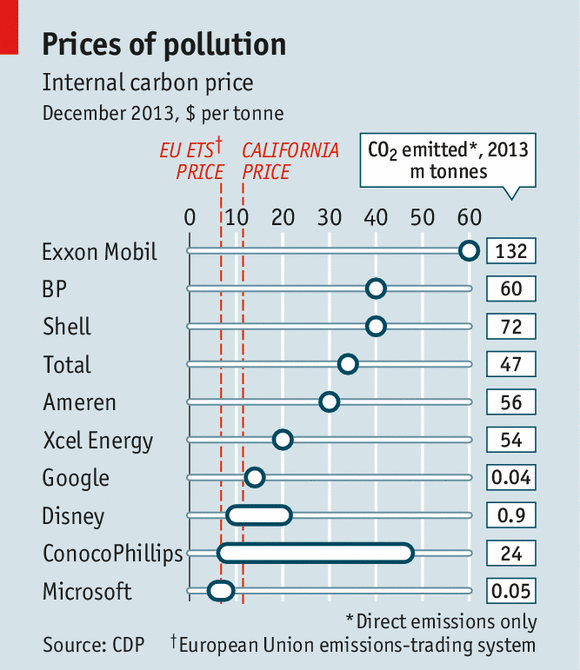
"The prices range from $6-7 a tonne of carbon dioxide at Microsoft to $60 a tonne at Exxon Mobil. … As a rule, those whose assets have a long productive life and which might be affected by green policies far into the future (such as oil companies) use higher prices than consumer-goods firms whose products are mainly influenced by current policies."
 
The companies are pushing ahead with this for two basic reasons: first, although it is hard to understand why they think so based on recent performance, firms anticipate politicians will eventually get their act together and impose a carbon price:
 
"For many companies the aim is to prepare themselves for future environmental legislation. AEP, a power supplier, says it uses the system because 'it assumes a price of carbon…will begin in the US by roughly 2020.' Delta Air Lines says it uses a price for evaluating flights to Europe 'in anticipation of compliance with EU ETS.'"
 
Second, it allows firms, such as ConocoPhillips and Disney (see: Strategic CSR – Carbon tax), to better understand the present value of future projects and investments:
 
"ConocoPhillips, an oil firm, requires that capital projects worth over $75m calculate the cost of emissions based on a price of between $8 and $46 a tonne, depending on the life of the project. The forecast value of a new oilfield would be: estimated output multiplied by the estimated future oil price minus development costs and carbon emissions. … Disney, a media conglomerate, goes further still. It invests in schemes to offset or reduce carbon emissions and charges the cost of these to business units in proportion to how much they contribute to the company's overall emissions. In effect, this works like an internal carbon tax."
 
The result of these varied approaches is a range of prices among firms. As the article notes, however, the surprising (and encouraging) thing is how high some of the prices are—much higher than any of the failing government experiments:
 
"The market price of carbon is €4.90 ($6.70) per tonne of CO2 in the EU, $11.50 in California. Big oil companies charge $34 or more. That is closer to the 'social cost of carbon'—the damage from an extra tonne of CO2—than to the market price. … the sort of carbon price some companies are using for planning would, if it became a market price, have a much bigger impact than any of the policies that governments are now talking about."
 
The graphic that accompanies the article demonstrates the extent of the differences in internal carbon price among firms:
 
 
Take care
David
 
David Chandler & Bill Werther
 
Instructor Teaching and Student Study Site: http://www.sagepub.com/chandler3e/
Strategic CSR Simulation: http://www.strategiccsrsim.com/
The library of CSR Newsletters are archived at: http://strategiccsr-sage.blogspot.com/


Carbon copy
Some firms are preparing for a carbon price that would make a big difference
December 14, 2013
The Economist
70
 

Friday, January 24, 2014

Strategic CSR - Financial Crisis

The article in the url below provides an update on the cost of the recent Financial Crisis:
 
“Wall Street could pay nearly $50 billion to buy peace from federal authorities who are taking aim at the banks over their role in the mortgage crisis, according to interviews and a confidential analysis of the industry’s potential legal exposure. … The $50 billion figure does not include JPMorgan’s $13 billion payout, which means the ultimate industry tab could exceed $60 billion, according to the analysis.”
 
The basis for these estimates is the $13 billion settlement announced at the end of last year between the government and JP Morgan. Based on the relative amounts of mortgages issued by each of the largest banks from 2005-2008 (see accompanying graphic) and comparing to the JP Morgan settlement, the article arrives at estimates for each of the banks, individually:
 
“The analysis, which lawyers prepared for one of the financial institutions and which was reviewed by The New York Times, indicates that Bank of America could ultimately settle for $11.7 billion in penalties, with an additional $5 billion in relief to homeowners. Morgan Stanley’s combined tally, the analysis shows, could be around $3 billion, with roughly a third going to consumer relief, while Goldman Sachs’s total could come to roughly $3.4 billion. For the Royal Bank of Scotland, the total price could be around $10 billion, which might prompt an outcry in Britain, where the government owns a majority stake in the bank. Citigroup could pay roughly $1 billion, the analysis shows. The potential penalties for other banks are under $1 billion, the analysis shows.”
 
It is encouraging to see the government act as a concerned stakeholder … at last. Of course, all pain is relative:
 
“A payment of $50 billion, made up of a string of separate deals, would amount to roughly half the total annual profit of large American banks in 2012.”
 
Have a good weekend
David
 
David Chandler & Bill Werther
 
Instructor Teaching and Student Study Site: http://www.sagepub.com/chandler3e/
Strategic CSR Simulation: http://www.strategiccsrsim.com/
The library of CSR Newsletters are archived at: http://strategiccsr-sage.blogspot.com/
 
 
Wall Street Predicts $50 Billion Bill to Settle U.S. Mortgage Suits
By Jessica Silver-Greenberg and Peter Eavis
January 10, 2014
The New York Times
Late Edition – Final
A1
 

Wednesday, January 22, 2014

Strategic CSR - Welcome back!


Welcome back to the Strategic CSR Newsletter!
The first Newsletter for the Spring semester is below.
As always, your comments and ideas are welcome.
 
 
Over the break, I read the foundational 1953 book by Howard Bowen, Social Responsibilities of the Businessman. Two thoughts struck me—reading the book was both uplifting and depressing, essentially for the same reason.
 
First, the process was uplifting because of how prescient Bowen was in identifying trends and proposing answers to issues that we still debate. Much of what he wrote in 1953 would not have looked out of place in a policy proposal or opinion paper published today. It may be that, if more people had just read Bowen’s book, a lot of the debate in the intervening period could have been circumvented.
 
Second, the process was depressing because we still do not have widely-agreed upon answers to the questions that Bowen (and others, such as Frank Abrams, see: Abrams, F. W. 1951. Management's Responsibilities in a Complex World. Harvard Business Review, 29(3): 29-34) were asking 60 years ago. Here is one example (the book is littered with similar ideas):
 
“The day of plunder, human exploitation, and financial chicanery by private businessmen [sic] has largely passed. And the day when profit maximization was the sole criterion of business success is rapidly fading. We are entering an era when private business will be judged solely in terms of its demonstrable contribution to the general welfare.” (p52)
 
Of course, the constant ‘reinventing of the wheel’ is great because it keeps us all in a job; but it would be nice to at least feel like we are making progress after so much effort.
 
Take care
David
 
David Chandler & Bill Werther
 
Instructor Teaching and Student Study Site: http://www.sagepub.com/chandler3e/
Strategic CSR Simulation: http://www.strategiccsrsim.com/
The library of CSR Newsletters are archived at: http://strategiccsr-sage.blogspot.com/