The CSR Newsletters are a freely-available resource generated as a dynamic complement to the textbook, Strategic Corporate Social Responsibility: Sustainable Value Creation.

To sign-up to receive the CSR Newsletters regularly during the fall and spring academic semesters, e-mail author David Chandler at david.chandler@ucdenver.edu.

Monday, April 11, 2016

Strategic CSR - LBJ

The article in the url below indicates how long we have known about the potential dangers of climate change and, as a result, how long we have delayed doing much about it. The article (published in February) celebrates the 50th anniversary of the first time a U.S. president highlighted the potential environmental risks of excessive carbon dioxide in the earth's atmosphere:
 
"President Lyndon Baines Johnson, in a February 8, 1965 special message to Congress warned about build-up of the invisible air pollutant that scientists recognize today as the primary contributor to global warming."
 
To quote LBJ in his address to Congress:
 
"'Air pollution is no longer confined to isolated places,' said Johnson less than three weeks after his 1965 inauguration. 'This generation has altered the composition of the atmosphere on a global scale through radioactive materials and a steady increase in carbon dioxide from the burning of fossil fuels.'"
 
The warning, however, was followed-up by action:
 
"The speech mainly focused on all-too-visible pollution of land and waterways, including roadside auto graveyards, strip mine sites, and soot pollution that had marred even the White House. Within the year, Johnson would sign six new environmental laws during a period better remembered for the strife that led to the Voting Rights Act of 1965 and the escalation of the Vietnam War. Johnson also that year established a dozen new national monuments, historic sites, and recreation areas; and submitted a draft nuclear non-proliferation treaty to the United Nations."
 
It is amazing to think that, in many ways, we have regressed in the subsequent 50 years and that LBJ would be the voice of progressiveness on this issue at such an early time:
 
"Beauty is not an easy thing to measure. It does not show up in the gross national product, in a weekly pay check, or in profit and loss statements. But these things are not ends in themselves. They are a road to satisfaction and pleasure and the good life. Beauty makes its own direct contribution to these final ends. Therefore it is one of the most important components of our true national income, not to be left out simply because statisticians cannot calculate its worth."
 
A complete transcript of the speech is available in the archives of LBJ's presidential library:
 
 
Take care
David
 
David Chandler & Bill Werther
 
Instructor Teaching and Student Study Site: http://www.sagepub.com/chandler3e/
Strategic CSR Simulation: http://www.strategiccsrsim.com/
The library of CSR Newsletters are archived at: http://strategiccsr-sage.blogspot.com/
 
 
A 50th anniversary few remember: LBJ's warning on carbon dioxide
By Marianne Lavelle
February 2, 2016
The Daily Climate

Friday, April 8, 2016

Strategic CSR - Security

The article in the url below reminds us that the best software infrastructure and security in the world is no match for the unpredictable nature of the humans with whom those systems have to interact:
 
"A survey of around 1,100 office workers at large companies in the U.S., U.K., Germany, France, Netherlands and Australia … found 20% said they would sell their corporate passwords to an outsider—and of those who would, 44% said they would do so for less than $1,000."
 
Moreover:
 
"While 85% said they would be upset if their personal information was breached by a company, 26% admitted they uploaded sensitive company information to a cloud app for the purpose of sharing that information outside the company."
 
While that should be enough to drive the most resolute CEO and Board absolutely crazy, I would like to see some more data about the situations that those willing to sell their passwords are working under. I am guessing the culture at those organizations is pretty toxic, no doubt compounded by a sense among employees that they are undervalued by management. I would think any CEO facing survey data that produced results anything like these should spend some time trying to understand the underlying factors driving this level of disenchantment, rather than railing against the employees willing to basically hand over the keys to the store.
 
Have a good weekend
David
 
David Chandler & Bill Werther
 
Instructor Teaching and Student Study Site: http://www.sagepub.com/chandler3e/
Strategic CSR Simulation: http://www.strategiccsrsim.com/
The library of CSR Newsletters are archived at: http://strategiccsr-sage.blogspot.com/
 
 
Survey Roundup: Passwords at a Price
By Ben Dipietro
March 25, 2016
The Wall Street Journal
 

Wednesday, April 6, 2016

Strategic CSR - Gift-giving

I have long believed that true altruism is a rare event in our lives – something that the human condition is not well suited for. For example, I believe that a great deal of charity occurs as much because it makes the donor feel good about themselves as much as the recipient benefits from the charity given. This also explains why a large proportion of aid and nonprofit activity is ineffective – there is often an ulterior motive that distorts the intended outcome (e.g., Strategic CSR – TOMS Shoes). The article in the url below summarizes some research to support this position:
 
"Those shopping for socially responsible gifts this holiday season, be forewarned: A recent study suggests they have the potential to disappoint. The reason, succinctly put: A fair-trade fruitcake is still just a fruitcake. In fact, socially responsible gifts are appreciated much more by the givers than the receivers."
 
Such gifts were classified by the researchers as gifts that were intended in some way to support a social cause:
 
"Socially responsible gifts include a range of things, such as charitable donations in the gift recipient's name, or so-called fair-trade products, such as a box of chocolates that directly benefits the cocoa farmers in some way that is better than what happens with other candies. The idea is to make someone feel good with a gift that supports a worthy cause on his or her behalf. Unfortunately, according to the study, it doesn't often work out that way."
 
The researchers also found that a "socially responsible gift" was more likely to be given the less close a person was to the giver. In other words, socially responsible gifts were more likely to be given to "acquaintances," while "friends" received more traditional gifts. The reason offered was that the givers were trying to frame the way they were received by the recipient:
 
"The study … also found there was a tendency, when the two people didn't know each other well, to want to give something that showed how much the giver cared about social issues, like fair-trade coffee."
 
There are all kinds of rituals surrounding the giving of gifts – especially the more formal the context becomes (e.g., business colleagues as opposed to family and friends). And I don't particularly think it matters if gift-giving is motivated as much (if not more) by personal gain than by its intended effect. The danger comes, I think, when the giver ends up doing more harm than good, especially when the intention was to help. The post about the counter-productive effects of TOMS Shoes (linked above) explores this issue in more detail. For a similar analysis in video form, see:
 
 
Take care
David
 
David Chandler & Bill Werther
 
Instructor Teaching and Student Study Site: http://www.sagepub.com/chandler3e/
Strategic CSR Simulation: http://www.strategiccsrsim.com/
The library of CSR Newsletters are archived at: http://strategiccsr-sage.blogspot.com/
 
 
Socially Responsible Gifts Are Great – Primarily for the Giver
By Simon Constable
December 14, 2015
The Wall Street Journal
Late Edition – Final
R4
 

Monday, April 4, 2016

Strategic CSR - Patriotism

I have noted before that I am constantly surprised that patriotism on the part of companies (paying their ‘fair’ share of taxes) is not more highly valued. This is particularly true in the U.S., but also elsewhere. The recent trend in inversions, particularly in the pharmaceutical industry, is evidence of the willingness of U.S. citizens (and politicians) to allow firms to avoid (bordering on evade) U.S. taxes:
 
“… the use of inversions [by U.S. corporations] is now entering its third year. Pfizer is trying the biggest one yet, a $152 billion deal for Allergan, the maker of Botox, which is based in Dublin.”
 
According to the article in the url below, however, the real value of inversion for firms lies in the associated policy of “earnings stripping”:
 
“A company completes an inversion deal and moves its headquarters for tax purposes outside the United States. The now-foreign company still has operations in the United States. These American operations are still taxed in the United States and pay taxes here. The point of the inversion, of course, was to reduce taxes as much as possible. So, the company arranges for the United States parts of its operations to borrow large amounts of money from the now-foreign parent. The indebted American subsidiary will pay interest on that debt to the parent. Under the United States tax code, the interest payment can be used to offset the American earnings. VoilĂ ! The earnings of the company are now offset by these interest payments. What used to be a significant tax bill disappears.”
 
In other words, while inversion allows firms to pay tax on its foreign earnings at the rate of its new foreign home, it still requires firms to pay U.S. taxes on revenues earned in the U.S. Alternatively, earnings stripping allows the firm potentially to avoid paying any U.S. taxes at all, which only increases my surprise that this lack of patriotism (a willingness to support the country that enabled the firm’s success and in which it is largely based) is not more of an issue:
 
“If you are an American taxpayer, it means the burden of making up lost revenue falls more heavily on you. It also creates an uneven playing field for other companies that end up feeling like fools for staying put. All in all, it highlights the problems of the United States tax code, which shows again and again how it just does not work in an increasingly global world.”
 
While the U.S. tax code certainly needs reforming, the real reason these avoidance practices continue is that stakeholders do not care enough to do anything about them.
 
Take care
David
 
David Chandler & Bill Werther
 
Instructor Teaching and Student Study Site: http://www.sagepub.com/chandler3e/
Strategic CSR Simulation: http://www.strategiccsrsim.com/
The library of CSR Newsletters are archived at: http://strategiccsr-sage.blogspot.com/


If You Think Corporate Inversions Are Bad, Brace Yourself
By Steven Davidoff Solomon
February 10, 2016
The New York Times
Late Edition – Final
B5
 

Friday, April 1, 2016

Strategic CSR - Beer

The article in the url below presents an interesting twist on the recycling debate. In particular, recycled water:
 
"In autumn of 2014 – three years into California's devastating drought– architect Russ Drinker became fixated on brewing beer from recycled greywater (that is, water that's been treated after use in sinks, showers and washing clothes). He was increasingly frustrated that the media paid little attention to water recycling. 'They were focused on conservation instead. But if Californians really want to have an impact on our water use, we have to recycle our freshwater ... and get over our psychological resistance to that.'"
 
This is a question that should be of concern to all drinks companies that rely on water as the basis for their product:
 
"While some microbrewers have been working hard to get their water usage down – some to three gallons of water for every gallon of beer – the industry has a high water to beer ratio. Despite this, it took Drinker about a year to find a brewer up for the challenge."
 
In the end, he teamed up with Half Moon Bay Brewing Company, a craft brewer based in San Francisco, to produce a version of its "Mavericks Tnuuel Vision IPA" using recycled water, which the company then put to a panel of tasters for a blind test:
 
"Made using the same Nasa water recycling technology as astronaut Scott Kelly used during his year long stint on the International Space Station, the tasting panel couldn't detect which of the two pints was made with recycled water."
 
The article mentions other breweries around the U.S. that are also using recycled grey water in their brewing process.
 
Have a good weekend and Cheers!
David
 
David Chandler & Bill Werther
 
Instructor Teaching and Student Study Site: http://www.sagepub.com/chandler3e/
Strategic CSR Simulation: http://www.strategiccsrsim.com/
The library of CSR Newsletters are archived at: http://strategiccsr-sage.blogspot.com/
 
 
The Californian craft beer brewed from waste Our Broken Environment Kills a Quarter of Us
By Kristine Wong
March 14, 2016
The Guardian
 

Wednesday, March 30, 2016

Strategic CSR - GMOs

The national debate here in the U.S. about food labelling is heating-up. In particular, it is the issue of genetically-modified organisms (GMOs) that is the battleground of choice:
 
"The country's first law requiring mandatory GMO labels is slated to go into effect in Vermont on July 1 after an industry-backed federal law that would block states' authority stalled in the U.S. Senate [recently]."
 
Given the extent of the fines associated with a failure to comply, it looks like the Vermont legislature is serious about enforcement and, as a result, the food companies have to be serious about compliance:
 
"Facing fines up to $1,000 a day per product, food makers from giants like General Mills Inc. to regional businesses like Vermont Fresh Pasta are making big adjustments, many of which extend beyond the state's borders."
 
As the article explains, the law in Vermont is ground-breaking not because Vermont is an important market, but because the nature of the supply chains of large, multinational companies is that they prefer uniformity, since it reduces costs. When the issue is legal compliance, in order for a firm to comply and also be consistent throughout its supply chain and all markets, it forces all operations to adhere to the highest standards of the strictest areas:
 
"Vermont is a tiny market for most companies, but the integrated nature of supply chains gives it an outsize effect. On Friday, General Mills said it is slapping GMO labels on its packaged food nationwide, saying it would be too complex and expensive to create a separate distribution network for the 626,000-person state of Vermont. The maker of Cheerios and Lucky Charms remains firm in its stance against mandatory labeling, but 'having one system for Vermont and one for everywhere else is untenable,' said Jeff Harmening, General Mills' chief operating officer of U.S. retail."
 
I see this action by Vermont as an excellent example of a stakeholder (the state legislature) holding an industry to account based on its expectations of what constitutes socially responsible behavior. As this chart in the article indicates, GMOs are already out there – the least the regulatory authorities can do is make consumers aware of the ingredients that are in the food they are buying:
 
 
Here is an example of what a label that complies with the new law might look like (see the box labelled "Produced with Genetic Engineering"):
 
 
What I would like to see now is an informed debate about the pros and cons of GMOs (including the science around these organisms), not only in the developed world, but in many emerging markets, too – something I have yet to see at any kind of broad level.
 
For more details about this story and its wide-ranging effects, see: http://www.theguardian.com/sustainable-business/2016/mar/24/gmo-food-labels-general-mills-kellog-mars
 
Take care
David
 
David Chandler & Bill Werther
 
Instructor Teaching and Student Study Site: http://www.sagepub.com/chandler3e/
Strategic CSR Simulation: http://www.strategiccsrsim.com/
The library of CSR Newsletters are archived at: http://strategiccsr-sage.blogspot.com/
 
 
GMO Labeling Law Roils Food Companies
By Annie Gasparro and Jacob Bunge
March 21, 2016
The Wall Street Journal
Late Edition – Final
B1
 

Monday, March 28, 2016

Strategic CSR - Compliance Officers

The article in the url below is interesting in the consequences it potentially has for a firm's Compliance Officer (CO):
 
"A U.S. District Court in Minnesota ruled that compliance officers and other individuals can be held responsible for anti-money laundering control failures under the Banking Secrecy Act, dealing a setback to a former chief compliance officer [MoneyGram Chief Compliance Officer Thomas Haider] who was hit with a $1 million fine by the Financial Crimes Enforcement Network [FinCEN]."
 
In other words, as a result of this ruling, not only is it the CO's responsibility to put in place the rules and culture to try and prevent corruption from occurring (either within the firm or in relation to the firm's dealings with external stakeholders), but the individual him/herself is potentially liable for any failure to do so:
 
"In the case against Mr. Haider, … defense lawyers challenged the ability of FinCEN to levy an individual penalty under the provisions it cited in the Banking Secrecy Act. … In his denial of a motion to dismiss, U.S. District Court Judge David Doty ruled that the provision of the act that requires institutions establish money laundering programs is governed by the act's broader civil penalty provision, which allows penalties against a 'partner, director, officer, or employee.' 'The plain language of the statute provides that a civil penalty may be imposed on corporate officers and employees like Haider, who was responsible for designing and overseeing MoneyGram's AML program,' Mr. Doty wrote."
 
This ruling is in-line with a September 2015 announcement by the Department of Justice that, in future, it plans to begin holding individuals to account for white-collar corporate wrongdoings, rather than relying on deferred prosecution agreements (where a firm is fined without admitting fault). The DoJ's memo to prosecutors announcing this shift can be downloaded at: http://www.justice.gov/dag/file/769036/download
 
Take care
David
 
David Chandler & Bill Werther
 
Instructor Teaching and Student Study Site: http://www.sagepub.com/chandler3e/
Strategic CSR Simulation: http://www.strategiccsrsim.com/
The library of CSR Newsletters are archived at: http://strategiccsr-sage.blogspot.com/
 
 
Court Rules Anti-Money Laundering Law Applies to Compliance Officers
By Stephen Dockery
January 13, 2016
The Wall Street Journal
 

Friday, March 25, 2016

Strategic CSR - Sea-levels

The article in the url below brings home the very real consequences of climate change (in the not too distant future):
 
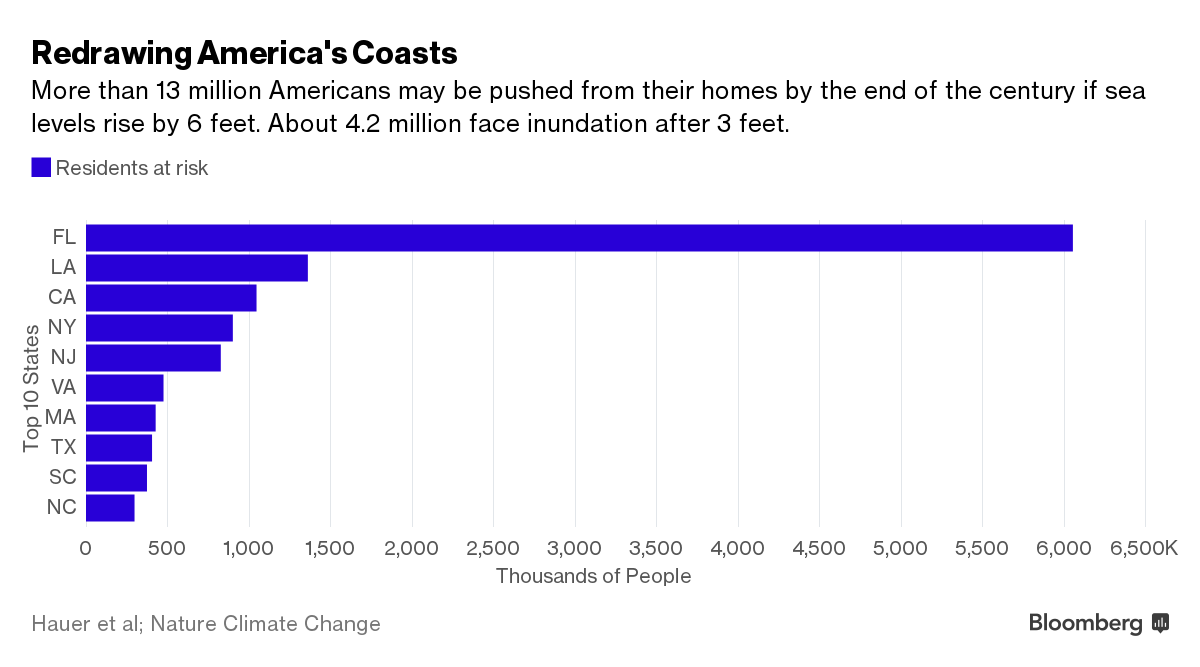
"The swelling ocean may threaten the homes of up to 13.1 million coast-dwelling Americans by the end of this century, according to the study published today in the journal Nature Climate Change. … the research is novel because it combines population projections with sea-level rise projections."
 
In particular, Florida residents are at the gravest risk in the worst-case scenario modelled by the researchers:
 
"The largest absolute numbers of people at risk are in Miami-Dade and Broward counties in Florida. These two areas would make up 25 percent of all people impacted nationally—or more than 3.5 million—if waters rise by 6 feet, which is the most extreme scenario the study's authors anticipated. That threat has made the southern Florida climate story the center of much attention in recent years. More than 100,000 people could be displaced in each of 31 counties in the 6-foot rise scenario."
 
Not only are the dangers great, however, but the options for prevention are limited and expensive:
 
"Starting to move Americans around would get expensive. Small Alaska towns are already moving, the Nature researchers note, as warmer sea and air temperatures make their coastal lives impossible. The cost incurred there has been an estimated $1 million a person."
 
A chart from the article indicating the most at-risk states in the U.S. can be found here.
 
Have a good weekend
David
 
David Chandler & Bill Werther
 
Instructor Teaching and Student Study Site: http://www.sagepub.com/chandler3e/
Strategic CSR Simulation: http://www.strategiccsrsim.com/
The library of CSR Newsletters are archived at: http://strategiccsr-sage.blogspot.com/
 
 
Up to 13 million Americans are at Risk of Being Washed Away
By Eric Roston
February 14, 2016
Bloomberg Businessweek
 

Wednesday, March 23, 2016

Strategic CSR - Children's TV

The article in the url below tackles an important subject -- the extent to which disabled characters are represented in children's TV programs. Although disabled people are integrated throughout society, they generally do not appear in children's TV shows in most countries:
 
"Fireman Sam and How to Train Your Dragon feature the only disabled characters currently on long-running children's television franchises. Other characters crop up here and there – the Disney Channel introduced double-amputee Aussie explorer, Wildlife Will to its Doc McStuffins show, and it featured wheelchair user Johnny McBride … in The Proud Family – but both appeared for one episode only. The BBC has a history of disabled characters, from Grange Hill's Rachel Burns with cerebral palsy, … to Balamory's wheelchair user Penny Pocket. The broadcaster also has its visual impairment show Melody, and sign-language show, Magic Hands."
 
In the UK the BBC takes this seriously, partly due to its remit as a public broadcaster. That same sense of responsibility does not appear to extend to the commercial channels:
 
"Camilla Arnold, creative director of Flashing Lights Media, the deaf-led company behind Magic Hands, argues that while the BBC is fulfilling its duties, no other channels are matching this. '[It's] shocking – we're in the 21st century! The other channels need to catch up as there's a definite lack of representation.'"
 
This is important because, apart from the purpose of educating people more generally about various disabilities, it is essential that children are educated using media that reflect the society in which they live and are growing up:
 
"… the Disney Channel, Zodiak Kids and Nickelodeon do not have a single current children's show with a prominent disabled character. FremantleMedia however, (responsible for the likes of The X Factor), does have its comedy series Strange Hill High which is aired on CBBC and includes Samia Speed (witty and in a wheelchair), school caretaker Murdock (with a bionic hand) and hero Mitchell Tanner (living with ADHD). But given that one in 20 children in the UK have a disability, this is pretty scant representation."
 
It is easy to see how the issues that are raised in addressing this imbalance can apply to other consequences of our infatuation with perfection:
 
"The need for better representation, says Philip Connolly, policy and communications manager at Disability Rights UK, comes from 'seeing people like ourselves on-screen. "It is like an acknowledgement or recognition that we are all human. We need to get away from this idea of 'perfection', the handsome prince and beautiful princess – these stories have a powerful grip on the imagination and how children come to see the world.'"
 
Take care
David
 
David Chandler & Bill Werther
 
Instructor Teaching and Student Study Site: http://www.sagepub.com/chandler3e/
Strategic CSR Simulation: http://www.strategiccsrsim.com/
The library of CSR Newsletters are archived at: http://strategiccsr-sage.blogspot.com/
 
 
Children's TV pretends disability doesn't exist
By Tim Smedley
July 28, 2015
The Guardian Sustainable Business
 

Monday, March 21, 2016

Strategic CSR - Pension funds

The article in the url below contains a piece of news that I did not see covered anywhere else. It seems to be that this could be something, but maybe not – as with all stakeholder constraint imposed on firms (and particularly with government regulation), it will depend on the extent to which it is enforced:
 
"The beauty of the stock market is that no one can tell you where to put your money—until now. [In October] the Obama administration's Labor Department issued Interpretive Bulletin 2015-01, which tells pension funds what factors to use when choosing investments, including climate change."
 
This follows-up on a 2008 guidance from the Labor Department regarding:
 
"… parts of the Employee Retirement Income Security Act of 1974, affectionately known as Erisa, that environmental, social and government factors—for instance, climate change—may affect the value of investments."
 
The difference is that, while the 2008 guidance is advisory, the 2015 guidance is a ruling that must be followed. Quoting directly from the Department of Labor's Bulletin:
 
"Environmental, social and governance issues may have a direct relationship to the economic value of the plan's investment. In these instances, such issues are not merely collateral considerations or tiebreakers, but rather are proper components of the fiduciary's primary analysis of the economic merits of competing investment choices."
 
As the article (which is skeptical – it is the WSJ after all) note, the key term here is the word "primary," meaning it cannot be subordinated to other investment criteria. This places fund managers in a bit of a tight spot:
 
"This government is essentially saying: Don't you dare invest in anything that causes or is hurt by climate change, or you'll be sued for failing your fiduciary responsibilities. Energy, utilities and industrials are 20% of the market. How can pension funds now own any of them?"
 
Not that I mind fund managers being forced to squirm a bit, mind you. Nevertheless, picking among the article's anti-climate change stance, the author does raise an important point about the ability of the government to dictate (as opposed to influence) market outcomes:
 
"Stock prices are a collective opinion on the prospect of a company. As reality changes, so do opinions. There are plenty of socially responsible investment funds; they rarely succeed. You can shun alcohol, tobacco and gambling stocks all you want, but many Americans enjoy all three, often at the same time. … Pushing politics on retirement funds will destroy returns. One little secret on Wall Street is that [pension] rules drive hedge funds to avoid pension money. It slows them down. As pension funds divest, hedge funds and other managers will gladly buy up undervalued climate-challenged companies."
 
The article also mentions that this latest notice will affect the whole U.S. pensions fund industry, which currently manages $9 trillion (which is why I thought it might be a big deal).
 
Take care
David
 
David Chandler & Bill Werther
 
Instructor Teaching and Student Study Site: http://www.sagepub.com/chandler3e/
Strategic CSR Simulation: http://www.strategiccsrsim.com/
The library of CSR Newsletters are archived at: http://strategiccsr-sage.blogspot.com/
 
 
Forcing Green Politics on Pension Funds
By Andy Kessler
November 19, 2015
The Wall Street Journal
Late Edition – Final
A13
 

Friday, March 18, 2016

Strategic CSR - Airplanes

It is a quirk of our attempts to regulate carbon emissions that automobiles have strict efficiency standards, while airplanes have none. As the editorial in the url below notes, this is damaging:
 
"It has been almost 50 years since the federal government began setting standards for automobile emissions. It is also about a half-century since the introduction of wide-body jets set off a runaway expansion of the aviation industry. About 3.8 billion people are expected to fly this year, 50 times as many as 50 years ago — making planes the fastest-growing source of carbon dioxide emissions, although they have faced none of the limits set on cars or trucks."
 
The editorial also notes that this is about to change:
 
"That is, until last week, when the International Civil Aviation Organization, a United Nations agency, finally proposed the first binding limits on aircraft emissions."
 
While this is just a start (and is far from fully accounting for all the costs incurred in our globalized transportation world) it is a welcome start to rectifying a regulatory anomaly that has persisted for far too long:
 
"For now, however, what is important is that an industry that accounts for almost 2 percent of global carbon dioxide emissions — about the same as Germany — and that is projected to double the number of passengers and flights by 2030 will finally join other major sources of greenhouse gas pollution that are subject to international emissions controls."
 
Have a good weekend
David
 
David Chandler & Bill Werther
 
Instructor Teaching and Student Study Site: http://www.sagepub.com/chandler3e/
Strategic CSR Simulation: http://www.strategiccsrsim.com/
The library of CSR Newsletters are archived at: http://strategiccsr-sage.blogspot.com/


Jets Will No Longer Get a Free Ride on Carbon
Editorial
February 14, 2016
The New York Times
Late Edition – Final
SR8
 

Wednesday, March 16, 2016

Strategic CSR - Artificial intelligence

The article in the url below presents an interesting take on the rapidly developing technology associated with artificial intelligence:
 
"Microsoft is feeding the enormous backlog of New Yorker cartoon submissions into AI software to give machines some understanding of human humor."
 
This problem/challenge emerged due to the success of The New Yorker's monthly cartoon challenge:
 
"Since 2005, the back page of the New Yorker has usually featured a wordless, black-and-white cartoon, and the funniest reader-submitted caption gets published in the following issue. The magazine's caption contest has become a fan favorite over the last decade, and the cartoon department receives some 5,000 entries each week."
 
This creates a heavy workload for the magazine's cartoon editor's assistant, who tends to last in the position "barely a couple of years because [the task] keeps burning them out." Hence the invitation to Microsoft to try and ease the burden:
 
"Soon, [the cartoon editor] Mankoff's assistants could get relief in the form of an assistant of their own: an artificial intelligence system with a sense of humor. Mankoff collaborated with researchers at Microsoft on an artificial intelligence project that aims to teach a computer what's funny."
 
The software program will not decide the winner, but will narrow down the submissions to a short list from which the editor and assistant can select a winner. Early results suggest that the software is getting good:
 
"For example, when evaluating a cartoon depicting a car salesman hawking a hybrid animal-vehicle with hairy legs instead of wheels, the AI picked, 'Just listen to that baby purr' as one of the top captions; 'It runs on a 100 percent fuel efficient Paleo diet' was rated one of the worst. … The machine and the New Yorker editors don't always align on shortlists. On average, though, all of the editors' favorites appeared in the AI's top 55.8 percent of choices, according to the study. That means the New Yorker could use the system to eliminate at least 2,200 submissions a week without missing the gems."
 
Beyond understanding humor, however, Microsoft's goal is to create humor – an important component of understanding how the brain works and, therefore, further developing a more effective system of artificial intelligence:
 
"The researchers say they hope to one day train computers to come up their own jokes based on situations, which would make digital assistants such as Cortana and Siri more pleasant to interact with. … A side benefit: With all the consternation over the evils of AI, Horvitz says it's nice to think of these systems doing something more pleasant than destroying the universe."
 
Take care
David
 
David Chandler & Bill Werther
 
Instructor Teaching and Student Study Site: http://www.sagepub.com/chandler3e/
Strategic CSR Simulation: http://www.strategiccsrsim.com/
The library of CSR Newsletters are archived at: http://strategiccsr-sage.blogspot.com/
 
 
And the New Yorker Cartoon Contest Winner is... A Computer
By Tim Smedley
July 28, 2015
The Guardian Sustainable Business
 

Monday, March 14, 2016

Strategic CSR - Sustainable Development Goals

The article in the url below critiques the newly announced Sustainable Development Goals (SDGs). While applauding the intention behind the goals, the author's critique highlights what he sees as a lack of focus:


"In a bid not to offend anyone, the new development agenda is expected to include an incredible 169 targets for investment. Giving priority to 169 things is the same as giving priority to nothing at all."


The author's argument highlights the sort of cost-benefit analysis that those who developed the SDGs clearly shied away from. In other words, he focuses on the relative value that a dollar spent in pursuit of each goal would bring:


"Consider how Ebola became the threat of the moment last year, to the point that American politicians were threatening travel embargoes against West Africans. Hundreds of millions of dollars were spent in response, much of it for specialized hospitals and other facilities that have hardly been used. Ebola was a genuine regional tragedy, claiming as many as 20,000 lives. But in the same year, far from the spotlight, some 600,000 people across the globe died from the less sensational illness of malaria, and around 1.5 million were killed by tuberculosis."


Another example of what the author would no doubt characterize as our misplaced priorities:


"The World Health Organization estimates that the effects of climate change are currently responsible for 141,000 deaths annually. If we look far ahead, to 2050, the death toll is expected to climb to 250,000. By contrast, some 4.3 million people will die this year from indoor air pollution. That is the direct result of poverty, of almost three billion people using dung and wood to heat and cook. Another 3.7 million people will die this year from outdoor air pollution."


The author arrives at his conclusions because he asked a group of people who have been thinking about these problems for some time:


"Over the past year, the Copenhagen Consensus Center, the think tank that I direct, asked 82 leading economists to work out exactly how much good could be achieved by investing in the 169 [targets]. We asked them, in short, to use the standard tools of economics to calculate the costs and benefits of achieving each target. The results were surprising. Freer trade from completing the World Trade Organization's Doha agreement would return more than $2,000 of extra value for each dollar spent to retrain and compensate displaced workers. It would lift 160 million people out of extreme poverty, giving every person in the developing world an extra $1,000 in income every year by 2030. By comparison, money transfers—paying the poorest people enough to lift them out of poverty—would have huge administrative challenges and institutional deficiencies, with benefits of only $5 for every dollar spent."


Conducting this analysis across all 169 targets results in a significantly narrower target:


"What did the economists conclude about the U.N.'s 169 targets? That concentrating on just 19 of them—not just the ones noted above but also such things as increasing access to family planning, fighting malaria and tuberculosis, and combating malnutrition—would produce, on average, more than $30 in benefits for each dollar spent, which betters the U.N. proposal by a factor of four. That is the same as quadrupling the aid budget."


Take care

David


David Chandler & Bill Werther

Strategic Corporate Social Responsibility: Stakeholders, Globalization, and Sustainable Value Creation (3e)

© Sage Publications, 2014


Instructor Teaching and Student Study Site: http://www.sagepub.com/chandler3e/

Strategic CSR Simulation: http://www.strategiccsrsim.com/

The library of CSR Newsletters are archived at: http://strategiccsr-sage.blogspot.com/


Trade-Offs for Global Do-Gooders

By Bjorn Lomborg

September 19-20, 2015

The Wall Street Journal

Late Edition – Final

C3

http://www.wsj.com/articles/trade-offs-for-global-do-gooders-1442589938


Friday, March 11, 2016

Strategic CSR - The climate debate

The article in the url below contains some straightforward answers to some of the essential questions around climate change. These answers leave open the possibility we can turn things around, but the door is not open very wide and it seems as though it will not be open for much longer. Here are some selections:
 
How much is the planet heating up?
"If emissions continue unchecked, they say the global warming could ultimately exceed 8 degrees Fahrenheit, which would transform the planet and undermine its capacity to support a large human population."
 
How much trouble are we in?
"The risks are much greater over the long run than over the next few decades, but the emissions that create those risks are happening now. … Scientists fear climate effects so severe that they might destabilize governments, produce waves of refugees, precipitate the sixth mass extinction of plants and animals in Earth's history, and melt the polar ice caps, causing the seas to rise high enough to flood most of the world's coastal cities. … Bolder efforts to limit emissions would reduce these risks, or at least slow the effects, but it is already too late to eliminate the risks entirely."
 
Is there anything I can do?
"… experts do not believe the needed transformation in the energy system can happen without strong state and national policies. So speaking up and exercising your rights as a citizen matters as much as anything else you can do."
 
What's the optimistic scenario?
"Earth turns out to be less sensitive to greenhouse gases than currently believed; plants and animals manage to adapt to the changes that have already become inevitable; human society develops much greater political will to bring emissions under control; and major technological breakthroughs occur that help society both to limit emissions and to adjust to climate change. … Scientists say the odds of all these things breaking our way are not very high."
 
What's the worst-case scenario?
"Perhaps the greatest fear is a collapse of food production, accompanied by escalating prices and mass starvation. … Another possibility would be a disintegration of the polar ice sheets, leading to fast-rising seas that would force people to abandon many of the world's great cities and would lead to the loss of trillions of dollars worth of property and other assets."
 
Will a breakthrough technology help us?
"… current efforts are not enough. For instance, spending on basic energy research is only a quarter to a third of the level that several in-depth reports have recommended. And public spending on agricultural research has stagnated even though climate change poses growing risks to the food supply."

There are more answers (to questions such as "Are the predictions reliable?", "Will anyone benefit from climate change?", and "Is there any hope?") in the online version of the article (url below).
 
Have a good weekend
David
 
David Chandler & Bill Werther
 
Instructor Teaching and Student Study Site: http://www.sagepub.com/chandler3e/
Strategic CSR Simulation: http://www.strategiccsrsim.com/
The library of CSR Newsletters are archived at: http://strategiccsr-sage.blogspot.com/
 
 
Short Answers to Hard Climate Questions
By Justin Gillis
December 1, 2015
The New York Times
Late Edition – Final
D6
 

Wednesday, March 9, 2016

Strategic CSR - Capitalism

The article in the url below argues a point that is central to understanding what is meant by strategic CSR. It does so by reacting to an announcement by the Ford Foundation made last year:
 
"On June 11, the $11 billion Ford Foundation announced that it will pour its resources—about $500 million in giving a year—into fighting inequality. 'We are talking about inequality in all its forms—in influence, access, agency, resources, and respect,' Darren Walker, the charity's president, wrote in a letter."
 
The irony the article highlights is that the money that underwrites the Ford Foundation's ability to operate comes from the economic success of the Ford motor company:
 
"The bulk of the Ford Foundation's assets came when it received 88% of the nonvoting shares in the Ford Motor Company, most after Henry Ford died in 1947. Ford hated inheritance taxes, then a punitive 70%. In 1956 Ford Motor went public at $3.2 billion. Most of the shares sold were from the Ford Foundation, about a quarter of its holdings."
 
As such, the author criticizes the Foundation for "getting exactly backward what its namesake, Henry Ford, understood. Society benefits from making, not giving." Instead of focusing on social problems and giving money away, the author makes the case that the Foundation should be investing in for-profit companies that are capable of delivering much greater social progress:
 
"Ford Motor was profitable because Henry Ford created scalable assembly lines, reduced the cost of the Model T to under $300, and sold 15 million of them. Model Ts made millions of businesses and workers more productive and created that 'public welfare' that the Ford Foundation struggles to achieve. Ford Motor created wealth for society, as well as for Henry Ford, and you can't do the latter without the former. … In other words, the Ford Motor company increased living standards, and as a result its owner became fabulously wealthy. This may have increased the perception of inequality, yet everyone was better off."
 
You get the sense that, if the author had his way, he would get rid of Foundations altogether:
 
"If the Ford or Clinton foundations really wanted to help society, they'd work on lowering barriers to business formation and cutting the regulatory chains that inhibit productive hiring in the U.S. and globally."
 
Take care
David
 
David Chandler & Bill Werther
 
Instructor Teaching and Student Study Site: http://www.sagepub.com/chandler3e/
Strategic CSR Simulation: http://www.strategiccsrsim.com/
The library of CSR Newsletters are archived at: http://strategiccsr-sage.blogspot.com/
 
 
The Capitalist as the Ultimate Philanthropist
By Andy Kessler
June 24, 2015
The Wall Street Journal
 

Monday, March 7, 2016

Strategic CSR - Google

The article in the url below reports fascinating news from the world of driverless cars:
 
"The self-driving car, that cutting-edge creation that's supposed to lead to a world without accidents, is achieving the exact opposite right now: The vehicles have racked up a crash rate double that of those with human drivers."
 
The problem, of course, is not the driverless cars so much as the irrational and unpredictable humans among which they have to operate:
 
"The glitch? [The driverless cars] obey the law all the time, as in, without exception. This may sound like the right way to program a robot to drive a car, but good luck trying to merge onto a chaotic, jam-packed highway with traffic flying along well above the speed limit. It tends not to work out well."
 
While a natural conclusion is that driverless cars will only work properly when there are no longer any humans driving, this creates a more challenging (and ethically interesting) problem that Google and other companies programming the cars have to face today:
 
"As the accidents have piled up -- all minor scrape-ups for now -- the arguments among programmers at places like Google Inc. and Carnegie Mellon University are heating up: Should they teach the cars how to commit infractions from time to time to stay out of trouble?"
 
In other words, having improved on the human driver, should programmers now dumb down that machine in order to account for the human drivers with whom they will have to interact for a few more years yet?
 
"Driverless vehicles have never been at fault, [a study by the University of Michigan's Transportation Research Institute] found: They're usually hit from behind in slow-speed crashes by inattentive or aggressive humans unaccustomed to machine motorists that always follow the rules and proceed with caution."
 
For now, Google's software engineers are struggling with how best to program the cars to be more imperfect – in other words, to be more human:
 
"Google has already programmed its cars to behave in more familiar ways, such as inching forward at a four-way stop to signal they're going next. But autonomous models still surprise human drivers with their quick reflexes, coming to an abrupt halt, for example, when they sense a pedestrian near the edge of a sidewalk who might step into traffic."
 
Take care
David
 
David Chandler & Bill Werther
 
Instructor Teaching and Student Study Site: http://www.sagepub.com/chandler3e/
Strategic CSR Simulation: http://www.strategiccsrsim.com/
The library of CSR Newsletters are archived at: http://strategiccsr-sage.blogspot.com/
 
 
Humans Are Slamming Into Driverless Cars and Exposing a Key Flaw
By Keith Naughton
December 17, 2015
Bloomberg Businessweek
 

Friday, March 4, 2016

Strategic CSR - Starbucks

The article in the url below suggests an interesting proposition -- that CEO pay should be converted into quantities of the firm's own product in order to better relate to the huge numbers often involved. The article illustrates this idea following the recent announcement of a slight cut in Howard Schultz's pay at Starbucks:
 
"Starbucks Corp. Chief Executive Officer Howard Schultz received $20.1 million in reported compensation last year, the Seattle-based company said in a filing Monday, down from $21.5 million in 2014. Measured in his favorite beverage, the value of his pay is enough to buy almost 9 million espresso macchiatos -- or 24,400 each day for a year."
 
That's a lot of coffee!
 
Have a good weekend
David
 
David Chandler & Bill Werther
 
Instructor Teaching and Student Study Site: http://www.sagepub.com/chandler3e/
Strategic CSR Simulation: http://www.strategiccsrsim.com/
The library of CSR Newsletters are archived at: http://strategiccsr-sage.blogspot.com/
 
 
Starbucks' Schultz is Paid the Equivalent of Nine Million Espresso Macchiatos
By Anders Melin
January 26, 2016
Bloomberg Businessweek