The CSR Newsletters are a freely-available resource generated as a dynamic complement to the textbook, Strategic Corporate Social Responsibility: Sustainable Value Creation.

To sign-up to receive the CSR Newsletters regularly during the fall and spring academic semesters, e-mail author David Chandler at david.chandler@ucdenver.edu.

Showing posts with label BMW. Show all posts

Tuesday, February 15, 2022

Strategic CSR - EVs in 2022

The article in the url below is interesting simply because it reflects the level of innovation currently going on in the automobile industry and, of course, how much EVs have moved the market in a relatively short period of time:

"This year, the U.S. market is about to see its options for electric vehicles more than double. Thirty entirely new models are poised to hit the streets, according to researcher IHS Markit, mostly created by luxury brands such as Cadillac, Lincoln, and Polestar. And unlike most of the EV standard-bearers to date, the next generation will arrive in the size Americans tend to like: extra large."


Apparently, the new models "include at least 14 SUVs, a van, and four pickups," the most notable of which is "a battery-powered version of Ford's F-150, the country's bestselling vehicle for decades." Given the expanded range of options and increasing comfort that consumers seem to have with the growing range of batteries, sales are expected to increase in proportion. The only constraint, it seems, is going to be the ability of the global supply chain to deliver these vehicles to market:


"IHS estimates that 1 in 20 American buyers this year will pick a fully electric vehicle—almost 1 million machines—if the supplies hold out. 'It's going to be a matter of what can be built,' says analyst Michael Fiske, 'not what can be sold.'"


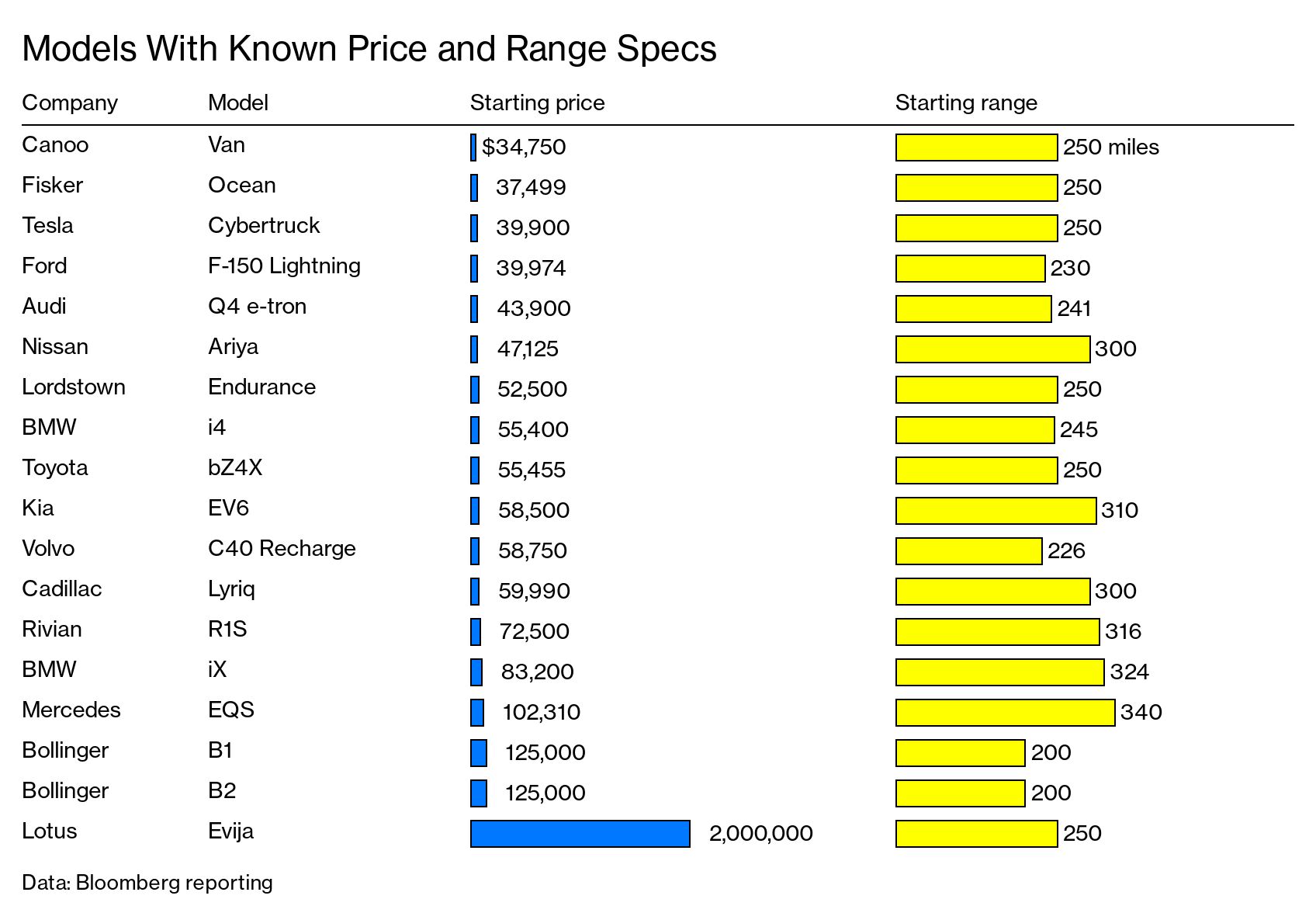
The chart accompanying the article illustrates those known models due to come to market, along with the driving range on a full battery:


https://assets.bwbx.io/images/users/iqjWHBFdfxIU/ifEpT.XXuJ3U/v0/pidjEfPlU1QWZop3vfGKsrX.ke8XuWirGYh1PKgEw44kE/-1x-1.png


Take care
David

David Chandler
© Sage Publications, 2020

Instructor Teaching and Student Study Site: https://study.sagepub.com/chandler5e 
Strategic CSR Simulation: http://www.strategiccsrsim.com/
The library of CSR Newsletters are archived at: https://strategiccsr-sage.blogspot.com/


America's Electriv Vehilce Selection is About to Get a Lot Wider
By Kyle Stock and Dorothy Gambrell
January 15, 2022
Bloomberg
 

Wednesday, September 6, 2017

Strategic CSR - Whole Foods

The article in the url below about Whole Foods' recent struggles is half right. It is correct in noting that Whole Foods is struggling, but incorrect in the underlying reasons for its difficulties:
 
"It's hard to think of a better poster child for 'conscious capitalism' than Whole Foods Market, the high-end grocery store that made a name for itself selling organic produce in feel-good, mood-lit stores. These days, the chain is floundering and a potential buyout is on the horizon. What does that say about the conscious capitalism it championed? … Whole Foods was supposed to be different. John Mackey, the company's chief executive, has long argued that Whole Foods is wired differently — that it runs on a 'conscious capitalism' model that outsmarts the competitive pressures of our for-profit system through creativity and innovation. … The Whole Foods founder penned his treatise in response to the growing consensus that capitalism is doing irreparable harm to the planet and the people who live on it. Our for-profit system is increasingly viewed as a zero-sum game in which ecological destruction, climate change and rising inequality are firmly linked to the rapacious behavior of multinational corporations. Mackey agrees that humans are harming the planet, but he doesn't think the problem lies in capitalism. Free-market capitalism, according to Mackey, is actually a 'beautiful,' 'heroic' system that, properly harnessed, can operate 'in harmony with the fundamentals of human nature' and the planet."
 
All of this is true. Fundamentally, however, the article misses the point about the root causes of Whole Foods' struggles. Yes, there are business decisions that the firm could have made that would have better protected it from competition. But, conscious capitalism is not the reason for the firm's decline. In essence, Whole Foods' sales are declining due to a lack of stakeholder support, particularly customers, who have been persuaded that products on offer at Walmart and Kroger (for example) are essentially the same as those offered at Whole Foods. As such, they see no reason to pay the higher prices that Whole Foods generally charges.
 
In reality, however, these customers are failing to distinguish between the low cost model pursued by most supermarkets and the differentiated model pursued by Whole Foods (something that might be threatened under Amazon's control). With food, as with many products, you get what you pay for and there is a price premium associated with quality. To draw an analogy, people are confusing a Toyota Corolla with a BMW 7 series because both cars are capable of getting you from A to B. Just because this is true, however, does not mean the two cars are comparable or even close to being the same product.
 
With all business models, stakeholder engagement represents either an endorsement or a rejection of what is on offer. Irrespective of what might be in our best interests, our perceived best interests take precedent. And, if customers no longer perceive Whole Foods to be a better value proposition, or they perceive a different company to be offering the same value at a lower price point, they will go elsewhere.
 
Whole Foods is essentially a premium product that, by definition, has a ceiling to its potential growth. Not everyone can afford or wants to shop at Whole Foods, just like not everyone can afford or wants to drive a BMW 7-series. The key, however, is to understand the underlying economic drivers – not be confused that products that are fundamentally different are really the same thing:
 
"Attractive as the conscious capitalism model may be, we simply can't rely on companies to deliver dignified workplaces, equitable models of food production or a better relationship between consumers and the planet. All stakeholders are not equal in our global economy, and even the best intentioned businesses run up against the implacable foes of profit and competition. Ultimately, the thorny problem of sustaining both decent livelihoods and a livable planet won't be solved by buying better things. It'll be solved through political struggle and demands that put people before profit."
 
Incorrect. Firms provide stakeholders with what they want and are willing to reward. Once we understand that good quality food is more expensive than poor quality food and are willing to pay for that product, then Whole Foods will have the success it deserves (and also be able to help improve the health of the general public and also the planet). We are not at that point at present.
 
Take care
David
 
 
Instructor Teaching and Student Study Site: https://study.sagepub.com/chandler4e
Strategic CSR Simulation: http://www.strategiccsrsim.com/
The library of CSR Newsletters are archived at: https://strategiccsr-sage.blogspot.com/
 
 
Whole Foods represents the failure of 'conscious capitalism'
By Nicole Aschoff
May 29, 2017
The Guardian
 

Wednesday, September 30, 2015

Strategic CSR - VW

I am sure you have all been following the unfolding drama at VW. Rather than focus on the firm alone, however, the article in the url below highlights the track-record of the whole industry in terms of regulatory compliance. By any measure that most of us care about, that record is not good:
 
"Long before Volkswagen admitted to cheating on emissions tests for millions of cars worldwide, the automobile industry, Volkswagen included, had a well-known record of sidestepping regulation and even duping regulators."
 
The duplicitous behavior remains prevalent in Europe, for example:
 
"For decades, car companies found ways to rig mileage and emissions testing data. In Europe, some automakers have taped up test cars' doors and grilles to bolster their aerodynamics. Others have used 'superlubricants' to reduce friction in the car's engine to a degree that would be impossible in real-world driving conditions. Automakers have even been known to make test vehicles lighter by removing the back seats."
 
In the U.S., it has been present as long as the Environmental Protection Agency (which regulates car emissions) has existed:
 
"Cheating in the United States started as soon as governments began regulating automotive emissions in the early 1970s. In 1972, certification of Ford Motor's new cars was held up after the Environmental Protection Agency found that the company had violated rules by performing constant maintenance of its test cars, which reduced emissions but did not reflect driving conditions in the real world."
 
It seems that evading rules and regulations is standard operating practice in the industry, with any fines that result from being caught seen as an affordable cost of doing business. After the EPA found Ford guilty in 1972, for example:
 
"Ford walked away with a $7 million fine. The next year, the agency fined Volkswagen $120,000 after finding that the company had installed devices intended specifically to shut down a vehicle's pollution control systems. In 1974, Chrysler had to recall more than 800,000 cars because similar devices were found in the radiators of its cars."
 
And so on, and so on. The article, of course, makes no mention of any car company that was put out of business as a result of its fraudulent behavior, even when people died as a result:
 
"No matter the offense, penalties have often been fleeting. Executives are not jailed; fines are manageable."
 
If you can believe it:
 
"In the United States, automakers' lobbying has ensured that the statute giving powers to the National Highway Traffic Safety Administration 'has no specific criminal penalty for selling defective or noncompliant vehicles,' says Joan Claybrook, a former administrator of the agency and a longtime advocate of auto safety."
 
Of course, the Ford Pinto stands as the poster child for "cost-benefit analysis," and nothing much has changed since. GM's recent fine of $900m for its ignition switch fiasco that resulted in the confirmed deaths of 124 people is just the latest in a long line of pathetic settlements that let everyone off-the-hook. Even though the Department of Justice found that GM knowingly sold faulty cars that were resulting in driver deaths, no individuals were held accountable as part of the settlement. It is just the most recent example of what appears to be a long-standing, soft-touch approach to regulating the industry:
 
"The universe of automotive scandals has been a broad and often tragic one, including Ford's 1978 recalls of 1.5 million Pintos after evidence emerged that its gas tanks were prone to catch fire during impacts. The Chrysler Corporation was indicted in 1987 on charges of disconnecting the odometers of 60,000 cars used by executives and then selling them as new. The Ford-Firestone scandal that started in the late 1990s was linked to 271 deaths. And more than 23 million cars have been recalled by 11 automakers over airbags made by Takata that could violently rupture in an accident."
 
The list goes on. And, in case you thought that the VW crisis is in any way less of a concern than these others, here is the opening paragraph in The Economist's lead editorial this week:
 
"Emissions of nitrogen oxides (NOx) and other nasties from cars' and lorries' exhausts cause large numbers of early deaths—perhaps 58,000 a year in America alone, one study suggests. So the scandal that has engulfed Volkswagen (VW) this week is no minor misdemeanour or victimless crime. … The damage to VW itself is immense. But the events of this week will affect other carmakers, other countries and the future of diesel itself."
 
So, I am interested in the burden of fault in all this. Who do you think is most to blame—the regulators for failing to punish firms in a way that discourages rule-breaking, or the firms themselves for taking advantage of the weak enforcement? While there is plenty of blame to go around, I think the regulators are primarily at fault. By consistently failing to punish firms in a way that lets them know rule-breaking will not be tolerated and will threaten the firm's license to operate if life is endangered, the regulators are implicitly condoning corner cutting for competitive advantage. That is the behavior they were incentivizing, so that is the behavior that resulted. Regulators have the power (and authority) to put repeat transgressors out of business—in fact, it is their duty to do so. That they don't, to me (and to the firms), signals that the behavior is ultimately acceptable to those setting the rules. Underpinning the concept of "corporate stakeholder responsibility" (an important component of Strategic CSR) is the idea that stakeholders have a responsibility to hold the firm to account. It is this accountability that underpins the idea that firms' self-interest lies in adhering to their stakeholders' wishes. If stakeholders are unwilling to enforce their values by holding firms to account, we can only blame ourselves when we do not get the behavior from companies that we say we seek. For now, stand by for this crisis to grow beyond VW:
 
"While officially stated fuel efficiency and carbon-dioxide emissions figures have steadily improved over the years, real-world tests showed no corresponding improvement, according to the European Federation for Transport and Environment, an advocacy group based in Brussels. In fact, the group's testing found that the average diesel car was producing emissions five times as high as what was permitted. Some vehicles from BMW and Opel emitted 10 times as much pollution on the road as in the lab. The difference between the lab and real-world results swelled to 40 percent last year, on average, from 8 percent in 2002, the group also found."
 
Take care
David
 
David Chandler & Bill Werther
 
Instructor Teaching and Student Study Site: http://www.sagepub.com/chandler3e/
Strategic CSR Simulation: http://www.strategiccsrsim.com/
The library of CSR Newsletters are archived at: http://strategiccsr-sage.blogspot.com/
 
 
An Industry With an Outlaw Streak Against Regulation
By Danny Hakim and Hiroko Tabuchi
September 24, 2015
The New York Times
Late Edition – Final
B1