While carbon markets at the governmental level are floundering (think Europe's low cost of carbon and Australia reversing course on legislation to introduce a cap-and-trade scheme), the article from The Economist in the url below shows that most of the innovation on this issue is coming from the private sector. Firms are increasingly developing a cost for carbon that they are then using to plan future projects and investments:
"A study by CDP, a research group, asked large firms based or operating in America what tools they had for managing risk; 29 said they used an internal carbon price. Anecdotally, more apply such a price but did not mention it as a risk-mitigation measure."
Because firms are doing this on a firm-by-firm basis and they range across vastly different industries, the prices they are allowing for a ton of carbon vary widely—primarily because carbon is relevant to their operations in different ways:
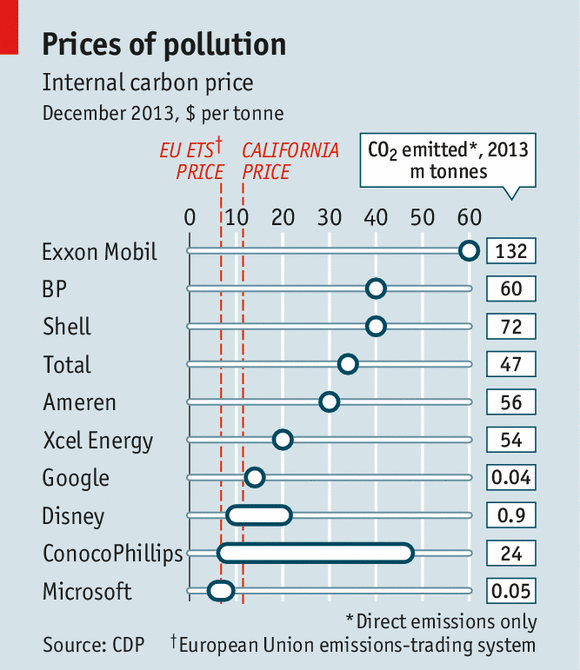
"The prices range from $6-7 a tonne of carbon dioxide at Microsoft to $60 a tonne at Exxon Mobil. … As a rule, those whose assets have a long productive life and which might be affected by green policies far into the future (such as oil companies) use higher prices than consumer-goods firms whose products are mainly influenced by current policies."
The companies are pushing ahead with this for two basic reasons: first, although it is hard to understand why they think so based on recent performance, firms anticipate politicians will eventually get their act together and impose a carbon price:
"For many companies the aim is to prepare themselves for future environmental legislation. AEP, a power supplier, says it uses the system because 'it assumes a price of carbon…will begin in the US by roughly 2020.' Delta Air Lines says it uses a price for evaluating flights to Europe 'in anticipation of compliance with EU ETS.'"
Second, it allows firms, such as ConocoPhillips and Disney (see: Strategic CSR – Carbon tax), to better understand the present value of future projects and investments:
"ConocoPhillips, an oil firm, requires that capital projects worth over $75m calculate the cost of emissions based on a price of between $8 and $46 a tonne, depending on the life of the project. The forecast value of a new oilfield would be: estimated output multiplied by the estimated future oil price minus development costs and carbon emissions. … Disney, a media conglomerate, goes further still. It invests in schemes to offset or reduce carbon emissions and charges the cost of these to business units in proportion to how much they contribute to the company's overall emissions. In effect, this works like an internal carbon tax."
The result of these varied approaches is a range of prices among firms. As the article notes, however, the surprising (and encouraging) thing is how high some of the prices are—much higher than any of the failing government experiments:
"The market price of carbon is €4.90 ($6.70) per tonne of CO2 in the EU, $11.50 in California. Big oil companies charge $34 or more. That is closer to the 'social cost of carbon'—the damage from an extra tonne of CO2—than to the market price. … the sort of carbon price some companies are using for planning would, if it became a market price, have a much bigger impact than any of the policies that governments are now talking about."
The graphic that accompanies the article demonstrates the extent of the differences in internal carbon price among firms:
Take care
David
David Chandler & Bill Werther
Instructor Teaching and Student Study Site: http://www.sagepub.com/chandler3e/
Strategic CSR Simulation: http://www.strategiccsrsim.com/
The library of CSR Newsletters are archived at: http://strategiccsr-sage.blogspot.com/
Carbon copy
Some firms are preparing for a carbon price that would make a big difference
December 14, 2013
Carbon copy
Some firms are preparing for a carbon price that would make a big difference
December 14, 2013
The Economist
70