The CSR Newsletters are a freely-available resource generated as a dynamic complement to the textbook, Strategic Corporate Social Responsibility: Sustainable Value Creation.

To sign-up to receive the CSR Newsletters regularly during the fall and spring academic semesters, e-mail author David Chandler at david.chandler@ucdenver.edu.

Showing posts with label Earth Day. Show all posts

Saturday, April 19, 2025

Strategic CSR - Earth Day

Ahead of Earth Day on Tuesday, some thoughts on recent developments around ESG.

When I criticize various sustainability policies or proposals, the response I often get is along the lines of 'well, at least we are trying.' To which I reply along the lines of 'well, good intentions do not substitute for good outcomes.' My general thought is that, kidding ourselves we are making progress is no help to anyone – if anything, it lulls everyone into a false sense of security through the illusion of progress, and that is a problem because it ensures even less progress than if we were sufficiently self-aware to know we were not really moving the needle.

The evolution of the resistance to ESG in the U.S., as reported in the article in the url below, demonstrates the danger of relying on good intentions. ESG, from the beginning, was clearly based on false assumptions and inconsistent logic, topped off with the desire to start making money as soon as possible. This could have continued for a while, except that the fragile intellectual foundation (characterized by incomplete definitions and inconsistent measurement) allowed ideological opponents to pick it apart. If ESG had rested on a sounder foundation, the ridiculous ideological attacks against it would have fallen flat. But, because ESG is inherently flawed, it was easy for those opposed to cherry-pick the flaws that best matched their arguments, to make their pushback sound more legitimate, even in the face of economic gain:

"Climate investors have warned the political right is winning a war against ESG investing. A recent poll shows American support for renewable energy and electric vehicles is fading. And yet, President Joe Biden's signature climate law is in many ways benefiting conservative red states the most."

I have said this many times, but I'll repeat for good measure – in my opinion, as a society, we are not serious about tackling climate change. In fact, I would go as far as to say that we have not even begun a conversation about planning how we might be serious at some distant point – as noted by Tad DeLay, quoted in the article in the second url below:

"Just by driving to get groceries you emit carbon dioxide … a fifth of [which] … will still be in the air in 500,000 years, killing species that haven't yet evolved."

You would think we would take all of this a little bit more seriously. All you have to do is realize that during the COVID lockdown, when none of us were going anywhere and the global economy had virtually shuttered, global carbon emissions dropped a mere 6% (see Strategic CSR – COVID-19). 6%! And we think we can get to net zero by 2050. It would be laughable if the implications of our self-delusion were not so serious.

Tackling climate change and creating the conditions for a more sustainable economic system will always require plenty of unconditional cheerleaders, not to mention brilliant minds who will innovate and provide encouragement along the way. It will also require those who can think critically about what we are doing, and work to prevent us from lulling into the false sense of security that is just as big a barrier to progress as sticking our collective heads in the sand.

Take care
David

David Chandler
© Sage Publications, 2023

Instructor Teaching and Student Study Site: https://study.sagepub.com/chandler6e 
Strategic CSR Simulation: http://www.strategiccsrsim.com/
The library of CSR Newsletters are archived at: https://strategiccsr-sage.blogspot.com/


Climate Investors Warn the Right Is Winning the Way on ESG
By Alastair Marsh
February 28, 2024
Bloomberg

'What if there just is no solution?' How we are all in denial about the climate crisis
By Maya Goodfellow
June 20, 2024
The Guardian
 

Thursday, October 19, 2023

Strategic CSR - Recycle logo

The article in the url below reveals some of the difficulties with using a simplified, generic (albeit well-designed) logo or label to represent a complex construct. Specifically, the article is talking about the universally-recognized recycling logo:

"The 'chasing arrows' logo, designed by a college student for the first Earth Day in 1970, has become ubiquitous on everything from cartons of milk to shampoo bottles as a way to nudge users to recycle packaging rather than discard it."

The trouble is that the logo is now so widely used that companies are putting it on materials that, while theoretically recyclable, are almost never being recycled, at least not in the U.S. The result is a form of false advertising that the U.S. government wants to prevent:

"At issue is the use of the logo along with the 'resin number' of different types of plastics. Resin one and two plastics, such as bottles and jugs, are the most easily recycled products, but those marked with numbers three to seven, categories that include plastic bags, styrofoam and plastic trays, are typically not recycled and are instead sent to landfills or burned."

Again, the issue is not that these plastics cannot be recycled, it is that they cannot yet be recycled efficiently and, as a result, there is no functioning market for the original materials, once they have been used (see Strategic CSR – Labels):

"A new rule was needed, the agency said, to help clear up this confusion. In 2021, California passed a law to restrict the use of the logo to avoid misleading claims about recycling. Environmental groups are pushing for an end to the blanket use of the logo, too, claiming that its use amounts to 'greenwashing' by companies."

We either need to find a way to recycle these plastics in ways that are efficient and practical (without the plastic degrading so much that the recycled material does not have many practical applications), or we need to reduce the amount of single-use plastic in our lives (a challenge that has its own complications; see Strategic CSR – COVID-19):

"Only around 5% of plastics are recycled in the US, a proportion that has been declining since China announced it would no longer be accepting unwanted plastic waste from western countries in 2018. American households produce around 51m tons of plastic waste a year, more than any other country, with much of that either dumped in landfills, incinerated or littered, often ending up in the ocean."

Take care
David

David Chandler
© Sage Publications, 2023

Instructor Teaching and Student Study Site: https://study.sagepub.com/chandler6e 
Strategic CSR Simulation: http://www.strategiccsrsim.com/
The library of CSR Newsletters are archived at: https://strategiccsr-sage.blogspot.com/


Universal 'chasing arrows' recycling symbol could be dumped in US
By Oliver Milman
May 18, 2023
The Guardian
 

Thursday, April 21, 2022

Strategic CSR - Science + social media

In celebration/commiseration of Earth Day on Friday, the article in the url below appeared in the daily Bloomberg Green newsletter that I enjoy receiving (you can sign-up here). This particular post argues that a big part of the problem with conveying the urgency around climate change is not the science behind it so much as the way in which the consensus findings are advertised:

"More than 5 billion mobile subscriptions and 3.6 billion social-media accounts globally are adding up to a massive disruption in human communities' evolutionary context. … Increasing the scale of human interactions by eight orders of magnitude in less than two decades makes even run-of-the-mill misinformation easier to disseminate, more influential, and—a crucial driver—more lucrative than ever."

In other words, simple, dramatic lies spread faster and easier over social media than the complicated, nuanced truth. What does this mean for the science community, in practice, and in particular in relation to the facts of climate change?

"This new global digital landscape is hostile to antiquated 20th-century science communication approaches, up to and including the upcoming United Nations Intergovernmental Panel on Climate Change reports, which comprise multiple volumes, each hundreds or thousands of pages long. 'This is why some people have argued the IPCC should have been dissolved,' said Jennifer Jacquet, [an] associate professor of environmental studies at New York University. Physical science is central to the fight against climate change, but 'it's not really giving us new tools to make a social difference.'"

There is growing evidence that social media has significant negative side effects in terms of enabling communication globally, and this article correlates that harm with the inability of scientists to effectively communicate the implications of their work:

"Amid emergency heat, flooding, and famine, it's even more critical that people recognize and agree at least on the big picture. And yet, as recent history has shown us time and again, they don't. Much of that can be blamed on the pandemic of misinformation—concerning climate change, Covid-19, vaccines, and so much more— now running rampant on social media."

Specifically, while social media is supposed to connect us; in fact, it loosens the quality or strength of those ties:

"The development of digital communications has eroded or vaporized community protections developed over millennia to ensure at least a minimally healthy flow of information, which leads to healthy decision-making. … Think of it like this. If you wanted to make the most obvious statement in the world, you could do worse than: 'Technology now allows people to communicate instantaneously and across great distances.' Yet if you wanted to elicit the most tortured answer in the world, you might ask something incredibly similar: 'What happens when people can communicate instantaneously and across great distances?'"


As a result, some scientists have proposed "a new academic discipline" to describe this phenomenon:


"As physiology has medicine and climate science has emissions-mitigation and adaptation–planning, they argue, the digital-misinformation pandemic requires an applied science—or as they call it, a 'crisis discipline.'" 


A specific label suggested for this new discipline is "agnotology, the study of the creation of ignorance," and it is "a useful and much-needed new lens for understanding the modern world:" 


"It also has much more to explore. The authors focus on channels of communication—digital media—but the complexity and diversity of modern audiences and messengers also require study."


Take care

David


David Chandler

Strategic Corporate Social Responsibility: Sustainable Value Creation (5e)

© Sage Publications, 2020


Instructor Teaching and Student Study Site: https://study.sagepub.com/chandler5e 

Strategic CSR Simulation: http://www.strategiccsrsim.com/

The library of CSR Newsletters are archived at: https://strategiccsr-sage.blogspot.com/


As Climate Change Fries the World, Social Media Is Frying Our Brains

By Eric Roston

June 29, 2021

Bloomberg Green Daily Newsletter

https://www.bloomberg.com/news/articles/2021-06-29/as-climate-change-fries-the-world-social-media-is-frying-our-brains


Tuesday, April 21, 2020

Strategic CSR - 50th Earth Day

With a nod to tomorrow's 50th anniversary of Earth Day, the newsletters this week focus on the field of ESG/SRI investing. Today, the article in the url below offers a broad critique by the WSJ columnist (James Mackintosh) who occasionally returns to this issue. Whenever he does, I find his perspective insightful because he tends to cut through a lot of the fluff that surrounds ESG/SRI (created largely by the investing companies trying to jump on the bandwagon). This column is no exception – I find the central conundrum that he presents fascinating:
 
"Much of ESG is about what economists call externalities: things such as carbon emissions that are free to the emitter but costly to wider society. Making money from pricing externalities is a matter of identifying which ones will lead to government, consumer or worker action and which ones won't."
 
The comment may seem cynical, but I think reflects how many investors (whether professional or layperson) think and act. If so, it captures an economic reality that is missing from most CSR commentary around ESG/SRI investing. It also takes into account the inconsistent approach from politicians (and all stakeholders, broadly speaking) to public policy:
 
"Treating your workers badly might help your profits, but it is likely to backfire in the long run as they leave for other employers. Using cheap ingredients that poison your customers, even if it seems to be legal, leads to lawsuits or government crackdowns."
 
The challenge, of course, is to identify when the backlash will come (and how strong it will be):
 
"It took decades for government to act on evidence that tobacco was killing people but just a few years to move against vaping. Alcohol, meanwhile, remains a great business despite the damage it does."
 
The result is that, although the amount of capital flowing into SRI/ESG funds is increasing rapidly (even more so in the current political environment), it is not clear it is achieving the goals that are intended for it. If so, then the investment companies are arguably deceiving many who are trying to channel their investments in ways that reflect their values. As Mackintosh notes at the beginning of this column:
 
"It is hard to move in the world of investment without being bombarded by sales pitches for running money based on 'ESG,' or environmental, social and governance criteria. The trouble is that few involved seem to agree on how it works (or, more to the point, doesn't)."
 
Take care
David
 
David Chandler
© Sage Publications, 2020
 
Instructor Teaching and Student Study Site: https://study.sagepub.com/chandler5e 
Strategic CSR Simulation: http://www.strategiccsrsim.com/
The library of CSR Newsletters are archived at: https://strategiccsr-sage.blogspot.com/

A Socially Responsible Strategy Can be Tricky
By James Mackintosh
November 13, 2019
The Wall Street Journal
Late Edition – Final
B1
 

Thursday, April 18, 2019

Strategic CSR - Moral assumptions

Given that Monday is Earth Day, today's Newsletter highlights the article in the url below, which explores the moral assumptions that underpin economic models of climate change. Specifically, the article argues that, beyond the inherent complexity of climate change (replete, at least in the US, with large segments of deniers of science), there is an essential economic challenge:
 
"Humanity must work out how many resources should be diverted from other valuable uses—from life-enriching consumer goods to funding for pensions—to the task of limiting global warming."
 
In essence, the core question of economics applies—how do we allocate scarce resources to address needs/wants in ways that create optimal outcomes? The additional challenge here is that, in spite of economics' insistence for many years to the contrary, this is not purely a mathematical problem:
 
"These calculations may look bloodless, but they are built on weighty moral assumptions, namely, how to value people's lives."
 
For the author of the article, having a discussion around these moral assumptions may increase the perceived level of importance of climate change:
 
"Though it is hard to know what might finally impel humanity to take the threat of climate change seriously, speaking more plainly about its moral costs might help."
 
Take, for instance, the discount rate, which is an essential component of any attempt to place a value on wealth that is deferred today for future benefit. Up until now, economists have used knowledge about our consumption patterns to determine how much we would be willing to sacrifice today for some future, unspecified benefit:
 
"But it is far from clear that the rates people have in mind when deciding whether to attend university or save for retirement should be applied to questions of social policy that will affect billions of lives. Climate policy does not simply shift a bit of ill-defined utility from one pile to another, after all. It determines how much life-threatening environmental harm the current generation will impose on scores of future ones."
 
This is where it gets interesting because we have the knowledge to make these tradeoffs; it is just not something that economists have spent a lot of time thinking about:
 
"Philosophers are accustomed to discussions about how to value lives distant from our own in time and place; economists are not. But [new research] puts the results of discounting in evocative terms: given a 5% rate of discount, one human life today is worth 132 a century hence. Is it really ethically acceptable to save one life now at the expense of so many in the future? … Economists should treat threats to future lives as just as morally reprehensible as present threats to our own."
 
By valuing the future in proportion to the present (there is a lot more of the future), we should be able to arrive at a conclusion of how much that future is worth, relative to our current wealth, and how much of an obligation we have to deliver it:
 
"… there is a risk that humanity will no longer be around a few centuries from now—for example, if a large comet hits the Earth, or if a supervolcanoes erupt and cloak the Earth in choking debris. It makes sense to discount future lives by a tiny amount to take account of the possibility that they will never come to be. That would nonetheless mean that humanity ought to be willing to bear substantial costs now to reduce eventual climate harms."
 
Take care
David
 
 
Instructor Teaching and Student Study Site: https://study.sagepub.com/chandler4e
Strategic CSR Simulation: http://www.strategiccsrsim.com/
The library of CSR Newsletters are archived at: https://strategiccsr-sage.blogspot.com/
 
 
Future lives matter
December 8, 2018
The Economist
Late Edition – Final
75
 

Friday, April 22, 2016

Strategic CSR - Earth Day

The article in the url below presents an interesting take on our symbiotic relationship with our environment, in its broadest sense:
 
"The lead in the water in Flint, Mich., is a devastating reminder of how closely human health is intertwined with the environment. While the Flint crisis may be an egregious example of cruelty and neglect, the damaging consequences of a broken environment are all around us, a new tally by the World Health Organization shows."
 
Specifically, the article focuses on the number of deaths caused by the dangers present in our environment, almost all of which are the result of human activity:
 
"Nearly a quarter of all deaths worldwide are caused by environmental risks like polluted air, dirty water, hazardous workplaces, and dangerous roads, according to the WHO report. The global health authority estimates that 12.6 million deaths in 2012, or about 23 percent of the total, were attributable to such factors."
 
However approximate this total is, what is equally fascinating are the categories of deaths that are not included in these numbers:
 
"The WHO report—which doesn't count risks that depend on individual behavior, such as smoking and diet—looks at the environment broadly, including 'physical, chemical, and biological factors external to a person' that can be modified. It focuses on environmental risks that are the product of the societal decisions that shape the world we live in."
 
What is also interesting is how the main causes of death have shifted over time:
 
"More people around the globe have gotten access to clean water, sanitation, and less harmful household cooking fuels. That transition has led to a decline in infectious diseases. At the same time, non-communicable diseases like heart disease and cancer account for a growing share of death and illness worldwide."
 
The underlying message is that all these causes are preventable. We build the environment in which we all live. As such we can change it, if we want to.
 
Happy Earth Day!
David
 
David Chandler & Bill Werther
 
Instructor Teaching and Student Study Site: http://www.sagepub.com/chandler3e/
Strategic CSR Simulation: http://www.strategiccsrsim.com/
The library of CSR Newsletters are archived at: http://strategiccsr-sage.blogspot.com/
 
 
Our Broken Environment Kills a Quarter of Us
By John Tozzi
March 14, 2016
Bloomberg Businessweek

Monday, April 18, 2016

Strategic CSR - Green bonds

 
This Friday is Earth Day. As such, this week's Newsletters will focus on sustainability issues.
 
 
The article in the url below indicates a subtle shift in corporate thinking regarding climate change. Beyond a recognition that it is occurring, it signals a willingness to invest in a solution (at the firm-level). Specifically, it indicates a willingness to issue new debt in order to invest in those solutions:
 
"Apple's $1.5bn green bond, announced last month, will fund several initiatives, including the company's conversion to 100% renewable energy, installation of more energy efficient heating and cooling systems and an increase in the company's use of biodegradable materials. A green bond, like a typical bond, is simply a way to borrow money, but it's issued specifically to fund environmental projects."
 
Along with the firm's recent announcement of a new recycling program and a reduction in e-waste (see here), Apple is increasingly taking the lead on sustainability issues:
 
"Lisa Jackson, Apple's vice president of environment, policy and social initiatives, told Reuters that the company decided to issue its green bond after December's UN Climate Summit in Paris, during which hundreds of companies pledged to fight climate change. With its bond sale, Apple has become the largest US company to have issued a green bond – although Toyota still holds the crown for the largest corporate green bond ever offered in the US with its $1.75bn green bond issued in 2014."
 
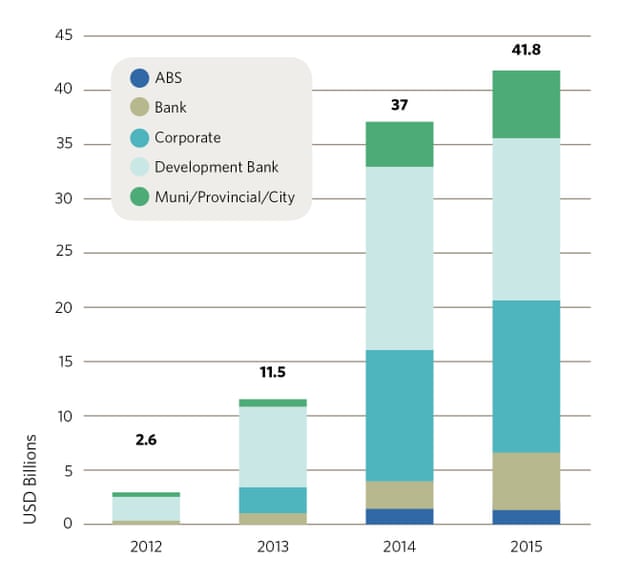
And, as a result of the increased corporate support, the value of green bonds that are being issued has grown exponentially (see this chart):
 
"The green bond market is still in its infancy. According to Climate Bonds Initiative, a UK nonprofit that tracks the market, the first green bond was issued in 2007, and the first corporate issuance didn't come along until 2013. Since then, a handful of high profile companies have jumped on the bandwagon, including EDF, a French power company, and Bank of America, which used the proceeds to loan money to cities and other businesses for installing solar panels, wind turbines and LED lighting."
 
This growth is predicted to continue into 2016 and beyond:
 
"According to Climate Bonds Initiative, the market, including government-issued bonds, reached an all-time high of $41.8bn in 2015, up from $36.6bn in 2014 and $11bn in 2013. Financial services company HSBC predicts between $55bn and $80bn worth of green bonds will be issued around the world in 2016, while the Climate Bonds Initiative believes sales will exceed $100bn."
 
Take care
David
 
David Chandler & Bill Werther
 
Instructor Teaching and Student Study Site: http://www.sagepub.com/chandler3e/
Strategic CSR Simulation: http://www.strategiccsrsim.com/
The library of CSR Newsletters are archived at: http://strategiccsr-sage.blogspot.com/
 
 
Can Apple's $1.5bn green bond initiative inspire more environmental investments?
By Alison Moodie
March 20, 2016
The Guardian
 

Friday, April 18, 2014

Strategic CSR - Earth Day!

In honor of Earth Day on Tuesday (April 22), this Newsletter features a review of Elizabeth Kolbert’s new book, The Sixth Extinction: An Unnatural History, which has been getting a lot of attention since it was released earlier this year. This, I think, is not because she is necessarily telling us something that we did not already know, but because (a) she is packaging the information in a way that conveys the full implications of the approaching calamity and (b) she does it in a way that is easily understandable to a wide audience. In short, Kolbert’s thesis is that there have been five major species extinctions in the history of the planet, and we are rapidly heading towards a sixth:
 
“Ms Kolbert, who writes for the New Yorker, uses case studies to document the crisis. Setting out for Panama to investigate a vanishing species of frog, she learns that amphibians are the world’s most imperilled class of animal. Close to her home in New England, a fast-spreading fungus has left bat corpses strewn through caves. On a tiny island off Australia’s coast, she laments the degradation of the Great Barrier Reef by ocean acidification, sometimes known as global warming’s ‘evil twin.’”
 
The consequences of this activity are broad and will be lasting:
 
“By the reckoning of the International Union for Conservation of Nature, two-fifths of all amphibians, a quarter of mammals and an eighth of birds are threatened.”
 
The twist to her argument is that, while natural causes are responsible for the first five mass extinctions (e.g., ice ages, comets from outer space, etc.), the primary responsibility for the sixth lies with humans:
 
“Ms Kolbert glides through the problems humans have created—climate change, incursion into wildlands, the transport of invasive species—with broad strokes. She misses a few chances to emphasise the value of biodiversity, beyond its natural wondrousness and the general interconnectedness of species. Her chapter on bats, for example, does not mention their importance to human food supplies as bug-eaters. … The root cause of the current extinctions is not ambiguous. Humans have already left a mark, and our ingenuity seems unlikely to turn things around.”
 
The message is both stark and overwhelming. As she concludes her book:
 
“‘Life,’ she writes, ‘is extremely resilient but not infinitely so.’”
 
Have a good weekend
David
 
David Chandler & Bill Werther
 
Instructor Teaching and Student Study Site: http://www.sagepub.com/chandler3e/
Strategic CSR Simulation: http://www.strategiccsrsim.com/
The library of CSR Newsletters are archived at: http://strategiccsr-sage.blogspot.com/


Killing machines
February 22, 2014
The Economist
Late Edition – Final
74
 

Monday, April 22, 2013

Strategic CSR - Earth Day!

The more you study a subject like CSR, the more it is easy to be dragged down into a conversation of increasing despair as the planet hurtles towards social introversion and environmental destruction. As such, it is extremely liberating to be reminded occasionally of the brilliance of human beings. Given the right conditions and incentives, we have the ability to thrive (and, hopefully, survive)! The article in the url below from the UK newspaper, The Guardian, presents a series of amazing innovations that extends our ability to recycle discarded products that were previously considered waste:
 
“From plastic bottles that have helped create Nike's 2013 Brazil home kit, to roof tiles made of toilet paper.”
 
Truly inspiring! Now, if we could only work out how to scale this kind of innovation so that we use less resources than we throw away …
 
Happy Earth Day!
David
 
 
Instructor Teaching Site: http://www.sagepub.com/strategiccsr/
The library of CSR Newsletters are archived at: http://strategiccsr-sage.blogspot.com/
 
 
Turning waste into worth - innovation in pictures
From fishing nets turned into carpet tiles, shampoo sludge that becomes fertiliser and plastic bottles transformed into Brazilian football kits, waste is being re-used in innovative ways to create new products. Our gallery pulls together some of the most interesting examples
April 10, 2013
The Guardian
 

Friday, April 20, 2012

Strategic CSR - Earth Day

Here are some interesting thoughts to keep in mind over the weekend in observance of Earth Day on Sunday (http://www.earthday.org/2012). In particular, the article in the url below presents some updated facts on the amount of waste that is generated in the U.S.:

“The nation's official trash tally [found in the Environmental Protection Agency's exhaustive annual compendium "Municipal Solid Waste in the United States] … maintains that the average American tosses out 4.4 pounds of trash a day, with about a third getting recycled and the rest going to landfills. … Americans actually throw out much more than the EPA estimates, a whopping 7.1 pounds a day, and that less than a quarter of it gets recycled.”

The consequences of the amount of waste we produce is significant:
  • “At 7.1 pounds of trash a day, each of us is on track to produce a staggering 102 tons of waste in an average lifetime.
  • American communities on average spend more money on waste management than on fire protection, parks and recreation, libraries or schoolbooks, according to U.S. Census data on municipal budgets.”

In addition to the waste itself, however, our current disposal systems are inefficient. There is a great deal of value discarded along with the remnants of our materialistic society:

“The chief executive of Waste Management, the world's largest trash company, estimates that there is at least $20 billion in valuable resources locked inside the materials buried in U.S. landfills each year, if only we had the technology to recover it cost effectively.”

Needless to say, it doesn’t have to be this way:

“Other countries with big economies and high standards of living have rejected the disposable products that make up so much of America's garbage—in part because European countries hold manufacturers, not taxpayers, responsible for the costs of packaging waste. With that sort of incentive, toothpaste tubes need not come in redundant cardboard boxes and television sets can leave the store with no boxes at all. The average Dane makes four pounds of trash a day, according to the Organization for Economic Cooperation and Development; the average Japanese generates 2.5 pounds. … Austria, the Netherlands, Sweden, Belgium and Denmark all send less than 4% of their garbage to landfills; Germany does no landfilling at all. Recycling rates there are two to three times America's, and the rest of their trash goes to waste-to-energy plants.”

Monday, October 31, 2011

Strategic CSR - 7 billion

The article in the url below reports that, today, the United Nations estimates that the world’s population will surpass seven billion people (probably somewhere in India). See the World Population Clock for confirmation: http://www.worldometers.info/world-population/. The shock is not the number itself, but the speed at which the total has grown exponentially in recent years:

“The first billion people accumulated over a leisurely interval, from the origins of humans hundreds of thousands of years ago to the early 1800s. Adding the second took another 120 or so years. Then, in the last 50 years, humanity more than doubled, surging from three billion in 1959 to four billion in 1974, five billion in 1987 and six billion in 1998.”

The article goes on to question whether the planet can support this many people. The author reports plenty of good news to suggest, in theory, that the Earth can easily support its current population and even a much larger one:

“Between 1820, at the dawn of the industrial age, and 2008, when the world economy entered recession, economic output per person increased elevenfold. Life expectancy tripled in the last few thousand years, to a global average of nearly 70 years. The average number of children per woman fell worldwide to about 2.5 now from 5 in 1950. The world’s population is growing at 1.1 percent per year, half the peak rate in the 1960s. The slowing growth rate enables families and societies to focus on the well-being of their children rather than the quantity.”

In practice, however, there is also cause for concern:

“Nearly half the world lives on $2 a day, or less. In China, the figure is 36 percent; in India, 76 percent. More than 800 million people live in slums. A similar number, mostly women, are illiterate. Some 850 million to 925 million people experience food insecurity or chronic undernourishment. … While the world produced 2.3 billion metric tons of cereal grains in 2009-10 — enough calories to sustain 9 to 11 billion people — only 46 percent of the grain went into human mouths. Domestic animals got 34 percent of the crop, and 19 percent went to industrial uses like biofuels, starches and plastics. … Already, more than a billion people live without an adequate, renewable supply of fresh water.”

And, the future prospects are daunting:

“The United Nations Population Division anticipates 8 billion people by 2025, 9 billion by 2043 and 10 billion by 2083. India will have more people than China shortly after 2020, and sub-Saharan Africa will have more people than India before 2040.”

The conclusion, which is hardly news, is that we are growing at an unsustainable rate—not only in terms of numbers, but the amount of resources being consumed by those numbers and, more importantly, the way those resources are being consumed:

“Human demands on the earth have grown enormously, though the atmosphere, the oceans and the continents are no bigger now than they were when humans evolved. … The mismatch between the short-term incentives that guide our political and economic institutions and even our families, on one hand, and our long-term aspirations, on the other, is severe.”

The upshot is that, while we should be able to manage the world’s population growth; the reality is that we are shooting ourselves in the foot (or, I suppose, our 14 billion feet).

Monday, April 25, 2011

Strategic CSR - Earth Day

The article in the url below appeared the day before Earth Day last year, but I think it is still very relevant. The article takes a tongue-in-cheek look at how consumers are encouraged to “buy green” (i.e., consume more resources) in order to demonstrate their commitment to conserving resources!?!

“With apologies to a cliché that predates the advent of Earth Day by a year, it is easy being green. Too easy. From adorable reusable shopping bags and organic clothing to hemp shower curtains (no nasty petroleum-based vinyl liner!) and "natural is now fun!" beauty products for girls, the proliferation of green products makes doing our bit for the planet a blast, since Americans can combine environmentalism with their favorite sport, shopping.”

In other words, the article argues that we are being sold the story that the environment can be saved with only minimal sacrifice or changes in behavior. And, where we are encouraged to act, it is in relation to relatively inconsequential personal behavior, rather than more meaningful, system-wide change:

“Of the Nature Conservancy's five recommendations for Earth Day, four—figure out your carbon footprint here, time your shower, go for a walk (!), and find a farmers’ market—involve individual behavior. Only a single suggestion, "speak up on climate change" … gets at the only kind of change that has been shown in the 40 years since the first Earth Day to make a difference.”

[Note: For this year’s Earth Day, all five of The Nature Conservancy’s suggested “easy actions” focus on personal action—http://earthday.nature.org/five-things/]

And, when expectations are low, the results are uninspiring:

“90 percent of Americans, Gallup found, say they recycle. And what good has it done? Some, to be sure. But we are producing 38 percent more garbage today than we were in 1970.”

It is all very Monty Python-esque: Come on everybody, let’s form a committee to consider setting-up a commission to make recommendations to compose the serious questions we need to address if we are to contemplate some type of action that should maybe move us in the right direction:

“The problem with the emphasis on changing individual behavior is this: it makes too many of us believe we have done our part. … By believing that green shopping—or even recycling, turning down the thermostat, or carpooling—is enough, we consent to the continuation of the same societal practices that got us into this mess. Compared with the scale of the disaster, changing individual behavior is pathetically inadequate.”

In other words, the more things change, the more they stay the same, while we dig ourselves in deeper.

Take care
David


Instructor Teaching Site: http://www.sagepub.com/strategiccsr/
The library of CSR Newsletters are archived at: http://strategiccsr-sage.blogspot.com/


On the 40th Anniversary of Earth Day, Let’s ... Go Shopping!
Buying green and changing personal behavior won't save the planet.
Newsweek
Apr 21, 2010

Monday, November 15, 2010

Strategic CSR - Measuring CSR (Lifecycle Pricing)

One of the most pressing and contentious areas of the CSR debate today revolves around the following question: How do we measure CSR?

How can we develop an accurate and consistent measure of CSR that allows stakeholders to evaluate the social and environmental impact of different products and firms, and compare them to other products and firms (i.e., compare apples with oranges along common metrics)? If we can’t measure CSR, how can we tell whether and when it matters? I have been thinking about this issue for a while now and will focus the next few Newsletters on some interesting and innovative steps firms are taking to address it.

One of the primary goals of measuring CSR should be to move towards some form of product lifecycle pricing.

Lifecycle pricing supports the idea that we need to develop an economic model that is no longer founded on waste by accounting for externalities in pricing (i.e., similar to the idea of Pigovian taxes). In other words, the price of a product should not only include the cost of production, but also include the costs associated with replenishing the raw materials used and disposing/recycling of the waste after consumption. Attempts to put a price on carbon reflect this process (either through a carbon tax or some form of cap-and-trade), while firms’ efforts to develop carbon footprints (e.g., http://www.walkerscarbonfootprint.co.uk/ and http://www.nytimes.com/2009/01/22/business/22pepsi.html) provide a possible means of implementation.

If all firms are forced to incorporate externalities into the price of a finished product or service, many of the cheap items in our disposable economy will become significantly more expensive and businesses will be incentivized to produce sustainable alternatives. The market remains the most effective means we know of allocating scarce and valuable resources in ways that maximize social outcomes. Rather than subsidizing specific industries, adequately pricing the ‘true’ cost of a product allows for a less distorted competition of ideas in the marketplace that should also generate socially responsible outcomes.

The articles in the two urls below contain examples of firms that are leading the way in this area. The article in the first url details attempts by the apparel industry to incorporate lifecycle product information into all the clothing we buy:

“More than 200 clothing manufacturers and retailers have joined together to create an industry-wide sustainability rating, the Eco Index, which will assess the environmental impact of products along their entire life-cycle chain. … The Eco Index, currently at the “beta” stage of development, provides three types of tools – guidelines, indicators and metrics. These can be used together or separately, and enable any company to participate, whether seasoned in sustainability or not. Each tool assesses a product’s impact within six life-cycle stages: materials; packaging; product manufacturing and assembly; transport and distribution; use and service; and end of life. … The stakeholder engagement process should be complete by the end of 2010, with the formal phase 1 index to launch in early 2011.”

The article in the second url looks at Whole Foods’ attempts to assess and support sustainable seafood products:

“[Whole Foods Market Inc.] on Monday launched a new color-coded rating program — with the help of Monterey Bay Aquarium and Blue Ocean Institute — that measures the environmental impact of its wild-caught seafood. … Similar to a stoplight, seafood is given a green, yellow or red rating. A green rating indicates the species is relatively abundant and is caught in environmentally friendly ways. Yellow means some concerns exist with the species' status or the methods by which it was caught. And a red rating means the species is suffering from overfishing, or the methods used to catch it harm other marine life or habitats. … Whole Foods also announced Monday that it will end sales of red-rated species by Earth Day 2013. The company has already phased out a number of such products.”

It is encouraging to see these firms collaborating on industry-wide standards that move us closer to understanding the holistic impact of our current economic system and business practices. What is not clear (and is not necessarily relevant) is the extent to which consumers want this information and whether they are willing to act on it.

Take care
David


Bill Werther & David Chandler
Strategic Corporate Social Responsibility: Stakeholders in a Global Environment (2e)
© Sage Publications, 2011

Instructor Teaching Site: http://www.sagepub.com/strategiccsr/
The library of CSR Newsletters are archived at: http://strategiccsr-sage.blogspot.com/


Eco Index: How green are your clothes?

Manufacturers and retailers are developing an ambitious rating system for the ecological impact of their clothes
Jeni Bauser
Ethical Corporate Magazine
October 15, 2010

Whole Foods to label seafood's sustainability
Green, yellow and red stickers to show if food is endangered or overfished
Sarah Skidmore
msnbc.com
September 17, 2010