The CSR Newsletters are a freely-available resource generated as a dynamic complement to the textbook, Strategic Corporate Social Responsibility: Sustainable Value Creation.

To sign-up to receive the CSR Newsletters regularly during the fall and spring academic semesters, e-mail author David Chandler at david.chandler@ucdenver.edu.

Showing posts with label Delta. Show all posts

Wednesday, April 22, 2026

Strategic CSR - Microsoft (+ Delta)

The article in the url below from Bloomberg Green Daily's newsletter is disappointing, for many reasons:


"Staff at Microsoft have told some developers of carbon removal credits that the company is pausing what is currently the world’s biggest program for financing the extraction of CO2 from the atmosphere."


To give you an idea of how big a blow this is to the market for carbon removal credits, the chart accompanying the article makes the extent of Microsoft's impact abundantly clear:


image.png


 To be specific:


"Microsoft is by far the largest investor in removal credits, having set an ambitious goal to be carbon negative by 2030. The company is engaged in deals across a variety of technologies, with Bloomberg estimating that its purchases in 2025 accounted for 96% of the entire market."


The article develops a line of argument that seeks to explain the decision to pull back but, in the process, instead makes clear why Microsoft's continued engagement is more essential than ever:


"While Microsoft has expanded its carbon removals program, the company’s greenhouse gas emissions have increased significantly on the back of its investment in data centers needed to power artificial intelligence."


Microsoft has been progressive on this issue for a long time, and was one of the first companies to account for an internal carbon price to help assess the ROI on projects (see Strategic CSR - Carbon tax). It is disappointing to see them pull back from this market, especially when technological innovation seems at a formative stage. But, they are clearly not alone -- on this or other related stories. To learn about companies dropping their 'net zero' targets, for example, see the article in the second url, below:


"Delta Air Lines Inc. quietly scrubbed a pair of key environmental targets from its sustainability web page. The Atlanta-based carrier deleted its pledge to use sustainable aviation fuel (SAF) for 10% of its jet fuel by 2030. It also rephrased its quest to achieve net-zero emissions by 2050 as an “aspiration,” rather than a 'goal.'”


As the graphic accompanying that article shows, Delta is far from where it would need to be to achieve the targets it (voluntarily) set itself -- unfortunately, they are not an outlier in the airline industry (see also Strategic CSR - Executive pay):


image.png


Take care

David


David Chandler

Strategic Corporate Social Responsibility: Sustainable Value Creation (6e)

© Sage Publications, 2023


Instructor Teaching and Student Study Site: https://study.sagepub.com/chandler6e  

Strategic CSR Simulation: http://www.strategiccsrsim.com/

The library of CSR Newsletters is archived at: https://strategiccsr-sage.blogspot.com/


Microsoft Staff Tell Some Carbon Capture Companies It's Pausing Deals

By Alastair Marsh and Ishika Mookerjee

April 13, 2026

Bloomberg Green Daily

https://www.bloomberg.com/news/newsletters/2026-04-13/microsoft-staff-say-carbon-removal-deals-paused-in-program-shakeup


Delta Waters Down Net Zero Target to an 'Aspiration'

By Ben Elgin and Kyle Stock

April 14, 2026

Bloomberg Green Daily

https://origin.www.bloomberg.com/news/newsletters/2026-04-14/delta-waters-down-net-zero-target-to-an-aspiration


Thursday, April 22, 2021

Strategic CSR - Personhood and politics

An issue that has surfaced for me in my classes this semester, particularly when discussing the challenges firms face in deciding their position on controversial issues such as the new Georgia voting laws, is the extent to which firms should be proactive or reactive in the actions they take. As indicated in the article in the url below, firms are increasingly finding themselves caught in a ratcheting of expectations – the more they engage in such issues, the more they are expected to do so:

"Civil-rights activists pressured Delta and Coca-Cola to take public stands against the law, which the groups have called restrictive and racist. Some of the companies' own employees echoed those concerns. After an initially muted public response, CEOs at both companies, which said they had been lobbying lawmakers behind the scenes, ultimately spoke out against the law."

But by waiting, the article argues, the firms end up pleasing no one and annoying everyone:

"In the end, their statements came too late to please many activists on the left and angered many on the right. Georgia House members voted to revoke a tax break for Delta, though the effort didn't go farther before the legislature adjourned last week. Senate Minority Leader Mitch McConnell accused big businesses of 'behaving like a woke parallel government,' and threatened 'serious consequences' for companies, though he later tempered his stance. The companies found themselves in the strange position of facing boycott calls from critics on both sides."

The more I thought about this, however, the more I realized that this might simply be another mistaken attempt to anthropomorphize large organizations (something the mainstream discussion around CSR does as a way to deflect blame from the real source of any problems they see – people). It seems to me that traits we might see as unprincipled in individuals might actually be a strength in corporations. In other words, another way to think about firms that wait to see which way the wind is blowing before issuing strong public statements on a particular issue is that they are waiting to see which issues their key stakeholders clearly care about. The article focuses on how customers react to such issues:

"According to a 2020 survey of 8,000 consumers by public-relations giant Edelman, about 63% said they choose, switch to, avoid, or boycott a brand based on its stand on social issues. And in a more recent Edelman poll of 33,000 consumers, 86% said they expect CEOs to publicly speak out on social issues, while 68% said companies should step in when the government fails to fix social ills."

But, there are two problems with thinking through this challenge only from the perspective of customers. First, it is unwise to rely on a survey to understand how people will really act and, second, there are many other stakeholders than customers to consider. Instead, if firms were to proactively determine their stance before an issue becomes part of the social discourse (an issue of principle that we might admire in an individual), the set of stakeholders who are able to participate in the decision is narrowed to the executives (and possibly the board). Since firms are non-agentic entities and it is only people who can act, in order for the firm to decide what to do ahead of time the firm's executives will need to decide on its behalf. This means potentially that a narrow set of interests/values/morals, etc. are represented in the decision that is announced. By waiting, however, the firm is effectively expanding the set of stakeholders who weigh in on an issue, determine it is important, and signal to the firm how they want it to respond.

This is not to diminish the value of a strong, values-based culture that can unite the firm and its stakeholders in achieving the firm's purpose. But, in particular on issues that can be so far removed from core operations and areas of expertise (like voting laws), it might pay firms to wait and see, instead of issuing premature statements that represent what the firm's executives think they should say/do, rather than what their stakeholders as a whole want them to say/do.

The key in all cases, of course, whether proactive or reactive, is that the firm is genuine in its intentions, and not just issuing a statement designed to appease stakeholders without committing to substantive action.

Take care
David

David Chandler
© Sage Publications, 2020

Instructor Teaching and Student Study Site: https://study.sagepub.com/chandler5e 
Strategic CSR Simulation: http://www.strategiccsrsim.com/
The library of CSR Newsletters are archived at: https://strategiccsr-sage.blogspot.com/


The New Business of Business is … Politics
By Chip Cutter, Suzanne Vranica, and Alison Sider
April 10-11, 2021
The Wall Street Journal
Late Edition – Final
B1, B9

Monday, May 4, 2020

Strategic CSR - Disney

The article in the url below says something interesting about our society. At least, it says something about Disney, the company, and the place it holds in people's minds (and hearts):
 
"At 7:30 in the morning on a recent Saturday, 14 people gathered on the 10th floor of Disney's Riviera Resort in Orlando, Fla. … These 14 adults — a mix of stay-at-home moms, young professionals without children and middle-aged parents from across the country — aren't just Disney fans. They are now considered experts."
 
They are experts because they had been selected and trained for part-time jobs helping holidayers plan their vacations with Disney. But, they are not only experts – these people are serious fans. Given the current shut-down of, essentially, the whole vacation industry, Disney will need fans like this when everything starts back up again:
 
"During breakfast, Mickey Mouse walked into the restaurant and most members of the group rushed to give him a hug and take photos. When Minnie Mouse arrived, others got up, complimented her dress, hugged her and asked for pictures. Group shots, selfies and posed photos were all taken. By 8:15 a.m., when Donald and Daisy Duck arrived, the panelists were too excited to contain themselves — they clapped and danced to the music as the characters put on a performance."
 
And, because there are so many fans out there, this was not an easy job to get. First, there was the training:
 
"The group had been together in Orlando since Wednesday, receiving training about how to be panelists. They learned how to ask each other for help, how to answer a question politely, how to urge someone to try something new."
 
But before that, there was the application process:
 
"They beat out more than 10,000 other applicants to become members of the 2020 Disney Parks Moms Panel, a website where people planning to go on a Disney cruise, or visit a Disney park or Disney Vacation Club in the United States, can ask questions and get responses from these experts. The company will announce the panelists on Wednesday morning. Eleven of this year's new panelists are women, three are men and two are not parents. The panel also has an additional 28 panelists returning from previous years."
 
OK, that's a little weird but, so far, so good, right? Or, maybe it gets weirder. What is interesting about this particular job is not so much what is expected of each employee, but their compensation package:
 
"The panelist position, while a Disney contractor role with an intensive application process, is not paid. In exchange for answering these questions every week, the panelists get a free stay at a Disney park or vacation club of their choice for five nights and can bring three people along. For this group, the trip is more than enough payment."
 
The idea that avid 'fans' would work for Disney for free reminded me of a Southwest case that I teach in my strategy class where the firm's passengers routinely take paid holidays from their jobs to help Southwest recruit new flight attendants. When asked why in the case, one respondent says, "Well, this is my airline, too." I am always left amazed that you just can't buy an endorsement like that. Who would do that for United, American, or Delta? And, what does it say about Southwest (and Disney for that matter) that that is the case? At some level, it has to speak to the culture the organization has created, combined with the meaningfulness that we crave in our lives. Those firms that can create significant overlap between the way we work and the way we live are doing something special:
 
"For [the] panelists, who like Dr. Chlon work full-time, working for Disney in this capacity is something of an honor. It's also an opportunity to contribute to a company that has sentimental and nostalgic meaning."
 
And that enthusiasm is conveyed through these volunteers:
 
"This is why the panelists aren't paid, according to [Leanne O'Regan, director of public relations for Disney Parks, Experiences and Products]. There is an 'authenticity of getting advice from someone who isn't being paid to give you advice,' she said. 'We want them to be honest when they answer questions.'"
 
On the other hand, however, this story also reminded me of the AoM meeting that was held a few years ago in Orlando at Disney World, and what an unmitigated disaster it was. Disney is, if nothing else, a company created by management consultants. And their attempts to get us to part with more money than we would otherwise voluntarily do was so transparent as to be insulting. Maybe it is the cynic in me, but every time someone at Disney told me to have "a wonderful Disney day," my heart sank. Clearly, however, many people out there are not management professors and simply love what it is that Disney does:
 
"This year, Disney put out the call for applications in August and kept the application portal open for one week in September. Many people apply for years before becoming panelists. Tamela Hansen, 45, finally made it onto the panel after 12 years of applying. Ms. Hansen said that she feels like she has been preparing to be a panelist for her whole life; she knew her time would eventually come. After all, she has been to Disney World from Alabama, where she grew up and currently lives, at least 100 times."
 
My question, therefore: Is Disney different from Southwest, or are they both tapping into something similar and fundamental? If so, why do I (largely) enjoy interacting with Southwest (apart from some of those annoying safety videos on YouTube), while Disney makes me feel weird?
 
Take care
David
 
David Chandler
© Sage Publications, 2020
 
Instructor Teaching and Student Study Site: https://study.sagepub.com/chandler5e 
Strategic CSR Simulation: http://www.strategiccsrsim.com/
The library of CSR Newsletters are archived at: https://strategiccsr-sage.blogspot.com/

Work for Disney without Pay? 10,000 Applied
By Tariro Mzezewa
January 19, 2020
The New York Times
Late Edition – Final
TR1, TR8
 

Thursday, October 19, 2017

Strategic CSR - Airlines

The article in the url below discusses the extent to which executive compensation tied to shareholder interests distorts decision making in the airline industry. What is interesting, though, is not that this happens (it has been a feature of western capitalism for a while now), but how the degree of influence has shifted so dramatically in this particular industry in a relatively short period of time:
 
"Five years ago, American Airlines factored in on-time arrivals, lost baggage and consumer complaints to help calculate annual incentive payments for top management. Today, these bonuses are based exclusively on the company's pretax income and cost savings. … 'Fifteen years ago, airlines competed with each other over who could buy the most planes or have the most routes,' said Jamie Baker, a top airline industry analyst at JPMorgan Chase. 'Executives are just as competitive today, but it's about who can achieve an investment-grade rating first, who can be a component in the S. & P. 500, and who has better returns for investors.'"
 
The article argues that this heightened pressure results from the relatively low levels of economic growth in recent years. When growth is low, increased returns for shareholders come at the expense of the interests of other stakeholders:
 
"Mature industries — where double-digit annual profit growth is a reach in the best of times — are especially vulnerable to activist investors' demands for board seats, bigger stock repurchases and other short-term financial rewards. The pressure is especially brutal in the airline industry because the key expense, fuel, is for the most part beyond management control. Yet airline executives have largely convinced Wall Street that the bad old days of bankruptcies and fare wars are over, replaced by the kind of predictable annual profits more common among industrial companies. That's among the reasons fees have popped up in recent years for everything from checking bags to securing an assigned seat before boarding. Known on Wall Street as ancillary revenue, this stream of income is especially favored by investors because it doesn't swing sharply the way fares do."
 
What is equally interesting, however, is why the airline firms' other stakeholders allow this disproportionate transfer of capital to shareholders to continue:
 
"And so far, despite occasional bouts of air rage and frequent consumer complaints, Wall Street has been getting what it wants. United's stock has surged to more than $80 per share from $25 per share five years ago, with profit margins rising to 13.6 percent from 3.7 percent over the same period. Overall industry margins hit 16.3 percent, up from 5.2 percent in 2012."
 
The lack of resistance is placing a significant amount of pressure on the legacy carriers to follow suit or be left behind:
 
"The pressure on United, American and other giants is only going to increase with the rise of so-called ultra-low-cost carriers like Spirit, Frontier and Allegiant. In fact, American and United are rolling out a stripped-down new class called Basic Economy. Here, in exchange for the cheapest tickets, fliers can't choose their seats before checking in and are more likely to be stuck in the middle of the row. They board last and are less likely to be able to sit with companions. No carry-on luggage is permitted, forcing anyone without elite frequent-flier status to check anything larger than a backpack — for a fee."
 
Again, we have no-one to blame but ourselves for the standard of customer service we now have to endure every time we fly:
 
"'The response isn't to Wall Street. It's to customer behavior,' said Alex Dichter, a senior partner at McKinsey who works with major airlines. 'About 35 percent of customers are choosing on price, and price alone, and another 35 percent choose mostly on price.' Mr. Dichter noted that when American added two to four inches of legroom in coach in the early 2000s, 'as far as I know, the airline didn't see one bit of improvement in market share or pricing.' 'The great irony is that most C.E.O.s would love to compete on product and experience,' he added. 'It's much more fun. The problem is that customers aren't paying attention to that.'"
 
Take care
David
 
 
Instructor Teaching and Student Study Site: https://study.sagepub.com/chandler4e
Strategic CSR Simulation: http://www.strategiccsrsim.com/
The library of CSR Newsletters are archived at: https://strategiccsr-sage.blogspot.com/
 
 
Route to Air Travel Discomfort Starts on Wall Street
By Nelson D. Schwartz
May 28, 2017
The New York Times
Late Edition – Final
A1
 

Sunday, January 26, 2014

Strategic CSR - Carbon price

While carbon markets at the governmental level are floundering (think Europe's low cost of carbon and Australia reversing course on legislation to introduce a cap-and-trade scheme), the article from The Economist in the url below shows that most of the innovation on this issue is coming from the private sector. Firms are increasingly developing a cost for carbon that they are then using to plan future projects and investments:
 
"A study by CDP, a research group, asked large firms based or operating in America what tools they had for managing risk; 29 said they used an internal carbon price. Anecdotally, more apply such a price but did not mention it as a risk-mitigation measure."
 
Because firms are doing this on a firm-by-firm basis and they range across vastly different industries, the prices they are allowing for a ton of carbon vary widely—primarily because carbon is relevant to their operations in different ways:
 
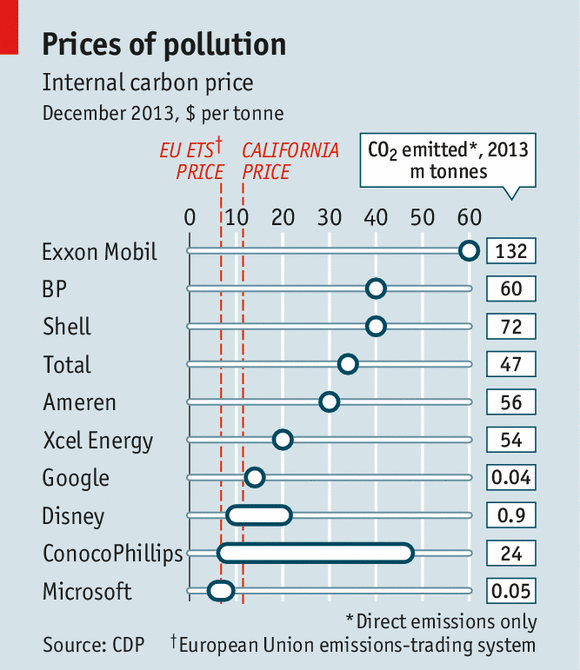
"The prices range from $6-7 a tonne of carbon dioxide at Microsoft to $60 a tonne at Exxon Mobil. … As a rule, those whose assets have a long productive life and which might be affected by green policies far into the future (such as oil companies) use higher prices than consumer-goods firms whose products are mainly influenced by current policies."
 
The companies are pushing ahead with this for two basic reasons: first, although it is hard to understand why they think so based on recent performance, firms anticipate politicians will eventually get their act together and impose a carbon price:
 
"For many companies the aim is to prepare themselves for future environmental legislation. AEP, a power supplier, says it uses the system because 'it assumes a price of carbon…will begin in the US by roughly 2020.' Delta Air Lines says it uses a price for evaluating flights to Europe 'in anticipation of compliance with EU ETS.'"
 
Second, it allows firms, such as ConocoPhillips and Disney (see: Strategic CSR – Carbon tax), to better understand the present value of future projects and investments:
 
"ConocoPhillips, an oil firm, requires that capital projects worth over $75m calculate the cost of emissions based on a price of between $8 and $46 a tonne, depending on the life of the project. The forecast value of a new oilfield would be: estimated output multiplied by the estimated future oil price minus development costs and carbon emissions. … Disney, a media conglomerate, goes further still. It invests in schemes to offset or reduce carbon emissions and charges the cost of these to business units in proportion to how much they contribute to the company's overall emissions. In effect, this works like an internal carbon tax."
 
The result of these varied approaches is a range of prices among firms. As the article notes, however, the surprising (and encouraging) thing is how high some of the prices are—much higher than any of the failing government experiments:
 
"The market price of carbon is €4.90 ($6.70) per tonne of CO2 in the EU, $11.50 in California. Big oil companies charge $34 or more. That is closer to the 'social cost of carbon'—the damage from an extra tonne of CO2—than to the market price. … the sort of carbon price some companies are using for planning would, if it became a market price, have a much bigger impact than any of the policies that governments are now talking about."
 
The graphic that accompanies the article demonstrates the extent of the differences in internal carbon price among firms:
 
 
Take care
David
 
David Chandler & Bill Werther
 
Instructor Teaching and Student Study Site: http://www.sagepub.com/chandler3e/
Strategic CSR Simulation: http://www.strategiccsrsim.com/
The library of CSR Newsletters are archived at: http://strategiccsr-sage.blogspot.com/


Carbon copy
Some firms are preparing for a carbon price that would make a big difference
December 14, 2013
The Economist
70
 

Wednesday, November 10, 2010

Strategic CSR - Airlines

The article in the url below is interesting because it takes a concept we take for granted (comparing fuel efficiency among different makes and models of cars) and applies it to an area of transportation we think less carefully about (fuel efficiency among different airlines).

In the case of cars, we measure miles per gallon. For airlines, the article argues the comparable measure is “how far one seat (occupied or not) can travel on one gallon of jet fuel”:

“And U.S. major airlines average about 64 mpg, according to calculations using Department of Transportation data for 2009. For each gallon of jet fuel, airlines could, on average, fly one seat 64 miles. That's better than your SUV or hybrid car, unless you pack lots of people into the car.”

This graphic from the article is enlightening:

http://si.wsj.net/public/resources/images/PJ-AW431_midsea_G_20100811210020.jpg


Perhaps it is not surprising that:

“The three worst major U.S. carriers for fuel efficiency happen to be the three biggest: Delta, American and United airlines. They fly the biggest planes, which aren't always more fuel efficient, and they have the oldest fleets.”

While, on the more positive side:

“Best in fuel economy: Alaska Airlines, jetBlue Airways and Continental Airlines, which all have fleets that average nine years of age or younger.”

The article also breaks down different mileages by plane make (i.e., Boeing or Airbus) and model, with the new Airbus A380 super-jumbo averaging “about 65 miles per gallon per seat.”

Take care
David

Bill Werther & David Chandler
Strategic Corporate Social Responsibility: Stakeholders in a Global Environment (2e)
© Sage Publications, 2011

Instructor Teaching Site: http://www.sagepub.com/strategiccsr/
The library of CSR Newsletters are archived at: http://strategiccsr-sage.blogspot.com/


The Middle Seat: A Prius With Wings vs. a Guzzler in the Clouds
By Scott McCartney
1221 words
12 August 2010
D1