The CSR Newsletters are a freely-available resource generated as a dynamic complement to the textbook, Strategic Corporate Social Responsibility: Sustainable Value Creation.

To sign-up to receive the CSR Newsletters regularly during the fall and spring academic semesters, e-mail author David Chandler at david.chandler@ucdenver.edu.

Showing posts with label nuclear. Show all posts

Tuesday, November 5, 2024

Strategic CSR - Electricity

The article in the url below presents some fascinating graphics about how electricity in the U.S. is made – specifically, what proportion of electricity is generated using coal, natural gas, petroleum, nuclear, wind, and solar. The article starts with the country as a whole, mapping the way electricity generation has evolved over the past two decades:

"Natural gas surpassed coal as the country's top source of power in 2016, and renewables like wind and solar have grown quickly to become major players in the U.S. power system."

The article presents this information in terms of a longitudinal graphic, from 2001 to 2023:


The article contains a similar graphic for each of the country's 50 states, and the variance among states is significant, from Nevada:

"… natural gas became the top source of electricity generation in 2005, earlier than in many other places. More recently, solar power has surged there."

… to Iowa:

"Wind has taken off … over the past two decades, beating out coal in 2019 to become the state's largest source of power generation."

… to Wyoming:

"… where coal still dominates, alternative sources of power have made steady gains."

While the shift to renewables is notable, however, fossil fuels continue to provide the source of the majority of electricity generated in the U.S.:

"[In 2023], coal was the top electricity fuel in 10 states, down from 32 states in 2001. Natural gas largely took over during that time, but wind also emerged as a leading power source across the Midwest."

Take care
David

David Chandler
© Sage Publications, 2023

Instructor Teaching and Student Study Site: https://study.sagepub.com/chandler6e  
Strategic CSR Simulation: http://www.strategiccsrsim.com/
The library of CSR Newsletters are archived at: https://strategiccsr-sage.blogspot.com/


How Does Your State Make Electricity
By Nadja Popovich
August 2, 2024
The New York Times
 

Tuesday, October 8, 2024

Strategic CSR - Three Mile Island

The article in the url below, covering the revival of Three Mile Island (the site of the worst nuclear accident in the U.S.), is interesting for a few reasons. First is that it can be revived at all – I had no idea it was only one reactor that failed – a second one is perfectly usable and had been operating up until a few years ago:

"Three Mile Island's undamaged Unit 1 reactor sits next to Unit 2, which was shut down after a partial core meltdown in 1979 led to five days of panic. The incident heightened awareness of nuclear plants' potential safety problems and contributed to a loss of enthusiasm for the industry that lasted decades. But the 835-megawatt Unit 1 continued operating and closed only under economic pressure five years ago."


The issue appears to have been the growing competitive pricing of renewable energy sources:


"Years of flat U.S. power demand had created a bruising battle for market share. Nuclear plants had a tough time competing against renewable energy and natural-gas-fired plants that tapped into a cheap source of fuel from the U.S. shale boom."


The second reason is Microsoft's creative decision to fund this revival in the form of an exclusive energy supply:


"Constellation expects to spend around $1.6 billion to restart the reactor by early 2028. Microsoft has signed a 20-year power-purchase agreement with Constellation, the companies said Friday. The deal would help Microsoft pair its 24-7 electricity use with a matching source of nearby clean power generation."


As a related story in Bloomberg noted:


"Microsoft has agreed to purchase the energy for two decades and declined to disclose financial terms. This is the first time Microsoft has secured a dedicated, 100% nuclear facility for its use."


And the third reason is what is driving the demand from Microsoft:


"A deal between Constellation Energy and Microsoft will restart Pennsylvania's Three Mile Island, the site of the country's worst nuclear power accident, to help power the tech giant's growing artificial intelligence ambitions. Under the agreement, Constellation would revive the plant's undamaged reactor, which was too costly to run and closed in 2019, and sell the power to Microsoft. The plan signals the gargantuan amount of power needed for data centers for AI, along with the tech industry's thirst for a carbon-free, round-the-clock electricity source needed to meet climate goals."


Take care

David


David Chandler

Strategic Corporate Social Responsibility: Sustainable Value Creation (6e)

© Sage Publications, 2023


Instructor Teaching and Student Study Site: https://study.sagepub.com/chandler6e  

Strategic CSR Simulation: http://www.strategiccsrsim.com/

The library of CSR Newsletters are archived at: https://strategiccsr-sage.blogspot.com/


Three Mile Island's Rebirth: Microsoft AI power Source

By Jennifer Hiller

September 21-22, 2024

The Wall Street Journal

Late Edition – Final

A1, A9

https://www.wsj.com/business/energy-oil/three-mile-islands-nuclear-plant-to-reopen-help-power-microsofts-ai-centers-aebfb3c8


Thursday, April 11, 2024

Strategic CSR - Nuclear

No doubt there is more to the story in the url below, but I was encouraged by this development:

"For the first time in more than 50 years the US granted permission for a new type of nuclear reactor, a sign regulators are becoming more open to different approaches to producing power from splitting the atom."

What is unique about this new reactor design, it appears, is the cooling technology:

"California startup Kairos Power received a construction permit from the Nuclear Regulatory Commission to build its Hermes demonstration reactor in Tennessee. While commercial reactors in use today are cooled by water, the Kairos technology uses molten fluoride salt as a coolant."

As I have noted previously (see Strategic CSR – Nuclear), there are a lot of misconceptions about nuclear energy (and subsequent resistance among environmental activists), but I have not seen any realistic future projection of sustainable energy use (and rapid transition away from fossil fuels) that does not draw on at least some nuclear energy.

Take care
David

David Chandler
© Sage Publications, 2023

Instructor Teaching and Student Study Site: https://study.sagepub.com/chandler6e 
Strategic CSR Simulation: http://www.strategiccsrsim.com/
The library of CSR Newsletters are archived at: https://strategiccsr-sage.blogspot.com/


US Approves New Kind of Nuclear Reactor for First Time in 50 Years
By Will Wade
December 13, 2023
Bloomberg
 

Tuesday, March 19, 2024

Strategic CSR – Solar

This graph from the article in the url below, for me, sums up the challenge inherent in many renewable energies:


The chart shows a single day (October 11, 2020) and plots demand for electricity in South Australia against the amount of electricity generated by solar power. Of course, this issue would not matter so much if we could adequately store solar energy and transport it over long distances. Since we haven't solved those challenges, we need to use solar energy as we create it, but that might not be when it is in most demand, as the chart demonstrates.

No doubt, the challenge of replacing fossil fuels is complicated, and involves a multi-pronged approach with multiple different energy sources (including nuclear, of course; see Strategic CSR – Nuclear). Nevertheless, I found this chart to be a powerful reminder of how complex the challenge is, and also how far we are from solving it.

Take care
David

David Chandler
© Sage Publications, 2023

Instructor Teaching and Student Study Site: https://study.sagepub.com/chandler6e 
Strategic CSR Simulation: http://www.strategiccsrsim.com/
The library of CSR Newsletters are archived at: https://strategiccsr-sage.blogspot.com/


One Last Postcard From the Future of Clean Energy
By Nathaniel Bullard
December 21, 2023
Bloomberg Green
 

Tuesday, November 14, 2023

Strategic CSR - Nuclear

If you want to understand why nuclear energy has to be a part of our collective solution to climate change, the article in the url below offers one of the most comprehensive and compelling explanations I have seen:

"Progressive lawmakers, along with environmental groups like the Sierra Club and Natural Resources Defense Council, have historically been against nuclear power — often focusing on the danger, longevity and storage requirements of the radioactive waste."

Key to the argument, you won't be surprised to hear, is removing the fearmongering and misinformation that is routinely spread about the byproduct of nuclear energy, nuclear waste:

"So it's no surprise that many Americans believe nuclear waste poses an enormous and terrifying threat. But after talking to engineers, radiation specialists and waste managers, I've come to see this misunderstanding is holding us back from embracing a powerful, clean energy source we need to tackle climate change. We must stop seeing nuclear waste as a dangerous problem and instead recognize it as a safe byproduct of carbon-free power."

First, the obvious advantages of nuclear energy (other than being carbon-free, of course):

"The countries that have cleaned up their electricity production the fastest have generally done so with hydroelectric power, nuclear, or a combination of the two. The distinct advantage of nuclear is that it requires little land and can reliably produce lots of power regardless of weather, time of day or season. Unlike wind and solar, it can substitute directly for fossil fuels without backup or storage. The International Energy Agency believes it's so crucial that global nuclear capacity must double by 2050 to reach net-zero emissions targets."

Next, overcoming the understandable (and arguably misplaced) fears about the waste, which is often presented in popular media as some fluorescent material that burns through anything it touches:

"In reality, nuclear fuel is made up of shiny metal tubes containing small pellets of uranium oxide. These tubes are gathered into bundles and loaded into the reactor. After five years of making energy, the bundles come out, containing radioactive particles left over from the energy-making reactions. The bundles cool off in a pool of water for another five to 10 years or so. After that, they are placed in steel and concrete containers for storage at the plant. These casks are designed to last 100 years and to withstand nearly anything — hurricanes, severe floods, extreme temperatures, even missile attacks."

The key takeaway:

"To date, there have been no deaths, injuries or serious environmental releases of nuclear waste in casks anywhere. And the waste can be transferred to another cask, extending storage one century at a time."

And, what about all the misinformation about the half-life of nuclear material?

"The way radiation works, the waste products that are the most radioactive are the shortest-lived, and those that last a long time are far less dangerous. About 40 years after the fuel becomes waste, the heat and radioactivity of the pellets have fallen by over 99 percent. After around 500 years, the waste would have to be broken down and inhaled or ingested to cause significant harm."

The author compares this to industrial waste that we are much less careful with, even though it tends not to lose any of its toxicity, over time:

"Take ammonia: It is highly toxic, corrosive, explosive and prone to leaking. Hundreds of ammonia-related injuries and even some fatalities have been reported since 2010, and we continue to produce and transport millions of tons of it annually by pipelines, ships and trains for fertilizer and other uses."

While there may be security reasons for storing nuclear waste in a single location, deep in the mountains, the author argues there is not much of a safety justification for doing so:

"The waste should really be a chief selling point for nuclear energy, particularly for those who care about the environment: There's not very much of it, it's easily contained, it becomes safer with time and it can be recycled. And every cask of spent nuclear fuel represents about 2.2 million tons of carbon, according to one estimate, that weren't emitted into the atmosphere from fossil fuels. For me, each cask represents hope for a safer, better future."

For interest, the NYT collected reader responses to this article, most of which appear to focus on the storage of nuclear waste, rather than rebutting the core argument (which is that the fears are greatly overblown):


The article in the second url below demonstrates the potential, via a company that has developed a technique that can be attached to existing nuclear reactors to generate hydrogen, at scale. Overall, of course, we need to proceed with caution (and there are all kinds of other issues with nuclear energy, such as how long it takes to approve and build a power station), but our options for significant carbon reduction are limited, and time is running out. Much better to be guided by facts, rather than mythical fears, in plotting the most effective way forward.

Take care
David

David Chandler
© Sage Publications, 2023

Instructor Teaching and Student Study Site: https://study.sagepub.com/chandler6e 
Strategic CSR Simulation: http://www.strategiccsrsim.com/
The library of CSR Newsletters are archived at: https://strategiccsr-sage.blogspot.com/


We're Thinking About Nuclear Waste All Wrong
By Madison Hilly
May 1, 2023
The New York Times
Late Edition – Final
A18

Billion-Dollar 'Pink Hydrogen' Plan on Hold as US Weighs Rules
By Will Wade
May 30, 2023
Bloomberg

Tuesday, April 11, 2023

Strategic CSR - Bureaucracy

The article in the url below examines how challenging it can be to build the energy infrastructure in the U.S. that is required to shift from fossil fuels to a renewable future. Of particular importance are transmission lines, so energy can be transported from those parts of the country where it is generated (often sparsely populated) to those parts of the country where it is needed (more densely populated):

"That means using the megawatts generated by Wyoming's winds to charge a Tesla in Los Angeles. But a bureaucratic thicket stands in the way. Both PacifiCorp [the biggest utility in the American West that operates a suite of wind farms in the county] and Mr Anschutz [a businessman who "wants to turn his Wyoming ranch into a sea of turbines"] have spent more than a decade trying to get high-voltage transmission lines that cross multiple states approved. TransWest Express, Anschutz Corporation's proposed line from Wyoming to the Nevada-California border, has yet to break ground."

The reason for the delay is the amount of regulation and compliance that characterizes this still-growing industry. Even though we have been saying we need to build this infrastructure for a long time now, the fact that we are still not close to realizing what is essential is extremely frustrating:

"But the process to get [clean energy projects] approved can be long, onerous and litigious. McKinsey, a consultancy, reckons it can take up to five years to get a permit for a solar farm and seven for an onshore wind farm. An ambitious timeline to build a high-voltage transmission line is at least ten years. … The Rhodium Group, a consultancy, estimates that [the Inflation Reduction Act has] the potential to cut emissions by 32-42% below 2005 levels by 2030. But a recent study … suggests that America would need to more than double its average pace of transmission expansion over the last decade to realise that goal."

And, this is not even considering technologies like "nuclear power and carbon capture" (which can achieve faster gains in emissions reductions more efficiently) that also exist in highly regulated industries that often generate local resistance:

"Legal challenges often revolve around threats to endangered species. In Wyoming, environmentalists worry that wind farms and transmission lines will harm sage-grouse habitat. Native American tribes sue to stop officials from approving energy projects on land sacred to them. A recent study … identified 53 big wind, solar and geothermal projects that were delayed or blocked between 2008 and 2021. A third of them faced permitting difficulties. [Environmental legal] challenges make up the largest proportion of federal climate-change litigation in America."

And, all the delays increase costs:

"PacifiCorp originally budgeted about $1.3bn for a transmission line from Wyoming to Utah. Some 15 years later, the cost has climbed to $1.9bn. For new nuclear plants, which are extremely capital-intensive, delay can mean death."

So, we face a choice – which "endangered species" are we willing to place under greater threat? If we don't move more quickly, it is hard not to conclude that the species under the greatest threat will be our own. We have delayed so long that it seems we have left it too late for the low-hanging fruit, and no longer have any easy choices left. As a result, we need to decide which of the least worst options is the most palatable. Whatever happens, we are going to be unlikely to please all of the people (and sage-grouse) all of the time.

Take care
David

David Chandler
© Sage Publications, 2023

Instructor Teaching and Student Study Site: https://study.sagepub.com/chandler6e 
Strategic CSR Simulation: http://www.strategiccsrsim.com/
The library of CSR Newsletters are archived at: https://strategiccsr-sage.blogspot.com/


Green v green
February 4, 2023
The Economist
Late Edition – Final
21-23
 

Monday, October 14, 2019

Strategic CSR - Nuclear

What is "the fastest way to slash greenhouse gas emissions" while providing sufficient energy for the world as it continues to seek higher living standards? The article in the url below thinks it has the answer – one that is controversial within the sustainability community:
 
"Where will this gargantuan amount of carbon-free energy come from? The popular answer is renewables alone, but this is a fantasy. Wind and solar power are becoming cheaper, but they are not available around the clock, rain or shine, and batteries that could power entire cities for days or weeks show no sign of materializing any time soon. Today, renewables work only with fossil-fuel backup."
 
In dismissing renewable sources of energy as simply not being able to scale sufficiently quickly, the authors present Germany as their case in point:
 
"Germany, which went all-in for renewables, has seen little reduction in carbon emissions, and, according to our calculations, at Germany's rate of adding clean energy relative to gross domestic product, it would take the world more than a century to decarbonize, even if the country wasn't also retiring nuclear plants early."
 
In contrast, the authors suggest relying on a proven energy source that has data to suggest it can make the conversion in a much quicker time:
 
"… we actually have proven models for rapid decarbonization with economic and energy growth: France and Sweden. They decarbonized their grids decades ago and now emit less than a tenth of the world average of carbon dioxide per kilowatt-hour. They remain among the world's most pleasant places to live and enjoy much cheaper electricity than Germany to boot."
 
Specifically:
 
"They did this with nuclear power. And they did it fast, taking advantage of nuclear power's intense concentration of energy per pound of fuel. France replaced almost all of its fossil-fueled electricity with nuclear power nationwide in just 15 years; Sweden, in about 20 years. In fact, most of the fastest additions of clean electricity historically are countries rolling out nuclear power."
 
Of course, there remain issues with nuclear power stations (construction time and waste management) but, primarily, these barriers are presented as political, rather than technical. As with many of the problems we face, we have the knowledge to do much better but the willpower is lacking.
 
Take care
David
 
David Chandler
© Sage Publications, 2020
 
Instructor Teaching and Student Study Site: http://studysites.sagepub.comstudy.sagepub.com/chandler5e 
Strategic CSR Simulation: http://www.strategiccsrsim.com/
The library of CSR Newsletters are archived at: https://strategiccsr-sage.blogspot.com/


Nuclear Power Can Save the World
By Joshua S. Goldstein, Stefan A. Qvist & Steven Pinker
April 7, 2019
The New York Times
Late Edition – Final
SR4
 

Tuesday, February 19, 2019

Strategic CSR - Green New Deal

The recently announced Green New Deal (GND), fronted most publicly by Alexandria Ocasio-Cortez (the new congresswoman from New York), is receiving a lot of attention in the media. As The Economist puts it in the article in the first url below, the proposal is both popular and controversial, having "been met with surprising enthusiasm in Washington." In more substantive (i.e., non-political) circles, however, the GND has been received less enthusiastically. The theme that seems to unite the skeptical commentaries I have read is the accusation that the proponents of the GND misunderstand the fundamental nature of the problem and, as such, have responded with an ineffective solution. In short, if the goal is to tackle climate change, then the GND is unlikely to be successful. Rather than seeing climate change as a "straightforward … market failure" that can be fixed through pricing (i.e., including the externalized costs of carbon into the price we pay to consume it), the GND instead sees climate change as a social problem that must be fixed through government intervention. Given the nature of the proposed intervention (in particular, the scale), skeptics expect numerous unintended consequences:
 
"… the Green New Deal largely dispenses with analysis of the costs and benefits of climate policy. It would create large opportunities for rent-seeking and protectionism, with no guarantee that the promised climate benefits will follow. It might chuck growth-throttling tax rises and dangerously high deficits into the bargain as well."
 
You can read about the GND here. Suffice it to say, it proposes a substantial increase in government involvement in the economy, at the expense of market forces. David Brooks tackles the topic in the article in the second url below, highlighting the massive reorganization of government responsibility:
 
"[The GND] would definitely represent the greatest centralization of power in the hands of the Washington elite in our history. … Under the Green New Deal, the government would provide a job to any person who wanted one. The government would oversee the renovation of every building in America. The government would put sector after sector under partial or complete federal control: the energy sector, the transportation system, the farm economy, capital markets, the health care system."
 
Unfortunately, as he notes, the proposal is both lacking in detail ("Exactly which agency would inspect and oversee the renovation of every building in America? Exactly which agency would hire every worker?") and is highly implausible. After all, "This is from people who couldn't even organize the successful release of their own background document":
 
"The authors of this fantasy are right that we need to do something about global warming and inequality. But simple attempts to realign incentives, like the carbon tax, would be more effective and more realistic than government efforts to reorganize vast industries."
 
Ultimately, Brooks concludes that the consequence of greatly expanding the role of government in society is that it just replaces one elite (capitalists) with another elite (politicians). And it is not clear that a political elite would generate better outcomes than a capitalist elite:
 
"But the underlying faith of the Green New Deal is a faith in the guiding wisdom of the political elite. The authors of the Green New Deal assume that technocratic planners can master the movements of 328 million Americans. … They assume that congressional leaders have the ability to direct what in effect would be gigantic energy firms and gigantic investment houses without giving sweetheart deals to vested interests, without getting corrupted by this newfound power, without letting the whole thing get swallowed up by incompetence. (This is a Congress that can't pass a budget.)"
 
Unfortunately, if we are looking for the efficient (and, for that matter, fair and ethical) allocation of resources, the empirics side with the market. Recent corruptions have produced the distorted outcomes that many are justifiably angry about. But, the solution is to eradicate the corruptions; not to get rid of the whole system and replace it with something that has been proven to be less effective. Any proposed solutions have to grapple with this complexity, rather than resort to unrealistic ideals. This brings me to the article in the third url below, which reviews a recently published book on climate change and brings a little more realism to the debate. In short, it relates how complicated it is for a society to shift from one dominant energy source to another:
 
"Some years ago, while studying how societies transitioned from one energy source to another over the past 200 years, the Italian physicist Cesare Marchetti and his colleagues discovered a hard truth: It takes almost a century for a new source of primary energy — coal, petroleum, natural gas, nuclear power — to command half the world market. Just to grow to 10 percent from 1 percent takes almost 50 years."
 
Rather than technology, the main barrier to progress is usually related logistics and infrastructure:
 
"You would expect suppliers to switch quickly to a better (more abundant, cheaper, cleaner) source. But infrastructure has to catch up: In America, natural gas needed long-distance pipelines to go national; electric cars need still-scarce charging stations. People have to adapt: Elizabethan preachers condemned coal as literally the Devil's excrement; some Victorian homeowners comfortable with gaslight thought Edison's light bulbs too bright. Competition from heavily invested older sources has to be overcome, as with fossil fuels today. These and other changes take time."
 
As the article continues, we do not have that much time to switch to a non-carbon-based energy. While the GND is important in terms of raising awareness, therefore, it does little to demonstrate an appreciation of the scale of the problem we face. It also fails to grapple with the realities of any necessary changes, such as which energy sources can possibly provide the supply we need in the available time-frame. To the authors of the book being reviewed, there is only one answer (logically and technically)—one that many environmentalists will find unacceptable:
 
"… worldwide energy consumption 30 years from now is projected to be about 50 percent higher than it is today. If that number sounds exaggerated, think of four billion Asians installing air-conditioning. For [the authors], the only possible solution to this double dilemma is a rapid, worldwide expansion of nuclear power. No other source or collection of sources of energy, they argue, is positioned to meet these challenges in time."
 
I am not sure how that would be possible (since nuclear power stations take time to build, largely because they are subject to political oversight) but, from everything I have read, there is no escaping the fact that nuclear has to be a big part of the solution. However, you won't find this sort of nuance in the GND.
 
Take care
David
 
 
Instructor Teaching and Student Study Site: https://study.sagepub.com/chandler4e
Strategic CSR Simulation: http://www.strategiccsrsim.com/
The library of CSR Newsletters are archived at: https://strategiccsr-sage.blogspot.com/


Brave new deal
February 9, 2019
The Economist
How the Left Embraced Elitism
By David Brooks
February 12, 2019
The New York Times

Nuclear Option
By Richard Rhodes
February 10, 2019
The New York Times Book Review
 

Tuesday, March 21, 2017

Strategic CSR - Nuclear

The article in the url below highlights the limits of our knowledge regarding renewable energies:
 
"The United States, and indeed the world, would do well to reconsider the promise and the limitations of its infatuation with renewable energy."
 
In particular, the issue is the reliability of renewables (e.g., solar is less productive in cloudy conditions), combined with our constrained ability to store and transfer that energy (wind energy, in particular, is difficult to transmit, meaning only windy places can generate wind energy). Although our knowledge and capabilities are improving at a rapid rate, our rush to bring renewable energy sources on-line is having repercussions throughout the network as a whole:
 
"Renewable sources are producing temporary power gluts from Australia to California, driving out other energy sources that are still necessary to maintain a stable supply of power."
 
In essence, the rapid expansion of renewable energies is a result of the success of the public policies (and subsidies) that were passed in an effort to reduce our dependence on carbon-based energy. The author suggests that these policies have been too successful. Of particular concern is the effect these constraints are having on the one renewable source that we know well:
 
"But in what may be the most worrisome development in the combat against climate change, renewables are helping to push nuclear power, the main source of zero-carbon electricity in the United States, into bankruptcy."
 
In response, the article calls for approaches that are "more subtle" than simply loading up on more and more renewable energy projects. And it is the public subsidies that are the cause of much of the trouble – a too rapid shift from known technologies to relatively unknown technologies. Although the market for nuclear energy has its own problems, its price per megawatt hour is continually being undercut either by subsidies or the failure to incorporate the full costs of an energy into the price (i.e., a carbon tax). Both forms of support distort the markets for specific energy sources:
 
"Nuclear generators' troubles highlight the unintended consequences of brute force policies to push more and more renewable energy onto the grid. These policies do more than endanger the nuclear industry. They could set back the entire effort against climate change."

California is offered as a case-in-point:
 
"As more and more solar capacity is fed onto the grid, it will displace alternatives. An extra watt from the sun costs nothing. But the sun doesn't shine equally at all times. Around noon, when it is blazing, there will be little need for energy from nuclear reactors, or even from gas or coal. At 7 p.m., when people get home from work and turn on their appliances, the sun will no longer be so hot. Ramping up alternative sources then will be indispensable. The problem is that nuclear reactors, and even gas- and coal-fired generators, can't switch themselves on and off on a dime. So what happens is that around the middle of the day those generators have to pay the grid to take their power. Unsurprisingly, this erodes nukes' profitability. It might even nudge them out of the system altogether."
 
Ultimately, the very real cost of integrating renewable energy sources into our utilities system has yet to be adequately accounted for:
 
"In Germany, where renewables have mostly replaced nuclear power, carbon emissions are rising, even as Germans pay the most expensive electricity rates in Europe. In South Australia, the all-wind strategy is taking its toll. And in California, the costs of renewables are also apparent."
 
At a minimum, it is worth making sure we know what we are getting with renewables before we shut-down the known problems of nuclear energy altogether:
 
"Displacing nuclear energy clearly makes the battle against climate change more difficult. But that is not what is most worrying. What if the world eventually discovers that renewables can't do the job alone?"
 
Once we get rid of the nuclear energy industry, we will not have the time or resources to bring it back.
 
Take care
David
 
 
Instructor Teaching and Student Study Site: https://study.sagepub.com/chandler4e
Strategic CSR Simulation: http://www.strategiccsrsim.com/
The library of CSR Newsletters are archived at: https://strategiccsr-sage.blogspot.com/


Embrace of Renewables Has a Hidden Cost
By Eduardo Porter
July 20, 2016
The New York Times
Late Edition – Final
B1
 

Monday, May 2, 2016

Strategic CSR - Ideological bias

The article in the url below explores an interesting question:
 
"Are liberals impairing our ability to combat climate change?"
 
The premise for the question is that everyone has biases, we are just selective in favoring those sources of information that match our particular biases. In other words, we support something when it complements our view of the world and find ways to undermine it when it challenges that view. For example, the widespread belief today (particularly among the left) is that conservatives pose the largest impediment to progress on climate change because they are 'anti-science.' This article suggests that, contrary to this view, there is anti-science bias all along the political spectrum:
 
"… even as progressive environmentalists wring their hands at the G.O.P.'s climate change denial, there are biases on the left that stray just as far from the scientific consensus. 'The left is turning anti-science,' Marc Andreessen, the creator of Netscape who as a venture capitalist has become one of the most prominent thinkers of Silicon Valley, told me not long ago. He was reflecting broadly about science and technology. His concerns ranged from liberals' fear of genetically modified organisms to their mistrust of technology's displacement of workers in some industries."
 
Further, the article suggests that it is in relation to the environment that liberal bias is particularly damaging:
 
"For starters, [liberals] stand against the only technology with an established track record of generating electricity at scale while emitting virtually no greenhouse gases: nuclear power. Only 35 percent of Democrats, compared with 60 percent of Republicans, favor building more nuclear power plants, according to a poll by the Pew Research Center. It is the G.O.P. that is closer to the scientific consensus. According to a separate Pew poll of members of the American Association for the Advancement of Science, 65 percent of scientists want more nuclear power too."
 
To put it more bluntly in relation to the current U.S. presidential campaign:
 
"Ted Cruz's argument that climate change is a hoax to justify a government takeover of the world is absurd. But Bernie Sanders's argument that 'toxic waste byproducts of nuclear plants are not worth the risks of the technology's benefit' might also be damaging."
 
And it is not difficult to demonstrate the extent to which people are selective in their appreciation of science. In short, it is not that people are ignorant or unexposed to scientific discoveries, but that they simply refuse to believe them because they conflict with their larger ideological perspective:
 
"People on the right tend to like private businesses, which they see as productive job creators. They mistrust government. It's not surprising they will play down climate change when it seems to imply a package of policies that curb the actions of the former and give a bigger role to the latter. On the left, by contrast, people tend to mistrust corporations — especially big ones — as corrupt and destructive. These are the institutions bringing us both nuclear power and genetically modified agriculture."
 
Take care
David
 
 
Instructor Teaching and Student Study Site: https://study.sagepub.com/chandler4e
Strategic CSR Simulation: http://www.strategiccsrsim.com/
The library of CSR Newsletters are archived at: http://strategiccsr-sage.blogspot.com/
 
 
Climate Change Bias, But on Both Sides
By Eduardo Porter
April 20, 2016
The New York Times
Late Edition – Final
B1
 

Tuesday, November 11, 2014

Strategic CSR - Alternative energy

The article in the url below presents a fascinating breakdown of the costs (and relative efficiencies) of different energy sources. In doing so, it makes a compelling argument that government subsidies are hurting as much, if not more, than they are helping us transition away from fossil fuels:
 
"Billions are spent nursing the infant solar- and wind-power industries in the hope that they will one day undercut fossil fuels and drastically reduce the amount of carbon dioxide being put into the atmosphere."
 
On the face of it, government subsidies are working:
 
"Photovoltaic panels have halved in price since 2008 and the capital cost of a solar-power plant—of which panels account for slightly under half—fell by 22% in 2010-13. In a few sunny places, solar power is providing electricity to the grid as cheaply as conventional coal- or gas-fired power plants."
 
In reality, however, they are encouraging the most inefficient alternative energies—wind and solar:
 
"… whereas the cost of a solar panel is easy to calculate, the cost of electricity is harder to assess. It depends not only on the fuel used, but also on the cost of capital (power plants take years to build and last for decades), how much of the time a plant operates, and whether it generates power at times of peak demand. To take account of all this, economists use "levelised costs"—the net present value of all costs (capital and operating) of a generating unit over its life cycle, divided by the number of megawatt-hours of electricity it is expected to supply."
 
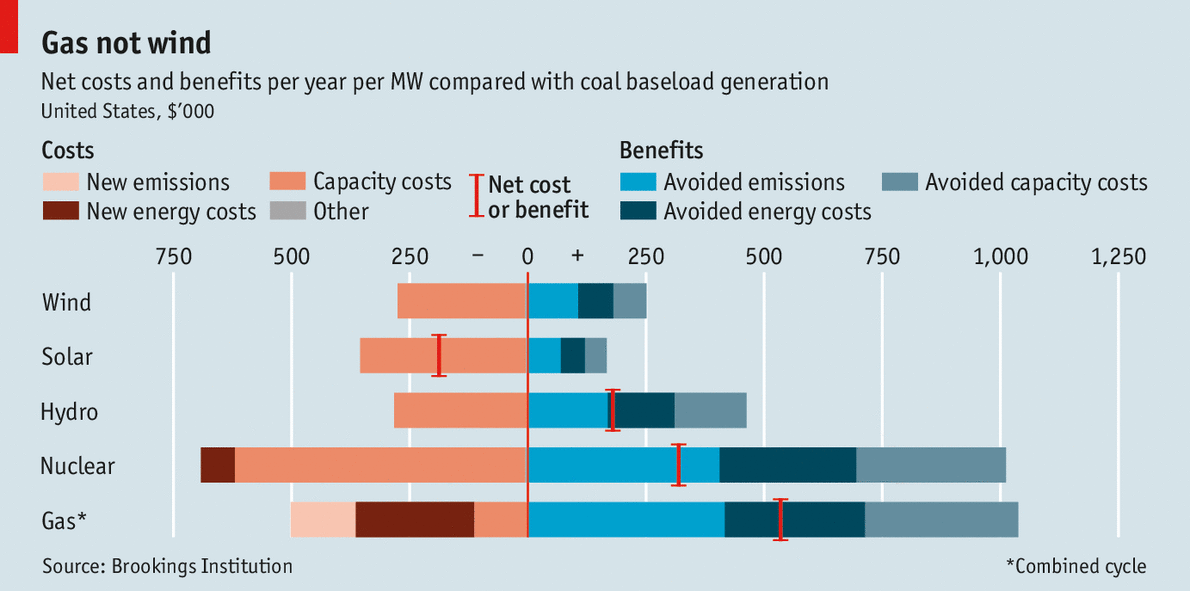
What the government should be doing is helping set a penalty for burning carbon (via a carbon tax) and then allowing the market to determine which alternative energy source provides the greatest overall benefit. When you consider all the costs involved in generating the energy (such as transporting it to where it is needed) and all the potential benefits (such as emissions avoided), the graphic that accompanies the article makes it clear that natural gas is the most cost effective alternative currently known to humanity, while nuclear is the most effective zero emissions energy source:
 
 
Specifically:
 
"If all the costs and benefits are totted up … solar power is by far the most expensive way of reducing carbon emissions. It costs $189,000 to replace 1MW per year of power from coal. Wind is the next most expensive. Hydropower provides a modest net benefit. But the most cost-effective zero-emission technology is nuclear power. The pattern is similar if 1MW of gas-fired capacity is displaced instead of coal. And all this assumes a carbon price of $50 a tonne. Using actual carbon prices (below $10 in Europe) makes solar and wind look even worse. The carbon price would have to rise to $185 a tonne before solar power shows a net benefit."
 
Emissions of carbon dioxide should not be the only criteria on which an energy source is chosen (as the article notes), but the article does make clear that our current understanding of these issues is limited and is certainly not at a level where the government should be picking winners and losers via misguided subsidies.
 
Take care
David
 
David Chandler & Bill Werther
 
Instructor Teaching and Student Study Site: http://www.sagepub.com/chandler3e/
Strategic CSR Simulation: http://www.strategiccsrsim.com/
The library of CSR Newsletters are archived at: http://strategiccsr-sage.blogspot.com/
 
 
Sun, wind and drain
July 26, 2014
The Economist
63
 

Wednesday, October 1, 2014

Strategic CSR - Fracking

Recently, there has been a lot of media coverage emphasizing the environmental benefits of fracking, in general, and the fracking of natural gas, in particular. The article in the url below, for example, notes that, because supply of natural gas has increased exponentially, prices have dropped to the point where it makes economic sense to burn gas instead of coal, which reduces carbon emissions:
 
"Coal generation peaked in 2007 at a little over two billion megawatt hours while in 2013 it dropped to 1.58 billion, according to the Energy Information Administration. (A megawatt-hour, or 1,000 kilowatt-hours, is the amount of electricity a typical suburban house uses in a month.) Over the same time, gas generation started at 857 million megawatt-hours and ended at 1.2 billion. If all the increase in gas-fired generation replaced coal, then the switch produced savings of 113.1 million tons of carbon a year."
 
This is good. Unfortunately, these same economic principles apply to any energy source that is more expensive than gas. As such, cheap natural gas is replacing nuclear energy ("zero carbon footprint") and, more worryingly, other non-fossil fuel sources, such as wind:
 
"Wind contributes only slightly to generation capacity needs, but whenever it runs, it saves fuel, mostly natural gas, and that gas is now worth about half of what it was a decade ago."
 
In addition, one of the main products of fracking for oil is natural gas. And, in places where there are no pipelines to take the gas away, it is flared:
 
"According to the Energy Information Administration, last year the producers flared enough gas to have produced 27 million megawatt-hours. That pushed emissions up by 16.5 million tons, about 15 percent as much as the reduction in coal burning saved. And some of the natural gas escapes unburned. Its main component, methane, is a global warming gas and is far more powerful than carbon dioxide, although it does not persist quite as long in the atmosphere. … from 2007 to 2013, the increase in gas consumption added methane with a carbon dioxide equivalent of about 19 million tons."
 
The quote in the article that stuck out most for me, however, concerned the long-term effects of cheap natural gas on any hope of limiting our carbon emissions into the atmosphere:
 
"The problem, said Michael Greenstone, a professor of environmental economics at M.I.T., is that while zero-carbon technologies have advanced significantly in the last 10 years, 'over the same period, there have been practically unimaginable advances in fossil fuels.' Limiting carbon emissions will most likely mean resolving to leave cheap fossil fuels in the ground, he said. Almost nothing valuable is left undrilled or unmined, he said. 'The history of leaving $100 bills buried in the ground is really a short one,' he said."
 
Past experience suggests we are not willing to sacrifice short-term economic profit for long-term environmental security.
 
Take care
David
 
David Chandler & Bill Werther
 
Instructor Teaching and Student Study Site: http://www.sagepub.com/chandler3e/
Strategic CSR Simulation: http://www.strategiccsrsim.com/
The library of CSR Newsletters are archived at: http://strategiccsr-sage.blogspot.com/
 
 
The Potential Downside of Natural Gas
By Matthew L. Wald
June 4, 2014
The New York Times
Late Edition – Final
B3
 

Friday, August 26, 2011

Strategic CSR - Japan

The article in the url below contains one of the more amazing facts from the aftermath of the Japanese earthquake, tsunami, and nuclear power disaster that occurred earlier this year:

Japanese citizens, long renowned for their diligence in returning lost items, have turned in more than $78 million in cash, most of it from lost wallets that washed ashore and some of it from safes found under rubble, in the aftermath of the devastating March earthquake and tsunami.

I have often thought that a good indicator of the strength of a society is how quickly it breaks down under stress. When you think about what happened in New Orleans after Katrina and the recent riots and looting in the UK, it is a phenomenal comment on Japanese society that it remained so strong when so much was thrown at it.

I lived and worked in Japan for six years and know that there are significant disadvantages as well as advantages to such strong social rules and norms. I am enormously proud of my ties to Japan, however, when the advantages are on display as an inspiration to other societies greatly in need of a little more structure and discipline.

Have a good weekend.
David

Monday, March 8, 2010

Strategic CSR - Climate Change

The article in the url below argues that, while those who take a stand against the science behind climate change risk their credibility, those who believe the current paradigm will result in substantive change are also “in denial”:

“The first UN agreement on climate change was struck in Rio back in 1992. But in the intervening years, the rate of CO emissions has risen steadily.”

There is a good argument to be made that economic development in the West got us into this mess and, as a result, the West carriers a higher burden to sort it out:

“The Indians and Chinese point out that the vast bulk of the CO already in the atmosphere has been put there by the industrialised countries of the west. China is now probably the largest emitter of CO in the world. But, on a per capita basis, emissions in China are still well below western levels. Why, ask the Indians and Chinese, should Americans and Europeans assume the right to continue using energy at levels that they seek to deny to poorer countries? It is a fair question.”

The odds of that happening any time soon, however, are not great:

“The proposed deal is that rich countries essentially bribe poorer countries to cut emissions and adopt cleaner technologies. China has proposed that developed nations should all agree to contribute 1 per cent of gross domestic product to help poorer nations fight global warming. Now imagine that you are Mr Obama trying to sell a deal like that back home.”

The numbers involved in enacting the level of change necessary are staggering:

“As Oliver Morton, the science writer, points out - "Building two terawatts of nuclear capacity by 2050 - enough to supply 10 per cent of the total carbon-free energy that's needed - means building a large nuclear power station every week; the current worldwide rate is about five a year. A single terawatt of wind - 5 per cent of the overall requirement - requires about 4m large turbines."”

Take care
David

Bill Werther & David Chandler
Strategic Corporate Social Responsibility
© Sage Publications, 2006
http://www.sagepub.com/Werther/


Climate activists are also in denial
By Gideon Rachman
941 words
28 July 2009
Financial Times
Asia Ed1
07

http://www.ft.com/cms/s/0/37c9c748-7adf-11de-8c34-00144feabdc0,s01=1.html
or
http://www.salaam.co.uk/news/displaynews.php?news_id=255946