The CSR Newsletters are a freely-available resource generated as a dynamic complement to the textbook, Strategic Corporate Social Responsibility: Sustainable Value Creation.

To sign-up to receive the CSR Newsletters regularly during the fall and spring academic semesters, e-mail author David Chandler at david.chandler@ucdenver.edu.

Showing posts with label agribusiness. Show all posts

Tuesday, October 7, 2025

Strategic CSR - Meat

The article in the url below presents an interesting discussion around the environmental impact of our collective diet. In particular, it focuses on the impact of eating as much meat as we do:

"Food systems account for about a third of global greenhouse gas emissions, driven largely by animal farming, which is a major source of methane and a drain on land and water resources. Even if the world transitions away from fossil fuels, food alone could push temperatures past the 1.5°C threshold needed to limit warming. The onus falls disproportionately on the wealthy: The richest 30% of the world's population are responsible for more than 70% of food-related pressures."

And this says nothing of the negative health impacts to us, individually. But, it is challenging to see how this turns around any time soon, especially with this statistic about the number of cows in the world (see also Strategic CSR – Chickens):

"1.5 billion: The number of cows on the planet. Nearly 60% of agriculture's greenhouse gas emissions come from animal-based products, with cows among the biggest culprits."

Take care
David

David Chandler
© Sage Publications, 2023

Instructor Teaching and Student Study Site: https://study.sagepub.com/chandler6e  
Strategic CSR Simulation: http://www.strategiccsrsim.com/
The library of CSR Newsletters are archived at: https://strategiccsr-sage.blogspot.com/


Dinner without a side of global warming
By Agnieszka de Sousa
October 2, 2025
Bloomberg
 

Thursday, January 23, 2025

Strategic CSR - Cows


Welcome back to the Strategic CSR Newsletter!
The first newsletter of the Spring semester is below.
As always, your comments and ideas are welcome.
 

This statistic blew my mind when I read it in the article in the url below:

"The average dairy cow in America produces 30 litres of milk a day; a cow in Africa, only 1.6."

Such a disparity speaks volumes, in my mind, of the power of the market to deliver societal progress. As the article continues:

"This 19-fold difference—call it the dairy divide—has enormous consequences. Closing even some of it would ease poverty, help children grow up better nourished, reduce emissions of greenhouse gases and perhaps even make civil wars less likely."

Take care
David

David Chandler
© Sage Publications, 2023

Instructor Teaching and Student Study Site: https://study.sagepub.com/chandler6e  
Strategic CSR Simulation: http://www.strategiccsrsim.com/
The library of CSR Newsletters are archived at: https://strategiccsr-sage.blogspot.com/


Bridging the dairy divide
December 14, 2024
The Economist
Late Edition – Final
50
 

Monday, November 18, 2024

Strategic CSR - Trees

The article in the url below reports on an encouraging application of science by a U.S.-based nonprofit (World Forest ID) to solve a specific supply chain challenge:

"Scientists are embarking on an effort to keep sanctioned Russian timber out of Europe by mapping the unique chemical fingerprints of trees, a process that could be used to vet corporate supply chains for other banned commodities."

In this case, the technology was used to enforce economic sanctions, but it is a small step to imagine how it could be used to verify the source of other rare and/or protected raw materials:

"The project aims to bring science to bear in a fight by companies and governments to stop illegal wood from seeping into timber supply chains—complex, difficult-to-police networks of logging companies, sawmills, wood manufacturers and traders."

It is encouraging to see that some companies see the potential application:

"Although work on the database is ongoing, furniture giant IKEA has already used it to vet suppliers for sanctioned timber after the war forced it to revamp its supply chain. Belgian authorities have also employed it to seize more than 260 tons of illegally shipped Russian timber."

And, the potential seems clear:

"If scaled up, the project could have broad implications for how companies source a range of other agricultural commodities, such as cotton and cacao, which have been linked to environmental and human rights abuses."

The science, with the aid of artificial intelligence, is logical in its approach:

"World Forest ID currently uses two tests to identify the chemical composition of wood samples. One measures the ratios of stable isotopes, which vary based on factors such as rainfall or temperature. The other test measures trace elements such as magnesium and copper, which vary based on the soils in which trees grow."

The results are encouraging:

"World Forest ID's model identified false origin claims in 40% to 60% of cases. … [Victor Deklerck, World Forest ID's head of science] said the test was designed to be conservative to minimize the chance of incorrectly identifying shipments as illegal."

Take care
David

David Chandler
© Sage Publications, 2023

Instructor Teaching and Student Study Site: https://study.sagepub.com/chandler6e 
Strategic CSR Simulation: http://www.strategiccsrsim.com/
The library of CSR Newsletters are archived at: https://strategiccsr-sage.blogspot.com/


Science Used to Police Banned Russia Timber
By Dylan Tokar
June 11, 2024
The Wall Street Journal
Late Edition – Final
B1, B4
 

Tuesday, March 15, 2022

Strategic CSR - Meat

An issue that has long been frustrating with the U.S.-centric model of capitalism is the declining level of competition within industries. Less competition today has been caused by antitrust regulators failing to enforce antitrust regulations over decades. In the face of this concentration, how do we begin to turn back the tide? The article in the url below tackles that question in the context of the meatpacking industry, where competition is woefully lacking:

"Corporate concentration is a growing problem across the economy, but meatpacking is especially afflicted. Four companies produce more than 80 percent of the nation's beef, and their dominance has come at the expense of cattle farmers, meatpacking workers and American consumers, who eat an average of 55 pounds of beef each year."

In response, a single cattle farmer (Chad Tentinger) is attempting to rally a number of small farmers to build their own meatpacking facility. The challenge is that, while the potential payoff is large, the effort requires a sizeable investment, at considerable risk to the individual farmers:

"The price tag for the plant is $450 million, about a third of which Mr. Tentinger hopes to raise from other farmers. He says he'll start building this spring with or without federal support, but government subsidies, in the form of grants, low-cost loans or loan guarantees, would improve the chances of survival."

The project is also challenging in ways that are not simply financial:

"It won't be quick … Mr. Tentinger doesn't plan to open his meatpacking operation until 2024. It also won't be easy. The government still needs to tighten regulation of existing producers, not least to prevent the big firms from buying up new meatpackers or pushing them out of business. And the Biden administration's approach is less likely to find a foothold in the chicken and pork industries, where corporate concentration has left fewer independent farmers."

Among the attempts to make the possible facility more friendly for farmers and workers, there are a number of innovations being considered. What caught my eye is that:

"Mr. Tentinger's company, Cattlemen's Heritage, aims to process about 400,000 head of cattle per year, or roughly 1 percent of the nation's beef. It's not the volume that makes the plant so intriguing — it's the business model. The company is offering a better financial deal to farmers, and if it succeeds, it's not hard to imagine other groups of farmers organizing to build more plants. (Indeed, a group in Nebraska already is working to build a similar plant.) Mr. Tentinger also is offering a better deal to workers. He chose Council Bluffs in the hopes of wooing workers from meatpacking plants across the river in Omaha with the promise of higher wages and better working conditions, including on-site day care. Consumers could benefit too. If productivity rises, prices could fall."

The project requires the vision to see past the upfront costs and hassle associated with innovation and through to the other side to a better meat processing industry. And it is better simply because it would make the industry that much more competitive.

Take care
David

David Chandler
© Sage Publications, 2020

Instructor Teaching and Student Study Site: https://study.sagepub.com/chandler5e 
Strategic CSR Simulation: http://www.strategiccsrsim.com/
The library of CSR Newsletters are archived at: https://strategiccsr-sage.blogspot.com/


Building a Better Meatpacking Industry
By Binyamin Appelbaum
January 16, 2022
The New York Times
Late Edition – Final
SR8
 

Tuesday, April 27, 2021

Strategic CSR - Food

The article in the url below is a review of a recently published book that seeks to highlight the state of the food that we eat:

"America's eating habits have changed radically over the past 40 years. We consume more and more food of less and less nutritional value. The nation's adult obesity rate is now 42.4%."

One of the reasons this shift toward unhealthy eating has occurred, the author argues, is demographic (many more two-parent working households, leaving less time to cook), while another is technological:

"The microwave oven gave birth to an industry of highly processed foods larded with fats and oils."

Rather than preparing foods that the industry knows we like or might be healthy, however, the author of the book proposes a more cynical explanation of how we got to where we are:

"In Hooked, Michael Moss, a Pulitzer Prize-winning journalist and the author of Salt Sugar Fat (2013), [asks:] What if the foods we're scarfing down have been designed and marketed to become addictive?"

In essence, Moss argues that food is more addictive than other substances we consume, such as tobacco or even hard drugs, because of the way that it enters our bodies:

"Mr. Moss notes that, while it takes 10 seconds for the brain to feel the effects of cigarettes, sugar's effects are felt 20 times faster—and salt and fat don't take much longer than that. The disparity stems from nicotine needing to enter the bloodstream to reach the brain, while sugar and salt take a shortcut through the taste buds. But the tongue is outmatched by the nose when it comes to driving our eating decisions. While there are 10,000 taste buds, there are 10 million olfactory receptors, and they can detect hundreds of scents."

While food itself can be addictive, the processed products that are manufactured by the modern-day food industry are designed specifically to prey on these weaknesses. The industry achieves this by featuring heavily those substances that are the most addictive (i.e., salt, sugar, and fat) in combinations that are most effective and, as a result, have become everyday staples:

"Those foods are the highly processed and sweetened concoctions that dominate the American diet: cereals, sodas, fruit juices, cookies, packaged meats, as well as the many condiments (like salad dressings and pasta sauces) that are packed with sodium and sugar. Consuming these items delivers intense and immediate pleasure and creates a need that fits Mr. Moss's broad definition of addiction."

Crucially, however, the author argues that this is a deliberate approach, rather than something that has simply happened over time:

"Mr. Moss argues that the industry's growth has been enabled by its 'manipulation of our instinctual desires,' not least through marketing and sales strategies. He describes companies super-sizing their products (such as the 'Double Stuf' Oreo) and creating packaging that can remain upright (thus easing consumption while, say, driving). One byproduct of these strategies, observes Mr. Moss, is that snacks—often processed products high in convenience but low in nutritional value—now account for about 25% of daily calorie consumption. Social norms have adjusted themselves accordingly: It has become 'socially acceptable to eat anything, anywhere, anytime,' Mr. Moss writes."

And, in a nice twist of irony, having created the problem of obesity, the same food companies then seek to capitalize on the guilt associated with the overconsumption of their products:

"Mr. Moss notes that as nutrition-less eating expanded our waistlines, food companies acquired low-calorie food lines (like Lean Cuisine) and diet franchises (such as Weight Watchers). It's as if 'Philip Morris had cornered the market on nicotine patches,' he writes. He says that food companies lobby to keep nutrition labels practically meaningless to most Americans."

Take care
David

David Chandler
© Sage Publications, 2020

Instructor Teaching and Student Study Site: https://study.sagepub.com/chandler5e 
Strategic CSR Simulation: http://www.strategiccsrsim.com/
The library of CSR Newsletters are archived at: https://strategiccsr-sage.blogspot.com/


Lured into Gluttony
By Matthew Rees
March 12, 2021
The Wall Street Journal
Late Edition – Final
A13

Thursday, April 9, 2020

Strategic CSR - Farming subsidies

The article in the url below summarizes a report by the Food and Land Use Coalition (https://www.foodandlandusecoalition.org/), which demonstrates the scale of the market distortions currently being distributed by governments in the agricultural sector:
 
"The public [worldwide] is providing more than $1m per minute in global farm subsidies."
 
What is worse is that almost none of these subsidies are promoting sustainable production processes. On the contrary, they are encouraging extremely damaging practices:

"Just 1% of the $700bn (£560bn) a year given to farmers is used to benefit the environment, the analysis found. Much of the total instead promotes high-emission cattle production, forest destruction and pollution from the overuse of fertiliser."
 
The best way to do this, the report argues, is to redirect these subsidies to more sustainable farming practices:
 
"The security of humanity is at risk without reform to these subsidies, a big reduction in meat eating in rich nations and other damaging uses of land, the report says. But redirecting the subsidies to storing carbon in soil, producing healthier food, cutting waste and growing trees is a huge opportunity, it says."
 
Specifically:
 
"A series of major recent reports have concluded the world's food system is broken. It is driving the planet towards climate catastrophe while leaving billions of people either underfed or overweight, 130 national academies of science and medicine concluded in November. Another report found that avoiding meat and dairy was the single biggest way to reduce your environmental impact on the planet, with livestock using 83% of farmland to produce just 18% of calories. The 'planetary health diet' published by scientists in January requires an 80% cut in the red meat eaten by Europeans and North Americans. Adopting this diet in coming decades would mean 60% of today's pasture could be used for wildlife or other purposes, an area similar to the size of Brazil."
 
In spite of these warning signs, the report:
 
"… couldn't find any examples of governments using their fiscal instruments to directly support the expansion of supply of healthier and more nutritious food. Overall, [the report] said the damaging way the world currently produces food and uses land causes $12tn a year in hidden costs to the environment, human health and development."
 
The report looked at agricultural subsidies worldwide, but also covered food production and the R&D that goes into improving the food supply chain:
 
"The subsidy analysis in the report was done by the International Food Policy Research Institute, using OECD data. It found three-quarters of the $700bn annual subsidy is paid directly to farmers and that 15% supports measures such as research on higher yielding crops and road building in rural areas. It analysed subsidies in 51 nations and includes most, but not all, of global subsidies."
 
While the report is highly critical of existing government support for big-ag, it finishes on a high note by mentioning some examples of the (rare) good practices that it found:
 
"Benefits from reforming subsidies has been seen in some places. Farmers in the European Union have reduced greenhouse gas emissions from fertiliser by 17% while yields rose, and China is phasing out support for fertilisers."
 
Take care
David
 
David Chandler
© Sage Publications, 2020
 
Instructor Teaching and Student Study Site: https://study.sagepub.com/chandler5e 
Strategic CSR Simulation: http://www.strategiccsrsim.com/
The library of CSR Newsletters are archived at: https://strategiccsr-sage.blogspot.com/

$1mn a minute: The farming subsidies destroying the world
By Damian Carrington
September 16, 2019
The Guardian
 

Thursday, November 3, 2016

Strategic CSR - GMOs

The article in the first url below provides an update on the Vermont law that went into effect earlier this year requiring firms to label products containing GMO ingredients (see Strategic CSR – GMOs). Rather than have firms deal with piecemeal legislation, state-by-state, Congress has now acted to pass federal law that supersedes any individual state's legislation. Unfortunately, the new law looks as though it is a victory for large companies and their lobbying budgets, rather than clarity for consumers:
 
"In a victory for food companies, Congress has passed a federal requirement for labeling products made with genetically modified organisms that will supersede tougher measures passed by one U.S. state and considered in others. The bill will require labels to be reworked or updated to show whether any of the ingredients had their natural DNA altered, but will take years to phase in and will give companies the option of using straightforward language, digital codes or a symbol to be designed later. The terms are in contrast to a law that went into effect this month in Vermont. That law required food manufacturers and grocers selling prepared foods explicitly to label items that contained GMO ingredients by January. Companies that violate the law face fines of as much as $1,000 a day."
 
By the time this law takes effect, at least in the US, it is going to be hard to find any food without ingredients that have "had their natural DNA altered" in some way:
 
"GMOs, used in the U.S. for about two decades with federal approval, are crops whose genes have been engineered to make them resistant to pests, better able to withstand drought and otherwise hardier. Federal regulators have approved the GMO seeds on the market, but environmentalists and natural food supporters say they can hurt the environment and rely on herbicides that could harm consumers. The vast majority of corn and soybeans grown in the U.S. is genetically engineered, and the Grocery Manufacturers Association trade group estimates that 70% to 80% of foods eaten in the U.S. contain ingredients that have been genetically modified."
 
While I support the science behind GMOs (which is pretty clear that there are no demonstrated negative effects from producing and consuming foods containing GMOs), I also believe that consumers should be able to decide for themselves whether they choose to ingest these products. As a general rule, transparency is always a good thing in communication between firms and all their stakeholders. Hopefully, those firms sufficiently progressive to see where the national debate is heading will voluntarily begin labelling their products accurately:
 
"Some big companies including Campbell Sound Co., General Mills Inc., Kellogg Co. and Mars Inc. went ahead and began placing GMO-labeled items on store shelves several months ago nationwide either in response to consumer demand or Vermont's law. Danone SA said on Thursday that it would also begin to label GMO ingredients in yogurts made for the U.S. market. A Campbell spokeswoman said the U.S.'s largest soup manufacturer will continue to print labels with words related to GMO ingredients, and the company is in discussions with federal regulators about the language. A Mars Inc. spokesman said the company is sticking with the text it has applied to products containing engineered ingredients for now. General Mills will review the regulations and assess consumer preference before developing its long-term plan on labeling, a spokesman said."
 
The article in the second url below reports on a more recent executive order that further standardizes what is considered to be a 'genetically-modified organism' and stipulates how companies will have to convey this information to their customers, even while breaking them in gently:
 
"The new law mandates that the Department of Agriculture define what constitutes a genetically modified food ingredient and then requires food manufacturers to label products that contain them. Disappointment among labeling proponents stems from the latitude the law gives food companies in how this labeling is done."
 
As the article concludes, however, GMOs are only one (and far from the most pressing) among many issues surrounding food quality and labeling:
 
"Of course, there is much more we could know about our food than whether it was genetically engineered. Now that we're 'allowed' to know about G.M.O.s, there are some other questions about the food we buy that we might like answered. For example: Where are the ingredients from? Were antibiotics routinely administered to animals? What pesticides and other chemicals were used, and do traces of these chemicals remain? Was animal welfare considered, and how? What farming practices were used? How much water was required? Let's really get down to it. Were the workers who sweated to put food on my table paid at least minimum wage? Did they get health benefits? Overtime? Were they unionized? Protected from pesticide exposure?"
 
Take care
David
 
 
Instructor Teaching and Student Study Site: https://study.sagepub.com/chandler4e
Strategic CSR Simulation: http://www.strategiccsrsim.com/
The library of CSR Newsletters are archived at: https://strategiccsr-sage.blogspot.com/
 
 
Congress Sets Rules for GMO Labels
By Heather Haddon
July 15, 2016
The Wall Street Journal
Late Edition – Final
B3
 
G.M.O. Labeling Law Could Stir a Revolution
By Mark Bittman
September 2, 2016
The New York Times
Late Edition – Final
A19
 

Tuesday, October 18, 2016

Strategic CSR - Patagonia

I had missed this, but Patagonia is now making and selling food. As the article in the url below reports, the independent company set-up by Patagonia for this is named Patagonia Provisions and draws on "regenerative agriculture" as its guiding philosophy:
 
"Conventional farming practices tend to entail reaping one annual crop, tilling the soil for next season's harvest, and making extensive use of inputs—fertilizer, herbicides, pesticides—to boost yield. Regenerative agriculture emphasizes a diverse variety of crops (throughout the farm, in rotation, or even in the same field), not tilling the soil, using fewer inputs, and adding perennials into the mix as buffers and cover crops. It's a lot harder than it sounds, but a growing body of soil science and on-farm research shows that these techniques—especially not tilling the soil—can generate competitive harvests while saving water and restoring topsoil. That restored soil is able to fix more nitrogen in place, so farmers can cut down on expensive nitrogen fertilizers and excess nitrogen doesn't run off into rivers and create dead zones in bays. This soil retains higher concentrations of carbon, too, so it doesn't rise in the atmosphere and trap heat there, frying the planet."
 
The article is long and detailed for all those wanting to find out more about this new venture. I was drawn to a couple of quotes by Yvon Chouinard towards the end of the article that illustrate this revolutionary founder's exasperation at the snail's pace of progress on what has become his life's work:
 
"For a while, [Chouinard] was proud of the work his sustainability teams did with companies like Walmart. But, he says, 'they took the low-hanging fruit, recycling plastic, converting their fleet over to natural gas. Things like that. They did everything that ends up making 'em more money. But when it comes down to doing the hard things, anything with a long-term payoff, they backed out.' He stresses that it's not just Walmart. 'All of these companies, whether it's Dannon or Unilever, they're all ­greenwashing. They start out making a big deal out of something and they back down. It's like Nike started out doing a little bit of organic cotton, like 1 percent. Now I don't know if they do any at all. The fashion industry, same thing.'"
 
Take care
David
 
 
Instructor Teaching and Student Study Site: https://study.sagepub.com/chandler4e
Strategic CSR Simulation: http://www.strategiccsrsim.com/
The library of CSR Newsletters are archived at: https://strategiccsr-sage.blogspot.com/
 
 
Solving Climate Change with Beer From Patagonia's Food Startup
By Bradford Wieners
October 10-16, 2016
Bloomberg Businessweek
Late Edition – Final
54-59
 

Monday, May 2, 2016

Strategic CSR - Ideological bias

The article in the url below explores an interesting question:
 
"Are liberals impairing our ability to combat climate change?"
 
The premise for the question is that everyone has biases, we are just selective in favoring those sources of information that match our particular biases. In other words, we support something when it complements our view of the world and find ways to undermine it when it challenges that view. For example, the widespread belief today (particularly among the left) is that conservatives pose the largest impediment to progress on climate change because they are 'anti-science.' This article suggests that, contrary to this view, there is anti-science bias all along the political spectrum:
 
"… even as progressive environmentalists wring their hands at the G.O.P.'s climate change denial, there are biases on the left that stray just as far from the scientific consensus. 'The left is turning anti-science,' Marc Andreessen, the creator of Netscape who as a venture capitalist has become one of the most prominent thinkers of Silicon Valley, told me not long ago. He was reflecting broadly about science and technology. His concerns ranged from liberals' fear of genetically modified organisms to their mistrust of technology's displacement of workers in some industries."
 
Further, the article suggests that it is in relation to the environment that liberal bias is particularly damaging:
 
"For starters, [liberals] stand against the only technology with an established track record of generating electricity at scale while emitting virtually no greenhouse gases: nuclear power. Only 35 percent of Democrats, compared with 60 percent of Republicans, favor building more nuclear power plants, according to a poll by the Pew Research Center. It is the G.O.P. that is closer to the scientific consensus. According to a separate Pew poll of members of the American Association for the Advancement of Science, 65 percent of scientists want more nuclear power too."
 
To put it more bluntly in relation to the current U.S. presidential campaign:
 
"Ted Cruz's argument that climate change is a hoax to justify a government takeover of the world is absurd. But Bernie Sanders's argument that 'toxic waste byproducts of nuclear plants are not worth the risks of the technology's benefit' might also be damaging."
 
And it is not difficult to demonstrate the extent to which people are selective in their appreciation of science. In short, it is not that people are ignorant or unexposed to scientific discoveries, but that they simply refuse to believe them because they conflict with their larger ideological perspective:
 
"People on the right tend to like private businesses, which they see as productive job creators. They mistrust government. It's not surprising they will play down climate change when it seems to imply a package of policies that curb the actions of the former and give a bigger role to the latter. On the left, by contrast, people tend to mistrust corporations — especially big ones — as corrupt and destructive. These are the institutions bringing us both nuclear power and genetically modified agriculture."
 
Take care
David
 
 
Instructor Teaching and Student Study Site: https://study.sagepub.com/chandler4e
Strategic CSR Simulation: http://www.strategiccsrsim.com/
The library of CSR Newsletters are archived at: http://strategiccsr-sage.blogspot.com/
 
 
Climate Change Bias, But on Both Sides
By Eduardo Porter
April 20, 2016
The New York Times
Late Edition – Final
B1
 

Friday, October 31, 2014

Strategic CSR - Gulf of Mexico

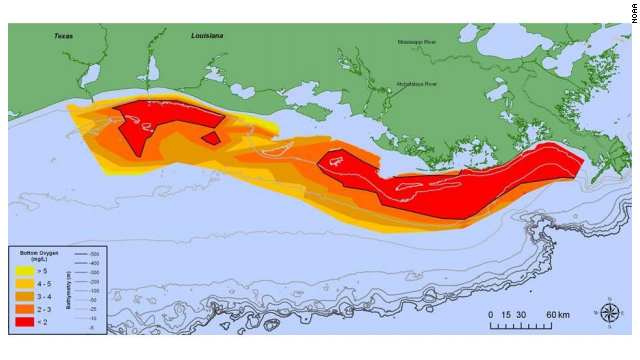
The article in the url below reports that the dead zone, the area of the Gulf of Mexico that cannot sustain aquatic life, is now the size of Connecticut:
 
"The Gulf of Mexico's annual spring-summer 'dead zone' is the size of Connecticut -- slightly smaller now than in recent years but nowhere near the trim scientists had sought, researchers said this week."
 
The dead zone is formed by chemical run-off from agricultural pollutants (fertilizer, etc.) that finds its way into the Mississippi River and flows down into the Gulf of Mexico:
 
"The zone is formed by nutrients that wash into the Gulf's waters -- largely agriculture fertilizer and wastewater coming down the Mississippi River. These boost algae blooms that suck up the oxygen in deep water, according to NOAA and the U.S. Geological Survey. Marine life struggles to find enough oxygen to survive within the zone."
 
The map included in the article illustrates how big this problem has become:
 
 
What I find ironic is that this dead zone never generates any public interest (let alone outrage). I put this down to the fact that we cannot see the damage being done (together, of course, with the influence of the agricultural industry's lobby in Washington). In contrast, the oil spill caused by the Deepwater Horizon explosion caused great public anger. This was justified, but the dead zone is a bigger problem that, unlike Deepwater Horizon, is not getting any better.
 
Happy Halloween.
David
 
David Chandler & Bill Werther
 
Instructor Teaching and Student Study Site: http://www.sagepub.com/chandler3e/
Strategic CSR Simulation: http://www.strategiccsrsim.com/
The library of CSR Newsletters are archived at: http://strategiccsr-sage.blogspot.com/
 
 
Gulf of Mexico 'dead zone' is the size of Connecticut
By Melodi Smith and Jason Hanna
August 7, 2014
CNN Tech
 

Friday, April 26, 2013

Strategic CSR - Monster Energy

Longtime subscribers of the Newsletter will know of my distaste (literally and figuratively) for the food industry. This distaste extends to the drinks industry, which is working hard to compete with agribusiness to see which group of firms can do the most damage to long-term public health. The article in the url below helps push the advantage back towards the drinks industry:
 
“Fans of Monster Energy, the popular high-caffeine energy drink, may not notice the change: its ingredients will be the same and its familiar label bearing a green, clawlike monogram will change only slightly. But the drink’s maker has decided after a decade of selling it as a dietary supplement to market it as a beverage, a switch that will bring significant changes in how it is regulated.”
 
What changes, exactly, are we talking about?
 
“Among them: Monster Beverage, the nation’s biggest seller of energy drinks, will no longer be required to tell federal regulators about reports potentially linking its products to deaths and injuries. … The changes by Monster and Rockstar demonstrate the degree to which energy drink manufacturers can decide which rules to follow.”
 
It must be nice to be able to make up the rules as you go along:
 
“For a decade, Monster sold its products as dietary supplements, apparently as part of a strategy to convince consumers that they were different from beverages. But the company, like its competitors, has run into a spate of bad news, including the disclosure in October that the F.D.A. had received reports in recent years that mentioned its drinks in connection with deaths and injuries. Since then, the F.D.A. has received three more death reports and 14 injury reports that cite Monster energy drinks, an F.D.A. spokeswoman, Tamara Ward, said in an e-mail. In recent months, the agency has also received added reports about other energy products; since October, for example, it has received 38 reports that cite the popular energy ‘shot’ 5-Hour Energy, including five involving a death.”
 
The company, of course, insists that the change is merely part of the important public service that they offer:
 
“A spokesman for Monster, Michael Sitrick, said the company had decided to market its products as beverages for several reasons. One was to stop what he described as ‘misguided criticism’ that the company was selling its energy drinks as dietary supplements because of the belief that such products were more lightly regulated than beverages. Another consideration, he said, was that consumers can use government-subsidized food stamps to buy beverages.”
 
It is always reassuring to know such socially-oriented companies place our collective wellbeing central to their mission!
 
Have a good weekend.
David
 
 
Instructor Teaching Site: http://www.sagepub.com/strategiccsr/
The library of CSR Newsletters are archived at: http://strategiccsr-sage.blogspot.com/
 
 
In a New Aisle, Energy Drinks Sidestep Some Rules
By Barry Meier
March 20, 2013
The New York Times
Late Edition – Final
A1
 

Friday, March 29, 2013

Strategic CSR - Food

Here are some highlights from the article in the url below, which makes the argument that reform of the food industry (and rejection of the current domination by agri-business) will take decades, rather than years:
 
“Nothing affects public health in the United States more than food. Gun violence kills tens of thousands of Americans a year. Heart disease, cancer, stroke and diabetes kill more than a million people a year — nearly half of all deaths — and diet is a root cause of many of those diseases.”
 
“… our system of hyper-industrial agriculture, the kind that uses 10 times as much energy as it produces.”
 
“We must figure out a way to un-invent this food system. It’s been a major contributor to climate change, spawned the obesity crisis, poisoned countless volumes of land and water, wasted energy, tortured billions of animals… I could go on. … only by saving the earth can we save ourselves, and vice versa.”
 
“There is no consensus behind a program for achieving sustainable production of food that promotes rather than attacks health. We can’t ask for ‘better food for all’; we must be specific.”
 
“… when we begin treating sugar-sweetened beverages as we do tobacco, we will make a huge stride in improving our diet.”
 
This point in particular, I think, reveals how far we have to go as a society in generating a healthy food culture, even given our knowledge of the damage being done by the status quo:
 
“An association between tobacco and cancer was discovered more 200 years ago. The surgeon general’s report that identified smoking as a public health issue appeared in 1964. The food movement has not yet reached its 1964; there’s isn’t even a general acknowledgment of a problem in need of fixing.”
 
Happy Easter!
David
 
 
Instructor Teaching Site: http://www.sagepub.com/strategiccsr/
The library of CSR Newsletters are archived at: http://strategiccsr-sage.blogspot.com/
 
 
Fixing Our Food Problem
By Mark Bittman
January 1, 2013
The New York Times
Late Edition – Final
A19
 

Wednesday, March 6, 2013

Strategic CSR - GMOs

The article in the url below details an ironic situation. In last November’s election in the U.S., there was a ballot initiative in California (Proposition 37) that was designed to force food companies to disclose any GMO ingredients in a product on the product’s label. Food companies are not currently required to do this anywhere in the U.S.—unfortunately, the issue is a low priority for many consumers, and that was not promising to change any time soon in a country where it is estimated that “75 percent of grocery products contain a genetically modified ingredient.”
 
In an effort to defeat Prop 37, corporations spent “more than $40 million” on lobbying and advertising during the election campaign and, as a result, the proposition failed to win a majority of votes. Another victory for the corporate lobby, right? Except that it did not work out that way:
 
“Instead of quelling the demand for labeling, the defeat of the California measure has spawned a ballot initiative in Washington State and legislative proposals in Connecticut, Vermont, New Mexico and Missouri, and a swelling consumer boycott of some organic or ‘natural’ brands owned by major food companies. … [today, there are] roughly 20 states considering labeling requirements.”
 
Ultimately, the actions taken by the food companies converted a local issue that no one was paying attention to into a national issue that is being hotly-debated:
 
“‘They spent a lot of money, got a lot of bad press that propelled the issue into the national debate and alienated some of their customer base, as well as raising issues with some trading partners,’ said Mr. Benbrook, who does work on sustainable agriculture.”
 
Now, forced to backtrack, the companies have joined the discussion with a wide-range of stakeholders to work out a more effective solution:
 
Executives from PepsiCo, ConAgra and about 20 other major food companies, as well as Wal-Mart and advocacy groups that favor labeling, attended a meeting in January in Washington convened by the Meridian Institute, which organizes discussions of major issues.”
 
A strategic CSR perspective would have got them to this place a lot sooner and saved them $40 million in the process.
 
Take care
David
 
 
Instructor Teaching Site: http://www.sagepub.com/strategiccsr/
The library of CSR Newsletters are archived at: http://strategiccsr-sage.blogspot.com/
 
 
Companies Weigh Federal Labels for Gene-Engineered Ingredients
By Stephanie Strom
February 1, 2013
The New York Times
Late Edition – Final
B1
 

Wednesday, December 5, 2012

Strategic CSR - Organic food


This will be the last CSR Newsletter of the Fall semester.
Have a great holiday season and I will see you in 2013!


The article in the url below charts the evolution of the organic food industry in the U.S. from the perspective of one of its founders—Michael Potter, founder of Eden Foods (http://www.edenfoods.com/). The article reports that, in many respects, the terms “organic” and “big food” are becoming synonymous:

The fact is, organic food has become a wildly lucrative business for Big Food and a premium-price-means-premium-profit section of the grocery store. The industry’s image — contented cows grazing on the green hills of family-owned farms — is mostly pure fantasy. Or rather, pure marketing. Big Food, it turns out, has spawned what might be called Big Organic.

Many of the small and local brands, which many consumers probably believe remain ‘small and local,’ are now ‘big and remote’:

Bear Naked, Wholesome & Hearty, Kashi: all three and more actually belong to the cereals giant Kellogg. Naked Juice? That would be PepsiCo of Pepsi and Fritos fame. And behind the pastoral-sounding Walnut Acres, Health Valley and Spectrum Organics is none other than Hain Celestial, once affiliated with Heinz, the grand old name in ketchup. Over the last decade, since federal organic standards have come to the fore, giant agri-food corporations like these and others — Coca-Cola, Cargill, ConAgra, General Mills, Kraft and M&M Mars among them — have gobbled up most of the nation’s organic food industry. Pure, locally produced ingredients from small family farms? Not so much anymore.

The result of all this consolidation and commercial interest, according to Potter, is the dilution of the meaning associated with the organic label and all the health benefits that he believes stem from good, wholesome food. One example of how the influence of agri-business is affecting the final product is in the compilation of the National Organic Standards Board (http://www.ams.usda.gov/AMSv1.0/NOSB) (increasingly corporate) and the Board’s list of what substances can be included in organic foods and still continue to call the final product ‘organic’ (increasingly long):

As corporate membership on the board has increased, so, too, has the number of nonorganic materials approved for organic foods on what is called the National List. At first, the list was largely made up of things like baking soda, which is nonorganic but essential to making things like organic bread. Today, more than 250 nonorganic substances are on the list, up from 77 in 2002.

Take care
David


Instructor Teaching Site: http://www.sagepub.com/strategiccsr/
The library of CSR Newsletters are archived at: http://strategiccsr-sage.blogspot.com/


Has ‘Organic’ Been Oversized?
By Stephanie Strom
July 8, 2012
The New York Times
Late Edition – Final
BU1