The CSR Newsletters are a freely-available resource generated as a dynamic complement to the textbook, Strategic Corporate Social Responsibility: Sustainable Value Creation.

To sign-up to receive the CSR Newsletters regularly during the fall and spring academic semesters, e-mail author David Chandler at david.chandler@ucdenver.edu.

Showing posts with label biofuels. Show all posts

Wednesday, April 22, 2026

Strategic CSR - Microsoft (+ Delta)

The article in the url below from Bloomberg Green Daily's newsletter is disappointing, for many reasons:


"Staff at Microsoft have told some developers of carbon removal credits that the company is pausing what is currently the world’s biggest program for financing the extraction of CO2 from the atmosphere."


To give you an idea of how big a blow this is to the market for carbon removal credits, the chart accompanying the article makes the extent of Microsoft's impact abundantly clear:


image.png


 To be specific:


"Microsoft is by far the largest investor in removal credits, having set an ambitious goal to be carbon negative by 2030. The company is engaged in deals across a variety of technologies, with Bloomberg estimating that its purchases in 2025 accounted for 96% of the entire market."


The article develops a line of argument that seeks to explain the decision to pull back but, in the process, instead makes clear why Microsoft's continued engagement is more essential than ever:


"While Microsoft has expanded its carbon removals program, the company’s greenhouse gas emissions have increased significantly on the back of its investment in data centers needed to power artificial intelligence."


Microsoft has been progressive on this issue for a long time, and was one of the first companies to account for an internal carbon price to help assess the ROI on projects (see Strategic CSR - Carbon tax). It is disappointing to see them pull back from this market, especially when technological innovation seems at a formative stage. But, they are clearly not alone -- on this or other related stories. To learn about companies dropping their 'net zero' targets, for example, see the article in the second url, below:


"Delta Air Lines Inc. quietly scrubbed a pair of key environmental targets from its sustainability web page. The Atlanta-based carrier deleted its pledge to use sustainable aviation fuel (SAF) for 10% of its jet fuel by 2030. It also rephrased its quest to achieve net-zero emissions by 2050 as an “aspiration,” rather than a 'goal.'”


As the graphic accompanying that article shows, Delta is far from where it would need to be to achieve the targets it (voluntarily) set itself -- unfortunately, they are not an outlier in the airline industry (see also Strategic CSR - Executive pay):


image.png


Take care

David


David Chandler

Strategic Corporate Social Responsibility: Sustainable Value Creation (6e)

© Sage Publications, 2023


Instructor Teaching and Student Study Site: https://study.sagepub.com/chandler6e  

Strategic CSR Simulation: http://www.strategiccsrsim.com/

The library of CSR Newsletters is archived at: https://strategiccsr-sage.blogspot.com/


Microsoft Staff Tell Some Carbon Capture Companies It's Pausing Deals

By Alastair Marsh and Ishika Mookerjee

April 13, 2026

Bloomberg Green Daily

https://www.bloomberg.com/news/newsletters/2026-04-13/microsoft-staff-say-carbon-removal-deals-paused-in-program-shakeup


Delta Waters Down Net Zero Target to an 'Aspiration'

By Ben Elgin and Kyle Stock

April 14, 2026

Bloomberg Green Daily

https://origin.www.bloomberg.com/news/newsletters/2026-04-14/delta-waters-down-net-zero-target-to-an-aspiration


Thursday, January 29, 2026

Strategic CSR - China

The article in the url below conveys the extent to which China is expanding its electricity generation capacity:

"China is undertaking an energy-building boom unlike anything the world has ever seen, as Beijing seeks to ensure supply for power-hungry facilities that are key to dominating emerging industries of the future."


The scale is staggering. In the last year alone, China has added more capacity than India's electrical grid:


"The nation added 543 gigawatts of new capacity across all technologies last year, according to data from the National Energy Administration on Wednesday. That's 12% more than all the power plants combined in India as of the end of 2024."


And, in the last 4 years, China has added more electrical power than the U.S. is able to generate:


"The generation China has added since the end of 2021 is also larger than the entire US system."


It is doing this across a wide-range of fuels and technologies (fossil and renewable), and it is doing it year-over-year.


Take care

David


David Chandler

Strategic Corporate Social Responsibility: Sustainable Value Creation (6e)

© Sage Publications, 2023


Instructor Teaching and Student Study Site: https://study.sagepub.com/chandler6e  

Strategic CSR Simulation: http://www.strategiccsrsim.com/

The library of CSR Newsletters are archived at: https://strategiccsr-sage.blogspot.com/


China's Four-Year Energy Spree Has Eclipsed Entire U.S. Power Grid

By Dan Murtaugh

January 27, 2026

Bloomberg

https://www.bloomberg.com/news/articles/2026-01-28/china-s-four-year-energy-spree-has-eclipsed-entire-us-power-grid


Tuesday, February 4, 2025

Strategic CSR - Aviation

I have been looking into the aviation industry, recently (see here). Thinking about how sustainability works in this space has been part of that inquiry. Along these lines, I found the article in the url below, which suggests we are nowhere near developing a sustainable aviation fuel (SAF), and that any headline you might have seen suggesting the opposite is misleading, at best:

"IPS report says replacement fuels well off track to replace kerosene within timeframe needed to avert climate disaster."

Even worse:

"Hopes that replacement fuels for airplanes will slash carbon pollution are misguided and support for these alternatives could even worsen the climate crisis, a new report has warned."

Specifically:

"There is currently 'no realistic or scalable alternative' to standard kerosene-based jet fuels, and touted 'sustainable aviation fuels' are well off track to replace them in a timeframe needed to avert dangerous climate change, despite public subsidies, the report by the Institute for Policy Studies, a progressive thinktank, found."

As with many good ideas in the sustainability space, the idea in theory is possible; in practice, scalability is the challenge:

"Chuck Collins, co-author of the report, said: 'To bring these fuels to the scale needed would require massive subsidies, the trade-offs would be unacceptable and would take resources aware from more urgent decarbonization priorities.'"

What are some of those potential tradeoffs?

"Burning sustainable aviation fuels still emits some carbon dioxide, while the land use changes needed to produce the fuels can also lead to increased pollution. Ethanol biofuel, made from corn, is used in these fuels, and meeting the Biden administration's production goal, the report found, would require 114m acres of corn in the US, about a 20% increase in current land area given over to the crop. In the UK, meanwhile, 50% of all agricultural land will have to be given up to sustain current flight passenger levels if jet fuel was entirely replaced."

The conclusion, due to the unique challenges of getting heavy airplanes off the ground:

"Phil Ansell, director of the Center for Sustainable Aviation at the University of Illinois, said the aviation industry had been faced with a much steeper challenge than other sectors to decarbonize. 'There's an under appreciation of how big the energy problem is for aviation. We are still many years away from zero pollution flights,' he said. … 'We are now trying to find solutions, but we are working at this problem and realizing it's a lot harder than we thought. We are late to the game. We are in the dark ages in terms of sustainability, compared to other sectors.'"

Take care
David

David Chandler
© Sage Publications, 2023

Instructor Teaching and Student Study Site: https://study.sagepub.com/chandler6e 
Strategic CSR Simulation: http://www.strategiccsrsim.com/
The library of CSR Newsletters are archived at: https://strategiccsr-sage.blogspot.com/


'Magical thinking': hopes for sustainable jet fuel not realistic, report finds
By Oliver Milman
May 14, 2024
The Guardian
 

Tuesday, November 5, 2024

Strategic CSR - Electricity

The article in the url below presents some fascinating graphics about how electricity in the U.S. is made – specifically, what proportion of electricity is generated using coal, natural gas, petroleum, nuclear, wind, and solar. The article starts with the country as a whole, mapping the way electricity generation has evolved over the past two decades:

"Natural gas surpassed coal as the country's top source of power in 2016, and renewables like wind and solar have grown quickly to become major players in the U.S. power system."

The article presents this information in terms of a longitudinal graphic, from 2001 to 2023:


The article contains a similar graphic for each of the country's 50 states, and the variance among states is significant, from Nevada:

"… natural gas became the top source of electricity generation in 2005, earlier than in many other places. More recently, solar power has surged there."

… to Iowa:

"Wind has taken off … over the past two decades, beating out coal in 2019 to become the state's largest source of power generation."

… to Wyoming:

"… where coal still dominates, alternative sources of power have made steady gains."

While the shift to renewables is notable, however, fossil fuels continue to provide the source of the majority of electricity generated in the U.S.:

"[In 2023], coal was the top electricity fuel in 10 states, down from 32 states in 2001. Natural gas largely took over during that time, but wind also emerged as a leading power source across the Midwest."

Take care
David

David Chandler
© Sage Publications, 2023

Instructor Teaching and Student Study Site: https://study.sagepub.com/chandler6e  
Strategic CSR Simulation: http://www.strategiccsrsim.com/
The library of CSR Newsletters are archived at: https://strategiccsr-sage.blogspot.com/


How Does Your State Make Electricity
By Nadja Popovich
August 2, 2024
The New York Times
 

Thursday, October 24, 2024

Strategic CSR - Airlines

The article in the url below covers the issue of sustainability in the airline industry and the current U.S. administration's attempts to incentivize the development and widespread use of sustainable aviation fuel (SAF):

"The best thing for the planet would be for everyone — particularly the most frequent flyers, responsible for the majority of emissions — to fly less. Airlines and government officials around the world, though, are vowing that commercial flight can grow while sharply curtailing its climate footprint. Their plans hinge on using vast quantities of sustainable aviation fuel. In the US, the Biden administration and airlines have trumpeted a goal to use 3 billion gallons of SAF by 2030."

Perhaps not surprisingly, the article also notes the reality of how far we are lagging behind that goal:

"The supply of cleaner jet fuel, though, is still only a trickle. US volumes hit 24.5 million gallons last year. That's an uptick from the 2.4 million gallons produced in 2019. But to reach the industry's goal by decade's end, airlines would need to somehow increase SAF consumption by 122-fold."

The chart accompanying the article demonstrates how far off track we currently are:
 

Take care
David

David Chandler
© Sage Publications, 2023

Instructor Teaching and Student Study Site: https://study.sagepub.com/chandler6e 
Strategic CSR Simulation: http://www.strategiccsrsim.com/
The library of CSR Newsletters are archived at: https://strategiccsr-sage.blogspot.com/


The Airline Industry's Biggest Climate Challenge: A Lack of Clean Fuel
By Ben Elgin
April 11, 2024
Bloomberg
 

Friday, March 17, 2023

Strategic CSR - Energy

This graphic caught my eye as I was scrolling through LinkedIn:


The thing that immediately caught my eye is the large number of states that still rely heavily on coal. This should give everyone reason to question whether EVs (and electrification, in general) are an immediate solution to our climate-related problems. The second thing, though, was how many states now have some form of renewable energy producing the largest amount of electricity. The same article produces a breakdown of each energy source for North America, as a whole:

Source of Power  Percentage
Natural Gas           44.32
Coal                       20.8
Nuclear                  8.83
Wind                      8.62
Hydro                    8.37
Solar                      3.46
Oil                         3.14
Other                     2.46

Have a good weekend
David

David Chandler
© Sage Publications, 2023

Instructor Teaching and Student Study Site: https://study.sagepub.com/chandler6e 
Strategic CSR Simulation: http://www.strategiccsrsim.com/
The library of CSR Newsletters are archived at: https://strategiccsr-sage.blogspot.com/


The Largest Source of Power in Every State and Province
By Alex
November 27, 2022
Vivid Maps
 

Sunday, November 24, 2019

Strategic CSR - United

Given that many of you in the U.S. will be travelling this week for the Thanksgiving holiday, the article in the url below covers the progress airlines are making on reducing the environmental impact of their core product. It details a one-off plane trip from Chicago to LA, operated by United, designed to demonstrate the range of new policies and practices the company is exploring to achieve carbon neutral plane flights. The airline has previously committed to reduce its emissions "by more than 50% by 2050," and this flight was designed to demonstrate its progress to date:
 
"The meals were served on compostable or recyclable plates; hot beverages were served in recyclable paper cups, an industry first, according to the airline. The cutlery was compostable. In first class, passengers' meals were covered with a beeswax wrap instead of the usual plastic and there was no plastic ring around the napkin."
 
A reduction in waste was the first of four areas of operations that United was using the flight to demonstrate. The other three areas were:
 
  • Fuel: "The Boeing 737-900 flight, with 161 passengers, was powered not just by traditional jet fuel; 30% was biofuel made from agricultural waste."
  • Efficiency: "Pilots used single-engine taxi procedures instead of using both engines to reduce fuel burn on the runway."
  • Offsets: "The airline purchased carbon offsets to cover the remaining portion of flight where it didn't achieve zero emissions."
 
Although this was only a one-off flight, United reported zero waste from the flight, with the exception of waste generated separately by the customers:
 
"The goal: zero cabin waste instead of the average 65 pounds of garbage taken off a United flight. (They got it down to 14 pounds, all of it passenger garbage.)"
 
What I find interesting about the experiment, however, are the customer reactions. The article reports a limited sampling, but all the comments are either superficial or negative:
 
"Annika Bjorklund, 17, … and her father, Steve, were on Flight 310 but didn't know the special events were planned. 'I think it's a really cool thing,' she said. Steve Bjorklund praised the airline's sustainability efforts but said they wouldn't dictate his choice of airline. 'I'm a United flyer,' he said. 'I'm going to fly United anyway.' Joanne DeTrana watched the festivities somewhat skeptically from the B11 gate area. … 'I believe in sustainability but I think sometimes you can carry it to the Nth degree,' she said. 'To me, that's not a big marketing sell.' DeTrana said it wouldn't factor into her ticket buying decisions. 'Price and comfort top that list, she said."
 
In other words, United goes to all that effort and its passengers merely shrug their shoulders. This still may be useful for the firm if it motivates its employees but, in order for United to continue these efforts, a key stakeholder group needs to demonstrate that it wants and appreciates them. Otherwise, what is the point?
 
Take care
David
 
David Chandler
© Sage Publications, 2020
 
Instructor Teaching and Student Study Site: https://study.sagepub.com/chandler5e 
Strategic CSR Simulation: http://www.strategiccsrsim.com/
The library of CSR Newsletters are archived at: https://strategiccsr-sage.blogspot.com/


Biofuel, beeswax wraps and recyclable coffee cups: United debuts 'eco-friendly flight'
By Dawn Gilbertson
June 6, 2019
USA Today

Wednesday, October 1, 2014

Strategic CSR - Fracking

Recently, there has been a lot of media coverage emphasizing the environmental benefits of fracking, in general, and the fracking of natural gas, in particular. The article in the url below, for example, notes that, because supply of natural gas has increased exponentially, prices have dropped to the point where it makes economic sense to burn gas instead of coal, which reduces carbon emissions:
 
"Coal generation peaked in 2007 at a little over two billion megawatt hours while in 2013 it dropped to 1.58 billion, according to the Energy Information Administration. (A megawatt-hour, or 1,000 kilowatt-hours, is the amount of electricity a typical suburban house uses in a month.) Over the same time, gas generation started at 857 million megawatt-hours and ended at 1.2 billion. If all the increase in gas-fired generation replaced coal, then the switch produced savings of 113.1 million tons of carbon a year."
 
This is good. Unfortunately, these same economic principles apply to any energy source that is more expensive than gas. As such, cheap natural gas is replacing nuclear energy ("zero carbon footprint") and, more worryingly, other non-fossil fuel sources, such as wind:
 
"Wind contributes only slightly to generation capacity needs, but whenever it runs, it saves fuel, mostly natural gas, and that gas is now worth about half of what it was a decade ago."
 
In addition, one of the main products of fracking for oil is natural gas. And, in places where there are no pipelines to take the gas away, it is flared:
 
"According to the Energy Information Administration, last year the producers flared enough gas to have produced 27 million megawatt-hours. That pushed emissions up by 16.5 million tons, about 15 percent as much as the reduction in coal burning saved. And some of the natural gas escapes unburned. Its main component, methane, is a global warming gas and is far more powerful than carbon dioxide, although it does not persist quite as long in the atmosphere. … from 2007 to 2013, the increase in gas consumption added methane with a carbon dioxide equivalent of about 19 million tons."
 
The quote in the article that stuck out most for me, however, concerned the long-term effects of cheap natural gas on any hope of limiting our carbon emissions into the atmosphere:
 
"The problem, said Michael Greenstone, a professor of environmental economics at M.I.T., is that while zero-carbon technologies have advanced significantly in the last 10 years, 'over the same period, there have been practically unimaginable advances in fossil fuels.' Limiting carbon emissions will most likely mean resolving to leave cheap fossil fuels in the ground, he said. Almost nothing valuable is left undrilled or unmined, he said. 'The history of leaving $100 bills buried in the ground is really a short one,' he said."
 
Past experience suggests we are not willing to sacrifice short-term economic profit for long-term environmental security.
 
Take care
David
 
David Chandler & Bill Werther
 
Instructor Teaching and Student Study Site: http://www.sagepub.com/chandler3e/
Strategic CSR Simulation: http://www.strategiccsrsim.com/
The library of CSR Newsletters are archived at: http://strategiccsr-sage.blogspot.com/
 
 
The Potential Downside of Natural Gas
By Matthew L. Wald
June 4, 2014
The New York Times
Late Edition – Final
B3
 

Monday, February 13, 2012

Strategic CSR - Ethanol

The Wall Street Journal editorial in the url below contains some astonishing numbers. The editorial leads with a quote from George Bush’s 2006 State of the Union address in which he committed the U.S. to develop ethanol as an alternative fuel. It then proceeds to detail the consequences of this policy as implemented by Barack Obama. In addition to billions of dollars of subsidies:

“… Mr. Bush assured the nation that by 2012 cars and trucks could be powered by cellulosic fuels from switch grass and other plant life. To launch this wonder-fuel industry, the feds under Mr. Bush and President Obama have pumped at least $1.5 billion of grants and loan subsidies to fledgling producers. Mr. Bush signed an energy bill in 2007 that established a tax credit of $1.01 per gallon produced.”

In particular:

“Most important, the Nancy Pelosi Congress passed and Mr. Bush signed a law imposing mandates on oil companies to blend cellulosic fuel into conventional gasoline. This guaranteed producers a market. In 2010 the mandate was 100 million barrels, rising to 250 million in 2011 and 500 million in 2012. By the end of this decade the requirements leap to 10.5 billion gallons a year.”

In reality, performance has been underwhelming, to say the least:

“When these mandates were established, no companies produced commercially viable cellulosic fuel. But the dream was: If you mandate and subsidize it, someone will build it. Guess what? Nobody has. Despite the taxpayer enticements, this year cellulosic fuel production won't be 250 million or even 25 million gallons. Last year the Environmental Protection Agency, which has the authority to revise the mandates, quietly reduced the 2011 requirement by 243.4 million gallons to a mere 6.6 million. Some critics suggest that even much of that 6.6 million isn't true cellulosic fuel. The EPA has already announced that the 2012 mandate of 500 million gallons is unattainable, so it is again expected to lower the mandate to fewer than 12 million gallons for next year.”

These numbers (6.6 million instead of 250 million) present the argument against economic micro-managing by politicians. With suspect allegiances and swayed by the disproportionate influence of money in politics today, government should focus on setting the broad legal framework within which market forces determine the most efficient outcomes. Regulation is an important part of this responsibility, but predetermined economic outcomes is well-beyond the government’s capabilities or the country’s economic interests. This is a theme I have touched on in prior newsletters (see: FREE ‘free markets’), but if the government wants to encourage alternative fuels, the most efficient way is to make carbon more expensive (i.e., a carbon tax). If this tax is transparent and equitably applied across industries, then the market will quickly marshal resources to produce a competitive alternative that is economically feasible. It is impossible to predict in advance, however, what that alternative will be (no matter how much public money you throw at the problem).

Wednesday, November 30, 2011

Strategic CSR - Greenwash

The article in the url below calls for an end to green marketing. The primary reason, the author argues, is because the increased focus on sustainability-related issues has not generated the scale of change necessary (Chapter 4, Greenwashing, p108):

“For more than 20 years, consumers haven’t been willing to vote with their dollars. … With the exception of some energy-saving devices, no green product has captured more than a tiny slice of the marketplace, at least in the U.S. Think about it: No environmentally preferable car, carpet, cleaner, cosmetic, clothing, coffee, credit card or cell phone has captured more than 2 percent of its respective market. In most cases, sales of green products represent well under 1 percent of any given category.”

Ultimately, the author feels that even where green products are somewhat successful, it is because of individual benefit rather than a broader ecological concern, “It’s not really about the planet”:

“Hybrid cars? They reduce costly trips to the pump. Energy Star TVs and appliances? They cut energy costs. … But those choices benefit us personally, today -- not some far-off forest or future.”

Now that green marketing is ubiquitous (and tarnished through multiple examples of greenwashing), it has lost much of its impact. As such, partly due to uninspired ad campaigns by firms, poor product quality, and price premiums associated with green products, consumers have not been willing to significantly alter their behavior. In other words, because everyone is now a sustainable company, no-one is a sustainable company—“Green Marketing is Over. Let’s Move On.”

Most of these criticisms, however, refer to business to consumer marketing. Business-to-business marketing, in contrast, provides reason for hope. Here, the push to develop and sell more environmentally-friendly products has been much more successful because it has focused on the business argument:

“A wide range of things companies buy -- building products, industrial cleaners, IT equipment, paper and forest products, appliances and some industrial feedstocks -- are being marketed effectively for their environmental attributes. Companies and other buyers (like government agencies, hospitals and universities) are more willing to change their buying habits, and their buying power can make for attractive economies of scale. Witness the continued market growth of green buildings, biobased packaging, alternative-fueled fleet vehicles and more.”

Friday, December 3, 2010

Strategic CSR - See you in January!


This will be the last CSR Newsletter of the Fall semester.
Have a great holiday season and I will see you in January!


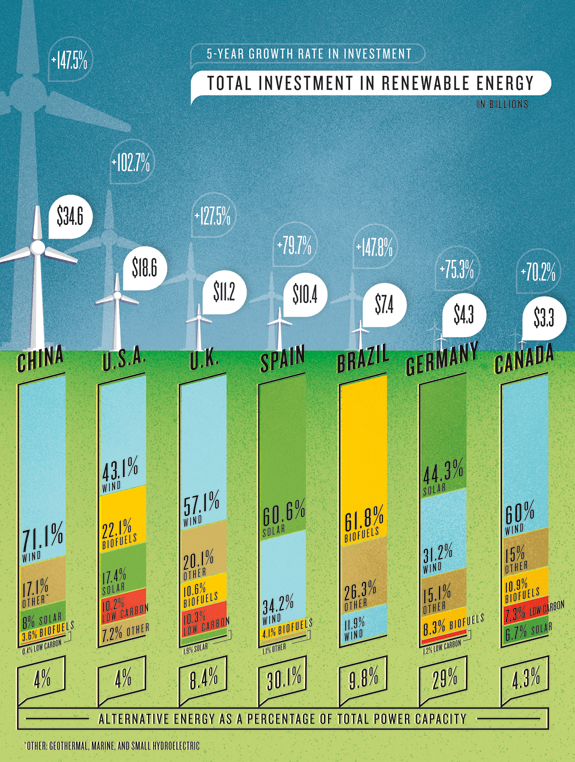
The article in the url below contains a graphic (http://images.fastcompany.com/magazine/148/now-22-infographic-inline.jpg) that depicts the total spending of the seven countries that have invested the most in renewable energy:

“As 3,500 global leaders in the energy field gather in Montreal to discuss trends and growth, we calculate which countries have earned the biggest bragging rights. Here, we compare the seven that have made the largest investments in alternative energy.”

As well as an overall figure, the graphic breaks down each country’s spending into different kinds of renewable energies (i.e., the percentage spent on wind, solar, biofuels, and so on). The 5 year growth rate in investment for each country is listed, as well as the percentage of total energy capacity that these investments constitute.

Have a good weekend.
David

Bill Werther & David Chandler
Strategic Corporate Social Responsibility: Stakeholders in a Global Environment (2e)
© Sage Publications, 2011

Instructor Teaching Site: http://www.sagepub.com/strategiccsr/
The library of CSR Newsletters are archived at: http://strategiccsr-sage.blogspot.com/


"Who's Really Investing in Alternative Energy?"
Fast Company Magazine
Issue: 148 | Date: September, 2010 | By: Emily Benton

Monday, February 11, 2008

Strategic CSR - Biofuels

The article in the url link below reports a proposal by the UN Food and Agriculture Organization to expand the production and international trade of bioenergy beyond its current narrow concentration of producing countries (Issues: Environmental Sustainability, p171):

“The US, Europe and Brazil last year accounted for almost 95 per cent of the world's biofuel production. Canada, China and India produced most of the rest.”

By encouraging production in a broader range of countries, the hope is that greater demand will be met, while allowing farmers in many developing countries to exploit the potential that exists for them to generate bioenergy:

“Biofuel production, mostly of corn-derived ethanol in the US and rapeseed-derived biodiesel in Europe, doubled between 2000 and 2005, according to the IEA. In 2005, however, that was still just 1 per cent of global road-transport fuel.”

The article argues that because the developed countries generating bioenergy are diverting resources that would otherwise be used for food production, the current production strategy is unsustainable in the long run:

“Corn prices this year reached an 11-year high of Dollars 4.30 a bushel while wheat prices last week rose to Dollars 6.96 a bushel, the highest since 1996. The US biofuel industry last year consumed about 20 per cent of the country's corn crop, far more than in the past.”

Take care
Dave

Bill Werther & David Chandler
Strategic Corporate Social Responsibility
© Sage Publications, 2006
http://www.sagepub.com/Werther

UN food chief urges rethink on biofuels.
By JAVIER BLAS
416 words
15 August 2007
Financial Times
London Ed1
Page 7
http://www.ft.com/cms/s/0/9d17df58-4ac7-11dc-95b5-0000779fd2ac.html

Wednesday, January 23, 2008

Strategic CSR - Monsanto

The article in the url link below from BusinessWeek charts Monsanto’s journey from pariah status and potential economic oblivion to a corporate success story today (Issues: Research and Development, p130; Science and Technology, p264; Special Cases of CSR: GM Labeling, p293; Monsanto, p300):

“During the 12 months preceding [the current CEO] Grant's elevation, Monsanto's stock price fell nearly 50% to $8 a share. In 2002, the prior fiscal year, the company lost $1.7 billion. … Fewer than five years later, Monsanto is thriving. The St. Louis company's net income leaped 44% last year, to $993 million, on $8.5 billion in revenue. Monsanto shares, which closed at $104.81 on Dec. 5, have risen more than 1,000% during Grant's tenure.”

The main reason for the firm’s recovery, the article argues, is its decision to switch away from straight-to-market consumer GM foods to seeds that are used to grow key food ingredients for agribusiness, such as “animal feed, ethanol, and corn syrup.” Monsanto’s retreat from foods more likely to stoke consumer fears about the science behind genetic modification has enabled the firm to steer clear of the focus of activist groups and build a commanding market share:

“Today, more than 90% of the genetically modified seeds in the world are sold either by Monsanto or by competitors that license Monsanto genes in their own seeds.”

Take care
Dave

Bill Werther & David Chandler
Strategic Corporate Social Responsibility
© Sage Publications, 2006
http://www.sagepub.com/Werther

Business Week Online
Insider Newsletter
December 07, 2007
********************
Monsanto: Winning the Ground War
How the company turned the tide in the battle over genetically modified crops
by Brian Hindo
http://newsletters.businessweek.com/c.asp?685460&c55a2ee820194f0f&3

Tuesday, November 27, 2007

Strategic CSR - Biofuels

The subject of biofuels and the ludicrous set of government subsidies and trade quotas that are creating artificial markets in related products has been the subject of past Newsletters [Note: The best article I have seen on this subject is still Thomas Friedman’s September 2006 article: http://select.nytimes.com/2006/09/20/opinion/20friedman.html]. The article in the url link below, however, provides an informed (and depressing) summary and update:

“Energy security and climate change are two of the most significant challenges confronting humanity. What we see, in response, is the familiar capture of policymaking by well-organised special interests. A superb example is the flood of subsidies for biofuels. These are farm programmes masquerading as answers to energy insecurity and climate change. Not surprisingly, they have the depressing characteristics of such programmes: high protection, open-ended support to producers, and indifference to economic rationality.”

The article is full of facts, figures, and unintended consequences that effectively dismantle the current approach of a number of political administrations that are committed to specific remedies as a result of the lobbying of entrenched interests. The goal at present, clearly, is not to find efficient solutions to the huge problem climate change presents; rather, it is to appear interested by pursuing those policies that play well with domestic audiences:

“This then is a classic farm programme: a costly system of transfers looking for a rationale. Or, as the report puts it: "The bewildering array of incentives that have been created for biofuels in response to multiple (and sometimes contradictory) policy objectives bear all the hallmarks of a popular bandwagon aided and abetted by sectional vested interests."”

Take care
Dave

Bill Werther & David Chandler
Strategic Corporate Social Responsibility
© Sage Publications, 2006
http://www.sagepub.com/Werther

Biofuels: an everyday story of special interests and subsidies.
By MARTIN WOLF
1081 words
31 October 2007
Financial Times
Asia Ed1
Page 11
http://www.ft.com/cms/s/0/40a71f96-8702-11dc-a3ff-0000779fd2ac.html

The author’s blog on this article (with useful and insightful comments) can be found at:
http://blogs.ft.com/wolfforum/2007/10/biofuels-a-tale.html

Friday, November 9, 2007

Strategic CSR - Unforeseen Consequences

The article in the url link below indicates the difficulty in upending established systems and replacing them with new systems that emphasize outcome over process, but also generate unforeseen consequences:

“Then there are biofuels. Often put forward as an eco-friendly alternative to fossil fuels, they now seem to be anything but. In theory, the crops from which the biofuels are derived should mop up around half the greenhouse gas generated by the burning of the fuel in vehicles. But environmentalists are now warning that the demand for biofuels is driving up rates of deforestation in Indonesia, Malaysia and Brazil, as farmers chop down trees in order to plant more profitable biofuel crops instead. A UN expert committee on energy warned this month that the result could be a net increase in greenhouse emissions, and "significant biodiversity loss, soil erosion and nutrient leaching".”

In addition to having to turn around the supertanker global economy in the face of global warming, sustainability advocates have the added pressure of discovering viable alternative processes and products, and quickly!

Have a good weekend.
Dave

Bill Werther & David Chandler
Strategic Corporate Social Responsibility
© Sage Publications, 2006
http://www.sagepub.com/Werther

Unforeseen consequences
Businesses can fend off the risk of 'revenge effects' with more vigilant expertise and less optimism.
By ROBERT MATTHEWS
1039 words
24 May 2007
Financial Times
London Ed1
Page 16
http://www.ft.com/cms/s/1892df7c-0994-11dc-a349-000b5df10621.html