The CSR Newsletters are a freely-available resource generated as a dynamic complement to the textbook, Strategic Corporate Social Responsibility: Sustainable Value Creation.

To sign-up to receive the CSR Newsletters regularly during the fall and spring academic semesters, e-mail author David Chandler at david.chandler@ucdenver.edu.

Showing posts with label Toyota. Show all posts

Tuesday, February 15, 2022

Strategic CSR - EVs in 2022

The article in the url below is interesting simply because it reflects the level of innovation currently going on in the automobile industry and, of course, how much EVs have moved the market in a relatively short period of time:

"This year, the U.S. market is about to see its options for electric vehicles more than double. Thirty entirely new models are poised to hit the streets, according to researcher IHS Markit, mostly created by luxury brands such as Cadillac, Lincoln, and Polestar. And unlike most of the EV standard-bearers to date, the next generation will arrive in the size Americans tend to like: extra large."


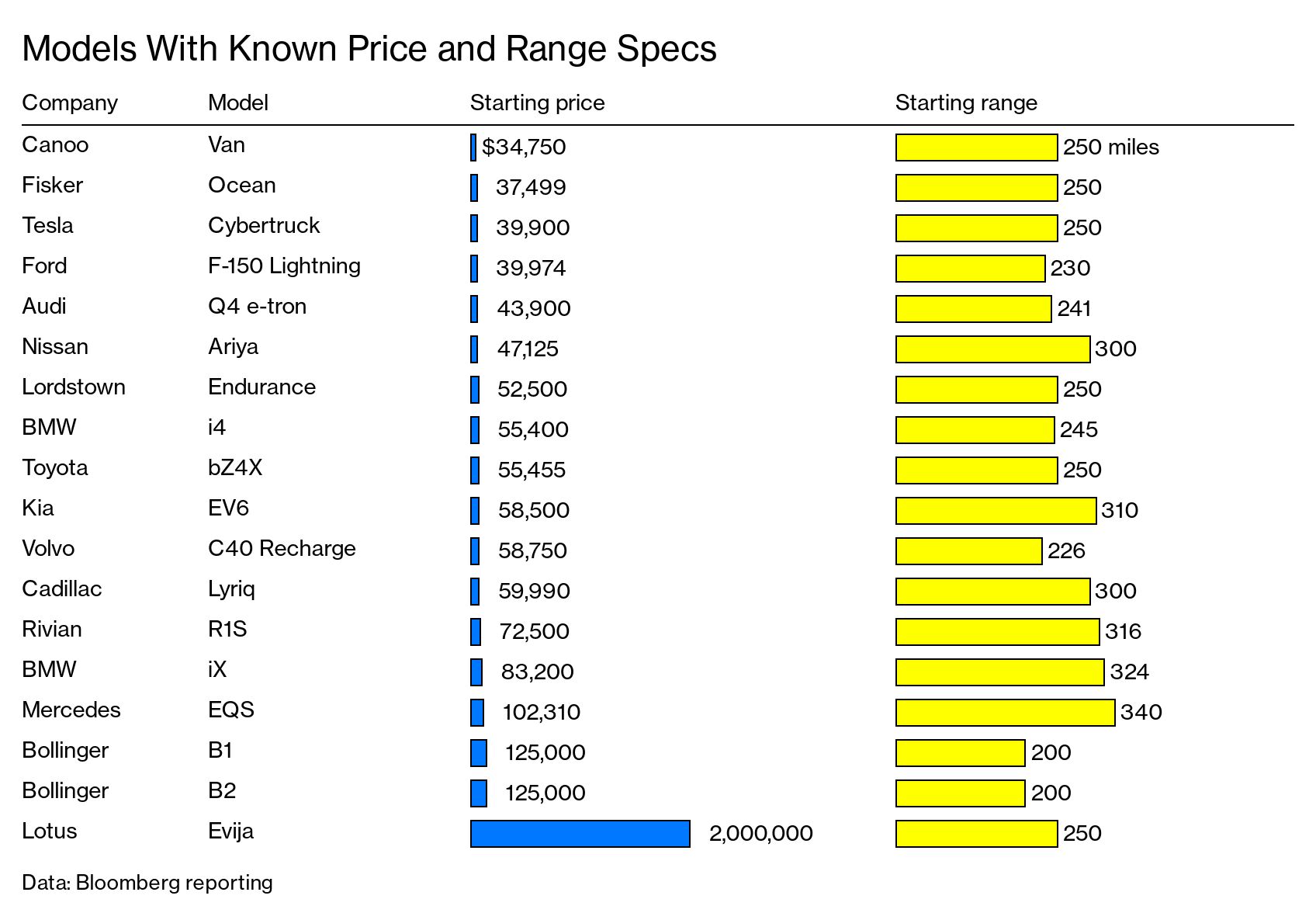
Apparently, the new models "include at least 14 SUVs, a van, and four pickups," the most notable of which is "a battery-powered version of Ford's F-150, the country's bestselling vehicle for decades." Given the expanded range of options and increasing comfort that consumers seem to have with the growing range of batteries, sales are expected to increase in proportion. The only constraint, it seems, is going to be the ability of the global supply chain to deliver these vehicles to market:


"IHS estimates that 1 in 20 American buyers this year will pick a fully electric vehicle—almost 1 million machines—if the supplies hold out. 'It's going to be a matter of what can be built,' says analyst Michael Fiske, 'not what can be sold.'"


The chart accompanying the article illustrates those known models due to come to market, along with the driving range on a full battery:


https://assets.bwbx.io/images/users/iqjWHBFdfxIU/ifEpT.XXuJ3U/v0/pidjEfPlU1QWZop3vfGKsrX.ke8XuWirGYh1PKgEw44kE/-1x-1.png


Take care
David

David Chandler
© Sage Publications, 2020

Instructor Teaching and Student Study Site: https://study.sagepub.com/chandler5e 
Strategic CSR Simulation: http://www.strategiccsrsim.com/
The library of CSR Newsletters are archived at: https://strategiccsr-sage.blogspot.com/


America's Electriv Vehilce Selection is About to Get a Lot Wider
By Kyle Stock and Dorothy Gambrell
January 15, 2022
Bloomberg
 

Tuesday, May 4, 2021

Strategic CSR - EVs

I was always aware that simple statements around the 'obvious benefits' of electrical vehicles (EVs) were obscuring a much more complex reality (where EVs are ultimately more beneficial for the environment, but not immediately so). The interactive article in the url below provides some data to support that position:

"Carmakers including General Motors Co. and Volkswagen AG are retooling their companies to make electric vehicles on the premise that their battery-powered motors are cleaner than gas-burning engines. Are EVs really better for the environment, though? A close look at all the factors shows they are—but it's a complex answer with some asterisks."

In order to answer this question, there are a number of factors that need to be taken into account:

"The environmental cost of a car includes both building it and fueling it. That means factoring in emissions associated with oil drilling and power plant smokestacks, as well as from mining metals such as nickel and cobalt that are needed for electric-car batteries."

In short, right off the production line:

"Building both a Tesla Model 3 and a Toyota RAV4 generates several tons of greenhouse gas emissions to smelt the aluminum, manufacture the components and assemble the vehicle. But building a Tesla actually generates more emissions because of the metals needed for its lithium-ion battery. Before it rolls off the assembly line, the Tesla has generated 65% more emissions than the RAV4."

After a few thousand miles, however, the Tesla begins to catch-up:

"The RAV4 burns gasoline, which is refined from crude oil extracted from wells around the world. At 5,000 miles, the RAV4 also needs its first motor oil change. The Tesla refills with electricity, and doesn't need motor oil changes. Generating electricity creates emissions, but the U.S. grid is getting cleaner each year, burning less coal and using more renewables and natural gas."

The study concludes that it is only after being driven for 20,600 miles that the Tesla becomes the more sustainable option:

"For every mile driven, generating the electricity for the Tesla emits 34% of the emissions associated with making and burning the gasoline consumed in the RAV4 engine. At 20,600 miles, the greenhouse gas emissions from building and driving the two cars are roughly the same. … Then the Tesla pulls ahead."

Finally, after what the article refers to as "the lifespan of a typical car," the Tesla far outshines the RAV4:

"By the time we get to 200,000 miles, ... Building and operating the RAV4 has generated 78 tons of greenhouse gases. The Model 3 has generated less than half: 36 tons. The Model 3 also comes out ahead in Consumer Reports's total cost of ownership, at $49,800 to $51,000."


So, according to this study, the Tesla is not only the overall better environmental option than the RAV4, but is also more cost-effective. Presumably, this comparison would be even more favorable for the Tesla if the other car was larger and heavier than a RAV4. The study also goes on to examine what would happen in four different scenarios in terms of the speed in which that transition occurs for all cars currently on U.S. roads ("more than 280 million light-duty vehicles"). Perhaps not surprisingly, the most effective results come when multiple complementary policy changes are made with the common goal of reducing our carbon footprint:


"No matter what kind of engines they run on, cars add to greenhouse gas emissions. But the data show that switching from gas to electric vehicles will make a huge impact. Consumers making individual choices between cars will make a difference. So will policy decisions made by governments and investments by companies as we drive into the future."


Take care

David


David Chandler

Strategic Corporate Social Responsibility: Sustainable Value Creation (5e)

© Sage Publications, 2020


Instructor Teaching and Student Study Site: https://study.sagepub.com/chandler5e 

Strategic CSR Simulation: http://www.strategiccsrsim.com/

The library of CSR Newsletters are archived at: https://strategiccsr-sage.blogspot.com/


Are Electric Cars Better for the Environment?

By Russell Gold, Jessica Kuronen and Elbert Wang

March 23, 2021

The Wall Street Journal

Late Edition – Final

A8

https://www.wsj.com/graphics/are-electric-cars-really-better-for-the-environment/
 

Wednesday, September 6, 2017

Strategic CSR - Whole Foods

The article in the url below about Whole Foods' recent struggles is half right. It is correct in noting that Whole Foods is struggling, but incorrect in the underlying reasons for its difficulties:
 
"It's hard to think of a better poster child for 'conscious capitalism' than Whole Foods Market, the high-end grocery store that made a name for itself selling organic produce in feel-good, mood-lit stores. These days, the chain is floundering and a potential buyout is on the horizon. What does that say about the conscious capitalism it championed? … Whole Foods was supposed to be different. John Mackey, the company's chief executive, has long argued that Whole Foods is wired differently — that it runs on a 'conscious capitalism' model that outsmarts the competitive pressures of our for-profit system through creativity and innovation. … The Whole Foods founder penned his treatise in response to the growing consensus that capitalism is doing irreparable harm to the planet and the people who live on it. Our for-profit system is increasingly viewed as a zero-sum game in which ecological destruction, climate change and rising inequality are firmly linked to the rapacious behavior of multinational corporations. Mackey agrees that humans are harming the planet, but he doesn't think the problem lies in capitalism. Free-market capitalism, according to Mackey, is actually a 'beautiful,' 'heroic' system that, properly harnessed, can operate 'in harmony with the fundamentals of human nature' and the planet."
 
All of this is true. Fundamentally, however, the article misses the point about the root causes of Whole Foods' struggles. Yes, there are business decisions that the firm could have made that would have better protected it from competition. But, conscious capitalism is not the reason for the firm's decline. In essence, Whole Foods' sales are declining due to a lack of stakeholder support, particularly customers, who have been persuaded that products on offer at Walmart and Kroger (for example) are essentially the same as those offered at Whole Foods. As such, they see no reason to pay the higher prices that Whole Foods generally charges.
 
In reality, however, these customers are failing to distinguish between the low cost model pursued by most supermarkets and the differentiated model pursued by Whole Foods (something that might be threatened under Amazon's control). With food, as with many products, you get what you pay for and there is a price premium associated with quality. To draw an analogy, people are confusing a Toyota Corolla with a BMW 7 series because both cars are capable of getting you from A to B. Just because this is true, however, does not mean the two cars are comparable or even close to being the same product.
 
With all business models, stakeholder engagement represents either an endorsement or a rejection of what is on offer. Irrespective of what might be in our best interests, our perceived best interests take precedent. And, if customers no longer perceive Whole Foods to be a better value proposition, or they perceive a different company to be offering the same value at a lower price point, they will go elsewhere.
 
Whole Foods is essentially a premium product that, by definition, has a ceiling to its potential growth. Not everyone can afford or wants to shop at Whole Foods, just like not everyone can afford or wants to drive a BMW 7-series. The key, however, is to understand the underlying economic drivers – not be confused that products that are fundamentally different are really the same thing:
 
"Attractive as the conscious capitalism model may be, we simply can't rely on companies to deliver dignified workplaces, equitable models of food production or a better relationship between consumers and the planet. All stakeholders are not equal in our global economy, and even the best intentioned businesses run up against the implacable foes of profit and competition. Ultimately, the thorny problem of sustaining both decent livelihoods and a livable planet won't be solved by buying better things. It'll be solved through political struggle and demands that put people before profit."
 
Incorrect. Firms provide stakeholders with what they want and are willing to reward. Once we understand that good quality food is more expensive than poor quality food and are willing to pay for that product, then Whole Foods will have the success it deserves (and also be able to help improve the health of the general public and also the planet). We are not at that point at present.
 
Take care
David
 
 
Instructor Teaching and Student Study Site: https://study.sagepub.com/chandler4e
Strategic CSR Simulation: http://www.strategiccsrsim.com/
The library of CSR Newsletters are archived at: https://strategiccsr-sage.blogspot.com/
 
 
Whole Foods represents the failure of 'conscious capitalism'
By Nicole Aschoff
May 29, 2017
The Guardian
 

Monday, April 18, 2016

Strategic CSR - Green bonds

 
This Friday is Earth Day. As such, this week's Newsletters will focus on sustainability issues.
 
 
The article in the url below indicates a subtle shift in corporate thinking regarding climate change. Beyond a recognition that it is occurring, it signals a willingness to invest in a solution (at the firm-level). Specifically, it indicates a willingness to issue new debt in order to invest in those solutions:
 
"Apple's $1.5bn green bond, announced last month, will fund several initiatives, including the company's conversion to 100% renewable energy, installation of more energy efficient heating and cooling systems and an increase in the company's use of biodegradable materials. A green bond, like a typical bond, is simply a way to borrow money, but it's issued specifically to fund environmental projects."
 
Along with the firm's recent announcement of a new recycling program and a reduction in e-waste (see here), Apple is increasingly taking the lead on sustainability issues:
 
"Lisa Jackson, Apple's vice president of environment, policy and social initiatives, told Reuters that the company decided to issue its green bond after December's UN Climate Summit in Paris, during which hundreds of companies pledged to fight climate change. With its bond sale, Apple has become the largest US company to have issued a green bond – although Toyota still holds the crown for the largest corporate green bond ever offered in the US with its $1.75bn green bond issued in 2014."
 
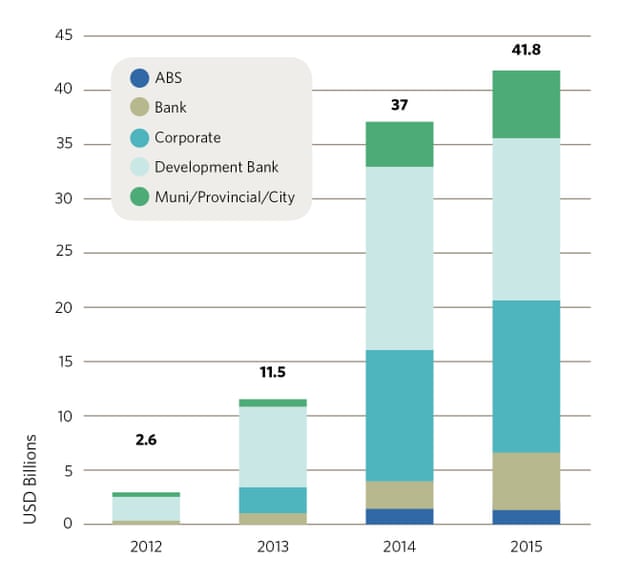
And, as a result of the increased corporate support, the value of green bonds that are being issued has grown exponentially (see this chart):
 
"The green bond market is still in its infancy. According to Climate Bonds Initiative, a UK nonprofit that tracks the market, the first green bond was issued in 2007, and the first corporate issuance didn't come along until 2013. Since then, a handful of high profile companies have jumped on the bandwagon, including EDF, a French power company, and Bank of America, which used the proceeds to loan money to cities and other businesses for installing solar panels, wind turbines and LED lighting."
 
This growth is predicted to continue into 2016 and beyond:
 
"According to Climate Bonds Initiative, the market, including government-issued bonds, reached an all-time high of $41.8bn in 2015, up from $36.6bn in 2014 and $11bn in 2013. Financial services company HSBC predicts between $55bn and $80bn worth of green bonds will be issued around the world in 2016, while the Climate Bonds Initiative believes sales will exceed $100bn."
 
Take care
David
 
David Chandler & Bill Werther
 
Instructor Teaching and Student Study Site: http://www.sagepub.com/chandler3e/
Strategic CSR Simulation: http://www.strategiccsrsim.com/
The library of CSR Newsletters are archived at: http://strategiccsr-sage.blogspot.com/
 
 
Can Apple's $1.5bn green bond initiative inspire more environmental investments?
By Alison Moodie
March 20, 2016
The Guardian
 

Monday, November 3, 2014

Strategic CSR - Green bonds

The article in the url below reports the latest developments in the market for green bonds:
 
"… instruments which tie the proceeds of a bond issue to environmentally friendly investments. Issuers of green bonds raise money, promising to spend it on (for example) building wind farms or less-polluting factories."
 
The market for these environmental/social-impact bonds has increased significantly in only the last two years:
 
"In 2012 $3 billion of such bonds were sold. In the first six months of 2014, the sum was about $20 billion, nearly twice as much as in 2013 as a whole. … Climate Bonds Initiative, a research group, reckons the cumulative value of all green bonds will be around $50 billion by the end of 2014. … two or three times more than German taxpayers will spend subsidising wind and solar energy—the largest green subsidy in Europe."
 
And, as the market for green bonds evolves, more entities (in particular, for-profit firms such as Unilever and Toyota) have started to issue them:
 
"All green bonds are investment grade; many have been two or three times oversubscribed; half were issued by companies, a switch from 2013, when most green bonds were sold by international agencies such as the World Bank."
 
As these types of bonds become more popular, however, the definition of what constitutes a green bond has become more contentious:
 
"The trouble with this sort of discretion is that different people have different views. Is fracking green? Is nuclear power? The definition is likely to be tested further because a big oil firm is working on a green bond to finance a carbon-capture and storage (CCS) scheme. CCS is an important technology—but oil firms are, for the most part, seen as beyond the pale by greens."
 
As a result, green bonds are running into a problem that eventually faces any diffusing practice—the issue of validation:
 
"A market needs standardised products. … Earlier this year 13 banks drew up a shared set of principles governing different categories of bonds; 49 institutions have signed up. Nonetheless, there is far from universal agreement over the question, 'What makes a bond green?' At the moment the answer is, 'If someone says it is.'"
 
Similar challenges threatened (and, ultimately, undermined) the legitimacy of carbon offsets, which we no longer hear much about. Given the size of the market for green bonds relative to the total bond market ($50 billion verses $80 trillion), we should hope that green bonds are given a more stable footing than carbon offsets, and that this happens sooner rather than later.
 
Take care
David
 
David Chandler & Bill Werther
 
Instructor Teaching and Student Study Site: http://www.sagepub.com/chandler3e/
Strategic CSR Simulation: http://www.strategiccsrsim.com/
The library of CSR Newsletters are archived at: http://strategiccsr-sage.blogspot.com/
 
 
Green grow the markets, O
July 5, 2014
The Economist
Late Edition – Final
61
 

Wednesday, September 5, 2012

Strategic CSR - The Prius Fallacy

The article in the url below identifies and defines the “Prius Fallacy”:

“… a belief that switching to an ostensibly more benign form of consumption turns consumption itself into a boon for the environment.”

The Prius Fallacy refers to our ability to convince ourselves that the best way to solve our excessive resource depletion of the Earth is to consume more things—essentially:

“… reframing luxury consumption preferences as gifts to humanity. A new car, a solar-powered swimming-pool heater, a 200-mile-an-hour train that makes intercity travel more pleasant and less expensive, better-tasting tomatoes—these are the sacrifices we're prepared to make for the future of the planet.”

By substituting one (possibly) greener product for another, we kill two birds with one stone—satisfying both our psychological and material needs. What we fail to realize, however, is that even as we innovate, rather than reducing our environmental impact, the unintended consequence is often the opposite (see The Jevons Paradox):

“The main effect of additional engineering improvements [to airplanes and travel routes] will be the same as for all such improvements in the past: to make travel easier, cheaper, more convenient and more attractive—thus encouraging us to do more of it.”

By continuing to support and work within the current paradigm, the overall effect is to make the problem worse, even while we convince ourselves that we are making it better:

“Global energy use is growing faster than population. It's expected to double by midcentury, and most of the growth will be in fossil fuels.”

Take care
David


Instructor Teaching Site: http://www.sagepub.com/strategiccsr/
The library of CSR Newsletters are archived at: http://strategiccsr-sage.blogspot.com/


It’s Too Easy Being Green
By David Owen
April 14, 2012
The Wall Street Journal
Late Edition – Final
C3

Friday, January 21, 2011

Strategic CSR - Welcome back!


Welcome back to the Strategic CSR Newsletter!
The first Newsletter of the Spring semester is below.
I will be traveling quite a bit this semester, so apologies in advance for any disruption to service. I will try and keep the Newsletters as regular as possible.
As always, your comments and ideas are welcome at any time.


The article in the url below, which appeared towards the end of December, focuses on firms’ PR management of the most prominent business crises in 2010. While the crises were a surprise to the general public, a common theme, in retrospect, is that the root causes were embedded in dysfunctional aspects of operations within each of the firms. Another common factor was mistakes by the firms in responding to the issues that served to exacerbate the negative reaction. In the case of Apple’s slow response to hardware problems with the iPhone 4, for example, the article advises:

“Always listen to your customer -- and if they are telling you something, say 'thank you' and offer to remediate the problem immediately. … Apple tried to minimize the problem, which is always a mistake.”

What seems clear is that each of the firms lacked a broad stakeholder approach to the problems it faced. While the firms focused on what they thought were key stakeholders (i.e., investors), they failed to appreciate the reaction of other stakeholders who turned out to be equally important in rectifying the problem (e.g., the government and consumers). While both BP (Gulf oil spill) and Toyota (product re-call) underestimated the role of regulatory authorities (in particular, the interaction between general public reaction and politicians’ willingness to act), for example, Apple (“Antennagate”) and Facebook (user privacy) failed to appreciate the central concerns of consumers. The cost of these misjudgments was often significant:

“A study by Interbrand, a branding firm owned by Omnicom Group Inc. that tracks and publishes the top 100 global brands every year, found that the BP brand fell off its top-100 global brand list this year. The oil company had been on the list for nine years, and ranked as the 83rd most valuable brand last year. … Interbrand found that Toyota's brand value fell 16% this year because of the recall. The car maker had been the eighth largest brand in the world in 2009 but slipped to No. 11 this year. Interbrand's metric takes into account the company's financial condition, third party consumer polling data and its specialists' opinions.”

Happy New Year!
David


Instructor Teaching Site: http://www.sagepub.com/strategiccsr/
The library of CSR Newsletters are archived at: http://strategiccsr-sage.blogspot.com/


The Year of Crisis Management: Public Relations Learned the Hard Way
By Suzanne Vranica
2020 words
30 December 2010
The Wall Street Journal
B6

Monday, April 27, 2009

Strategic CSR - Climate Change

The article in the url below offers a radical perspective that I found refreshing in its willingness to propose counter-intuitive ideas:

“Winning the war on global warming requires slaughtering some of environmentalism's sacred cows.”

The article covers ten “green heresies” that it argues need to be re-thought in order to maximize progress on the main goal—minimizing carbon-dioxide emissions:

“Live in Cities
A/C Is OK
Organics Are Not the Answer
Farm the Forests
China Is the Solution
Accept Genetic Engineering
Carbon Trading Doesn't Work
Embrace Nuclear Power
Used Cars — Not Hybrids
Prepare for the Worst”

Links to all ten “heresies” are on the article’s web page and contain interesting ideas and provocative suggestions. Typical is the claim that “A/C Is OK,” which is based on the argument that it is more environmentally-friendly to live in Arizona (where AC is a must) than in New England (where it is less of a necessity, but heating becomes much more important):

“When it's 0 degrees outside, you've got to raise the indoor thermometer to 70 degrees. In 110-degree weather, you need to change the temperature by only 40 degrees to achieve the same comfort level. … In the Northeast, a typical house heated by fuel oil emits 13,000 pounds of CO2 annually. Cooling a similar dwelling in Phoenix produces only 900 pounds of CO2 a year.”

Another interesting argument is that buying a second-hand car is more environmentally-friendly than buying a new hybrid:

“Pound for pound, making a Prius contributes more carbon to the atmosphere than making a Hummer, largely due to the environmental cost of the 30 pounds of nickel in the hybrid's battery. … If a new Prius were placed head-to-head with a used car, would the Prius win? Don't bet on it. Making a Prius consumes 113 million BTUs. … A single gallon of gas contains about 113,000 Btus, so Toyota's green wonder guzzles the equivalent of 1,000 gallons before it clocks its first mile. A used car, on the other hand, starts with a significant advantage: The first owner has already paid off its carbon debt. Buy a decade-old Toyota Tercel, which gets a respectable 35 mpg, and the Prius will have to drive 100,000 miles to catch up.”

The frightening thing, however, is that it might not make any difference what we do:

“The Electric Power Research Institute in Palo Alto, California, calculates that even if the US, Europe, and Japan turned off every power plant and mothballed every car today, atmospheric CO2 would still climb from the current 380 parts per million to a perilous 450 ppm by 2070, thanks to contributions from China and India. (Do nothing and we'll get there by 2040.)”

Take care
Dave

Bill Werther & David Chandler
Strategic Corporate Social Responsibility
© Sage Publications, 2006

WIRED MAGAZINE: 16.06.2008
Science: Planet Earth
Inconvenient Truths: Get Ready to Rethink What It Means to Be Green
In the age of climate change, what matters most is cutting carbon dioxide and other greenhouse gasses. That means rethinking everything you ever learned about being green.
http://www.wired.com/science/planetearth/magazine/16-06/ff_heresies_intro