The CSR Newsletters are a freely-available resource generated as a dynamic complement to the textbook, Strategic Corporate Social Responsibility: Sustainable Value Creation.

To sign-up to receive the CSR Newsletters regularly during the fall and spring academic semesters, e-mail author David Chandler at david.chandler@ucdenver.edu.

Monday, February 14, 2011

Strategic CSR - Soda Tax (II)

Given Friday’s Newsletter about Save the Children’s abandonment of its support for a soda tax, I was encouraged to see this full-page ad that appeared in The New York Times last week:


The ad, which was sponsored by Coca-Cola, Dr. Pepper, PepsiCo, SunnyD, and the American Beverage Association, featured the following copy:

America’s beverage companies are adding new labels to the front of every can, bottle and pack we produce—and displaying the total calories per container on beverages 20 ounces or smaller. We’re working together to provide calorie information right up front, so you can choose what’s right for you.

Not a huge event in itself, but a positive incremental step that speaks to food/beverage firms’ willingness to be held accountable for the products they produce by providing consumers with the information they need to make informed decisions about their food and drink consumption.

More information about the campaign can be found at the American Beverage Association host for the site:


Take care
David


Instructor Teaching Site: http://www.sagepub.com/strategiccsr/
The library of CSR Newsletters are archived at: http://strategiccsr-sage.blogspot.com/

Friday, February 11, 2011

Strategic CSR - Soda Tax (I)

Call me a cynic, but this story struck me as a convenient coincidence:

Over the last year, Save the Children emerged as a leader in the push to tax sweetened soft drinks as a way to combat childhood obesity. The nonprofit group supported soda tax campaigns in Mississippi, New Mexico, Washington State, Philadelphia and the District of Columbia. At the same time, executives at Save the Children were seeking a major grant from Coca-Cola to help finance the health and education programs that the charity conducts here and abroad, including its work on childhood obesity. The talks with Coke are still going on. But the soda tax work has been stopped.

When the COO for Save the Children was interviewed, she said there was no connection between the negotiations with Coke and the charity’s decision to drop its campaign advocating for a soda tax:

A $5 million grant from PepsiCo also had no influence on the decision, she said.

Needless to say:

Both companies fiercely oppose soda taxes.

The rationalized argument for halting the campaign was that it was “too controversial” and “[didn’t] fit with the way that Save the Children works.

There are three types of organizations in society – for-profit firms, nonprofit organizations, and regulatory agencies. For-profit firms are the major organizations in society – they are able to utilize market forces to combine scarce and valuable resources in the most efficient ways. The value that nonprofits and regulators bring, however, is in acting to correct market gaps or abuses. All three sectors need to be strong and independent in order for social value to be maximized. To the extent that one organizational form is inefficient or corrupted by another, society loses.

It seems to me that, if there is any campaign in which a children’s charity that is concerned about childhood obesity should be involved, it is acting to limit the average daily calorie intake for the most impressionable among us.

Representatives of both Coca-Cola and Pepsi said they had not asked the charity to alter its position on soda taxes.

I am sure they didn’t have to.

Have a good weekend.
David


Instructor Teaching Site: http://www.sagepub.com/strategiccsr/
The library of CSR Newsletters are archived at: http://strategiccsr-sage.blogspot.com/


Save the Children Backs Away From Soda Tax Campaign
By WILLIAM NEUMAN
1120 words
15 December 2010
The New York Times
Late Edition - Final
1

Wednesday, February 9, 2011

Strategic CSR - Fairtrade

The article in the url below contains some revealing facts and figures about the growing industry for Fairtrade-labeled products:

Although Fairtrade products represented only 0.01 per cent of worldwide food and beverage sales in 2009, their revenues rose by more than 40 per cent annually between 1998 and 2007, by 22 per cent in 2008 and by 15 per cent in 2009. In some niches, the movement exercises considerable clout. Although Fairtrade accounted for only 1 per cent of the worldwide coffee market last year, it captured 20 per cent of UK retail sales of ground coffee.

The quotes were taken from a report released last November by the Institute of Economic Affairs (IEA) titled ‘Fair Trade without the Froth.’ Interestingly:

The cost of obtaining Fairtrade certification is relatively high: £1,570 in the first year. … In 2007, the four leading Fairtrade-certified nations were Mexico, Colombia, Peru and South Africa.

The conclusion by the free-market-oriented IEA is that, contrary to many who believe in efficient markets, Fairtrade goods do not distort the free interplay of demand and supply. In essence, Fairtrade goods are luxury items, for which there is a demonstrated market demand:

Buying Fairtrade chocolate no more distorts the chocolate market than buying a Louis Vuitton handbag distorts the handbag market. In both cases buyers are sending signals: that they are prepared to spend more on a bag with a prestigious label, or on chocolate that provides cocoa growers with a better life.

Take care
David


Instructor Teaching Site: http://www.sagepub.com/strategiccsr/
The library of CSR Newsletters are archived at: http://strategiccsr-sage.blogspot.com/


No markets were hurt in making this coffee
By Michael Skapinker
803 words
9 November 2010
Financial Times
Asia Ed1
09
or

Monday, February 7, 2011

Strategic CSR - Seventh Generation

The article in the url below gives a good indication of the extent to which Walmart’s sustainability drive is genuine:

For years, Seventh Generation Inc. co-founder Jeffrey Hollender liked to say "hell would freeze over" before his company's environmentally friendly household products would be sold by Wal-Mart Stores Inc. He feels differently now. Starting next month, Seventh Generation staples, including laundry detergent, dish soap, all-purpose sprays and disinfectant wipes, will be sold in about 1,500 Wal-Mart stores. By September, other cleaners, diapers and baby wipes will be available on Walmart.com.

The combination gives Seventh Generation the mainstream outlet it has been seeking and Walmart expanded access to the growing environmentally conscious household cleaning market:

‘We're not just putting [Seventh Generation's] products on the shelf,’ says Al Dominguez, Wal-Mart's vice president of household chemicals and paper goods. ‘We want their help in developing a category that's more sustainable.’

In general, Walmart has come a long way:

Five years ago, the world's largest retailer by revenue began setting goals to reduce its energy consumption, cut waste and introduce more sustainable products. Last year, Wal-Mart introduced a program to screen chemical-based products for ingredients that could have harmful health or environmental effects.Seventh Generation and Wal-Mart are both members of the Sustainability Consortium, a group of manufacturers, retailers, nongovernmental organizations and government officials that is developing tools and strategies to evaluate the environmental and social impacts of products' lifecycles. Wal-Mart plans to eventually incorporate the data into a sustainable product index, which it plans to make available to consumers.

Ultimately, it is all about scale for a firm that wants to disseminate its message as widely as possible:

“‘At this point, we now believe that we can have a bigger impact by partnering with Wal-Mart than by shunning it,’ Mr. Hollender wrote.

Take care
David


Instructor Teaching Site: http://www.sagepub.com/strategiccsr/
The library of CSR Newsletters are archived at: http://strategiccsr-sage.blogspot.com/


Adversary's Clean Start With Wal-Mart
After Years Criticizing Retailer's Environmental Sins, Seventh Generation Now Partners on Efforts, Puts Products on Shelf
By ELLEN BYRON
WSJ
July 26, 2010

Saturday, February 5, 2011

Strategic CSR - CO2

The article in the url below presents the scale of the climate change problem in graphical form. It contains various representations of the relative carbon dioxide emissions of different countries, focusing on the U.S. and China. These two countries currently account for 19.9% and 21.4% of global emissions respectively—figures that are projected to continue rising absolutely and be 15.9% and 29% respectively by 2030:


The article also shows the disparities between the two countries on a per capita basis (for example, while the U.S. in 2005 had 461 cars per thousand people, the comparable number in China was only 15 per thousand), which highlights the difficulties of managing China’s economic expansion in a sustainable manner:

Each will have to use much less coal-fired electricity, for example, and opt instead for more renewables. Above all, people will have to use less energy. In the case of China, that means more energy than today, but less than they might have used without emissions curbs. In the US, it means using less than today - a difficult adjustment.

Have a good weekend
David

Bill Werther & David Chandler
Strategic Corporate Social Responsibility: Stakeholders in a Global Environment (2e)
© Sage Publications, 2011

Instructor Teaching Site: http://www.sagepub.com/strategiccsr/
The library of CSR Newsletters are archived at: http://strategiccsr-sage.blogspot.com/


The G2: the key to CO2
Ed Crooks and Valentina Romei
484 words
9 December 2009
Financial Times
Asia Ed1
08
or

Friday, January 28, 2011

Strategic CSR - CSR in 2010

The article in the url below provides an overview of the major CSR stories in 2010.

Issues covered range from the BP Gulf oil spill, to the launch of ISO26000 (Case-study: ISO26000, p305), to the expansion of Marks & Spencer’s Plan A (Case-study: Primark versus Marks & Spencer, p198), to the release of The Economics of Ecosystems and Biodiversity (Teeb) study.

In terms of both its breadth (range of issues and firms covered) and depth (facts and figures), the article is a very good summary of the past 12 months in CSR.

Have a good weekend.
David


Instructor Teaching Site: http://www.sagepub.com/strategiccsr/
The library of CSR Newsletters are archived at: http://strategiccsr-sage.blogspot.com/


2010: A Year Dominated by Macro Trends
Rajesh Chhabara
December 3, 2010
Ethical Corporate Magazine
11

Wednesday, January 26, 2011

Strategic CSR - Bribery

The article in the url below reports on the Bribery Act, new legislation that is due to be introduced in the UK in April. The legislation is similar to the Foreign Corrupt Practices Act (FCPA) in the U.S., but, in key areas, goes further:

The Bribery Act covers any company that conducts business in Britain, regardless of where the company is based. It goes beyond the FCPA by not just prohibiting illicit payments to foreign officials, but also bribes between private businessmen. It applies even if the individual who makes the payment doesn't realize the transaction was a bribe, legal experts say.

The Bribery Act, which is described in the article as “the FCPA on steroids,” consolidates various UK rules and policies concerning bribery, while also extending the reach of government oversight and the possible punishments for transgressions:

[It] boosts the maximum penalty for bribery to 10 years in prison from seven, and sets no limits on fines.

The Act also bans “grease payments” (“small bribes common in some countries to get mail service, phone hook-ups or other services that otherwise would be delayed”) that are permitted under the FCPA, as long as they are declared.

The UK legislation appears as the U.S. government is increasing FCPA prosecutions (in terms of both number and penalties), while China and other European countries are also increasingly monitoring their firms’ activities on this issue. The recent clause of the Dodd-Frank Act in the U.S. providing financial incentives for whistleblowers to report bribery carries the potential to alter the landscape for firms regarding bribery and heightens the need to increase their compliance programs to ensure they are protected.

Take care
David


Instructor Teaching Site: http://www.sagepub.com/strategiccsr/
The library of CSR Newsletters are archived at: http://strategiccsr-sage.blogspot.com/


U.K. Law On Bribes Has Firms In a Sweat
By Dionne Searcey
951 words
28 December 2010
The Wall Street Journal
B1

Monday, January 24, 2011

Strategic CSR - Pepsi

I recently noticed a regular column that appears in the FT on Thursdays titled “The Case Study.” It presents a brief analysis of a problem facing a firm and the solution that it came up with to resolve the problem. Sometimes the problems are related to CSR, but most of the time they are not.

The case in the url below focused on Pepsi’s decision to pursue a more environmentally friendly bottle for its drinks. Thinner bottles use less plastic (reducing waste and raw materials) and lighter bottles are easier to transport (reducing carbon emissions). The case states that the project was pursued by a senior engineer within Pepsi, Rajendra Gursahaney, and was far from straightforward:

The idea would either revolutionise the bottling industry or cost his company millions of dollars in delays.

The difficulty arises because plastic bottles require a minimum amount of rigidity to retain their shape during the production process:

Non-carbonated drinks are vulnerable to bacteria if they are not bottled properly. So, most companies heat beverages to a temperature that destroys micro-organisms. The hot liquid is then poured into a bottle until it is full, destroying any bacteria on its inner wall. Bottlers must use a thick plastic that will not deform, which means it is expensive, heavy and has a big environmental footprint.

It is when the liquid cools that the potential for deformity occurs and a thinner bottle increases this risk. The proposed solution was to add nitrogen (a gas that does not harm either the product or consumer) during production. As the gas expands, Gursahaney reasoned, it would counteract the cooling of the liquid to retain the bottle’s shape:

The difficulty was that nitrogen could not be added to a hot drink, as it would instantly vaporise and the fluid would bubble out.

Read the article to find out how the team at Pepsi overcame the problem, gradually refining the process until quality control reached an acceptable success rate. The solution was a result of the team of six working for over a year in the laboratory. The outcome for Pepsi and the environment was significant:

A traditional 1.5 litre bottle weighs 63g; Guru's bottle weighed only 48g. Pepsi forecasts $7.5m in annual plastics savings in Russia alone.

Importantly, to ensure the broadest application of this technology and secure the greatest environmental benefit:

Pepsi has chosen not to patent this idea, but instead is willing to share the technology with other companies.

Take care
David


Instructor Teaching Site: http://www.sagepub.com/strategiccsr/
The library of CSR Newsletters are archived at: http://strategiccsr-sage.blogspot.com/


The case study: Creating a lighter plastic bottle; Pepsi Beverages Company
Elton, Chester Gostick, Adrian
795 words
4 November 2010
Financial Times
USA Ed1
12
or

Friday, January 21, 2011

Strategic CSR - Welcome back!


Welcome back to the Strategic CSR Newsletter!
The first Newsletter of the Spring semester is below.
I will be traveling quite a bit this semester, so apologies in advance for any disruption to service. I will try and keep the Newsletters as regular as possible.
As always, your comments and ideas are welcome at any time.


The article in the url below, which appeared towards the end of December, focuses on firms’ PR management of the most prominent business crises in 2010. While the crises were a surprise to the general public, a common theme, in retrospect, is that the root causes were embedded in dysfunctional aspects of operations within each of the firms. Another common factor was mistakes by the firms in responding to the issues that served to exacerbate the negative reaction. In the case of Apple’s slow response to hardware problems with the iPhone 4, for example, the article advises:

Always listen to your customer -- and if they are telling you something, say 'thank you' and offer to remediate the problem immediately. … Apple tried to minimize the problem, which is always a mistake.

What seems clear is that each of the firms lacked a broad stakeholder approach to the problems it faced. While the firms focused on what they thought were key stakeholders (i.e., investors), they failed to appreciate the reaction of other stakeholders who turned out to be equally important in rectifying the problem (e.g., the government and consumers). While both BP (Gulf oil spill) and Toyota (product re-call) underestimated the role of regulatory authorities (in particular, the interaction between general public reaction and politicians’ willingness to act), for example, Apple (“Antennagate”) and Facebook (user privacy) failed to appreciate the central concerns of consumers. The cost of these misjudgments was often significant:

A study by Interbrand, a branding firm owned by Omnicom Group Inc. that tracks and publishes the top 100 global brands every year, found that the BP brand fell off its top-100 global brand list this year. The oil company had been on the list for nine years, and ranked as the 83rd most valuable brand last year. … Interbrand found that Toyota's brand value fell 16% this year because of the recall. The car maker had been the eighth largest brand in the world in 2009 but slipped to No. 11 this year. Interbrand's metric takes into account the company's financial condition, third party consumer polling data and its specialists' opinions.

Happy New Year!
David


Instructor Teaching Site: http://www.sagepub.com/strategiccsr/
The library of CSR Newsletters are archived at: http://strategiccsr-sage.blogspot.com/


The Year of Crisis Management: Public Relations Learned the Hard Way
By Suzanne Vranica
2020 words
30 December 2010
The Wall Street Journal
B6

Friday, December 3, 2010

Strategic CSR - See you in January!


This will be the last CSR Newsletter of the Fall semester.
Have a great holiday season and I will see you in January!


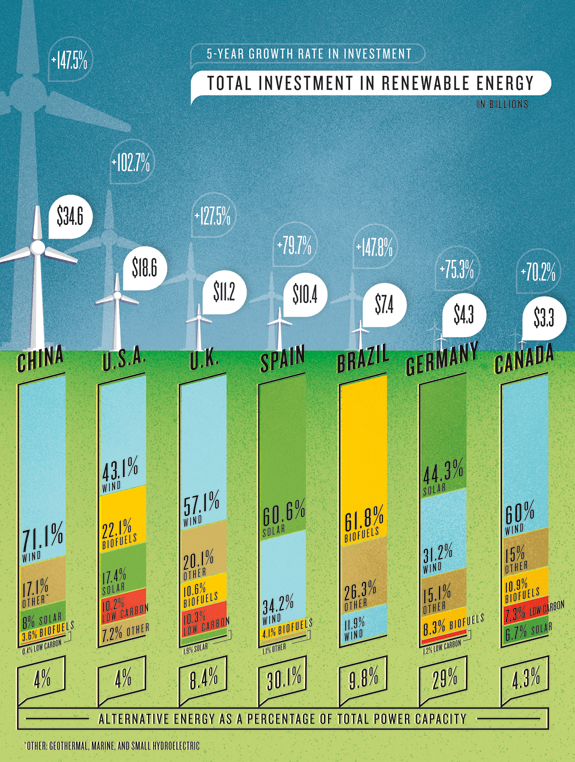
The article in the url below contains a graphic (http://images.fastcompany.com/magazine/148/now-22-infographic-inline.jpg) that depicts the total spending of the seven countries that have invested the most in renewable energy:

As 3,500 global leaders in the energy field gather in Montreal to discuss trends and growth, we calculate which countries have earned the biggest bragging rights. Here, we compare the seven that have made the largest investments in alternative energy.

As well as an overall figure, the graphic breaks down each country’s spending into different kinds of renewable energies (i.e., the percentage spent on wind, solar, biofuels, and so on). The 5 year growth rate in investment for each country is listed, as well as the percentage of total energy capacity that these investments constitute.

Have a good weekend.
David

Bill Werther & David Chandler
Strategic Corporate Social Responsibility: Stakeholders in a Global Environment (2e)
© Sage Publications, 2011

Instructor Teaching Site: http://www.sagepub.com/strategiccsr/
The library of CSR Newsletters are archived at: http://strategiccsr-sage.blogspot.com/


"Who's Really Investing in Alternative Energy?"
Fast Company Magazine
Issue: 148 | Date: September, 2010 | By: Emily Benton

Wednesday, December 1, 2010

Strategic CSR - Caring Capitalism

The article in the url below focuses on the growing wealth of successful Indian entrepreneurs (such as Vinod Khosla, “the billionaire venture capitalist and co-founder of Sun Microsystems”) and their willingness to invest it in philanthropic enterprises. One quote, in particular, from the article stood out:

Mr. Khosla said his experience with microfinance had helped shape his views on the best way to tackle poverty. He has invested in commercial microfinance lenders and has donated to nonprofit ones, and he said that moneymaking versions had grown much faster and reached many more needy borrowers.

The article and the philosophy behind the quote draws heavily on the Bottom-of-the-Pyramid (BOP) work of C.K. Prahalad (Issues: Profit, p271):

By backing businesses that provide education loans or distribute solar panels in villages, he says, he wants to show that commercial entities can better help people in poverty than most nonprofit charitable organizations.

While there is certainly an important role for social entrepreneurs in CSR (Issues: Social Entrepreneurship, p189), however, I think it is overly optimistic to think businesses should exist primarily to solve social problems.

Business is the solution to market problems/opportunities that carry social value as a consequence. Firms maximize social value by combining scarce and valuable resources to meet market needs, while considering the interests of a broad range of stakeholders and planning to maximize sustainable shareholder returns over the long term. Firms can often use their expertise to aid in meeting social goals, but this should not be their primary concern. Governments and nonprofits also play important social roles where gaps in the market occur.

The danger in using for-profit organizations primarily to solve social problems is that the profit motive can easily corrupt the founding purpose. This is becoming increasingly evident in the microfinance industry (see Strategic CSR – Microfinance, September 27, 2010, below) in which the article reports that Khosla has just profited “about $117 million” from SKS Microfinance’s recent IPO (see also, more recently, Strategic CSR – Microfinance, November 22, 2010).

Take care
David


Instructor Teaching Site: http://www.sagepub.com/strategiccsr/
The library of CSR Newsletters are archived at: http://strategiccsr-sage.blogspot.com/


In Capitalism, Sun's Co-Founder Sees a Pathway to Help the Poor
By VIKAS BAJAJ
1287 words
6 October 2010
The New York Times
Late Edition - Final
1


From: David Chandler {msbbe096}
Sent: Monday, September 27, 2010 11:45 AM
Subject: Strategic CSR - Microfinance

The article in the url below suggests the dangers of success for the microfinance business model (Issues: Microfinance, p245):

SKS Microfinance, India's largest lender to the poor, aims to raise about $350m this month by selling a 21.6 per cent stake in an initial public offering expected to spark a wave of listings by equity-strapped Indian microfinance companies.”

While the high rates of repayment and community structure present a real opportunity for microfinance institutions to be profitable (or at least self-sustaining), the profit-maximization pressures (higher interest rates and lower loan qualification standards) that accompany a public listing carry the potential to undermine the social-entrepreneurship microfinance goals (Issues: Social Entrepreneurship, p189):

“Muhammad Yunus, the Nobel Peace Prize-winning founder of Bangladesh's Grameen Bank - the world's most famous microlender - has criticised the commercialisation of the industry, saying profit-oriented microlenders are little different to the loan sharks they once set out to replace.”

The possibility for corruption quickly arises as the pursuit of profit spreads across the sub-units of the organization:

“SKS, which says it has 7m borrowers in 19 Indian States, also plans to boost its revenues through alliances with large companies to distribute their products - such as mobile phones and water purifiers - even as it provides rural consumers with the microloans needed to buy the items.”

The article in the second url below shows the success and rapid growth of microfinance organizations, such as SKS, in India:

“For the last three years, outstanding loan portfolios of Indian micro-finance institutions have grown by 65 per cent annually, according to the World Bank, with total loans of about $2.5bn to about 22.6m households.”

As well as reinforcing the threats:

“Typical loans average between $200 and $250, and carry rates of about 28 per cent - lower than money-lenders, albeit still expensive when compared with commercial bank rates.”

Take care
David


Instructor Teaching Site: http://www.sagepub.com/strategiccsr/
The library of CSR Newsletters are archived at: http://strategiccsr-sage.blogspot.com/


SKS Microfinance plans to raise $350m in IPO
By James Fontanella-Khan in Mumbai and Amy Kazmin in New Delhi
418 words
21 July 2010
Financial Times
Asia Ed1
17

New networks help ease debt dilemma
Kazmin, Amy
603 words
21 July 2010
Financial Times
Asia Ed1
17