The CSR Newsletters are a freely-available resource generated as a dynamic complement to the textbook, Strategic Corporate Social Responsibility: Sustainable Value Creation.

To sign-up to receive the CSR Newsletters regularly during the fall and spring academic semesters, e-mail author David Chandler at david.chandler@ucdenver.edu.

Sunday, January 26, 2014

Strategic CSR - Carbon price

While carbon markets at the governmental level are floundering (think Europe's low cost of carbon and Australia reversing course on legislation to introduce a cap-and-trade scheme), the article from The Economist in the url below shows that most of the innovation on this issue is coming from the private sector. Firms are increasingly developing a cost for carbon that they are then using to plan future projects and investments:
 
"A study by CDP, a research group, asked large firms based or operating in America what tools they had for managing risk; 29 said they used an internal carbon price. Anecdotally, more apply such a price but did not mention it as a risk-mitigation measure."
 
Because firms are doing this on a firm-by-firm basis and they range across vastly different industries, the prices they are allowing for a ton of carbon vary widely—primarily because carbon is relevant to their operations in different ways:
 
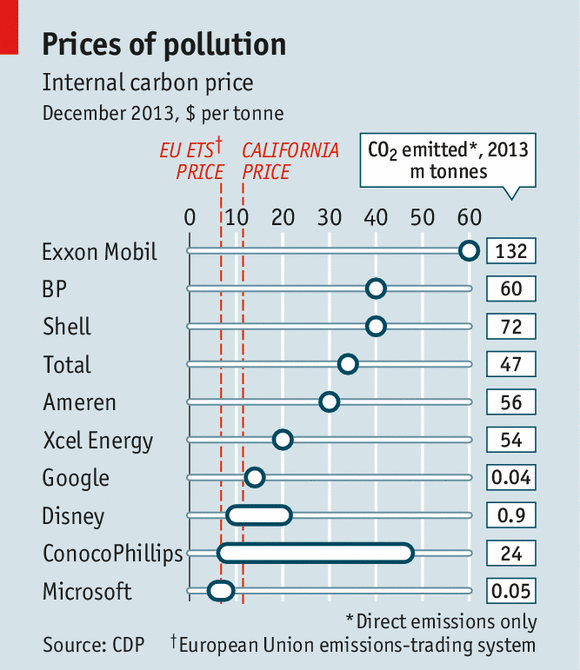
"The prices range from $6-7 a tonne of carbon dioxide at Microsoft to $60 a tonne at Exxon Mobil. … As a rule, those whose assets have a long productive life and which might be affected by green policies far into the future (such as oil companies) use higher prices than consumer-goods firms whose products are mainly influenced by current policies."
 
The companies are pushing ahead with this for two basic reasons: first, although it is hard to understand why they think so based on recent performance, firms anticipate politicians will eventually get their act together and impose a carbon price:
 
"For many companies the aim is to prepare themselves for future environmental legislation. AEP, a power supplier, says it uses the system because 'it assumes a price of carbon…will begin in the US by roughly 2020.' Delta Air Lines says it uses a price for evaluating flights to Europe 'in anticipation of compliance with EU ETS.'"
 
Second, it allows firms, such as ConocoPhillips and Disney (see: Strategic CSR – Carbon tax), to better understand the present value of future projects and investments:
 
"ConocoPhillips, an oil firm, requires that capital projects worth over $75m calculate the cost of emissions based on a price of between $8 and $46 a tonne, depending on the life of the project. The forecast value of a new oilfield would be: estimated output multiplied by the estimated future oil price minus development costs and carbon emissions. … Disney, a media conglomerate, goes further still. It invests in schemes to offset or reduce carbon emissions and charges the cost of these to business units in proportion to how much they contribute to the company's overall emissions. In effect, this works like an internal carbon tax."
 
The result of these varied approaches is a range of prices among firms. As the article notes, however, the surprising (and encouraging) thing is how high some of the prices are—much higher than any of the failing government experiments:
 
"The market price of carbon is €4.90 ($6.70) per tonne of CO2 in the EU, $11.50 in California. Big oil companies charge $34 or more. That is closer to the 'social cost of carbon'—the damage from an extra tonne of CO2—than to the market price. … the sort of carbon price some companies are using for planning would, if it became a market price, have a much bigger impact than any of the policies that governments are now talking about."
 
The graphic that accompanies the article demonstrates the extent of the differences in internal carbon price among firms:
 
 
Take care
David
 
David Chandler & Bill Werther
 
Instructor Teaching and Student Study Site: http://www.sagepub.com/chandler3e/
Strategic CSR Simulation: http://www.strategiccsrsim.com/
The library of CSR Newsletters are archived at: http://strategiccsr-sage.blogspot.com/


Carbon copy
Some firms are preparing for a carbon price that would make a big difference
December 14, 2013
The Economist
70
 

Friday, January 24, 2014

Strategic CSR - Financial Crisis

The article in the url below provides an update on the cost of the recent Financial Crisis:
 
“Wall Street could pay nearly $50 billion to buy peace from federal authorities who are taking aim at the banks over their role in the mortgage crisis, according to interviews and a confidential analysis of the industry’s potential legal exposure. … The $50 billion figure does not include JPMorgan’s $13 billion payout, which means the ultimate industry tab could exceed $60 billion, according to the analysis.”
 
The basis for these estimates is the $13 billion settlement announced at the end of last year between the government and JP Morgan. Based on the relative amounts of mortgages issued by each of the largest banks from 2005-2008 (see accompanying graphic) and comparing to the JP Morgan settlement, the article arrives at estimates for each of the banks, individually:
 
“The analysis, which lawyers prepared for one of the financial institutions and which was reviewed by The New York Times, indicates that Bank of America could ultimately settle for $11.7 billion in penalties, with an additional $5 billion in relief to homeowners. Morgan Stanley’s combined tally, the analysis shows, could be around $3 billion, with roughly a third going to consumer relief, while Goldman Sachs’s total could come to roughly $3.4 billion. For the Royal Bank of Scotland, the total price could be around $10 billion, which might prompt an outcry in Britain, where the government owns a majority stake in the bank. Citigroup could pay roughly $1 billion, the analysis shows. The potential penalties for other banks are under $1 billion, the analysis shows.”
 
It is encouraging to see the government act as a concerned stakeholder … at last. Of course, all pain is relative:
 
“A payment of $50 billion, made up of a string of separate deals, would amount to roughly half the total annual profit of large American banks in 2012.”
 
Have a good weekend
David
 
David Chandler & Bill Werther
 
Instructor Teaching and Student Study Site: http://www.sagepub.com/chandler3e/
Strategic CSR Simulation: http://www.strategiccsrsim.com/
The library of CSR Newsletters are archived at: http://strategiccsr-sage.blogspot.com/
 
 
Wall Street Predicts $50 Billion Bill to Settle U.S. Mortgage Suits
By Jessica Silver-Greenberg and Peter Eavis
January 10, 2014
The New York Times
Late Edition – Final
A1
 

Wednesday, January 22, 2014

Strategic CSR - Welcome back!


Welcome back to the Strategic CSR Newsletter!
The first Newsletter for the Spring semester is below.
As always, your comments and ideas are welcome.
 
 
Over the break, I read the foundational 1953 book by Howard Bowen, Social Responsibilities of the Businessman. Two thoughts struck me—reading the book was both uplifting and depressing, essentially for the same reason.
 
First, the process was uplifting because of how prescient Bowen was in identifying trends and proposing answers to issues that we still debate. Much of what he wrote in 1953 would not have looked out of place in a policy proposal or opinion paper published today. It may be that, if more people had just read Bowen’s book, a lot of the debate in the intervening period could have been circumvented.
 
Second, the process was depressing because we still do not have widely-agreed upon answers to the questions that Bowen (and others, such as Frank Abrams, see: Abrams, F. W. 1951. Management's Responsibilities in a Complex World. Harvard Business Review, 29(3): 29-34) were asking 60 years ago. Here is one example (the book is littered with similar ideas):
 
“The day of plunder, human exploitation, and financial chicanery by private businessmen [sic] has largely passed. And the day when profit maximization was the sole criterion of business success is rapidly fading. We are entering an era when private business will be judged solely in terms of its demonstrable contribution to the general welfare.” (p52)
 
Of course, the constant ‘reinventing of the wheel’ is great because it keeps us all in a job; but it would be nice to at least feel like we are making progress after so much effort.
 
Take care
David
 
David Chandler & Bill Werther
 
Instructor Teaching and Student Study Site: http://www.sagepub.com/chandler3e/
Strategic CSR Simulation: http://www.strategiccsrsim.com/
The library of CSR Newsletters are archived at: http://strategiccsr-sage.blogspot.com/
 

Wednesday, December 11, 2013

Strategic CSR - Earth


This will be the last CSR Newsletter of the Fall semester.
Have a great holiday season and I will see you in 2014!
 
 
Some stark quotes from a review of the book Countdown: Our Last, Best Hope for a Future on Earth? that appeared recently in The New York Times Book Review:
 
“If we wanted to bring about the extinction of the human race as quickly as possible, how might we proceed? … the most effective measure, counterintuitive as it may be, would be to increase our numbers. … The more people, the greater the likelihood of ecological collapse, nuclear war, plague.”
 
“Some seven billion people are alive today; the United Nations estimates that by the end of the century we could number as many as 15.8 billion. Biologists have calculated that an ideal population — the number at which everyone could live at a first-world level of consumption, without ruining the planet irretrievably — would be 1.5 billion.”
 
“[The author’s] dire warnings, and the warnings of the scientists and government officials he interviews, are unrelenting, with variations of the following sentence appearing at regular intervals: ‘In the entire history of biology, every species that outgrows its resource base suffers a population crash — a crash sometimes fatal to the entire species.’”
 
“From Thomas Malthus to Paul and Anne Ehrlich, authors of The Population Bomb (1968), population doomsayers have endured ridicule and vilification, largely because their predictions of imminent doom fail to materialize on schedule. In our own time, there are a few mitigating indicators. Much of the current population growth comes in the developing world, where carbon consumption remains low, so the environmental effect is relatively muted. The next thousand Americans will do more than twice as much damage as the next hundred thousand Nigeriens.”
 
“The grim prophecies are illustrated with statistics. Each year the world adds the equivalent of another Germany or Egypt; by 2040, China will have more than 100 million 80-year-olds. We add another million people every four and a half days.”
 
Thoughts worth pondering as we enter the most materialistic (sorry, I meant ‘festive’) time of the year!
 
Take care
David
 
David Chandler & Bill Werther
 
Instructor Teaching and Student Study Site: http://www.sagepub.com/chandler3e/
Strategic CSR Simulation: http://www.strategiccsrsim.com/
The library of CSR Newsletters are archived at: http://strategiccsr-sage.blogspot.com/


Earth Control
By Nathaniel Rich
October 13, 2013
The New York Times Book Review
Late Edition – Final
18
 

Monday, December 9, 2013

Strategic CSR - Twitter

While it has been apparent for some time now that the free flow of information was shifting the balance of power away from corporations and into the hands of their most active stakeholders (Chapter 4, The Free Flow of Information, p161), the article in the url below demonstrates how far firms have to go in order to regain the initiative:
 
“News of a business crisis spreads internationally within an hour in more than a quarter of cases, and in more than two-thirds of cases it has reached an average of 11 countries within 24 hours, yet it takes businesses on average fully 21 hours to start getting their own version of the story out.”
 
The report on which this article was based was written after interviewing “100 senior PR professionals”—a reasonable source for information about the PR/reputation/crisis management industry. And, for those firms out there who do not yet understand this (see: Strategic CSR – British Airways):
 
“Social media are important channels for airing dirty laundry, albeit more so locally than internationally. In half the cases, social media had ‘a significant impact’ on how the news spread locally, but in somewhat under a third of the cases internationally, the report said.”
 
What is worse is that, if a firm starts behind the curve on a breaking story, the damage can be significant:
 
“Not only do social media help spread the word initially, they also help keep the spotlight on the story. … Freshfields found that ‘inability to control reputational crises in the early stages can prove costly for a business, affecting its value, revenue and long-term reputation.’ In about six out of 10 cases, the impact disrupted operations. In just over half the cases, revenue suffered. Over a quarter of cases–27%–resulted in a stock price drop. ‘Only one in 10 companies (11%) suffered no impact or were adequately prepared to deal with the issue,’ the survey found.”
 
What is most interesting about the report, however, is that it has begun to tease apart different moderating effects for the role that social media plays in enhancing the reputational damage associated with crises:
 
“Freshfields identified four kinds [of crises]: operational, such as a product recall or environmental problem; behavioural, involving dubious conduct by the company or its employees; corporate, such as a liquidity problem or litigation; or informational, i.e. IT or data security problems. Operational crises had the most serious revenue impact, while behavioral crises were the fastest to move through social media. In fact, social media moved news of bad behavior at twice the speed of operational crises, with 40% of behavioral bad news spreading within an hour through social media, the report said, twice the rate of operational crises.”
 
While the report identifies various reasons for firms’ slow responses (e.g., the need to get sign-off by lawyers and senior executives), the underlying message is that firms are not preparing ahead of time to minimize the potential damage when the crisis occurs. The overall goal? To avoid “trial by Twitter.
 
Take care
David
 
David Chandler & Bill Werther
 
Instructor Teaching and Student Study Site: http://www.sagepub.com/chandler3e/
Strategic CSR Simulation: http://www.strategiccsrsim.com/
The library of CSR Newsletters are archived at: http://strategiccsr-sage.blogspot.com/
 
 
Business Caught Flat-footed in Trial by Twitter
By Gregory J. Millman
November 4, 2013
The Wall Street Journal
 

Friday, December 6, 2013

Strategic CSR - Walmart

Walmart is a phenomenon that CSR advocates need to take seriously because it is so huge. When Walmart does something, it immediately and irrevocably alters whatever market it is affecting. As reported in the article in the url below, this effect is no more apparent than in its experiments with solar energy:
 
“In the race for commercial solar power, Wal-Mart is killing it. The company now has almost twice as much capacity as second-place Costco. A better comparison: Wal-Mart is converting more sun into energy than 38 U.S. states [see: https://openpv.nrel.gov/rankings].”
 
Whatever Walmart decides to do (good or bad) is big news. This applies equally to its attempts to reduce packaging in its supply chain (Chapter 3: The Walmart Paradox, p102) as it is for beer:
 
“Wal-Mart recently decided alcohol was good business and vowed to double sales by 2016. The result: 500 reps from the alcohol industry converged on the Sam’s Club auditorium in Bentonville, Arkansas, for an ‘adult beverages summit’ focused on Wal-Mart.”
 
In similar ways, Walmart’s effect on the market for solar power is dramatic:
 
“After a 40 percent surge in installations through the second quarter, Wal-Mart now draws on 89 megawatts of capacity, according to a report last week by the Solar Energy Industries Association. That’s roughly enough to power 22,250 U.S. homes.”
 
This graphic, which accompanies the article, displays the disparity among Walmart and its nearest solar power competitors:
 
 
Have a good weekend
David
 
David Chandler & Bill Werther
 
Instructor Teaching and Student Study Site: http://www.sagepub.com/chandler3e/
Strategic CSR Simulation: http://www.strategiccsrsim.com/
The library of CSR Newsletters are archived at: http://strategiccsr-sage.blogspot.com/


Wal-Mart Now Draws More Solar Power Than 38 U.S. States
By Tom Randall
October 25, 2013
Bloomberg
 

Wednesday, December 4, 2013

Strategic CSR - e-waste

The CSR community often applies screens to filter for CSR behavior at the level of the industry. In other words, tobacco is a bad industry, along with alcohol and weapons. In reality, however, there is considerable variance within industries, but data that allows like-for-like comparison is hard to get. The article in the url below provides some insight in this respect by looking at how e-waste (Chapter 8, Case study: e-waste, p544) is being handled in the cellphone industry. To be sure, no company is excelling and the industry as a whole has much work to do:
 
“All the major carriers say they are working hard to get consumers to bring mobile devices back into stores for reuse or recycling. But the hard numbers – overall – remain low. The Environmental Protection Agency estimates that only 11% of smartphones and tablets are being recycled. Electronic waste has become a major environmental issue, with mercury and other heavy metals from devices crowding landfills across the US.”
 
Nevertheless, the results generated by the article’s comparison among the performance of the industry’s biggest players are surprising:
 
“When it comes to e-waste, though, not all US carriers are equal. I asked the top US carriers – Verizon, AT&T, Sprint and T-Mobile – how many phones they recycled in 2012 so I could compare those figures with the number of phones sold in the same year. Among the major carriers, Sprint is way ahead of the pack. Its recycled or reused smartphones equate to 44% of its sales in 2012, compared to only 11.5% for AT&T. For Verizon, which divulged numbers incorporating all devices instead of just smartphones, its recycling and reuse rate came to 28%. T-Mobile doesn't list its figures and didn't respond to the Guardian's request for a similar percentage.”
 
The article is not clear about what is driving the differences (trade-in rates do not explain it, for example). What is clear, however, is that Sprint is doing something right on an issue that is becoming increasingly important for this industry:
 
“Since 2001, Sprint has diverted more than 53m mobile devices from landfills and it offers up to $300 in-store credit for old devices, including those from other carriers. In 2012, Sprint paid out $100 million in-store credit to customers.”
 
What is also clear, is that this makes a lot of business sense to Sprint:
 
“Sprint has made it clear that its buyback program isn't just about doing good; the program also has boosted the bottom line. Last year, the company avoided $1bn in costs with its phone trade-in program. Nine out of 10 used products brought into its stores get reused or remanufactured. … The company has set a goal of collecting 90% of the devices it sells by 2017.”
 
Take care
David
 
David Chandler & Bill Werther
 
Instructor Teaching and Student Study Site: http://www.sagepub.com/chandler3e/
Strategic CSR Simulation: http://www.strategiccsrsim.com/
The library of CSR Newsletters are archived at: http://strategiccsr-sage.blogspot.com/


Sprint wins on e-waste: Why do AT&T and Verizon fall short?
By Jennifer Inez Ward
November 5, 2013
The Guardian
 

Monday, December 2, 2013

Strategic CSR - Human Life

What is the price of a human life? That is a question that actuaries at insurance companies spend a lot of time quantifying. Clearly, however, the answer to the question is relative, rather than absolute. All human lives are not valued equally. Factors such as education, profession, and future projected earnings provide the foundation for the differences. Another variable that is relevant, it seems, is the nationality of the individual. If you are Bangladeshi, for example, and more specifically a Bangladeshi who works in a garment factory, your life is apparently not worth very much:
 
“A dozen global retailers began two days of meetings in Geneva on Wednesday to negotiate a $77 million compensation package for the victims of two Bangladesh garment factory accidents, as labor unions pressed the companies for payments that would acknowledge their responsibility for the country's worst facilities. …To get to the grand total, labor unions and workers' rights groups applied a formula that has been used in previous Bangladesh factory accidents, awarding 25 years of salary plus various bonuses to the families of the deceased victims.”
 
Although that may sound reasonable on paper, “25 years of salary” does not add up to much if your salary is not very high to begin with. As such, the bottom line is less impressive:
 
“Families could receive about $33,000 for each victim, according to calculations.”
 
Of course, one of the underlying issues that needs to be determined in such compensation packages is responsibility and, therefore, legal liability:
 
“Some companies are reluctant to make payments to victims of those accidents that could acknowledge their responsibility—and open themselves to lawsuits—for events they believe they couldn't control. Some labor groups counter that apparel companies are broadly responsible even if they weren't producing in the factories at the time of the disasters.”
 
More details of the proposed settlement—how it is calculated and apportioned among factory owners, trade unions, the government, and the western retailers/brands that were producing in the country at the time—are contained in the graphic that accompanies the story:
 
 
Take care
David
 
David Chandler & Bill Werther
 
Instructor Teaching and Student Study Site: http://www.sagepub.com/chandler3e/
Strategic CSR Simulation: http://www.strategiccsrsim.com/
The library of CSR Newsletters are archived at: http://strategiccsr-sage.blogspot.com/


Retailers Debate Reparations for Deaths

By Christina Passariello and Shelly Banjo
September 12, 2013
The Wall Street Journal
Late Edition – Final
A12
 

Friday, November 29, 2013

Strategic CSR - Unilever

The article in the url below poses a great question:
 
“It's easy to identify the companies that are leading the way on climate change. But how many of them follow the same principles when it comes to their pension funds?”
 
If a firm believes in an issue or way or running a company, why would it not extend those same principles to the management of one of its largest assets/liabilities?
 
“We often think of European companies leading the way on good environmental practices. But a recent report by Independent Capital Management AG, took a closer look at the pension funds of a number of Swiss companies, all of which are listed on the global Dow Jones Sustainability Index. Not one fund it looked at adopted the same stringent investment policies as its sponsoring company.”
 
The dissonance extends to some of the leading CSR brands:
 
“Catherine Howarth, the chief executive of ShareWatch said: ‘In the UK there are a numerous examples of companies who have developed good corporate social responsibility policies, but their pension funds are not fully engaging with these issues at present.’ She said this applied to companies such as Unilever, GlaxoSmithKline and Kingfisher, which owns B&Q – all of which run substantial pension funds. … She added: ‘Unilever is a good example. Paul Polman [the chief executive] has talked seriously at company AGMs about the financial risks of climate change, and the business benefits of taking a sustainable approach. If it is in the best interest of the company to do this, then surely these same arguments apply to the pension fund?’”
 
Good point. In general, the way companies have treated the duty placed in them by employees regarding their pension funds leaves much to be desired. As a result, I would extend the CSR components of this issue. In addition to responsible asset management and investing principles, what about a minimum standard for the percentage of the pension that is funded (i.e., the percent of pension obligations to current and future retirees)? Also, what discount rate do firms use in calculating the annual funds paid into the scheme? And, at the most basic level, which firms still have defined benefit (rather than defined contribution) plans?
 
Have a good weekend and Happy Thanksgiving to those of you in the US.
David
 
David Chandler & Bill Werther
 
Instructor Teaching and Student Study Site: http://www.sagepub.com/chandler3e/
Strategic CSR Simulation: http://www.strategiccsrsim.com/
The library of CSR Newsletters are archived at: http://strategiccsr-sage.blogspot.com/


Do Sustainable Companies Offer Sustainable Pensions
By Emma Simon
September 19, 2013
The Guardian
 

Wednesday, November 27, 2013

Strategic CSR - Scale

Marc Gunther writes some great articles for the UK newspaper, The Guardian. He also writes a very good blog. He started a recent post with the following provocative question:
 
“Which trio of companies has done more for the environment…
Patagonia, Starbucks and Chipotle?
or
Walmart, Coca-Cola and McDonald’s?”
 
While provocative, the answer to the question is also intuitive – size matters! That is not to say, however, that the question isn’t an important one to ask. And, perhaps for the CSR/sustainability/business ethics community, it is the only one worth asking. Ultimately, the core of the issue is: Are we interested in unrealizable ideals or realistic change? If change is what we want, then Walmart, Coca-Cola, and McDonald’s need to be the source. If we want to hold onto ideals, however, then we will at least sleep well as we head towards oblivion while cheering on the efforts of Patagonia, Starbucks, and Chipotle.
 
Focusing on firms such as Walmart, Coca-Cola, and McDonald’s does nothing to change the fact that Patagonia, Starbucks, and Chipotle are wonderful firms, doing great things, under inspired leadership. If anything, they are the roadmap for what larger firms also need to accomplish. This argument merely acknowledges the reality that these firms operate at the periphery, rather than the core, of the economy. It is similar to the conundrum I face every time I recycle a plastic bottle – it is the sustainable thing to do, even though I am fully aware that I am not saving the world. All of the plastic bottles that are recycled every day pale in comparison to the huge amount of resources that are wasted elsewhere in our economic system.
 
For-profit firms are the most important organizational form because it is only these organizations that can combine scarce resources in the most efficient way on the scale necessary to implement meaningful economic reform in the timeframe in which change needs to occur. Within the vast group of organizations labelled for-profit firms, however, there are some that contain vastly more potential for significant impact. As the article from The Economist in the url below indicates, massive firms have a disproportionate impact on our daily lives. The market capitalization of the Top 10 global firms alone is $1.5 trillion; the scale of their operations are almost unfathomable. As a result, what these large firms do in the near future will do more to influence our lifestyles, standard of living, and future security than all of the smaller firms put together. Or, as Jason Clay puts it in his TED talk on how big brands can save biodiversity:
 
“100 companies control 25% of the trade of all 15 of the most significant commodities on the planet. … Why is 25% important? Because if these companies demand sustainable products they will pull 40-50% of production.”
 
According to Clay, it is all about scale in the supply chain. Large companies pushing other large companies will achieve change much faster and on a scale that actually matters, rather than waiting for consumers, one-by-one, to wake up to the global consequences of their consumption decisions:
 
“Convince just 100 key companies to go sustainable, and … global markets will shift to protect the planet our consumption has already outgrown.”
 
Take care
David
 
David Chandler & Bill Werther
 
Instructor Teaching and Student Study Site: http://www.sagepub.com/chandler3e/
Strategic CSR Simulation: http://www.strategiccsrsim.com/
The library of CSR Newsletters are archived at: http://strategiccsr-sage.blogspot.com/
 
 
Back on top
September 21, 2013
The Economist
24-25
 

Monday, November 25, 2013

Strategic CSR - Compliance Officers

According to the article in the first url below, Compliance Officers are “hot” on Wall Street!
 
“The kings of Wall Street used to be the traders and investment bankers who said yes to big deals and big trades, but today's power brokers increasingly are the compliance officers who quite often say no to risky proposals.”
 
I have seen a number of articles in the mainstream national business press in recent weeks, all with the same story line—there are insufficient qualified applicants for the number of compliance openings available. As noted in the article in the second url below, both JP Morgan and HSBC are reacting to increasing government oversight and enforcement (having suffered significant fines recently for past misdeeds):
 
“The Wall Street Journal previously reported that J.P. Morgan would spend $4 billion and commit 5,000 people to risk and compliance efforts and that HSBC added 1,600 compliance jobs in the first half of the year. But there is even more demand for compliance. The Institute of Internal Auditors shared with Risk & Compliance Journal some preliminary findings from its Pulse of the Profession survey, expected to be made public in November, which found 67% of internal auditors believe that audit committees see compliance as one of the top five risk areas, up from 59% at the same time last year.”
 
As the first article points out, although long in the making, the focus on compliance has gathered pace in recent years as the consequences of non-compliance become increasingly apparent:
 
“[Much of] Wall Street's focus on compliance … dates back to October 2003, when a provision of the Patriot Act that required financial institutions to verify the identities of certain customers went into effect. Banks were then forced to bolster so-called AML (anti-money laundering) compliance departments to monitor their customers and transactions. But it was only in recent years – after the 2008-2009 financial crisis – that regulators and prosecutors have intensified a crackdown on the flow of money tied to suspected terrorist activity, drug lords and tax evaders. Enforcement actions have stacked up across the industry, with anti-money laundering settlements, including some sanctions violations, spiking to total $3.5 billion in 2012, from $26.6 million in 2011, according to the Association of Certified Anti-Money Laundering Specialists. That jump includes last year's $1.9 billion blockbuster fine on HSBC for its failures to stop hundreds of millions of dollars of drug money routed through it from Mexico.”
 
Clearly, there is a market for business schools and organizations such as the Ethics & Compliance Officers Association (ECOA, http://www.theecoa.org/) that are training students with the necessary skills to conduct this work:
 
“There are no specialized degrees required for compliance officials, who were typically repurposed from other divisions of a bank. But as demand picked up, candidates with degrees from reputable law schools started moving into the field, recruiters say. At a bank or broker-dealer, a compliance employee with a couple years of experience might make between $65,000 and $85,000 plus a bonus; five to 10 years of experience generally commands a base salary of up to $150,000 per year; and top professionals can expect $1 million or more.”
 
Take care
David
 
David Chandler & Bill Werther
 
Instructor Teaching and Student Study Site: http://www.sagepub.com/chandler3e/
Strategic CSR Simulation: http://www.strategiccsrsim.com/
The library of CSR Newsletters are archived at: http://strategiccsr-sage.blogspot.com/


Wall Street’s Hot Trade: Compliance Officers
By Aruna Viswanatha
October 9, 2013
Reuters
By Gregory J. Millman
October 22, 2013
The Wall Street Journal

Wednesday, November 20, 2013

Strategic CSR - World Toilet Day

Who knew? Yesterday was World Toilet Day! As explained by the good people at http://www.worldtoiletday.org/:
 
“World Toilet Day is observed annually on 19 November. This international day of action aims to break the taboo around toilets and draw attention to the global sanitation challenge. … World Toilet Day brings together different groups, such as media, the private sector, development organisations and civil society in a global movement to advocate for safe toilets. Since its inception in 2001, World Toilet Day has become an important platform to demand action from governments and to reach out to wider audiences by showing that toilets can be fun and sexy as well as vital to life.”
 
Why is this important?
  • 2.5 billion people do not have a clean toilet
  • 1.1 billion people defecate in the open
  • Investing $1 in sanitation generates a return of $5

This reminds me of the phenomenal work done by the Bill and Melinda Gates Foundation (see: Strategic CSR - Toilets) and others to improve this situation. It is astounding that we still face basic health challenges like this in the twenty-first century.
 
For more discussion of this subject, see this op-ed piece that appeared in yesterday’s New York Times: http://www.nytimes.com/2013/11/19/opinion/bill-gates-cant-build-a-toilet.html
 
I am travelling on Friday, so I will see you on Monday.
Have a good weekend
David
 
David Chandler & Bill Werther
 
Instructor Teaching and Student Study Site: http://www.sagepub.com/chandler3e/
Strategic CSR Simulation: http://www.strategiccsrsim.com/
The library of CSR Newsletters are archived at: http://strategiccsr-sage.blogspot.com/
 

Monday, November 18, 2013

Strategic CSR - Ethics

Two big guiding principles that I picked up during my Ph.D. were, first, that life is not a dichotomy, but is continuous and, second, that life is not linear, but is curvilinear. These might seem like subtle shifts in emphasis, but when you apply them to all aspects of human behavior and interactions, they alter dramatically your understanding of how the world works. Unfortunately, most people (as I did prior to my studies) go through life as if it is both dichotomous (everything is either black or white) and linear (if a little of something is good, more of it will always be better), even if, when challenged, they understand intuitively that not to be true.
 
The relevance of these guiding principles to debates about CSR, broadly speaking, is we are reduced to discussions as to whether CSR is good or bad, or whether a firm is responsible or irresponsible, when the reality is extremely complex (with most people and companies being complex amalgams of both good and bad, positive and negative). Another area that this affects is our understanding of the teaching of ethics—i.e., Can ethics be taught to students (or not)?
 
An example that reveals the complex reality of ethics as a subject matter (irrespective of how it might be taught or even how would we know if someone has learned something from the class or not) is contained in the article in the url below. Not only does the article convey the irrationality and inconsistency of humans, but also how thinking of anyone or anything as ethical (or not) misses the point. As usual, the answer is that ‘it depends’:
 
“If you're shopping for a used car—or deposing a witness—try to do it in the morning. That's the implication of new research from scientists at Harvard University and the University of Utah, who found that people are quite a bit more honest in the morning than in the afternoon.”
 
How did the researchers discover this?
 
“In one experiment, volunteers assigned a simple visual perception task were given a financial incentive to cheat. Sure enough, afternoon participants cheated 20% more than did their morning counterparts. In a second trial, afternoon volunteers not only cheated more on the perception task but showed lower moral awareness. Given four word fragments to complete, including ‘_ _ R A L’ and ‘E_ _ _ C_ _ ,’ morning participants were nearly three times likelier to complete the words as ‘moral’ and ‘ethical’ (versus ‘coral’ and ‘effects’).”
 
This reminds me of research I saw a while ago that reported that parole boards in prisons were more likely to grant parole to a prisoner if the request was considered immediately after a break (a lunch break or coffee break) than if it was considered just before that break. The explanation was that, as the board members became tired or hungry (and more irritable), their ability to approach their evaluation objectively was compromised. In the case in the article below, the explanation was similarly frustrating:
 
“What accounts for all this? Consistent with earlier studies of self-control, the researchers found evidence that, as the day wears on, mental fatigue sets in from hours of decision-making and self-regulation, raising the odds of transgression. ‘Unremarkable daily activities,’ the researchers write, can produce depletion that leads them ‘to act in ethically questionable ways.’”
 
Take care
David
 
David Chandler & Bill Werther
 
Instructor Teaching and Student Study Site: http://www.sagepub.com/chandler3e/
Strategic CSR Simulation: http://www.strategiccsrsim.com/
The library of CSR Newsletters are archived at: http://strategiccsr-sage.blogspot.com/


Ethics’ Afternoon Swoon
By Daniel Akst
November 9-10, 2013
The Wall Street Journal
Late Edition – Final
C4