The CSR Newsletters are a freely-available resource generated as a dynamic complement to the textbook, Strategic Corporate Social Responsibility: Sustainable Value Creation.

To sign-up to receive the CSR Newsletters regularly during the fall and spring academic semesters, e-mail author David Chandler at david.chandler@ucdenver.edu.

Friday, November 14, 2014

Strategic CSR - Chinese edition

If any of you ever have the need, the Chinese edition of Strategic CSR (3e) has just been published:


This adds to the Korean translation of the 2e that was published in 2013:


Thank you all very much for your ongoing support.
 
Have a great weekend.
David
 
David Chandler & Bill Werther
 
Instructor Teaching and Student Study Site: http://www.sagepub.com/chandler3e/
Strategic CSR Simulation: http://www.strategiccsrsim.com/
The library of CSR Newsletters are archived at: http://strategiccsr-sage.blogspot.com/
 

Tuesday, November 11, 2014

Strategic CSR - Alternative energy

The article in the url below presents a fascinating breakdown of the costs (and relative efficiencies) of different energy sources. In doing so, it makes a compelling argument that government subsidies are hurting as much, if not more, than they are helping us transition away from fossil fuels:
 
"Billions are spent nursing the infant solar- and wind-power industries in the hope that they will one day undercut fossil fuels and drastically reduce the amount of carbon dioxide being put into the atmosphere."
 
On the face of it, government subsidies are working:
 
"Photovoltaic panels have halved in price since 2008 and the capital cost of a solar-power plant—of which panels account for slightly under half—fell by 22% in 2010-13. In a few sunny places, solar power is providing electricity to the grid as cheaply as conventional coal- or gas-fired power plants."
 
In reality, however, they are encouraging the most inefficient alternative energies—wind and solar:
 
"… whereas the cost of a solar panel is easy to calculate, the cost of electricity is harder to assess. It depends not only on the fuel used, but also on the cost of capital (power plants take years to build and last for decades), how much of the time a plant operates, and whether it generates power at times of peak demand. To take account of all this, economists use "levelised costs"—the net present value of all costs (capital and operating) of a generating unit over its life cycle, divided by the number of megawatt-hours of electricity it is expected to supply."
 
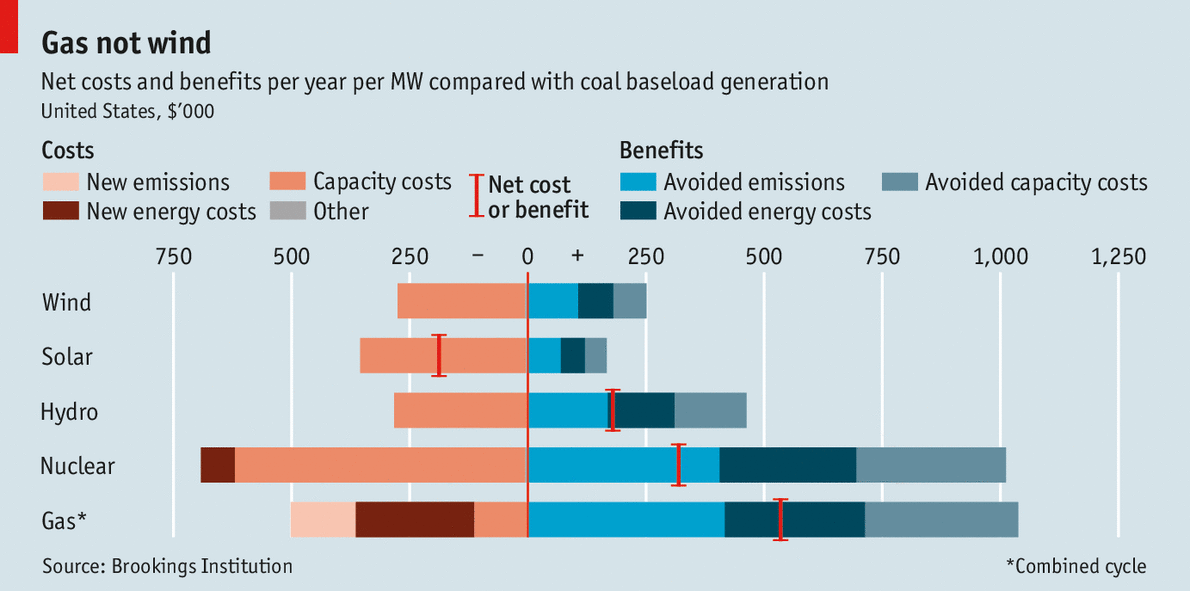
What the government should be doing is helping set a penalty for burning carbon (via a carbon tax) and then allowing the market to determine which alternative energy source provides the greatest overall benefit. When you consider all the costs involved in generating the energy (such as transporting it to where it is needed) and all the potential benefits (such as emissions avoided), the graphic that accompanies the article makes it clear that natural gas is the most cost effective alternative currently known to humanity, while nuclear is the most effective zero emissions energy source:
 
 
Specifically:
 
"If all the costs and benefits are totted up … solar power is by far the most expensive way of reducing carbon emissions. It costs $189,000 to replace 1MW per year of power from coal. Wind is the next most expensive. Hydropower provides a modest net benefit. But the most cost-effective zero-emission technology is nuclear power. The pattern is similar if 1MW of gas-fired capacity is displaced instead of coal. And all this assumes a carbon price of $50 a tonne. Using actual carbon prices (below $10 in Europe) makes solar and wind look even worse. The carbon price would have to rise to $185 a tonne before solar power shows a net benefit."
 
Emissions of carbon dioxide should not be the only criteria on which an energy source is chosen (as the article notes), but the article does make clear that our current understanding of these issues is limited and is certainly not at a level where the government should be picking winners and losers via misguided subsidies.
 
Take care
David
 
David Chandler & Bill Werther
 
Instructor Teaching and Student Study Site: http://www.sagepub.com/chandler3e/
Strategic CSR Simulation: http://www.strategiccsrsim.com/
The library of CSR Newsletters are archived at: http://strategiccsr-sage.blogspot.com/
 
 
Sun, wind and drain
July 26, 2014
The Economist
63
 

Monday, November 10, 2014

Strategic CSR - Supply chain

The article in the url below indicates opposite approaches to the same problem (tainted food ingredients in the supply chain) by different companies (McDonald's, KFC, and Yum Brands):
 
"The allegations came in a report from Dragon TV–continuing a pattern of Western companies facing critical scrutiny from Chinese TV stations–which said the Shanghai unit of OSI Group Inc. had been supplying meat that was beyond its sell-by date."
 
While KFC and Yum Brands promptly dropped the supplier (OSI), McDonald's in China has decided to stick with the firm (at least for now) to try and correct the situation. As commentators in the article note, this may be because it is simply more expedient to try and salvage a known supplier, rather than invest the cost and time to find a new partner firm. Whether by luck or design, however, McDonald's approach is also consistent with what I understand best CSR practice to be in situations like this:
 
"Anthony Johndrow of the Reputation Institute views McDonald's stance as a thoughtful approach to protecting its reputation. 'I think they're smart in trying to handle this strategically rather than just throwing the supplier under the bus,' he said. Both McDonald's and OSI have offered fulsome apologies and the next step is to take 'tangible, believeable steps' that will allow McDonald's to demonstrate its attention to its supply chain and to hygiene issues, Mr. Johndrow said. The crisis could turn out to be an object lesson, he said: 'There's a new story being told here.'"
 
For McDonald's, the greater long-term investment might be in re-training OSI to ensure the higher standards now in place are met. Doing so also sends a positive message to McDonald's other suppliers that the firm is more interested in developing meaningful relationships and will not cut-and-run at the first sign of trouble. In this case, continued vigilance will/should also involve regular audits. But, given OSI's apparent contrition, and keeping in mind the value of supporting firms and industries in developing economies by encouraging production capabilities (something that is in everyone's interests, especially  those of McDonald's), it seems to me that giving OSI the opportunity to correct its serious mistakes is the right response at this stage.
 
Take care
David
 
David Chandler & Bill Werther
 
Instructor Teaching and Student Study Site: http://www.sagepub.com/chandler3e/
Strategic CSR Simulation: http://www.strategiccsrsim.com/
The library of CSR Newsletters are archived at: http://strategiccsr-sage.blogspot.com/
 
 
McDonald's Takes New Approach to China Food Scare
By Nicholas Elliott
July 28, 2014
The Wall Street Journal
Late Edition – Final
 

Friday, November 7, 2014

Strategic CSR - HSBC

The article in the url below contains a staggering statistic:
 
"HSBC Holdings PLC's third quarter earnings call brought the striking revelation that nearly 25,000 of its 258,000 employees, almost 10%, work in compliance. Compliance was a major driver in the 5% increase in operating expenses reported, and management left no doubt that higher compliance costs would not go away soon, if ever."
 
That statistic (10% of all employees work in compliance) is a function of operating in a highly regulated industry. These regulations, however, are a function of past behavior that ignores the interests of a broad range of stakeholders. The result of such a narrow operational perspective is to invite additional scrutiny from the regulatory authorities. Banks have no one to blame but themselves for the increased costs that come from having to comply with that scrutiny.
 
Have a good weekend.
David
 
David Chandler & Bill Werther
 
Instructor Teaching and Student Study Site: http://www.sagepub.com/chandler3e/
Strategic CSR Simulation: http://www.strategiccsrsim.com/
The library of CSR Newsletters are archived at: http://strategiccsr-sage.blogspot.com/
 
 
HSBC Costs Illustrate New Cost of Banking
By Gregory J. Millman
November 4, 2014
The Wall Street Journal
 

Wednesday, November 5, 2014

Strategic CSR - Corporations

The article in the url below is an interesting survey of the state of CSR today – where we have been and, possibly, where we are going. In the process, it poses the following question:
 
“Is it naïve to expect corporations to assist in addressing the social, economic and environmental challenges of the day?”
 
There are two points the author makes, in particular, that I want to highlight. First, is the idea that the executives who lead the corporations of the past:
 
“… served not just stockholders, but also workers, customers and the community.”
 
The implication reinforced throughout the article is that executives today serve only stockholders. It is frustrating continually to see such complex ideas presented so simplistically. I understand the constraints of space that newspaper journalists face, but that does not seem to be the main driver behind the problem. In general, we like to see the world as a series of dichotomies, rather than the continua that are all around us. Businesses today operate within a series of stakeholder relationships. They do not choose this; it is simply the way that it is. Now, they can certainly prioritize the interests of one group over another, but it is not true to say that executives only care about stockholders. It is impossible to run a business that way. An overly simplistic representation of this when discussing CSR prevents the more important discussion around stakeholder prioritization, which is the true challenge that executives face. In fact, you could argue that the main job of executives today is to manage among competing stakeholder interests to allocate scarce resources in the best interests of the firm.
 
Second, the author concludes that, due to the narrow, distorted perspective of businesses today:
 
“Elected governments are certainly imperfect. But to address our most intractable ills, they are the better tool.”
 
As someone who has been thinking about CSR for many years (so is well aware of the many ways in which for-profit firms both create and destroy value, broadly defined), I think this statement is ludicrous. A strong and active government is clearly a vital component of a functioning democratic system. But, anyone who pins their hope for social progress primarily on government agencies and, heaven forbid, elected politicians, has just not been paying attention over the past few decades. No-one makes this point more effectively than Milton Friedman, in an interview on The Donahue Show in 1979 (http://www.youtube.com/watch?v=GapXLpLoZBs), which I show in my class and should be, I think, compulsory viewing for all business students:
 
“The great achievements of civilization have not come from government bureaus. Einstein didn’t construct his theory under order from a bureaucrat. Henry Ford didn’t revolutionize the automobile industry that way. In the only cases in which the masses have escaped from [grinding poverty], the only cases in recorded history, is where they have had capitalism and largely free trade. If you want to know where the masses are worst off, it is exactly in the kinds the societies that depart from that. So the record of history is absolutely crystal clear, that there is no alternative way so far discovered of improving the lot of the ordinary people that can hold a candle to the productive activities that are unleashed by a free enterprise system.”
 
Take care
David
 
David Chandler & Bill Werther
 
Instructor Teaching and Student Study Site: http://www.sagepub.com/chandler3e/
Strategic CSR Simulation: http://www.strategiccsrsim.com/
The library of CSR Newsletters are archived at: http://strategiccsr-sage.blogspot.com/
 
 
Motivating Corporations to do Good
By Eduardo Porter
July 15, 2014
The New York Times
Late Edition – Final
B1
 

Monday, November 3, 2014

Strategic CSR - Green bonds

The article in the url below reports the latest developments in the market for green bonds:
 
"… instruments which tie the proceeds of a bond issue to environmentally friendly investments. Issuers of green bonds raise money, promising to spend it on (for example) building wind farms or less-polluting factories."
 
The market for these environmental/social-impact bonds has increased significantly in only the last two years:
 
"In 2012 $3 billion of such bonds were sold. In the first six months of 2014, the sum was about $20 billion, nearly twice as much as in 2013 as a whole. … Climate Bonds Initiative, a research group, reckons the cumulative value of all green bonds will be around $50 billion by the end of 2014. … two or three times more than German taxpayers will spend subsidising wind and solar energy—the largest green subsidy in Europe."
 
And, as the market for green bonds evolves, more entities (in particular, for-profit firms such as Unilever and Toyota) have started to issue them:
 
"All green bonds are investment grade; many have been two or three times oversubscribed; half were issued by companies, a switch from 2013, when most green bonds were sold by international agencies such as the World Bank."
 
As these types of bonds become more popular, however, the definition of what constitutes a green bond has become more contentious:
 
"The trouble with this sort of discretion is that different people have different views. Is fracking green? Is nuclear power? The definition is likely to be tested further because a big oil firm is working on a green bond to finance a carbon-capture and storage (CCS) scheme. CCS is an important technology—but oil firms are, for the most part, seen as beyond the pale by greens."
 
As a result, green bonds are running into a problem that eventually faces any diffusing practice—the issue of validation:
 
"A market needs standardised products. … Earlier this year 13 banks drew up a shared set of principles governing different categories of bonds; 49 institutions have signed up. Nonetheless, there is far from universal agreement over the question, 'What makes a bond green?' At the moment the answer is, 'If someone says it is.'"
 
Similar challenges threatened (and, ultimately, undermined) the legitimacy of carbon offsets, which we no longer hear much about. Given the size of the market for green bonds relative to the total bond market ($50 billion verses $80 trillion), we should hope that green bonds are given a more stable footing than carbon offsets, and that this happens sooner rather than later.
 
Take care
David
 
David Chandler & Bill Werther
 
Instructor Teaching and Student Study Site: http://www.sagepub.com/chandler3e/
Strategic CSR Simulation: http://www.strategiccsrsim.com/
The library of CSR Newsletters are archived at: http://strategiccsr-sage.blogspot.com/
 
 
Green grow the markets, O
July 5, 2014
The Economist
Late Edition – Final
61
 

Friday, October 31, 2014

Strategic CSR - Gulf of Mexico

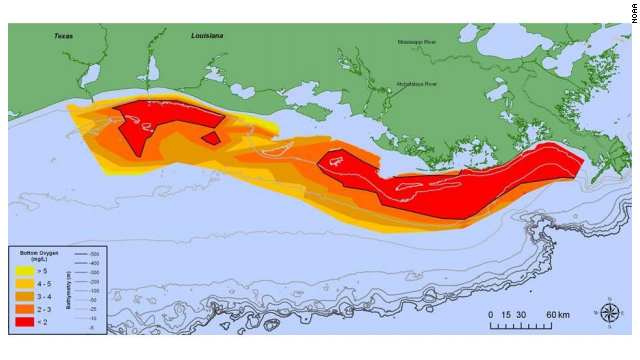
The article in the url below reports that the dead zone, the area of the Gulf of Mexico that cannot sustain aquatic life, is now the size of Connecticut:
 
"The Gulf of Mexico's annual spring-summer 'dead zone' is the size of Connecticut -- slightly smaller now than in recent years but nowhere near the trim scientists had sought, researchers said this week."
 
The dead zone is formed by chemical run-off from agricultural pollutants (fertilizer, etc.) that finds its way into the Mississippi River and flows down into the Gulf of Mexico:
 
"The zone is formed by nutrients that wash into the Gulf's waters -- largely agriculture fertilizer and wastewater coming down the Mississippi River. These boost algae blooms that suck up the oxygen in deep water, according to NOAA and the U.S. Geological Survey. Marine life struggles to find enough oxygen to survive within the zone."
 
The map included in the article illustrates how big this problem has become:
 
 
What I find ironic is that this dead zone never generates any public interest (let alone outrage). I put this down to the fact that we cannot see the damage being done (together, of course, with the influence of the agricultural industry's lobby in Washington). In contrast, the oil spill caused by the Deepwater Horizon explosion caused great public anger. This was justified, but the dead zone is a bigger problem that, unlike Deepwater Horizon, is not getting any better.
 
Happy Halloween.
David
 
David Chandler & Bill Werther
 
Instructor Teaching and Student Study Site: http://www.sagepub.com/chandler3e/
Strategic CSR Simulation: http://www.strategiccsrsim.com/
The library of CSR Newsletters are archived at: http://strategiccsr-sage.blogspot.com/
 
 
Gulf of Mexico 'dead zone' is the size of Connecticut
By Melodi Smith and Jason Hanna
August 7, 2014
CNN Tech
 

Wednesday, October 29, 2014

Strategic CSR - Samsung

The article in the url below reports Samsung's discovery of child labor violations in its supply chain and its decision to suspend one of its suppliers as a result:
 
"Samsung Electronics said on Monday that it had temporarily suspended business with a factory in southern China after allegations last week that it had illegally hired under-age workers to produce cellphone components. … In a news release, Samsung said that the authorities in China were investigating the case, and that if the under-age workers had been hired illegally, the factory could be permanently barred from working with Samsung."
 
The Risk & Compliance Journal (a daily Newsletter published by the Wall Street Journal) commented on this story, arguing that this will likely encourage other firms to investigate their supply chains and root out similar transgressions, if they exist:
 
"Samsung Electronics Co.'s admission it has child labor within its supplier network and the U.S. State Department's recent demotions of Thailand, Malaysia and Venezuela to lowest-tier status for child and forced labor problems are serving as a wake-up call to multinational companies about cleaning up their own supply chains. Failing to weed out problems in their systems could lead to their bad behavior becoming front-page news, says the head of one organization fighting to eliminate child labor. 'The hide-your-head-in-the-sand days are over,' said Diane Mull, executive director of the International Initiative on Exploitative Child Labor."
 
Two things interest me about this case: First, is that Samsung apparently knew nothing about these violations, in spite of having widely-lauded audit procedures and auditing this specific factory three times in the past year (the last time less than a month ago):
 
"The allegations were embarrassing because on June 30, Samsung released its annual global sustainability report, which noted for the second year in a row that its audits had not turned up any under-age workers in more than 130 supplier factories audited in China. The company also said that it had strict compliance procedures in place, including facial recognition software at its facilities and instructions that Samsung suppliers refrain from hiring workers younger than 18."
 
Second, I agree that events such as this constitute "a wake-up call to multinational companies about cleaning up their own supply chains," but not in the way that the WSJ sees it. I think it is just as likely that companies will learn the opposite lesson from this – that if they keep quiet the chances are they will slide under the radar, but if they "weed out these problems" they will be pilloried in the press (rather than being lauded for having investigated and identified transgressions). Given the poor record of unearthing problems like this, companies continue to be incentivized to know as little as possible about what is going on in their supply chain. At least then they can claim ignorance, rather than companies that self-report a problem, only to be accused subsequently of covering things up. In short, firms are currently discouraged from seeking complete and voluntary transparency (think BP after the Deep Horizon oil spill). There are as many people waiting to take advantage of corporate willingness to admit wrongdoing as there are people willing to encourage such behavior in the first place.
 
Ultimately, whether or not there is a social sanction will determine whether such behavior is deterred. I wonder how many people chose not to purchase a Samsung phone as a result of this news story? I am guessing, not many.
 
Take care
David
 
David Chandler & Bill Werther
 
Instructor Teaching and Student Study Site: http://www.sagepub.com/chandler3e/
Strategic CSR Simulation: http://www.strategiccsrsim.com/
The library of CSR Newsletters are archived at: http://strategiccsr-sage.blogspot.com/
 
 
Samsung Suspends China Supplier Over Child Labor Case
By David Barboza
July 15, 2014
The New York Times
Late Edition – Final
B7
 

Monday, October 27, 2014

Strategic CSR - Australia

The article in the url below contains a bad headline:
 
"Australia Becomes First Developed Nation to Repeal Carbon Tax."
 
This matters because Australia was "one of the first major countries outside Europe to adopt a carbon price." More importantly, however, it matters because Australia is one of the highest carbon polluting countries, per capita, in the world:
 
"Australia, the world's 12th largest economy, is one of the world's largest per capita greenhouse gas emitters due to its reliance on coal-burning power stations to power homes and industry. In 2011, daily emissions per head amounted to 49.3 kilograms (108 pounds), almost four times higher than the global average of 12.8 kilograms, and slightly ahead of the U.S. figure of 48.2 kilograms."
 
The graphic accompanying the article shows Australia's carbon emissions relative to the rest of the G20—Australia is second only to Saudi Arabia:
 
 
What is also striking is that this decision by Australia runs counter to the global trend which, although achingly inertial, is at least moving in the right direction:
 
"The World Bank in May produced a State and Trends of Carbon Pricing report counting carbon pricing programs in 40 nations and 20 regions worth a collective US$30 billion, while also singling out repeal plans in Australia as one of the biggest international threats to the rollout of similar programs elsewhere, given its example."
 
Australia is not the only carbon bad news story, unfortunately. Both Japan and Canada, for essentially similar local, short-term political considerations, have also taken significant steps away from recent public commitments to lower their emissions:
 
"Japan last year retreated on pledges to cut greenhouse emissions, blaming the shutdown of its nuclear plants in the wake of the 2011 Fukushima nuclear disaster for a decision to release 3% more greenhouse emissions by 2020 instead of a 25% cut on 1990 levels previously promised. … Canada withdrew from the Kyoto protocol in 2011, with the conservative government saying the agreement would unfairly penalize its fossil fuel-reliant economy for failing to meet a promised 6% cut."
 
In short, what was already a slow, incremental process worldwide has just became slower and further away from where we need to be.
 
Take care
David
 
David Chandler & Bill Werther
 
Instructor Teaching and Student Study Site: http://www.sagepub.com/chandler3e/
Strategic CSR Simulation: http://www.strategiccsrsim.com/
The library of CSR Newsletters are archived at: http://strategiccsr-sage.blogspot.com/


Australia Becomes First Developed Nation to Repeal Carbon Tax
By Rob Taylor & Rhiannon Hoyle
July 17, 2014
The Wall Street Journal
Late Edition – Final
 

Friday, October 24, 2014

Strategic CSR - Waste

The article in the url below contains some interesting statistics regarding the extent of waste throughout the global food system:
 
"Our mission, should we choose to accept it, is first to find 175-220m hectares of additional cropland by 2030; second, to increase total food production by about 70% by 2050, mostly through improving crop yields; and third, to achieve all this without damaging the land, poisoning ourselves or impairing the health of our finite and already fragile ecosystems."
 
"This challenge is hard enough, but we also have to tackle the problem of 1.3bn tonnes of food wasted every year – roughly a third of all food produced for human consumption."
 
"According to the FAO, the total value of lost food is $4bn per year in Africa and $4.5bn a year in India, with up to 50% of fruit and vegetables ending up as waste. In developing countries including China and Vietnam, most food is lost through poor handling, storage and spoilage in distribution. It is estimated that 45% of rice in China and 80% in Vietnam never make it to market for these reasons."
 
The article proposes a variety of technological innovations (such as food packaging, refrigeration, transportation, and the treatment of animal by-products) as containing the potential solutions to these and other related problems. Reading the article, however, it sounds like a bit of common sense wouldn't go amiss either.
 
Have a good weekend.
David
 
David Chandler & Bill Werther
 
Instructor Teaching and Student Study Site: http://www.sagepub.com/chandler3e/
Strategic CSR Simulation: http://www.strategiccsrsim.com/
The library of CSR Newsletters are archived at: http://strategiccsr-sage.blogspot.com/
 
 
Tackling the food waste challenge with technology
By Wayne Visser
July 29, 2014
The Guardian
 

Wednesday, October 22, 2014

Strategic CSR - Impact investing

The article in the url below outlines a productive use for the money that U.S. corporations currently have parked offshore. And, there is a lot of it. The money is offshore because the companies want to avoid paying U.S. corporation taxes on it. As such, they are waiting for the U.S. government to grant them a tax holiday to re-patriate the funds. Although this would make some sense (the U.S. government could generate some income and the U.S. economy would benefit greatly), the article suggests these companies should not hold their collective breath:
 
"… bringing home more than $2tn in profit would cost billions in corporate taxes. So companies wait, find ways to park their funds overseas and hope for an unlikely tax holiday as their 'problem' grows. Just last year, these idle overseas amounts grew 11.8%."
 
In the meantime, the article's authors have come up with an interesting use for that money that revolves around solving one of the most pressing poverty-related problems facing a sizeable chunk of the world's population (many of whom are in India and Africa)—easy access to electricity:
 
"Most Americans take turning lights on for granted. But one in five people in the world still can't plug anything in. The World Bank estimates 1.2 billion people lack electricity all together – resulting in millions of premature deaths yearly – and many more have undependable or unaffordable electricity service."
 
The authors estimate that the amount needed to solve this problem is $50bn:
 
"… solar photovoltaic cells, batteries and LED lights have grown so cheap and durable that an 'off-grid' household – spending less than it would dole out on kerosene over two years – can harvest enough electricity to power lights and charge a cellphone for decades. In Africa, for example, companies such as Azuri Technologies and M-KOPA Solar already sell 'pay-as-you-go' electrification systems for as little as $1.50 per month. At $200 each for these systems, a total of $50bn in loans – over several years – would be enough to finance the electricity to light up the world's dark homes."
 
How feasible is this? Well, the $2 trillion in corporate assets parked offshore is more than 200 times the $50bn needed to solve the problem. In fact:
 
"Some companies have enough in overseas billions – take Apple's $138bn, GE's $110bn, Microsoft's $93bn, IBM's $52bn, Cisco's $48bn and Google's $48bn ­– that just one of them could take on the whole job singlehandedly. Another lender could jump in to finance bigger systems for households or villages, or to fund renewable replacements for the sooty biomass that 2.5 billion people now use for heating and cooking (resulting in approximately 1.5 million deaths from fumes and smoke annually)."
 
Importantly, this money would be invested (rather than donated) and the transaction could be structured as:
 
"… a giant working capital fund. … Investments would be loans, and investments in promising commercial ventures, not philanthropy, and a successful program could set margins to yield competitive returns."
 
Moreover:
 
"Unlike microfinance for individuals, working capital funds would go to companies – experienced manufacturers and vendors – that would supply the systems. With this funding, these companies could grow manufacturing, education and marketing efforts, sales and collections."
 
Of course, such an investment would have multiplier economic benefits—grow companies and industries, provide jobs and local taxation, etc., etc. It is a simple idea that would have wide-ranging positive consequences for everyone. Or, as the authors put it:
 
"All this adds up to an enormous opportunity for US multinationals to make history with bold game-changing investments that will bring a billion people into the global economy – and to profit in the process. … Which company will step up to put its cash to good use, take a big bite out of fossil fuels and light up the world?"
 
Take care
David
 
David Chandler & Bill Werther
 
Instructor Teaching and Student Study Site: http://www.sagepub.com/chandler3e/
Strategic CSR Simulation: http://www.strategiccsrsim.com/
The library of CSR Newsletters are archived at: http://strategiccsr-sage.blogspot.com/


How a single multinational corporation could light up the world
By Daniel M. Kammen and Felix Kramer
September 24, 2014
The Guardian Sustainable Business
 

Friday, October 17, 2014

Strategic CSR - Copyright

The article in the url below raises a fascinating question around the issue of copyright in the digital age – Who owns the copyright of a photo when it is taken by a monkey?
 
 
The photo above was taken in 2011 by a group of monkeys with a camera that belonged to a British photographer:
 
"The remarkably photogenic monkey won fans by capturing her own smiling image … after a group of macaques in Indonesia appropriated British wildlife photographer David Slater's equipment. The resulting image went viral — and sparked an argument between Slater, who says he owns the photo, and others who say he doesn't."

As such, this selfie raises some important questions of privacy and ownership in the internet age that the U.S. Copyright Office was asked to solve. The Office solved the problem in a round-a-bout way when it recently released an updated version of its exciting-sounding publication—the Compendium of U.S. Copyright Office Practices:
 
"Chapter 300 of the compendium's 1,222 pages … notes that 'copyright law only protects 'the fruits of intellectual labor' that 'are founded in the creative powers of the mind.''"
 
The Chapter then lists a series of examples that are not subject to copyright law:
 
• A photograph taken by a monkey.
• A mural painted by an elephant.
• A claim based on the appearance of actual animal skin.
• A claim based on driftwood that has been shaped and smoothed by the ocean.
• A claim based on cut marks, defects, and other qualities found in natural stone
• An application for a song naming the Holy Spirit as the author of the work.
 
Helpfully, in relation to the creative powers of the Holy Spirit, the U.S. Copyright Office declares that:
 
"… it's OK to claim divine inspiration for a work — you just can't claim the divinity did all the work."
 
Have a good weekend.
David
 
David Chandler & Bill Werther
 
Instructor Teaching and Student Study Site: http://www.sagepub.com/chandler3e/
Strategic CSR Simulation: http://www.strategiccsrsim.com/
The library of CSR Newsletters are archived at: http://strategiccsr-sage.blogspot.com/
 
 
Who Owns a Monkey's Selfie? No-one Can, U.S. Says
By Bill Chappell
August 22, 2014
National Public Radio
 

Tuesday, October 14, 2014

Strategic CSR - What is CSR?

The article in the url below from the Financial Times demonstrates much of what remains troubling about the CSR debate:
 
"US and UK companies in the Fortune Global 500 spend $15.2bn a year on corporate social responsibility (CSR) activities, according to the first report to quantify this spending."
 
Given the descriptions provided, the only way the authors of the report could determine what spending constitutes "CSR spending" was to add up all of the figures voluntarily declared by each firm. This is problematic because the authors are forced to rely on how corporations currently think about "CSR" and, as a result, quickly fell back on a definition that equates CSR to philanthropy:
 
"In-kind donations, such as donating free drugs to health programmes or giving free software to universities, accounted for 71 per cent of the $11.95bn US spending on CSR. … In the UK, while donating goods and services in kind was the largest component of the $3.25bn CSR activity, it totalled just 46 per cent of the total. Employee volunteering and fundraising made up 34 per cent and cash contributions 20 per cent."
 
What is increasingly clear to me, however, is that all activity by the firm constitutes CSR. That is, if we define CSR as the value added by the firm. In other words, while it can be helpful to think of economic value and social value as separate constructs; in reality, they are not independent. On the contrary, they are highly correlated and are infused in the firm's decisions regarding production (e.g., Do we pollute the local river, or not? Do we hire at the minimum wage or a living wage?) and the consumer's decisions regarding consumption (e.g., Do I buy from the firm that produces domestically or the one that outsources? Do I pay the premium associated with a more environmentally-friendly product or purchase the cheaper, disposable product?). All of these production and consumption decisions contain value-laden consequences that, ultimately, determine the economic success of the firm (and the value it adds to society).
 
In contrast, most of the published research/commentary on CSR that I see still treats economic problems and social problems as separate entities (see Michael Porter's Shared Value idea as one of the more egregious examples). Again, a simple thought experiment highlights the overly-simplistic nature of this forced dichotomy. Is feeding people a social problem or an economic problem? Of course, there are hundreds of for-profit food manufacturers (not to mention the hundreds of thousands of restaurants) that produce food and distribute it widely (and efficiently) to whole populations of people. What about clothing people—a social problem or an economic problem? A visit to the mall will quickly reveal how efficiently for-profit firms have essentially eradicated the supply of clothes as a challenge for all but the most deprived societies. Or, what about providing internet access to every household in the country—economic or social? Certainly, you could make an argument that, today, a family is essentially excluded from many aspects of society if it cannot get online; yet, internet provision in most developed economies is the sole responsibility of the private sector (as it is for the food and apparel industries).
 
While the FT does some good work by promoting CSR more than most media outlets, this story demonstrates they still have a way to go to fully understanding the parameters of this important topic and, as a result, what its consequences are for business today.
 
Take care
David
 
David Chandler & Bill Werther
 
Instructor Teaching and Student Study Site: http://www.sagepub.com/chandler3e/
Strategic CSR Simulation: http://www.strategiccsrsim.com/
The library of CSR Newsletters are archived at: http://strategiccsr-sage.blogspot.com/
 
 
Fortune 500 companies spend more than $15bn on corporate responsibility
By Alison Smith
October 12, 2014
Financial Times
 

Monday, October 13, 2014

Strategic CSR - The future

The article in the url below is a review of three books on climate change that struggle (to different conclusions) with the effects of this planet-wide phenomenon on our future prospects. The first book, for example, demonstrates the amazing capacity of life to adapt to wildly changing circumstances:
 
"Cliff swallows in the Great Plains are evolving to have shorter wings. This helps them to swerve more easily away from speeding cars on the interstate. … Stockholm's Central Station uses the body heat of railway travelers to warm a nearby office building. … A new water bottle, inspired by the anatomy of a beetle in the Namibian desert, condenses air moisture and refills itself."
 
The result of this perspective is it allows the author to conclude that we will be able to adapt to our changing environment, however bad things get:
 
"… there is nothing 'natural' about Earth in 2014. For more than three millenniums, human civilization has reorganized nature to suit its tastes. … It is telling that Ms. Ackerman's central image, of a young orangutan at the Toronto Zoo playing on an iPad, is seen as cute, rather than a perversion of nature. She describes the rapid rise in global temperatures as merely a 'low-grade fever' that 'won't be tragic everywhere and for every species.'"
 
In contrast to the first book's optimistic view about the future based on scientific innovation, the second book paints a different picture:
 
"It is also possible that by the end of the century, the populations of Africa and Australia will be wiped out, New York and most other coastal cities will be accessible only to scuba divers, 70 percent of all species will go extinct, a second Black Death will kill off half of Europe, 1.5 billion people will be displaced around the world, and, as soon as 2050, the United States government will declare martial law to prevent food riots. … Why has our civilization been unable to take the most basic steps to prevent a future that could include mass starvation, displacement and pestilence?"
 
This question is answered by the third book:
 
"'We have not done the things that are necessary to lower emissions because those things fundamentally conflict with deregulated capitalism, the reigning ideology for the entire period we have been struggling to find a way out of this crisis.' Or, more succinctly: 'Our economic system and our planetary system are at war.' Something's got to give, and nature, as we've learned, is not in a giving mood."
 
The possible consequences of continued inaction?
 
"By 2023, [the author of the third book] writes, we'll be lucky to restrict the ultimate rise in global temperatures to an average of four degrees Celsius, or seven Fahrenheit. Four degrees' warming, as it turns out, is the premise for the nightmarish future described by [the second book]."
 
Take care
David
 
David Chandler & Bill Werther
 
Instructor Teaching and Student Study Site: http://www.sagepub.com/chandler3e/
Strategic CSR Simulation: http://www.strategiccsrsim.com/
The library of CSR Newsletters are archived at: http://strategiccsr-sage.blogspot.com/


Three Divergent Visions of Our Future Under Climate Change
By Nathaniel Rich
September 23, 2014
The New York Times
Late Edition – Final
D5
 

Friday, October 10, 2014

Strategic CSR - Lego

The article in the url below demonstrates the potential of stakeholder action:
 
"A 1-minute, 45-second video has ended a long-term relationship between Lego and Royal Dutch Shell. The Danish toymaker said today that it will not renew a co-promotion deal with Shell, after a Greenpeace video linking Lego with the oil company's Arctic drilling program went viral."
 
Whether or not you think Greenpeace's campaign to get Lego to break with Shell is valid, I think, is beside the point (or, at least, beside the point that I would like to make with today's Newsletter). More important is that Greenpeace was willing to act to shape the business behavior it wants to see. And, they used a particularly creative and effective tool in which to advance their goal:
 
 
Given that Lego was the target, using Lego bricks to make the video was particularly effective. Again, irrespective of whether you think their campaign was legitimate, I would like to see a world in which all stakeholders worked as diligently to effect the behavior by firms that we say we all want.
 
Have a good weekend.
David
 
David Chandler & Bill Werther
 
Instructor Teaching and Student Study Site: http://www.sagepub.com/chandler3e/
Strategic CSR Simulation: http://www.strategiccsrsim.com/
The library of CSR Newsletters are archived at: http://strategiccsr-sage.blogspot.com/
 
 
Greenpeace's Arctic Drilling Video Sinks Lego's Deal With Shell
By Carol Matlack
October 9, 2014
Bloomberg Businessweek
 

Wednesday, October 8, 2014

Strategic CSR - Supply chain

What happens when pressures for higher operational standards in the West are resisted further down the supply chain?
 
"Eight times now, the European-dominated Accord on Fire and Building Safety in Bangladesh — a group of more than 150 retailers and brands — has forced the temporary closing of garment factories after its inspectors found dangerous conditions. But from the time the inspections began, tensions have been growing between the Accord and the Bangladeshi apparel industry, … And this time, as on several previous occasions, the Bangladeshi government has aligned with a garment manufacturer opposed to having its factory closed, even temporarily."
 
In the West, the collapse of the Rana Plaza building, which caused the deaths of 1,129 workers in April 2013, brought pressure to bear on large brands to improve conditions or close factories. In Bangladesh, however, worker safety cannot be separated from the economic development benefits these factories bring and, in some cases, may supersede it—both for the factory owners and for the workers that the Western brands are trying to protect:
 
"… factory closings can have immediate economic impact. Some factory owners worry about losing large and profitable orders to other companies and countries, and garment workers themselves fear losing their jobs. In one of the first closings after an Accord inspection, workers took to the streets in a raucous demonstration, protesting that their wages might not be paid."
 
What is the responsibility of firms once the possibility of an impending disaster has been identified?
 
"… in numerous cases where hazardous conditions were uncovered, the groups have confronted considerable resistance to closing a factory building altogether, and to the notion that a building should be closed as soon as possible."
 
Should they move to protect themselves by dropping suppliers that resist and moving to countries with better safety standards (causing unemployment and greater poverty in Bangladesh), or should they risk damage to their brands by staying in Bangladesh and working to improve conditions while the factories remain open? And whose responsibility is it to pay for the higher standards the Western firms are suddenly demanding?
 
"The remediation process, garment industry experts say, could lead to clashes between the Bangladeshi factory owners and the Western brands about who should pay for needed safety improvements — especially because many factory owners are expected to say they cannot afford to make the repairs."
 
Take care
David
 
David Chandler & Bill Werther
 
Instructor Teaching and Student Study Site: http://www.sagepub.com/chandler3e/
Strategic CSR Simulation: http://www.strategiccsrsim.com/
The library of CSR Newsletters are archived at: http://strategiccsr-sage.blogspot.com/
 
 
Stalemate Over Safety in Bangladesh
By Steven Greenhouse and Julfikar Ali Manik
June 26, 2014
The New York Times
Late Edition – Final
B1