The CSR Newsletters are a freely-available resource generated as a dynamic complement to the textbook, Strategic Corporate Social Responsibility: Sustainable Value Creation.

To sign-up to receive the CSR Newsletters regularly during the fall and spring academic semesters, e-mail author David Chandler at david.chandler@ucdenver.edu.

Wednesday, February 23, 2022

Strategic CSR - BP

The article in the url below presents BP's 2010 Deepwater Horizon oil spill in a new light:

"The Deepwater Horizon oil spill in the Gulf of Mexico a dozen years ago was a human and environmental tragedy. It killed 11 people, dumped millions of barrels of oil into the Gulf, and cost BP Plc more than $65 billion in cleanup costs and damage payments. But had all that oil instead been sold and used, it would have been even deadlier and more devastating to the environment."

The author is actually quoting a tweet on this topic that went viral soon after it was posted:


Apparently, the argument is not only compelling, but relatively straightforward:

"The spill caused an estimated 200 million gallons of oil to flow into the Gulf of Mexico. Burning as many gallons of oil and diesel in combustion engines would have emitted over 1.4 million tons of CO₂, not even counting, for example, emissions from refining and transporting the oil. Translated into average lives lost due to the resulting climate change implies about 325 deaths over the course of the century, linked to higher temperatures alone. That doesn't include deaths from the fine particulate matter generated by burning that fuel, which could amount to another 350 premature deaths in a year."

Although it seems unnecessary and unrelated to the point he was trying to make, the original author was forced to add a qualification later as the tweet spread:

"Twitter being Twitter, the responses necessitated a follow-up from David: 'My point isn't that we should spill crude oil.' We shouldn't. There are plenty of other environmental costs not captured by the 11 deaths and $65 billion. The devastating impact on wildlife can only be partially reflected in any monetary damage number. Some of the oil spilled burned uncontrollably, again releasing CO₂. Oil that's not burned but eventually evaporates also causes plenty of environmental harm."

Needless to say:

"Alas, there is a big difference between a statistical calculation based on global damage estimates and being able to put faces and names to deaths, as to those on the Deepwater Horizon oil platform. Eleven deaths are a tragedy, while 325 statistically estimated ones are just that, a statistic."

Nevertheless, the ability to calculate a direct connection between environmental harm and human lives lost is becoming more developed and accurate:

"Thanks to rapid advances in the new field of attribution science, climate-related deaths and other damages can now be linked more directly to tons of CO₂ emitted. Indeed, an increasing number of lawsuits are closing in on establishing a proximate cause via climate damages, but no oil company so far has been forced to pay damages linked to the burning of its products sold to customers."

The author then discusses the contextual nature of our assessment of harm/damage, and the difference between direct and indirect attribution of blame:

"[Cary Coglianese, a professor of law and political science at the University of Pennsylvania] likens the difference between climate change and the BP oil spill to that between the Covid-19 pandemic and the terrorist attacks of Sept. 11, 2001: 'September 11th killed around 3,000 people,' he says. 'We had about that many Covid deaths in the U.S. yesterday alone.' More than 900,000 Americans died from Covid over the past two years, well over 5.5 million worldwide, and those are just the directly attributed deaths. 'We seem to be getting numb to this daily catastrophe,' adds Coglianese."

But, the ultimate point of the article (and the original tweet that stimulated it) is a more immediate understanding of the level of harm that is being committed by what we currently term 'normal behavior:'

"We must not, of course, get numb to either thousands of Covid deaths a day, or to the hundreds of deaths conservatively linked to a BP-spill-size amount of oil that is burned as intended. The links from selling, to burning fossil fuels, to the damages immediately attributable to the resulting emissions, are all too clear. It's high time our laws and courts catch up with that reality."

Take care
David

David Chandler
© Sage Publications, 2020

Instructor Teaching and Student Study Site: https://study.sagepub.com/chandler5e 
Strategic CSR Simulation: http://www.strategiccsrsim.com/
The library of CSR Newsletters are archived at: https://strategiccsr-sage.blogspot.com/


Daily Climate Damage Should Feel More Like A Disaster
By Gernot Wagner
February 11, 2022
Bloomberg
 

Thursday, February 17, 2022

Strategic CSR - Death penalty

Today's newsletter is a follow-up to one I sent in the Fall about an art project highlighting the final meals of death row inmates (see Strategic CSR – Obituaries):

"Six tacos, six glazed doughnuts and a Cherry Coke: That was the last meal of a man executed in Oklahoma in July 1999. Rendered in cobalt blue glaze on a white china plate the next year, it was the first in Julie Green's decades-long art project, 'The Last Supper,' which documented the final meals of death row prisoners around the country."

The link below is related, in that it is a series of photographs by a photographer who seeks to recreate the last meals (more visceral, I think, than an artistic representation or written description). The title of the series is "No Seconds":


To be clear, the photographer recreates the last meals (these are not photos of actual last meals). He has been described as a "food stylist," so his shoots involve food he manipulates for artistic effect. This approach, of course, introduces the artist's interpretation into the finished piece, which naturally affects the audience's reaction.

Nevertheless, I found that seeing the actual food alters my perception of the 'ritual.' It is more real and immediate, and the implications seem more profound. I have always been struck by the stark contrast between the apparent humanity of offering someone who is condemned the dignity of a final meal request and the barbarity of the actual act of execution. The photographs seem to make this contrast more tangible.

Take care
David

David Chandler
© Sage Publications, 2020

Instructor Teaching and Student Study Site: https://study.sagepub.com/chandler5e 
Strategic CSR Simulation: http://www.strategiccsrsim.com/
The library of CSR Newsletters are archived at: https://strategiccsr-sage.blogspot.com/

Tuesday, February 15, 2022

Strategic CSR - EVs in 2022

The article in the url below is interesting simply because it reflects the level of innovation currently going on in the automobile industry and, of course, how much EVs have moved the market in a relatively short period of time:

"This year, the U.S. market is about to see its options for electric vehicles more than double. Thirty entirely new models are poised to hit the streets, according to researcher IHS Markit, mostly created by luxury brands such as Cadillac, Lincoln, and Polestar. And unlike most of the EV standard-bearers to date, the next generation will arrive in the size Americans tend to like: extra large."


Apparently, the new models "include at least 14 SUVs, a van, and four pickups," the most notable of which is "a battery-powered version of Ford's F-150, the country's bestselling vehicle for decades." Given the expanded range of options and increasing comfort that consumers seem to have with the growing range of batteries, sales are expected to increase in proportion. The only constraint, it seems, is going to be the ability of the global supply chain to deliver these vehicles to market:


"IHS estimates that 1 in 20 American buyers this year will pick a fully electric vehicle—almost 1 million machines—if the supplies hold out. 'It's going to be a matter of what can be built,' says analyst Michael Fiske, 'not what can be sold.'"


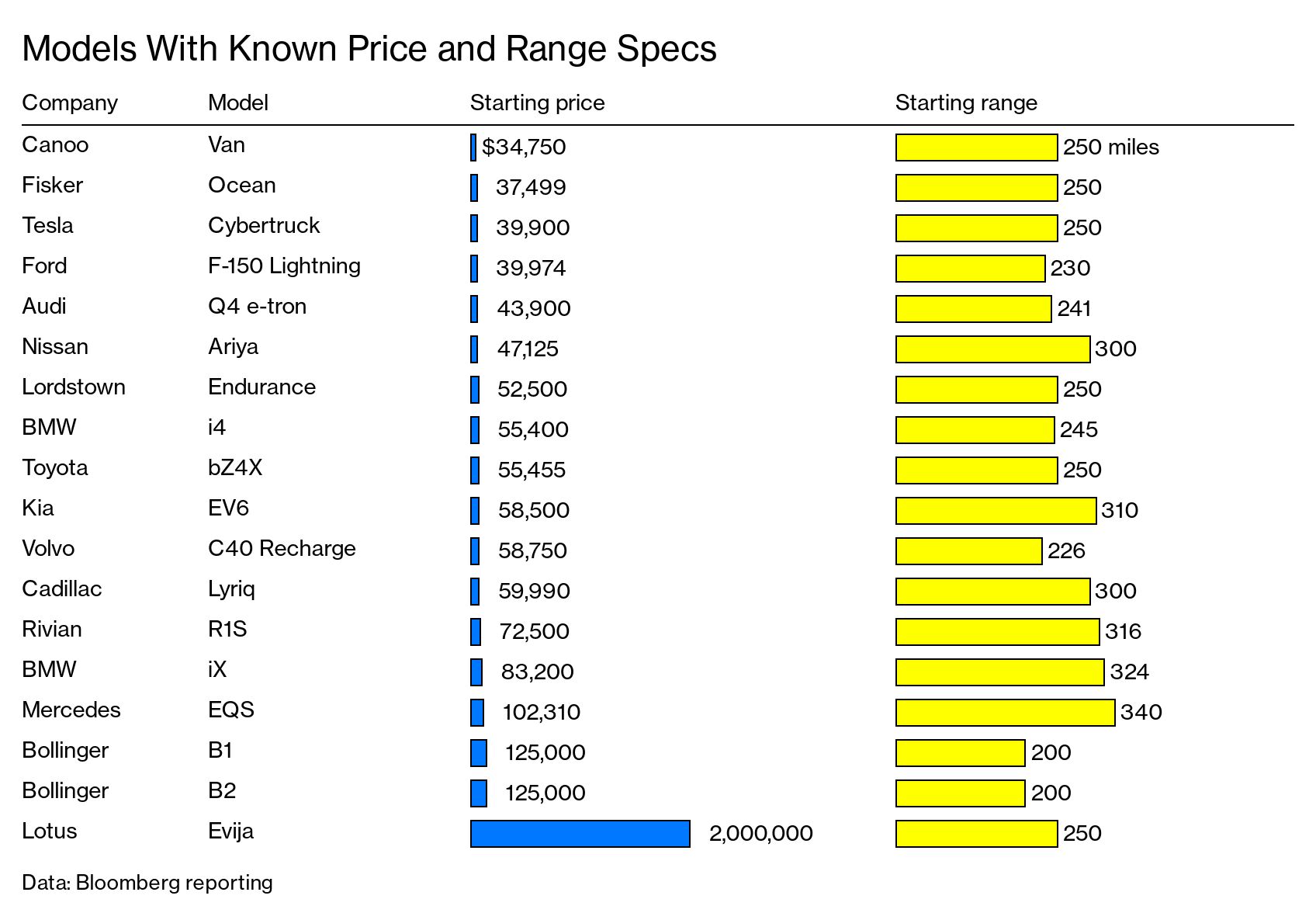
The chart accompanying the article illustrates those known models due to come to market, along with the driving range on a full battery:


https://assets.bwbx.io/images/users/iqjWHBFdfxIU/ifEpT.XXuJ3U/v0/pidjEfPlU1QWZop3vfGKsrX.ke8XuWirGYh1PKgEw44kE/-1x-1.png


Take care
David

David Chandler
© Sage Publications, 2020

Instructor Teaching and Student Study Site: https://study.sagepub.com/chandler5e 
Strategic CSR Simulation: http://www.strategiccsrsim.com/
The library of CSR Newsletters are archived at: https://strategiccsr-sage.blogspot.com/


America's Electriv Vehilce Selection is About to Get a Lot Wider
By Kyle Stock and Dorothy Gambrell
January 15, 2022
Bloomberg
 

Friday, February 11, 2022

Strategic CSR - Collegiality

The article in the url below was one of the best stories that I read over the break:

"At 64, Alfredo Lupi, a janitor at a factory in Graffignana, an industrial town southeast of Milan, was less than three years away from his retirement, a threshold that was at once incredibly close but impossibly far. A cognitive impairment that he had suffered from almost since birth was making his job more difficult by the day. The condition was too debilitating for him to work without discomfort, but quitting would have been hard to afford without a pension. That's where his co-workers came in."

Of course, the collegiality among employees was moving:

"Technically, his colleagues gave him … vacation days. They had transferred some of their own allotment — some gave more days, some gave less, but all gave something. That allowed him to stop working, but meant he could remain on the books at the Senna Inox factory and collect a salary until he reached the retirement age of 67."

Apparently, this idea of donating vacation days is a 'thing' in Italy:

"In recent years, the story of a mother who was given the equivalent of three years to take care of her disabled son, as well as tales of time-off donated to hospital workers who have young children and no time to spend with them, have made headlines in Italy. But Mr. Lupi's case was unusual because all 50 of his colleagues pitched in, collecting 20 months worth of working days."

But, the reaction of the employer (Senna Inox), a family-run firm, to the situation was also inspiring because the employees had not donated sufficient time to cover all of the days before his official retirement:

"Still, for all of their generosity, the employees hadn't collected enough time, but Senna Inox rounded things off by agreeing to pay him for the remaining year he would need to reach retirement age."

Clearly, the company understands the value of its employees as its most important stakeholder:

"'You might see it as a big present, but we see it as an investment in solidarity,' said Pietro Senna, one of the four brothers who run the factory founded by their grandfather in 1950. 'We are not depriving ourselves of anything, quite the opposite.'"

As a result:

"Mr. Senna said that the vast majority of their employees at the factory, which designs and produces equipment for the pharmaceutical and food production industry, work there for their entire careers."

Have a good weekend.
David

David Chandler
© Sage Publications, 2020

Instructor Teaching and Student Study Site: https://study.sagepub.com/chandler5e 
Strategic CSR Simulation: http://www.strategiccsrsim.com/
The library of CSR Newsletters are archived at: https://strategiccsr-sage.blogspot.com/


A Janitor Was Struggling, So His Colleagues Donated Toward an Early Retirement
By Gaia Pianigiani
December 27, 2021
The New York Times
Late Edition – Final
A6
 

Tuesday, February 8, 2022

Strategic CSR - Labels

The article in the url below summarizes a bill that has been introduced in the California Legislature aiming to restrict use of the commonly-used recyclable logo:

The bill is designed to solve a problem that the logo's critics describe as false advertising:

"The triangular 'chasing arrows' recycling symbol is everywhere: On disposable cups. On shower curtains. On children's toys. What a lot of shoppers might not know is that any product can display the sign, even if it isn't recyclable. It's false advertising, critics say, and as a result, countless tons of non-recyclable garbage are thrown in the recycling bin each year, choking the recycling system."

Although it might seem obvious, the California bill is designed to prevent companies from using the logo in a misleading way. What is surprising is that California is the first state in the U.S. to try and do this explicitly:

"A bill passed by the state's assembly would ban companies from using the arrows symbol unless they can prove the material is in fact recycled in most California communities, and is used to make new products."

Although this piece of legislation is aimed at the logo, it is really part of a much wider effort to address the woefully poor record of recycling that we have:

"Though materials like paper or metals are widely recycled, less than 10 percent of plastic consumed in the United States is recycled, according to the most recent estimates by the Environmental Protection Agency. Instead, most plastic is incinerated or dumped in landfills, with the exception of some types of resins, like the kind used for bottled water or soda."

An important part of this broader campaign is a multi-state effort to try and constrain companies' willingness to greenwash:

"This summer, Maine and Oregon passed laws overhauling their states' recycling systems by requiring corporations to pay for the cost of recycling their packaging. In Oregon, the law included plans to establish a task force that would evaluate 'misleading or confusing claims' related to recycling. Legislation is pending in New York that would, among other things, ban products from displaying misleading claims. In the past year, a number of environmental organizations have filed lawsuits seeking to combat misleading claims of recyclability by major corporations."

Importantly, the recycling industry is fully on board with the California legislation, for obvious operational reasons:

"Recycling companies say the move will help them cut down on the non-recyclable trash thrown in recycling bins that needs to be transported, sorted and sent to the landfill. Pete Keller, vice president of recycling and sustainability at Republic Services, one of the country's largest waste and recycling companies, said in an interview that more than a fifth of the material his company processes nationwide is non-recyclable garbage. That means that even on its best day, Republic is running at only 80 percent efficiency, processing materials it shouldn't be processing, he said."

And, in case you are wondering, the article identifies the most common forms of unrecyclable trash that people try and recycle:

"Some of the most common forms of non-recyclable trash marring operations at Republic's 70 facilities across the United States, which processes six million tons of curbside recycling a year: snack pouches, plastic film, grocery bags and packing material. Plastic bags, in particular, can't be recycled in most curbside recycling programs and notoriously gum up recycling machines."

Of course, those companies that produce packaging are less enthusiastic, responding with an extremely convoluted argument:

"The plastics and packaging industry has opposed the bill, saying it would create more confusion for consumers, not less. An industry memo circulated among California lawmakers urges them to oppose the bill unless it is amended, arguing it 'would create a new definition of recyclability with unworkable criteria for complex products and single use packaging.' The letter was signed by industry heavyweights like the American Chemistry Council, the Plastics Industry Association and Ameripen, a packaging industry group. California should wait for Washington to come up with nationwide labeling standards, the groups said."

The opposition's clinching argument? That products that are not recyclable should not be identified as such because then we would not try and recycle them, even though they are not recyclable and actually increase the costs of recycling those materials that are recyclable:

"The Plastics Industry Association, which represents plastic manufacturers, warned that the bill would determine a slew of products to be unrecyclable and therefore would be landfilled. (Supporters of the bill point out those products are landfilled anyway, despite displaying the recycling symbol.)"

Hmmmmm, cunning.

Take care
David

David Chandler
© Sage Publications, 2020

Instructor Teaching and Student Study Site: https://study.sagepub.com/chandler5e 
Strategic CSR Simulation: http://www.strategiccsrsim.com/
The library of CSR Newsletters are archived at: https://strategiccsr-sage.blogspot.com/


Bill Says Recyclable Logo Should Mean Something
By Hiroko Tabuchi and Winston Choi-Schagrin
September 10, 2021
The New York Times
Late Edition – Final
A17

Thursday, February 3, 2022

Strategic CSR - Fossil fuels

The article in the url below highlights the massive amount of money that is still being used to subsidize the fossil fuel industry (see also Strategic CSR – Energy subsidies and Strategic CSR – Free markets). Although the total amount dropped in 2020, that was mostly due to a significant drop in demand (due to the pandemic), rather than any enlightened reevaluation of the extent to which governments should be supporting this economic activity to the extent that it is. Cumulatively, the annual subsidies add up to a lot of money:

"In the five years from 2015 to 2019, G-20 governments provided $3.3 trillion of direct support to coal, oil and gas, and fossil fuel-fired power generation. That number has been pretty stubborn over the years, falling from a high of $706 billion in 2015 to a low of $636 billion in 2019 — a change of only about 10%."

While the opportunity costs of such investments are massive (both avoiding alternative investments, but also causing greater pollution and associated health issues), the money might be largely wasted if it is invested in assets that, ultimately, need to be stranded:

"Support at the business level, however, could be even more significant for the long-term prospects of decarbonization. Government funding capacity may not be strictly limited, but it's also not infinite, and funds devoted to supporting an incumbent fossil fuel industry are by definition not able to fund energy transition. Just as importantly, government support has the potential to lock in assets — and the behaviors that go with them — for decades. Those include assets and behaviors related not just to the consumption of fossil fuels, but also to the production and distribution of same, not to mention the politics that go along with them. Government action also creates future unfunded liabilities in the form of potential bills for clean-up and environmental mediation. Finally, governments may be creating future stranded assets, projects that for either policy or economic reasons could soon be permanently out of the money."

These ongoing subsidies are particularly frustrating as the need to shift to more sustainable energies is urgent, yet the longer we wait and the more money we pump into the extraction industries, the longer and harder it is going to be for us to reach true net zero:

"If we want to achieve a net-zero energy system by mid-century, companies and governments will need to invest anywhere from $92 trillion to $173 trillion in the next three decades, according to BNEF's latest New Energy Outlook. Doing so will be difficult, but not impossible. Every dollar supporting any path other than zero net carbon dioxide emissions by 2050, however, makes net zero all the more difficult in the meantime."

Take care
David

David Chandler
© Sage Publications, 2020

Instructor Teaching and Student Study Site: https://study.sagepub.com/chandler5e 
Strategic CSR Simulation: http://www.strategiccsrsim.com/
The library of CSR Newsletters are archived at: https://strategiccsr-sage.blogspot.com/


The World's Biggest Governments Are Still Propping Up Fossil Fuels
By Nathaniel Bullard
July 22, 2021
Bloomberg
 

Tuesday, February 1, 2022

Strategic CSR - Google

At various points, I have seen the claim that Google should be declared a public utility (and regulated as such), but never understood the arguments in detail. The article in the url below by the Republican Attorney General of Ohio does this effectively by explaining legal action that he had recently taken:

"As Ohio's attorney general, I went to court last month asking for a judicial declaration that Google has evolved into such an entity: a public utility of internet search."

The attorney general first makes his point, quite convincingly I think, that Google is a monopoly:

"Google is ubiquitous. More web traffic goes to Google and YouTube, a subsidiary of Google, than the other top 50 websites combined. And it's not just internet traffic: Google dominates internet search, cornering nearly 90 percent of the U.S. search market, and even more globally. Bing, the runner-up in internet search, claims a mere 6 percent of the U.S. market and 2 percent globally."

He then explains what it would mean if the courts decided in favor of his case, and suggests it would be a lot less traumatic for the company than the alternative of antitrust action that is currently being considered in Washington:

"As a common-law public utility, Google would then have a legal duty to act with consideration of the public interest, to provide equal access to all users and all information providers and to act without unreasonable bias against information providers, particularly Google's competitors in other business lines. That's it. As legal touches go, it's a lot lighter than what antitrust law would demand."

Then, he details the consequences of the decision for the public at large:

"The subtle common-carrier changes for users will be positive, such as showing you the results you requested instead of being steered to Google products. My lawsuit alleges that Google prioritizes its own products and platforms in search results. … As a public utility, Google search would have to give others a better shot. Those searching would get results that are not skewed to Google, and the marketplace would be a bit more competitive."

And, finally, he rebuts some of the more common objections he sees made to defend the company. For example:

"Critics of Ohio's lawsuit abound, of course. To knock down a few straw men: Ohio's action is not chilling Google's right to free speech. To the contrary, Google will remain free to say anything it pleases. … Critics also say that this creates a dormant commerce clause problem — that one state among 50 is using its law in a manner that burdens interstate commerce, a violation of sovereignty and federalism. But Google can geo-fence Ohio (and the other states that will most likely follow Ohio's lead) if it chooses. The truth of the matter is that foreign governments already are regulating cyberspaces around the world, and with a far heavier hand."

Ultimately, however, his argument relies on the point that Google's dominance undermines the competitive market. That is, whether Google is currently abusing its position is beside the point for two reasons: first, the company might be doing so in a way that is currently unobservable to many and, second, left unchecked, it could do so at some point in the future. The author provides an anecdote, taken from U.S. history, which helped motivate the original antitrust legislation by Congress:

"The duty for a public utility to operate in the public interest dates back to English common law, when key economic players such as ferry operators had to fulfill certain obligations to the public. During the Gilded Age, the railroad magnate Cornelius Vanderbilt controlled a bridge that was key to getting to New York City by train. In the late 1860s, he closed the bridge to rivals, effectively shutting the rest of the country out of its largest port, and the city off from food supplies from the west. As the competing railroads' stock crashed, he quickly bought up a controlling position. As a result, Vanderbilt used his control of a chokepoint to help establish a monopoly. To curb such predations, Congress passed the Sherman Antitrust Act in 1890 and subsequently began codifying common-carrier and public-utility law."

His conclusion is that, if Google's current market position is not addressed, it is society that will suffer:

"The preface to Google's parent company's code of conduct says, 'Do the right thing — follow the law, act honorably and treat co-workers with courtesy, support and respect.' Google could do that by acknowledging what is obvious: It's so dominant that the rules of private companies no longer apply to it."

Take care
David

David Chandler
© Sage Publications, 2020

Instructor Teaching and Student Study Site: https://study.sagepub.com/chandler5e 
Strategic CSR Simulation: http://www.strategiccsrsim.com/
The library of CSR Newsletters are archived at: https://strategiccsr-sage.blogspot.com/


Let's Make Google a Public Good
By Dave Yost
July 11, 2021
The New York Times
Late Edition – Final
SR2
 

Thursday, January 27, 2022

Strategic CSR - Global carbon tax

Over the summer, you may have noticed the EU's roadmap of how it plans to reduce its carbon emissions by 55% by 2030 (benchmarked to some point in the 1990s), a plan it labelled "Fit for 55." Central to that plan is the idea that the EU will impose a carbon tariff on imports from countries with lower carbon emissions rules than the EU (which, I am guessing, is all countries outside the EU). While there are plenty of geopolitics at stake reading between the lines, the enticing element of this tariff plan is its implications for a global carbon tax, as explained in the article in the url below:

"A global carbon tax is viewed by many economists as the most efficient approach to decarbonizing industry, but creating one has always seemed a political impossibility. A new European Union carbon border tax just might start to change that."

The key is the tax on all imports to the EU from countries with more lax standards on carbon emissions than the EU:

"The levy—called a 'carbon border adjustment mechanism,' or CBAM—is part of a wide-ranging package adjusting EU rules to meet new climate ambitions. The measure is intended to both level the playing field between foreign and domestic producers and cut the risk that local companies relocate outside the EU to avoid the bloc's stringent rules. As drafted, CBAM could open a path to a global carbon price by establishing a cost of carbon on some imports into the EU, one of the world's biggest markets."

The hope seems to be that the U.S. will join the EU by imposing a similar tariff (see here). This is partly because if the EU and U.S. have a similar approach, it has a better chance of affecting other countries, but also it would avoid the complicated eventuality of the EU imposing a costly tax on imports from the U.S. Another motivator, as with all tax proposals, is the opportunity to collect revenue. In this case, the U.S. would prefer to collect the revenue themselves, as opposed to allowing the EU to collect it instead:

"While that level of cooperation currently seems unlikely, the estimated €9 billion in annual CBAM-related income the EU anticipates by 2030 might tempt politicians to act so that they collect the cash instead of Brussels."

The proposed effect is broad – so much so that the commentary around the tariff is that it will affect, in essence, all industries and products:

"CBAM will target aluminum, cement, fertilizer, power, steel and iron. Companies from regions without similar carbon costs would need to buy CBAM credits for the verified emissions released in the production of their imports into the EU. The price will be linked to the carbon cost determined by the EU's Emissions Trading System, currently over €50 a metric ton."

But, again, the tantalizing prospect is that the effect will be global and, in essence, establish a global tax on carbon:

"A global carbon price remains a fanciful notion for now, but something resembling it could take shape if the EU's CBAM, like its ETS, sets an example for other regimes to learn from. Much depends on the ambitions of Washington."

Take care
David

David Chandler
© Sage Publications, 2020

Instructor Teaching and Student Study Site: https://study.sagepub.com/chandler5e 
Strategic CSR Simulation: http://www.strategiccsrsim.com/
The library of CSR Newsletters are archived at: https://strategiccsr-sage.blogspot.com/


Europe's Carbon Prices Are Going Global
By Rochelle Toplensky
July 15, 2021
The Wall Street Journal
Late Edition – Final
B12
 

Tuesday, January 25, 2022

Strategic CSR - Uber/Lyft

The article in the url below reports on recent research that conducts a marginal cost-benefit analysis for each person that switches from a private car to only using a ride-hail company. The premise for the research was the promise that Uber and Lyft originally made to justify their business models:

"A decade ago, Uber Technologies Inc. and Lyft Inc. charged into cities with a promise: By reducing personal car trips, ride-hailing businesses could both ease traffic and bolster the use of public transit. What happened was the reverse: A host of pre-pandemic research linked the rise of these services to sharp upticks in traffic and waning ridership on buses and trains."

The results were quite surprising. Even more surprising is that, even if all the Uber and Lyft vehicles become electric, that is still not going to tip the balance:

"Now a new study puts a price on the external costs that come with switching from a personal vehicle to one from a transportation network company (or TNC): about 35 cents per trip on average. And it finds that even a fully electrified fleet of ride-hailing cars may not fully mitigate the extra toll they exact on society compared to driving yourself."

Some detail about the study (see also, here):

"To determine the role that ride-hailing plays in generating these often-hidden effects, [the authors] simulated replacing 100,000 private passenger vehicle trips with TNC trips in six U.S. cities, using publicly available ride-hailing data from New York City, Austin, Chicago and the state of California. Through a review of other studies that have quantified the externalities of driving in general, such as local air pollution, greenhouse gas emissions and traffic deaths, they approximated the dollar amounts that society saves or spends when travelers choose Uber or Lyft over their own automobiles."

Of course, there are some benefits, but the net effect is pretty clear:

"Ride-hailing helps on at least one front, the researchers found: air pollution. … But that benefit was undone by the negative impacts of deadheading, or the time in between trips when drivers are traveling passenger-free to their next pickup."

The overall result?

"All told, switching from a private car to a TNC increased net external costs by 30% to 35%, or about 35 cents per trip. … In other words, even a fully electrified ride-hailing industry — the likes of which Uber and Lyft have both promised by 2030 — would not be enough to make up for the congestion and deaths created by the added TNC miles."

Take care
David

David Chandler
© Sage Publications, 2020

Instructor Teaching and Student Study Site: https://study.sagepub.com/chandler5e 
Strategic CSR Simulation: http://www.strategiccsrsim.com/
The library of CSR Newsletters are archived at: https://strategiccsr-sage.blogspot.com/


That Uber or Lyft Trip May Be Worse for the Planet Than Driving Yourself
By Laura Bliss
September 30, 2021
Bloomberg

Thursday, January 20, 2022

Strategic CSR - Welcome back!

 
Welcome back to the Strategic CSR Newsletter!
The first newsletter of the Spring semester is below.
As always, your comments and ideas are welcome.
 

The article in the url below should bring a smile to your face:

"A German court has ruled that a man who slipped while walking a few metres from his bed to his home office can claim on workplace accident insurance as he was technically commuting."

Not that breaking your back is something to smile about—more that it feels like the kind of story that makes sense given the last couple of years. Injury and pain aside, the story gets quite funny in its detailed analysis:

"The court noted that the employee usually started working in his home office 'immediately without having breakfast beforehand,' but did not explain why that was relevant to the case. However, later it said that statutory accident insurance was only afforded to the 'first' journey to work, suggesting that a trip on the way to get breakfast after already being in the home office could be rejected."

There was no mention of whether the man can claim his pajamas as a tax-deductible work clothes expense.

Hope you all had a good break and have a good semester.

Take care
David

David Chandler
© Sage Publications, 2020

Instructor Teaching and Student Study Site: https://study.sagepub.com/chandler5e 
Strategic CSR Simulation: http://www.strategiccsrsim.com/
The library of CSR Newsletters are archived at: https://strategiccsr-sage.blogspot.com/


Fall on walk from bed to desk is workplace accident, German court rules
By Oliver Holmes
December 9, 2021
The Guardian
 

Tuesday, December 7, 2021

Strategic CSR - The future

 
This is the last CSR Newsletter of the Fall semester.
Happy Holidays and I will see you in the New Year!
 

I try and keep the opening and closing newsletters of the term a little shorter, as things are just getting going or just winding down, and I figure you are all busy doing other things. The article in the url below makes this easy because it is about a photograph that has been shortlisted this year for the Prix Pictet prize in London. The nominated photograph was taken at a garbage dump in Senegal, which is named Mbeubeuss:

"The land on which it sits was once flat swampland. It began as a landfill site in 1968; today, it is a mountain of rubbish. It has accumulated so much plastic waste from the city that to reach it you have to drive on a road of compacted trash."

The article features an interview with the photographer, Fabrice Monteiro, so I'll let you read more into the photograph and how it came about, if you would like. For this newsletter, I think the photograph speaks loudly enough for itself:


As the photographer concludes:

"Across all I do, I'm interested in identity and how we separate ourselves from those we consider the 'other.' Throughout history, humankind has created an idea of the other in order to justify his or her exploitation. It is an idea that was central to slavery and colonialism. But it's also at the heart of our approach to the environment. Only because we see ourselves as apart from the natural world, or superior to it, can we continue to treat it this way."

For more environmental photography, there is a related story here.

Take care
David

David Chandler
© Sage Publications, 2020

Instructor Teaching and Student Study Site: https://study.sagepub.com/chandler5e 
Strategic CSR Simulation: http://www.strategiccsrsim.com/
The library of CSR Newsletters are archived at: https://strategiccsr-sage.blogspot.com/


Fabrice Monteiro's best photograph: A spirit emerges from a rubbish dump in Senegal
By Edward Siddons
November 24, 2021
The Guardian

Thursday, December 2, 2021

Strategic CSR - Carbon trading

Over the summer, you may have missed the announcement that China's carbon trading scheme launched. The article in the url below makes the case that this is the most important attempt so far by the human race to address climate change. If countries like China (and the U.S.) do not act quickly, things might get out of hand. Given that we are finally seeing some activity in the U.S. (however belated and incremental), China (and India, and Brazil, and …..) needs to start acting, too:

"While the world has been focused on spacefaring billionaires over the past week, a big development for planet Earth has only merited moderate attention: On Friday, China's long awaited national carbon market started trading. How well that market functions could go a long way toward deciding how much chance the world really has to reduce the probability of worst-case climate scenarios. It also could end up being a key issue between China and the West. If the U.S. and the European Union conclude China is serious about tackling emissions, that could help spur more aggressive climate action in the developed world—and open up more space for a less zero-sum approach to relations in general."

This trading scheme is the potential answer to a carbon price in China, which should stimulate action, even if this opening salvo still leaves a lot of progress to go:

"So far, cautious optimism is probably warranted. But the price of carbon in China is still clearly too low, and the market itself still excludes key energy users like steel. Both need to change soon."

The article contained some interesting comparisons to make the point that the current price is way too low:

"The carbon market closed at 51.23 yuan, equivalent to $7.91, per metric ton on Friday according to Thomson Reuters. That is still well below prices in Europe, where a metric ton will cost you around $60, and probably below levels needed to really change behavior. For instance, ANZ Bank estimates that a 36 yuan per metric ton carbon price would only represent around an extra 5% operational cost for Chinese coal plants. And a 2016 World Bank paper found that reducing Chinese emissions in 2030 by 16% from their baseline estimate would require carbon prices rising to 157 yuan per metric ton by that date."

There is also an issue with the penalties for noncompliance that have so far been discussed:

"Draft regulations released in January set a maximum penalty of only 30,000 yuan ($4,630) for not buying enough offsets. A more recent proposal from the Ministry of Ecology and Environment in March suggests a 500,000 yuan maximum."

Ultimately, the article is hopeful, for a very pragmatic reason:

"In the end the biggest reason for optimism is that Beijing needs the system to work. Policy makers have been trying for years to direct investment out of energy-consuming industries such as steel and into high-tech sectors—including green technologies—with mixed success. A real price on carbon is one obvious solution."

Take care
David

David Chandler
© Sage Publications, 2020

Instructor Teaching and Student Study Site: https://study.sagepub.com/chandler5e 
Strategic CSR Simulation: http://www.strategiccsrsim.com/
The library of CSR Newsletters are archived at: https://strategiccsr-sage.blogspot.com/


China's Carbon Trading is Up and Running, but it is a Mixed Bag
By Nathaniel Taplin
July 20, 2021
The Wall Street Journal
Late Edition – Final
B12

Tuesday, November 30, 2021

Strategic CSR - Obituaries

I generally do not spend much time with the obituaries in The New York Times, although I know they are well-written and researched. I do tend to read The Economist's obituary, since they only publish one a week (and, like everything The Economist does, it usually has an interesting twist), but it is not a particular area of interest – something about looking forward, rather than back, I suspect. Anyway, the obituary in the url below caught my interest because it covers a number of issues that I care about (art as social commentary, the SCOTUS, constitutional law and, in particular here in the U.S., the death penalty):

"Six tacos, six glazed doughnuts and a Cherry Coke: That was the last meal of a man executed in Oklahoma in July 1999. Rendered in cobalt blue glaze on a white china plate the next year, it was the first in Julie Green's decades-long art project, 'The Last Supper,' which documented the final meals of death row prisoners around the country."

The motivation for Green doing what she did (and devoting her life to it), I think, is both noble and a searing commentary on this particular U.S. institution:

"To Professor Green, who taught art at Oregon State University, their choices put a human face on an inhumane practice. Some requests were elaborate: fried sac-a-lait fish (otherwise known as white perch or crappie, it's the state fish of Louisiana) topped with crawfish étouffée. And some were starkly mundane: two peanut butter cups and a Dr Pepper."

Green also had a clear goal in mind:

"She planned to paint the meals until capital punishment was abolished, or until she had made 1,000 plates, whichever came first. In September, she painted her 1,000th plate, an oval platter with a single familiar image: the bottle of Coca-Cola requested by a Texas man in 1997."

Ironically given the subject matter of her work, her death was a controlled intervention:

"She died a few weeks later, on Oct. 12, at her home in Corvallis, Ore., by physician-assisted suicide, which is permitted under Oregon's Death With Dignity Act."

For Green, the subject of her work, food, was central to the point of what she was doing:

"Professor Green was teaching at the University of Oklahoma when she read the details of a recently executed man's final meal in a local paper, The Norman Transcript. The menu's homeyness — those glazed doughnuts — and its specificity made her think of all the meals she had prepared and shared with her family. The man had committed a horrific crime, but his food preferences humanized him. 'I'm a food person,' she told The New York Times in 2013. 'I grew up with great cooks and great food. Food has always been a celebratory thing for me. That's part of why this whole thing is interesting to me, because of the contrast. It's not a celebration.'"

Part of her intention is to highlight the contrast in approaches across states to this relatively humane gesture that is part of such an inhumane process:

"Texas, which has executed more prisoners than any other state in the country (573 since 1976, including three men this year), no longer allows special meal requests; its menus are drawn from standard prison fare. But not all states are so rigid. In 2001 in Indiana, a prison granted an inmate's request to have his mother make him chicken dumplings in the institution's kitchen. Professor Green painted the word 'Mother' on the platter that pays homage to that meal. Another Indiana inmate told prison officials that he'd never had a birthday cake, so they ordered him one, along with the pizza he had requested, which he shared with 15 family members and friends in 2007. Professor Green painted a cake that bristles with candles."

In addition, she saw her work as an extension of the reason last suppers are published – to create a formal record of an act that is sanctioned by the state. And, of course because she was painting food, the canvas should be a plate:

"In 1917, a Montana man asked only for an apple. 'I have a bad taste in my mouth,' he was reported as saying. In Mississippi in 1947, two Black teenagers asked for fried chicken and watermelon before they went to the electric chair. Professor Green painted one ornate platter for each boy."

The photo in the article shows some of the hundreds of plates that Green painted. The description attached is pertinent:

"Julie Green in 2013 with some of the hundreds of plates on which she painted death row inmates' last meals. 'Andy Warhol said in the future the artist will just point,' she said. 'I paint to point.'"

Take care
David

David Chandler
© Sage Publications, 2020

Instructor Teaching and Student Study Site: https://study.sagepub.com/chandler5e 
Strategic CSR Simulation: http://www.strategiccsrsim.com/
The library of CSR Newsletters are archived at: https://strategiccsr-sage.blogspot.com/


Julie Green, 60, Artist who Memoralized Inmates' Last Suppers, Dies
By Penelope Green
November 8, 2021
The New York Times
Late Edition – Final
D7

Tuesday, November 23, 2021

Strategic CSR - Sweatshops

Today's newsletter is perhaps appropriate for Thanksgiving week here in the U.S. – at least, appropriate for the traditional Black Friday that follows what is otherwise a relatively non-materialistic holiday. This video was introduced to me by a colleague as an insightful commentary on the fast fashion business model:


The video tells the story of a campaign to educate German consumers about the implications of their fast fashion purchases (#WhoMadeMyClothes). Specifically, the organization (which subsequently seems to have stopped operating) set up a vending machine advertising €2 t-shirts. When someone inserts their money, however, they are presented with a video profiling the people who work in fast fashion sweatshops and emphasizing the amount they need to be paid in order to generate the low prices western consumers pay/demand. At the end of the video, the consumer is then presented with the question, "Do you still want to purchase the €2 t-shirt?" and are given the option of donating the €2 instead.

The ploy is very effective – so much so that the organization reports that over 80% of the people who insert money into the vending machine end up donating the money instead of purchasing the t-shirt (see here).

It is a good story, but lots of reasons to question the donation stats that are reported (e.g., it is only 2 euros in a highly developed economy, moral shaming, etc., etc.). Most important, however, the video doesn't grapple with the most important question – what happens to these workers' livelihoods if people do not buy the t-shirts? In other words, what options do they have as alternatives to their current condition, however bad when judged from a western perspective?

The key issue for me in attempting to understand the conditions under which people accept employment elsewhere and then judging their choice is whether there was coercion involved. If so, that is a separate situation/discussion. But, assuming free choice, then it is most likely that the person who elected to work at the factory felt that this job was their best option, given their economic reality. In other words, that this job is adding more value for that individual than any other alternative option.

The other macro-level consideration in this discussion is the idea that all economies progress through phases and that the sweatshop phase is a necessary step along the road to greater prosperity. In other words, every economy that we think of as developed today, at one point went through a sweatshop phase. Think of the original outsourcing economies – Japan, Korea, etc. And, before that, think of the first countries to industrialize – the UK and U.S./Canada. How are all of those economies doing today?

The benefit that developing economies have over the first economies to industrialize is that they know what is on the other side of their sweatshop phase. In other words, they are likely to be in their sweatshop phase for less time than the earlier industrializing economies because they see what better looks like. None of this is to say that a sweatshop phase is good in an objective sense (in fact, I generally struggle with the idea of what good means in an objective sense), but it does suggest that we should think of such things as relative. Even, perhaps, that the sweatshop phase is a good thing in that it suggests the economy is developing and will someday leave that phase to move on to something more developed.

Happy Thanksgiving, everyone.
David

David Chandler
© Sage Publications, 2020

Instructor Teaching and Student Study Site: https://study.sagepub.com/chandler5e 
Strategic CSR Simulation: http://www.strategiccsrsim.com/
The library of CSR Newsletters are archived at: https://strategiccsr-sage.blogspot.com/

Thursday, November 18, 2021

Strategic CSR - BRCC

Following on from Tuesday's newsletter, the article in the url below announces the public listing of Black Rifle Coffee Company (BRCC). If you are unfamiliar with BRCC, I wrote about it earlier this year (see Strategic CSR – Black Rifle Coffee):

"The article in the url below profiles Black Rifle Coffee – a roasting company in Salt Lake City that, I would argue, is just as good an example of strategic CSR in action as Patagonia. … While enacting a very different set of values to Patagonia and, as a result, appealing to a completely different part of the population, the point is that Black Rifle stands for something and that thing is highly valued by a specific market segment."

In the article featured in today's newsletter, the company is announcing its listing via a merger with a special-purpose acquisition company (SPAC):

"Black Rifle Coffee Co. is going public by combining with a special-purpose acquisition company in a merger that values the coffee seller focused on military veterans at about $1.7 billion, the companies said. Known for its pricier coffee and firearms-themed products such as its AK-47 Espresso Blend, Black Rifle is combining with the SPAC SilverBox Engaged Merger Corp. I. Black Rifle also sells branded apparel and produces digital content to promote its products to veterans and first responders."

While SPACs have a spotty track record and are often associated with dubious business propositions, what is interesting about this announcement is that the merger is positioning BRCC as a social enterprise:

"Founded by former Green Beret Evan Hafer in 2014, Black Rifle has capitalized on consumers' desire to shop at brands that support social causes. Mr. Hafer vowed in 2017 to hire 10,000 veterans after Starbucks Corp. promised to hire 10,000 refugees following then President Donald Trump's executive order barring more refugees from entering the country."

More specifically, the merger is enabling the company to validate this claim by altering its legal status:

"As part of the deal, Black Rifle plans to reorganize as a public-benefit corporation, meaning it will have fiduciary duties both to shareholders and social good. Many startups have become PBCs, with investors increasingly giving priority to companies' missions. 'We want to do well for ourselves and do good for our community,' Joe Reece, the SPAC's executive chairman, said."

Relating back to the comparison I made back in March with Patagonia, and given that Patagonia is also a public benefit corporation (since 2012), I am struck by how different the values and guiding missions of these two companies are, but how they are equally appealing to their specific set of key stakeholders:

"Today, about half of Black Rifle's roughly 600 employees are military veterans, a total that Mr. Hafer said in an interview he expects to grow after the SPAC deal."

Take care
David

David Chandler
© Sage Publications, 2020

Instructor Teaching and Student Study Site: https://study.sagepub.com/chandler5e 
Strategic CSR Simulation: http://www.strategiccsrsim.com/
The library of CSR Newsletters are archived at: https://strategiccsr-sage.blogspot.com/


Black Rifle Coffee, SPAC to Merge
By Amrith Ramkumar
November 3, 2021
The Wall Street Journal
Late Edition – Final
B3