The CSR Newsletters are a freely-available resource generated as a dynamic complement to the textbook, Strategic Corporate Social Responsibility: Sustainable Value Creation.

To sign-up to receive the CSR Newsletters regularly during the fall and spring academic semesters, e-mail author David Chandler at david.chandler@ucdenver.edu.

Tuesday, January 31, 2023

Strategic CSR - Unintended consequences

The article in the url below is interesting because it demonstrates what can happen when good intentions disrupt well-established market practices/solutions:

"When one of the best-known supermarket chains in the U.K. decided to remove plastic from its products, it hadn't anticipated a spike in shoplifting. Yet that is what happened when Iceland Foods Ltd. started selling steak in recyclable paper trays. Some customers bent the pliable containers in half and stuffed them down their trousers, executives said. Such theft wasn't as easy when the steaks came wrapped in more rigid plastic packaging."

Such unintended consequences have arisen at the supermarket (named Iceland), in part, because the company has pledged to remove single-use plastic (e.g., packaging) from "its hundreds of store-brand products" by the end of 2023. This tight, self-imposed deadline has resulted in the implementation of rushed solutions that haven't yet been tested properly:

"Disentangling plastic packaging from food can be exceptionally hard in the best of times. A surge in demand for plastic-wrapped food during the pandemic and recent supply-chain disruptions caused by the war in Ukraine are making this objective even harder. More-expensive paper packaging is proving to be a liability at a time of rampant inflation, particularly because Iceland typically caters to more price-sensitive consumers."

But, aside from cost-related issues, I find the unintended consequences to be far more interesting:

"When Iceland wrapped bananas in paper bands instead of plastic bags, the fruit rotted more quickly or snapped off. When it packed bread in opaque paper bags, sales fell as shoppers balked at buying something they couldn't see. When it punched holes in paper bags filled with potatoes to make the contents more visible, the bags ripped."

Plastic has become as widely-used as it is for a very good reason. Single-use plastic, in particular, is extremely important, especially in any scenario were hygiene (food) or cleanliness (healthcare) is a priority. If there were better options out there, you would think they would be used instead. So, now that we realize the damage plastic is doing, firms are being rushed into optimistic, perhaps reckless deadlines (something that could easily be a metaphor for the whole climate change conversation), without having ready solutions in place. So, the innovation timeline is being forced, with the resulting consequences we are witnessing:

"Plastics and food have a long and complex relationship. After World War II, plastics such as cellophane played a pivotal role in creating the modern grocery store, allowing retailers to bring precut, pre-wrapped meat, fish and produce under one roof and obviating the need for counter-staff at butchers, fishmongers and greengrocers. Concerns about a lack of recycling, litter and greenhouse gas emissions from plastics began swirling in the 1970s, accelerating toward the end of the following decade and picking up momentum again in recent years."

In spite of knowing these negative consequences since "the 1970s," countries like Britain are late to the game in trying to implement change, with all the trial and error consequences we would expect. The popularity of plastic today, merely increases the scale at which change must be introduced. The article, therefore, is not a critique of Iceland, which is actually being more creative than most in terms of trying to find a solution, quickly; more, it is reflective of the scale of the challenge and demonstrates how unprepared we are currently to meet it:

"Scrapping plastic is particularly tricky for a number of products Iceland offers. Bacon that isn't wrapped in plastic quickly discolors, salad leaves wilt and unwrapped cucumbers rot more quickly. When Iceland first replaced the roughly 10 million plastic bags it used for bunches of bananas with paper bands, the switch lasted just a couple of months. The bananas shrank 20%, snapped off and rotted more quickly. The grocer scrapped a separate trial selling loose bananas and other produce after customers found it inconvenient and sales dropped 30%. … The greasier the product, the more plastic it needs to stop the grease seeping out of the pack. A paper bag for frozen shrimp needs a thinner coating than one for chicken nuggets, for instance."

Take care
David

David Chandler
© Sage Publications, 2023

Instructor Teaching and Student Study Site: https://study.sagepub.com/chandler6e 
Strategic CSR Simulation: http://www.strategiccsrsim.com/
The library of CSR Newsletters are archived at: https://strategiccsr-sage.blogspot.com/


The Price of No Plastic? Stolen Steak
By Saabira Chaudhuri
June 18-19, 2022
The Wall Street Journal
Late Edition – Final
B6
 

Thursday, January 26, 2023

Strategic CSR - Carbon offsets

I would categorize the article in the url below under the heading of 'least surprising stories of 2023':

"The forest carbon offsets approved by the world's leading provider and used by Disney, Shell, Gucci and other big corporations are largely worthless and could make global heating worse, according to a new investigation."

Specifically:

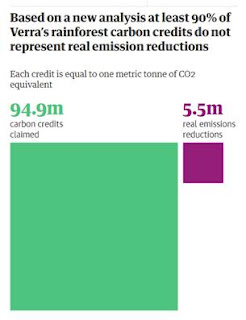
"The research into Verra, the world's leading carbon standard for the rapidly growing $2bn (£1.6bn) voluntary offsets market, has found that, based on analysis of a significant percentage of the projects, more than 90% of their rainforest offset credits – among the most commonly used by companies – are likely to be 'phantom credits' and do not represent genuine carbon reductions."

The graphic in the article presents the same information in more dramatic terms:
 

Perhaps the most surprising aspect of the story is that the lead word of the title is "Revealed," suggesting some counterintuitive investigative reporting that shakes the foundations of our existing belief system. While real reporting no doubt produced the data (and it is always good to have evidence to support an argument), the idea that this is a surprise will be news only to those who have not been paying attention:

"The analysis raises questions over the credits bought by a number of internationally renowned companies – some of them have labelled their products 'carbon neutral,' or have told their consumers they can fly, buy new clothes or eat certain foods without making the climate crisis worse. But doubts have been raised repeatedly over whether they are really effective."

Who knows, next they will be 'revealing' that we are going to miss the 1.5 degree Celsius Paris Accord target or that, even more shocking, all the 2050 carbon neutral commitments by companies and countries are going to be harder to achieve than our leaders have previously suggested. Stay tuned for more revealing stories about how we are in a much worse state than previously believed.

Take care
David

David Chandler
© Sage Publications, 2023

Instructor Teaching and Student Study Site: https://study.sagepub.com/chandler6e 
Strategic CSR Simulation: http://www.strategiccsrsim.com/
The library of CSR Newsletters are archived at: https://strategiccsr-sage.blogspot.com/


Revealed: more than 90% of rainforest carbon offsets by biggest provider are worthless, analysis shows
By Patrick Greenfield
January 18, 2023
The Guardian
 

Tuesday, January 24, 2023

Strategic CSR - Population

I wanted to draw your attention to the article in the url below just because it seems like a pretty big deal:

"China has been the world's most populous country for hundreds of years. In 1750 it had an estimated 225m people, more than a quarter of the world's total. India, not then a politically unified country, had roughly 200m, which ranked it second. In 2023 it will seize the crown. The UN guesses that India's population will surpass that of China on April 14th. India's population on the following day is projected to be 1,425,775,850."

I had long ago heard that India's population would one day overtake China's, but I guess I did not expect it to happen right now. What is important about this point in time, though, is what the shift signals:

"The crown itself has little value, but it is a signal of things that matter. That India does not have a permanent seat on the UN Security Council while China does will come to seem more anomalous. Although China's economy is nearly six times larger, India's growing population will help it catch up. India is expected to provide more than a sixth of the increase of the world's population of working age (15-64) between now and 2050."

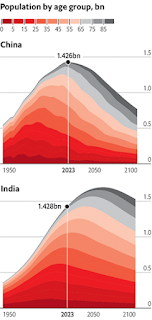
It is also interesting that China's population has been calculated to have peaked, while India's still has a way to go, as depicted in the charts accompanying the article:


Given that a country's population is generally negatively correlated with its level of economic development – higher wealth and participation of women in the workforce leads to declining birth rates (India's economy is still growing and projected to be the world's third largest "by 2029," but it's per capita GDP remains low), and given that India clearly still has room left to run, this will have all kinds of implications for resource utilization and, in particular, energy use (given that both countries still rely on fossil fuels, coal in particular, to produce their energy).

Take care
David

David Chandler
© Sage Publications, 2023

Instructor Teaching and Student Study Site: https://study.sagepub.com/chandler6e 
Strategic CSR Simulation: http://www.strategiccsrsim.com/
The library of CSR Newsletters are archived at: https://strategiccsr-sage.blogspot.com/


Fatter elephant, leaner dragon
By Brooke Unger
November 18, 2022
The Economist
Late Edition – Final
71-72
 

Thursday, January 19, 2023

Strategic CSR - Welcome back!


Welcome back to the Strategic CSR Newsletter!
The first newsletter of the Spring semester is below.
As always, your comments and ideas are welcome.
 

Last Fall, the carbon offsets industry was subjected to the scrutiny of John Oliver: https://youtu.be/6p8zAbFKpW0

Needless to say, it did not come off looking very good. The segment was funny (in a demoralizing way), well researched, and accurate in exposing the hypocrisy that allows us all to pretend we are making progress in tackling climate change, when we are really just making the problem worse (see Strategic CSR – Climate inaction).

Hope you all have a good semester.
David

David Chandler
© Sage Publications, 2023

Instructor Teaching and Student Study Site: https://study.sagepub.com/chandler6e 
Strategic CSR Simulation: http://www.strategiccsrsim.com/
The library of CSR Newsletters are archived at: https://strategiccsr-sage.blogspot.com/

Tuesday, December 6, 2022

Strategic CSR - World Cup

 
This is the last CSR Newsletter of the Fall semester.
Happy Holidays and I will see you in the New Year!
 

The World Cup in Qatar, as usual, is a spectacle as much for what happens off the pitch than on it. Of particular interest in this World Cup has been the human/civil rights record of the host country, along with the plight of migrant workers who were central to building the infrastructure required for the competition to proceed. With this in mind, the article in the url below points out that the societal inequity that was essential for the competition to be held is not limited to the host country, but includes the complicit involvement of many who are likely criticizing the host country:

"As the World Cup in Qatar kicked off last week, millions of fans pulled on jerseys costing $90 to $150 that were sold by Nike and Adidas, the official outfitter of this year's tournament. Players, wearing new, brightly colored uniforms, slipped into shiny cleats and shoes that can retail for more than $200. But what did the people who made these items get paid? In the case of 7,800 workers at the Pou Chen Group factory in Yangon, Myanmar, a supplier of soccer shoes for Adidas, the answer is 4,800 kyat, or $2.27, per day."

Apparently, the workers in this Myanmar factory attempted to use the World Cup as leverage to raise the issue of their working conditions, in the hope of securing something better:

"After workers began a strike in October, demanding a daily wage of $3.78, factory managers called soldiers into the complex and later fired 26 workers. They included 16 members of the factory's union, who were believed to have led the strike of more than 2,000 employees."

Workers facing similar conditions elsewhere are utilizing social media effectively to raise their plight, with personal appeals to soccer stars caught in a no-win situation:


In Myanmar, and elsewhere, all of these factories are contractors, of course, so the line of responsibility to major sports brands is opaque:

"Most Western fashion and sportswear brands do not own production facilities, instead contracting with independent factories or suppliers, often in the Global South, to make their garments. This means they are not technically the employers of these workers, and therefore are not legally responsible for enforcing labor standards or human rights."

The level of hypocrisy that these major sports competitions expose (whether the World Cup, Olympics, Commonwealth Games, F1, or similar global/international events) is always both interesting and incredibly frustrating. Of course, these contradictions were always there but, while awareness appears to be growing, meaningful action in response is less obvious. Ultimately, organizations like FIFA have felt at liberty to break laws and social conventions throughout their existence (the corruption needed to secure the World Cup in Qatar is only the most recent and blatant example) with few concerns about being held to account for their actions (see also, John Oliver's passionate piece on the World Cup). While regulatory authorities are beginning to take specific legal action, major sponsors remain tied to their long-term contracts (not unwillingly, it seems). Given that these global sporting events are wrapped in patriotism, but driven by money, all stakeholders need to hold these sports organizations to account for anything meaningful to change, including the fans purchasing these expensive replica shirts. While the Qatar World Cup has revealed the faultlines more specifically and completely (as information today travels more transparently than ever before), I don't see any serious consequences for the actions that produce headlines such as the one in the article in the url below.

Take care
David

David Chandler
© Sage Publications, 2023

Instructor Teaching and Student Study Site: https://study.sagepub.com/chandler6e 
Strategic CSR Simulation: http://www.strategiccsrsim.com/
The library of CSR Newsletters are archived at: https://strategiccsr-sage.blogspot.com/


Luxury Soccer Jerseys, but Rock-Bottom Wages
By Elizabeth Paton
December 2, 2022
The New York Times
Late Edition – Final
B1, B5

Thursday, December 1, 2022

Strategic CSR - Dr. Bronner's

The article in the url below provides an interesting case of a corporation that is not afraid to stand on principle:

"Dr. Bronner's, the liquid soap company best known for its teeny-font labels preaching brotherly love and world peace, would like you to consider the benefits of mind-altering drugs."

Specifically:

"The sentiment is promoted on limited-edition soap bottles that sing the praises of psychedelic-assisted therapies, and through the trippy pronouncements of David Bronner, grandson of the company's founder and one of its top executives, who is not shy about sharing details of his many hallucinogenic journeys."

Dr. Bronner's has started offering psychedelic treatments as part of its employee healthcare coverage; it has also campaigned for wider acceptance and adoption of such treatments, and decriminalization and legalization of many drugs that are currently banned:

"Since 2015, Dr. Bronner's Magic Soaps — yes, that's its official name — has donated more than $23 million to drug advocacy and research organizations, according to corporate documents. They include scientists researching the healing properties of the club drug Ecstasy, activist groups that helped decriminalize psilocybin 'magic mushrooms' in Oregon and Washington, D.C., and a small nonprofit working to preserve habitat for peyote, the hallucinogenic cactus central to some Native American spiritual traditions. Over the years, the company has also spent millions on efforts toward cannabis legalization, including litigation that in 2018 helped reverse a federal prohibition on the cultivation of industrial hemp."

There are many other details about the company in the article that make for fun/uplifting reading:

"But the founder's unconventional approach to business lives on. Top salaries at the company cannot exceed five times that of the lowest-paid worker with five years on the job, which means Michael and David each earn roughly $300,000 a year. Their 300 employees receive an array of benefits, including up to $7,500 in child-care assistance and annual bonuses of up to 10 percent of their annual pay. The cafeteria's vegan meals are free, as are the Zumba classes, back massages and solar-powered electric-vehicle charging stations."

The company is progressive on a number of issues and values its ability to remain independent so it can continue fighting the various causes in which it believes strongly:

"The company regularly spurns the kind of buyout offers that have claimed other independent brands like Burt's Bees (now part of Clorox), Tom's of Maine (Colgate-Palmolive) and Kiehl's (L'Oréal). The offers, the brothers say, go right into the trash. In a good year, the company gives away 45 percent of its profits, or about $8 million, according to the company's annual report. 'If we cashed out, we'd be less effective as a charitable engine,' David said."

Relatedly, in this month's election here in the U.S., CO residents passed a proposition to legalize psilocybin as a medical treatment (along with "psilocyn, DMT, ibogaine and mescaline," see here), with the support of 52% of the vote.

Take care
David

David Chandler
© Sage Publications, 2023

Instructor Teaching and Student Study Site: https://study.sagepub.com/chandler6e 
Strategic CSR Simulation: http://www.strategiccsrsim.com/
The library of CSR Newsletters are archived at: https://strategiccsr-sage.blogspot.com/


Suds with a Mission
By Andrew Jacobs
March 1, 2022
The New York Times
Late Edition – Final
D1, D5
 

Tuesday, November 29, 2022

Strategic CSR - COP27

I don't know what you all have read and think about the recent COP27 conference. But, from what I have read, it can only be thought of as a failure. Just one of the many statistics to come out of the event – there were over 600 lobbyists from the fossil fuel industry present. Accordingly, they got exactly what they were no doubt paid a lot of money to secure – a toothless agreement to continue to talk about possibly doing something at some vague future point. As noted in the article in the url below:

"It really does beggar belief, that in the course of 27 Cops, there has never been a formal agreement to reduce the world's fossil fuel use. … It is no surprise, then, that from Cop1 in Berlin in 1995, to Egypt this year, emissions have continued – barring a small downward blip at the height of the pandemic – to head remorselessly upwards."

Of course, to plumb these depths, COP27 had to out-do the disastrous COP26, a year earlier:

"Expectations were never especially high over the course of the 12 months since Glasgow's Cop26. Even so, COP27 has to be a new low – held in a country cowed by a malicious dictatorship, the world's biggest plastic polluter on board as a sponsor, and hosting more than 600 fossil fuel representatives and many others who are there to prevent, rather than promote progress and action. Some old hands have labelled it the worst COP ever, and I doubt many would argue."

A big part of the problem, according to the author of the article, is the scale of each COP meeting, which takes place in front of the world media:

"In all honesty, it is becoming increasingly difficult to view these events as anything other than photo opportunities for presidents and prime ministers who turn up simply to make the world think they care. The reality is that, in most cases, they have no inkling of how bad climate breakdown is set to be and little interest in finding out."

So, where do we go from here? The author of the article suggests moving away from massive, global meetings (where compromise almost always seems to mean the lowest common denominator) and move towards smaller groups of people with the authority to make decisions. Arguably, the best thing to come out of COP27 had nothing to do with the COP process, itself – China and the U.S. agreed to resume working bilaterally on this issue. Given that they collectively emit close to 40% of greenhouse gas emissions, if that small group of two can decide to do something, and then can secure the buy-in of the EU, we might make some meaningful progress:

"What is needed is an apparatus that is less cumbersome and more manageable – something leaner and meaner that zeros in on the most critical aspects of the climate crisis, that does its work largely hidden from the glare of the media, and which presents a less obvious honey pot to the busy bees of the fossil fuel sector. One way forward, then, could be to establish a number of smaller bodies, each addressing one of the key issues – notably energy, agriculture, deforestation, transport, loss and damage, and perhaps others."

And, essentially, these would be standing committees, rather than very large groups of constantly shifting people who meet one week a year in a different location, each time:

"Such bodies would operate full-time, liaising with one another and perhaps coming together a few times a year. Ideally, they would be made up of representatives from both developed and majority-world countries. In direct contact with representatives of national governments, part of their remit would be to negotiate agreements that are workable, legally binding, and which actually do the job – whether reversing deforestation, cutting methane emissions, or drawing down coal usage. As and when all terms and conditions are agreed, these could be validated and signed off by world leaders as a matter of course and without the need for the ballyhoo of a global conference."

As they say, what's the worst that could happen? You could argue 'global climate calamity,' but that is the direction we are heading in with the current arrangement.

Take care
David

David Chandler
© Sage Publications, 2023

Instructor Teaching and Student Study Site: https://study.sagepub.com/chandler6e 
Strategic CSR Simulation: http://www.strategiccsrsim.com/
The library of CSR Newsletters are archived at: https://strategiccsr-sage.blogspot.com/


The big takeaway from COP27? These climate conferences just aren't working
By Bill McGuire
November 20, 2022
The Guardian

Friday, November 25, 2022

Strategic CSR - Climate dissonance

The article in the url below is making a nuanced distinction between "climate denial" and "climate dissonance." The author is arguing that we have progressed (or should that be, regressed) from denial to dissonance and that this shift is consequential because it captures the gap between what corporations are now promising, and what they are delivering (now or into the future):

"… this basic phenomenon, in which powerful people make climate pledges that turn out to wildly outrace their genuine commitments, has now become so pervasive that it begins to look less like venality by any one person or institution and more like a new political grammar. The era of climate denial has been replaced with one plagued by climate promises that no one seems prepared to keep."

In other words, the author is acknowledging that few corporate leaders can now get away with ignoring climate change or not at least pretending to do anything about it. The trouble is that this denial has been replaced with promises to act that remain essentially meaningless:

"For years, when advocates lamented the 'emissions gap,' they meant the gulf between what scientists said was necessary and what public and private actors were willing to promise. Today that gap has almost entirely disappeared; it has been estimated that global pledges, if enacted in full, would most likely bring the planet 1.8 degrees Celsius of warming — in line with the Paris agreement's stated target of 'well below two degrees' and in range of its more ambitious goal of 1.5 degrees. But it has been replaced by another gap, between what has been pledged and what is being done. In June, a global review of net-zero pledges by corporations found that fully half of them had laid out no concrete plan for getting there; and though 83 percent of emissions and 91 percent of global G.D.P. is now covered by national net-zero pledges, no country — not a single one, including the 187 that signed the Paris agreement — is on track for emissions reductions in line with a 1.5 degree target, according to the watchdog group Climate Action Tracker."

But, because the embrace of apparent action is so comprehensive, the effect is to introduce ambiguity in the name of clarity:

"Five years ago, the stakes were clear, to those looking closely, but so were the forces of denial and inaction, which helps explain the global crescendo of moral fervor that appeared to peak just before the pandemic. Today the rhetorical war has largely been won, but the outlook grows a lot more confusing when everyone agrees to agree, paying at least lip service to the existential rhetoric of activists."

It seems we have entered a more dangerous phase (confirmed by the failure of the recent COP27 meeting), where we now kid ourselves that we are doing something, when we are no better off than before all these pledges were made. In fact, the author argues, we are worse off than during that time:

"Rhetoric this unmoored from reality is often called disinformation. It is also simply disorienting — especially given how many narratives have been layered over our picture of the post-warming future. … But even among those who take the inevitability of warming seriously, there's also a lot of normalization and compartmentalization, which allow many of the world's most privileged to regard climate suffering as distant, if tragic."

Kidding ourselves that we are doing something, it turns out, is likely worse than deliberately doing nothing:

"We nod our heads reflexively about proposals to plant a trillion trees, without realizing that doing so, as climate scientists like David Ho have pointed out, would set the carbon clock back by less than eight months at current emissions levels. (Plus, trees burn, unfortunately; last year, in fact, the carbon released by wildfires exceeded that released by any of the world's economies except the United States and China)."

Take care
David

David Chandler
© Sage Publications, 2023

Instructor Teaching and Student Study Site: https://study.sagepub.com/chandler6e 
Strategic CSR Simulation: http://www.strategiccsrsim.com/
The library of CSR Newsletters are archived at: https://strategiccsr-sage.blogspot.com/


What's Worse: Climate Denial or Climate Hypocrisy?
By David Wallace-Wells
June 26, 2022
The New York Times Sunday Magazine
Late Edition – Final
14-15
 

Tuesday, November 22, 2022

Strategic CSR - Chick-fil-A

The article in the url below is superficially a story about the local nuisance being caused by a popular fast-food drive-through lane, during the COVID lockdown:

"Business has boomed for Chick-fil-A franchisee Travis Collins during the pandemic, thanks to surging appetite for chicken sandwiches from his drive-through window. Now he's throwing the works at controlling the lines of cars spilling onto surrounding streets. The city council in this affluent coastal city has proposed declaring his drive-through a public nuisance. Neighbors and city officials say customers hungry enough to brave the crowded lot for Chick-n-Strips or the signature sandwich of chicken with pickles on a buttered bun have caused so many traffic jams, bus delays and hazards on the city's main drag that something must be done."

Apparently, this is not a problem that is restricted to California, but is more common to Chick-fil-A's across the country:

"Businesses in Toledo, Ohio, and Beaumont, Texas, have filed lawsuits against Chick-fil-A franchises over mushrooming drive-through queues. In the Township of Union, N.J., a judge ordered another Chick-fil-A location to temporarily close its drive-through, after a competing restaurant next door said its customers couldn't get around the line."

And, it is officially, a thing:

"In a 14-page memorandum titled 'Traffic Conditions Associated with Chick-fil-A Queuing' sent to city officials in January, Santa Barbara's chief transportation engineer, Derrick Bailey, wrote that the drive-through snarled traffic for an average of 70 minutes on weekdays and 92 minutes on Saturdays. The backup on the busiest day of the study period was 2½ hours."

The article offers no real explanation as to why this is such a problem at Chick-fil-A restaurants, other than hinting that the current "labor shortages" are resulting in a slower service. Implicit in the story, however, is that this is happening at Chick-fil-A and not other fast-food restaurants, which results from the greater popularity of this chain.

Whenever I see a story about Chick-fil-A, however, I can't help but think of the values at play. In short, it is a complicated company – on the one hand, a poster-child for an era (not so long ago) of homophobia in the U.S. (see Strategic CSR – Chick-fil-A); on the other hand, it is also a company that treats its employees extremely well and has a progressive franchise model (only one store per franchisee).

So, what does this say about the importance of values to a company? Or, perhaps more importantly, the importance of values to the company's stakeholders who, in theory, are seeking meaning in their interactions with the company? How much are they aware of the values that define this company (and that their support is a tacit endorsement), or are they simply thinking in more shallow terms (I like the sandwiches, or I want a job, etc.). There are three options, as far as I can see. People either:
  1. Don't know.
  2. Know and don't care.
  3. Agree.

This seems relatively important because, if it is #1 or #2, it is harder to make the argument that values matter to stakeholders, and there is value to firms of publicly stating their values and taking sides on issues of social relevance and importance. If, in fact, stakeholders don't know or care to find out (or, worse, know and don't care), then the more traditional model of CEOs striving to remain 'neutral' in the social battles of the day will be a missed opportunity for society to progress.

Take care
David

David Chandler
© Sage Publications, 2023

Instructor Teaching and Student Study Site: https://study.sagepub.com/chandler6e 
Strategic CSR Simulation: http://www.strategiccsrsim.com/
The library of CSR Newsletters are archived at: https://strategiccsr-sage.blogspot.com/


Chick-fil-A's Drive-Through Crowds Get Neighbors Squawking
By Christine Mai-Duc
April 25, 2022
The Wall Street Journal
Late Edition – Final
A1, A10

Thursday, November 17, 2022

Strategic CSR - Greenhushing

The article in the url below discusses a term I had not seen previously – greenhushing:

"First, there was greenwashing — a term referring to deceptive marketing campaigns and other performative gestures by companies to make consumers and investors believe that they are environmentally responsible. Now, there is greenhushing. And it's also a problem. Firms engage in greenhushing when they are actively working to reduce their carbon footprint, produce less waste, manufacture less plastic, and build greater sustainability, but they don't tell anyone about their efforts."

While this is an interesting term, it is not a particularly surprising phenomenon. I have seen a similar approach to sustainability adopted by Walmart, for example, although the reason the firm does not advertise its (often industry leading) efforts is because of the perception that green products are more expensive (even when that is not the case). Crucially, the firm does not want the perception of higher prices among its customers to undermine its low cost strategy:

"It seems like a contradiction for companies to be 'doing good while doing well' and not blasting the news across every corner of the internet."

Frustrating. It only seems "like a contradiction" if you do not put much thought into what is meant by the phrase "doing good while doing well." In reality, it is stakeholder pressure that is determinative. The cornerstone of "doing good while doing well" suggests there is a level of "good" that is objectively known and agreed upon. But this is clearly ridiculous – what constitutes good behavior is both highly contested and a moving target. Thus, if a firm is feeling pressured by one stakeholder group (say, investors or the government) to perform in a certain way, while the opposite pressure is being applied by another stakeholder group (say, customers concerned about low prices), then it is immediately obvious why a firm would want to manipulate the message it conveys to these different groups by saying different things. As the article continues to note:

"If a company specifically states its ESG goals and reports its progress in hitting those targets, it could face pushback from stakeholders who find the plans aren't ambitious enough. … On the other hand, it could also face backlash from investors and politicians who believe ESG efforts undermine profits or run counter to prevailing values. For example, oil-rich Texas recently banned its municipalities from doing business with banks that have ESG policies against fossil fuels and firearms."

Another reason firms keep quiet about ESG, of course, could be that they know the foundations on which much of it is built are shaky:

"One of the biggest challenges for firms seeking to improve their environmental, social, and corporate governance is a lack of standards across those dimensions. Globally, there is no single method of data collection or measurement, which often leads to confusion — and greater incentive not to share information."

Take care
David

David Chandler
© Sage Publications, 2023

Instructor Teaching and Student Study Site: https://study.sagepub.com/chandler6e 
Strategic CSR Simulation: http://www.strategiccsrsim.com/
The library of CSR Newsletters are archived at: https://strategiccsr-sage.blogspot.com/


Greenhushing: Why Some Firms Keep Quiet About ESG
By Angie Basiouny
November 8, 2022
Knowledge @ Wharton
 

Tuesday, November 15, 2022

Strategic CSR - Carl Sagan

The video in the url below was recommended to me by YouTube. It's all-knowing algorithm thought I would be interested to watch Carl Sagan (a household name here in the U.S. from a different era when science and scientists were respected) testify to Congress in December, 1985 about climate change:


It is amazing to see how eloquently he described the greenhouse gas effect in a way that non-experts would clearly understand. In other words, there are many frustrating things about the video, but the most frustrating is that it is 1985 and science was able to articulate to non-scientists that this is a problem and it is only going to get worse.

Take care
David

David Chandler
© Sage Publications, 2023

Instructor Teaching and Student Study Site: https://study.sagepub.com/chandler6e 
Strategic CSR Simulation: http://www.strategiccsrsim.com/
The library of CSR Newsletters are archived at: https://strategiccsr-sage.blogspot.com/

Monday, November 7, 2022

Strategic CSR - Nietzsche

The article in the url below made me smile. It is a review of a recently published book, 'If Nietzsche Were a Narwhal.' The book is a philosopher's perspective on human intelligence and, perhaps not surprisingly, the author is not impressed. As the reviewer neatly summarizes for us:

"The following bit of black humor isn't drawn from Mr. Gregg's book but summarizes much of its argument. After a worldwide nuclear holocaust, the few surviving amoeba-like creatures hold a meeting at which they decide to try evolving again. But before they do so, they together make a solemn vow: 'This time, no brains!'"

The kernel of the book's idea comes from the author's analysis of Nietzsche, who was both liberated and constrained by his own intelligence:

"'If Nietzsche Were a Narwal' begins, appropriately enough, with the great depressive himself, who had plenty of brains. 'Nietzsche,' Mr. Gregg writes, 'both wished he was as stupid as a cow so he wouldn't have to contemplate existence, and pitied cows for being so stupid that they couldn't contemplate existence.'"

The author builds on this foundation, questioning the value of the key characteristic that supposedly defines human intelligence – an awareness of our own eventual demise:

"Mr. Gregg maintains, for example, that death awareness—widely considered a hallmark of human intelligence—isn't all it's cracked up to be. While the human understanding of time and gift of foresight have their perks, when it comes to death, is ignorance bliss? Mr. Gregg thinks so. 'The day-to-day consequences of death wisdom'—grief, dread, nihilism, mental and emotional anguish—'really do suck,' he writes. 'I believe that animals … do not suffer as much as we do for the simple reason that they cannot imagine their deaths.'"

The author expands on this core idea, illustrating exactly how we can be our own worst enemies:

"We humans are besotted by intelligence, especially our own. And yet 'intelligence is not the miracle of evolution we like to think it is. … The planet does not love us as much as we love our intellect.' In fact, 'our many intellectual accomplishments are currently on track to produce our own extinction, which is exactly how evolution gets rid of adaptations that suck.'"

In this sense, perhaps the sub-title of the book is more revealing: 'What Animal Intelligence Reveals About Human Stupidity.' The point can be applied broadly:

"As for ethics and morality, Mr. Gregg notes that, while human cognitive skills 'have molded the human moral sense from the clay of animal normativity,' our moral reasoning 'often leads to more death, violence, and destruction than we find in the normative behavior of nonhuman animals.' Animals, not unlike humans, typically have norm-based systems, but deviations rarely result, as they do with us, in mass death and suffering."

As the reviewer concludes:

"It is startling to consider that our very intelligence may have made humans no better morally, even no better off physically, than other species. Indeed, by many measures of evolutionary success (number of individuals, persistence over time, likelihood of persisting into the future), Homo sapiens is doing poorly compared to many other species. And not benefiting the Earth, either."

The author's own conclusion covers similar ground:

"Mr. Gregg concludes, glumly but effectively, that 'there's good reason to tone down our smugness. Because, depending on where we go from here, human intelligence may just be the stupidest thing that has ever happened.'"

For comparison, there is another review of the same book in the article in the second url below.

Take care
David

David Chandler
© Sage Publications, 2023

Instructor Teaching and Student Study Site: https://study.sagepub.com/chandler6e 
Strategic CSR Simulation: http://www.strategiccsrsim.com/
The library of CSR Newsletters are archived at: https://strategiccsr-sage.blogspot.com/


Big Brains, Big Problems
By David P. Barash
July 21, 2022
The Wall Street Journal
Late Edition – Final
A15

Sorry, but We're Not as Smart as We Think
By Jennifer Szalai
August 11, 2022
The New York Times
Late Edition – Final
C2
 

Thursday, November 3, 2022

Strategic CSR - Second chances

For a while now, I have been interested in the idea of "second-chance" employment. Such campaigns have arisen in response to application forms at many companies in the U.S. that ask whether the applicant has ever committed a felony crime. If so, the applicant is legally required to check a box, at which point most companies file their application in the trash. Gradually, companies are beginning to recognize that doing so might mean they are missing something – first, because the idea of punishment after a crime should be primarily to rehabilitate and, if someone has served their sentence, then (in theory, at least) they have paid for their mistake and should not continue to be punished. Second, and more importantly, I think, to give a second chance to someone who routinely has doors slammed in their face is to tap into potential others are ignoring, primarily because it is a way to build trust, respect, and loyalty because of the opportunity that is being extended.

One of my favorite companies, Dave's Killer Bread (DKB), is an active proponent of second-chance employment (due largely to the colorful history of the "Dave" of DKB); so much so that somewhere around 50% of employees at the company have been hired under the program. As the company proclaims on its website:

"The Dave's Killer Bread Foundation was created in 2015 to inspire and equip other businesses to adopt Second Chance Employment. A lack of information or understanding about employing people with criminal backgrounds can make businesses hesitant to explore this option, and we're here to change that. We believe that in the long term, Second Chance Employment has the power to reduce the negative impact of recidivism in America, and we work to educate organizations on the importance of employing this part of our population. Find out more at dkbfoundation.org."

And, as the company notes on its Foundation website, this is not a minor issue:

"Every year, 650,000 Americans return to society from incarceration to find themselves locked out of gainful employment opportunities. People with criminal records were 5x more likely to be unemployed in 2019 than the rest of the nation."

As the article in the url below notes, other companies are beginning to catch on to the potential advantages of a more progressive approach on this issue:

"A labor shortage has pushed more employers to recruit employees who have served prison time. In recent years, small businesses and big U.S. companies including banks and pharmacy chains say they have recognized that so-called second-chance hiring offers a chance to ease societal inequities. It also helps them find more workers in a tight job market."

The barriers people in this situation face are significant:

"Finding steady, formal employment has long been a challenge for people who have been convicted of crimes. Job applications often ask about felony convictions, even though there have been efforts across the country to ban such a question. After that, a background check may flag a job seeker's criminal history, potentially invalidating the application. These roadblocks contribute to higher unemployment rates for formerly incarcerated people. Their unemployment rate was estimated at over 27%, according to a 2018 report from the Prison Policy Initiative. … just having an arrest record can hurt people's employment prospects, even if charges were dropped."

Thankfully, the value of supporting causes like this is beginning to spread as the idea gains support/legitimacy:

"The Second Chance Business Coalition—a group of companies that work to share best practices on hiring people with a criminal background—was formed in 2021 with 29 companies and now has more than 40. Among those are JP Morgan Chase & Co., American Airlines Group Inc., AT&T Inc. and CVS Health Corp."

And, in some case, with meaningful impact:

"About one-tenth of JPMorgan Chase's new hires last year, roughly 4,300 people, had criminal records, according to Nan Gibson, executive director for JPMorgan Chase's PolicyCenter. Many of them are placed into teller positions and other jobs at bank branches, said Michelle Kuranty, the company's global head of talent acquisition sourcing."


What would be useful and interesting, is to know how these employees perform relative to others after being hired. I suspect they perform at a higher level and remain loyal to the organization for longer, but I presume it is privacy concerns that prevent firms from tracking these data:


"The company doesn't track these workers after they are hired, said Ms. Kuranty."


Take care

David


David Chandler

Strategic Corporate Social Responsibility: Sustainable Value Creation (6e)

© Sage Publications, 2023


Instructor Teaching and Student Study Site: https://study.sagepub.com/chandler6e 

Strategic CSR Simulation: http://www.strategiccsrsim.com/

The library of CSR Newsletters are archived at: https://strategiccsr-sage.blogspot.com/


More Businesses Try 'Second-Chance' Hiring

By Allison Prang

October 10, 2022

The Wall Street Journal

Late Edition – Final

A3

https://www.wsj.com/articles/more-businesses-want-to-hire-people-with-criminal-records-amid-tight-job-market-11665173965


Tuesday, November 1, 2022

Strategic CSR - Warning labels

The article in the url below asks an interesting question:

"What if gas station pumps warned drivers about climate change the way cigarette packs warn smokers about lung cancer?"

Apparently, they do in Cambridge, MA:

"Drive up to any gas pump in Cambridge, Massachusetts, and you'll see a yellow label slightly bigger than a greeting card. In red lettering, it tells drivers, 'WARNING: Burning Gasoline, Diesel and Ethanol has major consequences on human health and on the environment including contributing to climate change.'"

These labels are the first of their kind in the U.S. They were originally installed in early 2021, and they are not subtle:


The theory motivating the idea for the labels places the responsibility for action on each of us, as individuals:

"'The fight to reverse climate change requires that everyone take action to change their behavior,' the council noted in its policy order for the labels, 'and the City must underscore the fact that each individual's behavior can make an impact on the environment and on public health.'"

The idea first appeared in Vancouver, Canada, but was more of a muted effort:

"North Vancouver ended up agreeing to the idea first, and in 2016 became the first Canadian city to put climate labels on its pumps. But local officials opted not to go with a graphic warning about climate change proposed by activists and instead chose a label that the energy industry helped design. The word 'warning' doesn't appear. Instead, the labels state 'Reducing Emissions Help Fight Climate Change' and also offer tips on how to do so through things like maintaining tire pressure and not idling your car."

Perhaps not surprisingly, Scandinavia is making faster progress on this issue:

"In Sweden, a campaign to put climate labels on gas pumps launched in 2013 and was passed by parliament in 2018. Now color-coded labels can be found in most fueling stations across the country; they compare the carbon intensity of fossil fuels, biodiesel, and electric vehicle chargers."

The comparison with health warnings on cigarettes is obvious, but the effectiveness of such labels is unknown:

"Perhaps the closest parallel are the warning labels on cigarettes; but even there, the effectiveness remains unclear. 'Do the warnings on cigarette packs actually prevent people from smoking? We don't know,' [Patricia Nolan, the Cambridge City Council member sponsoring the labeling effort] said. For her, the point of the gas labels is 'educating the public. The science is very clear: burning gasoline hurts people's health and the environment.'"

Take care
David

David Chandler
© Sage Publications, 2023

Instructor Teaching and Student Study Site: https://study.sagepub.com/chandler6e 
Strategic CSR Simulation: http://www.strategiccsrsim.com/
The library of CSR Newsletters are archived at: https://strategiccsr-sage.blogspot.com/


Where Are All the Climate Warnings on Labels on Gas Pumps?
By Zahra Hirji
July 19, 2022
Bloomberg Businessweek

Thursday, October 27, 2022

Strategic CSR - Self-esteem

The article in the url below discusses a video launched over the summer as part of the "Dove Self-esteem Project," called Toxic Influence. The video focuses on the effects social media can have on young girls and, in particular, highlights the extent to which neither they, nor their mothers, have any idea about the content to which they are being exposed:


The article explains what happens in the video:

"In the video, one mom says she thinks social media can be good or bad, while another says it can be confidence-building; one girl says she thinks it has had a mostly positive impact on her life. The girls are then told to start scrolling on their phones. Images appear on the big screen, quick clips of TikTok-ish influencers touting weird beauty hacks. 'Most parents underestimate how harmful toxic beauty advice can be on social media,' the text says. Then, out of left field: 'Using face-mapping technology, we put highly toxic advice into the mouths of their moms.' Now the five mothers appear on the movie screen, digitally morphed into the people doling out grotesque recommendations: how you are never too young for 'baby Botox'; how at-home lip-injection kits are so amazing; how there are powders you can ingest to skip meals; how to straighten your teeth with a nail file. 'Skinny,' the last toxic influencer/deepfake mom tells us, 'is never finished.' 'You wouldn't say that to your daughter,' the text announces. 'But she still hears it online, every day.' The mothers are shocked, the daughters contrite."

The point of the article (and video) is not necessarily to highlight the big picture extent to which social media affects young girls' self-esteem, but the extent to which it does that subtly so that, for the most part, people are not aware of the changes that are happening. The author in the article writes this in her concluding paragraph:

"Yesterday I picked up my 10-year-old's old turquoise iPod Touch to see what was on it. I found a few selfies she took — as unsmiling as Morticia Addams, as the kids like it these days. I also found some chatty videos she made of herself painting seashells, copying the style of her favorite arts-and-crafts YouTuber. Every so often, she would bat her tangled hair back with splayed hands, the way people with long nails do. My daughter does not have long nails. Her favorite YouTuber does. The amount of ingested culture in this tiny gesture stopped me short. This was nothing a feed 'detoxed' of teeth-filers would address. It was bigger: everything she sees, all the time, everywhere, an open fire hydrant of messages — including, no matter how much they would prefer to seem above it, Dove's."

Take care
David

David Chandler
© Sage Publications, 2023

Instructor Teaching and Student Study Site: https://study.sagepub.com/chandler6e 
Strategic CSR Simulation: http://www.strategiccsrsim.com/
The library of CSR Newsletters are archived at: https://strategiccsr-sage.blogspot.com/


Soft Soap
By Mireille Silcoff
July 24, 2022
The New York Times Sunday Magazine
Late Edition – Final
7-10