The CSR Newsletters are a freely-available resource generated as a dynamic complement to the textbook, Strategic Corporate Social Responsibility: Sustainable Value Creation.

To sign-up to receive the CSR Newsletters regularly during the fall and spring academic semesters, e-mail author David Chandler at david.chandler@ucdenver.edu.

Showing posts sorted by relevance for query carbon tax. Sort by date Show all posts

Tuesday, February 2, 2021

Strategic CSR - Carbon tax

The article in the url below is a useful and clear explanation of the benefits of a carbon tax as the most effective, immediate remedy to the challenge of climate change:

"The economics of climate change is straightforward. Earth is warming both because greenhouse gases are costly to eliminate and because governments have permitted people to emit them into the atmosphere without penalty. The classical remedy is a carbon tax, a fee on the carbon content of fossil fuels. Generally levied where fuels are extracted or imported, it discourages carbon emissions by making goods with larger carbon footprints more expensive. The World Bank reports that as of 2019, 57 local, regional and national governments have either enacted some form of carbon tax or plan to do so. When people must pay for their emissions, they quickly discover creative ways to reduce them."

One of the main barriers to the implementation of a carbon tax, of course, is the lack of political will. That is, politicians fear sponsoring anything that looks like a tax, based on the reasonable assumption that their voters will vote them out of office if they do so:

"Even with such gains in prospect, many legislators remain unenthusiastic because they perceive a carbon tax as being unpopular with voters. Many families have been struggling to make ends meet, they might say, and the last thing they need is a stiff new tax on energy use."

The most commonly-prescribed solution to this problem is to make the tax revenue-neutral. That is, each person would receive a monthly rebate that is (in theory) equal to their estimated carbon usage. The problem, of course, is how to accurately measure individual usage to ensure poorer families do not end up paying more in carbon taxes than they receive in rebates. As a potential remedy, the author of this article suggests a more progressive rebate system based on the uneven carbon usage by different income groups:

"Because the wealthy consume much more energy than others, they would contribute a disproportionate share of the revenue from a carbon tax. The top 10 percent of all income recipients account for almost half of carbon emissions worldwide, an Oxfam International study has found. Use patterns are less skewed in the United States, but here, too, the wealthy live in bigger houses, drive bigger cars and, at least when the pandemic isn't raging, take many more trips to distant destinations."

So, rather than try and calculate each taxpayer's carbon usage, this article suggests that simply giving everyone the same payment would amount to a net gain for those at lower income levels:

"Even with equal rebates per capita, most people would get a monthly check for more than they'd paid that month in carbon taxes. Rebates could, of course, be distributed in a more progressive fashion."

There is even an argument that higher income earners would still be better off, even though they would be net contributors to the carbon tax system:

"Although low- and middle-income families would be net cash beneficiaries under this plan, the wealthy would pay more in tax each month than they would receive in rebates. Even so, prosperous voters would also come out ahead, on balance. That's both because they would benefit disproportionately from the resulting reductions in climate losses and because they would otherwise have to shoulder much of the tax burden of climate adaptation measures. In short, compelling evidence suggests that a carbon tax would improve life outcomes for rich and poor alike."

This twist of a progressive rebate distribution is intriguing, and something I do not remember seeing before. The result could be persuasive to politicians with the creativity to frame it appropriately to their constituents:

"Had carbon taxes been widely adopted decades ago, the planet would not be facing a climate crisis today. Critics are correct that it is too late for this measure alone to defuse the climate threat. … But adopting a carbon tax even at this late date would greatly reduce both the cost of achieving climate stability and the time needed to achieve that goal."

Take care
David

David Chandler
© Sage Publications, 2020

Instructor Teaching and Student Study Site: https://study.sagepub.com/chandler5e 
Strategic CSR Simulation: http://www.strategiccsrsim.com/
The library of CSR Newsletters are archived at: https://strategiccsr-sage.blogspot.com/


Behavioral Contagion Could Spread Carbon Tax Benefits
By Robert H. Frank
August 23, 2020
The New York Times
Late Edition – Final
BU5

Monday, October 22, 2012

Strategic CSR - Carbon Tax

What would public policy look like if our political system focused on substance rather than rhetoric (and also threw in a bit of intelligence for good measure)? The article in the url below suggests that, regarding carbon emissions and taxation policy at least, it might look a little bit like British Columbia, Canada:

“[Last July], the best climate policy in the world got even better: British Columbia’s carbon tax — a tax on the carbon content of all fossil fuels burned in the province — increased from $25 to $30 per metric ton of carbon dioxide, making it more expensive to pollute.”

Why is raising tax on carbon emissions so good? Because the provincial government uses the revenue as an offset to lower both individual income and corporate taxes:

“Thanks to this tax swap, British Columbia has lowered its corporate income tax rate to 10 percent from 12 percent, a rate that is among the lowest in the Group of 8 wealthy nations. Personal income taxes for people earning less than $119,000 per year are now the lowest in Canada, and there are targeted rebates for low-income and rural households.”

As the authors argue:

“Substituting a carbon tax for some of our current taxes — on payroll, on investment, on businesses and on workers — is a no-brainer. Why tax good things when you can tax bad things, like emissions? The idea has support from economists across the political spectrum … . That’s because economists know that a carbon tax swap can reduce the economic drag created by our current tax system and increase long-run growth by nudging the economy away from consumption and borrowing and toward saving and investment.”

This tax policy, of course, also lowers carbon emissions:

“Economic theory suggests that putting a price on pollution reduces emissions more affordably and more effectively than any other measure. … British Columbia’s carbon tax is only four years old, but preliminary data show that greenhouse gas emissions are down 4.5 percent even as population and gross domestic product have been growing. Sales of motor gasoline have fallen by 2 percent since 2007, compared with a 5 percent increase for Canada as a whole.”

The authors argue that the U.S. should adopt a similar approach to taxation policy and have gone to the trouble of outlining what such an approach would look like:

“According to our calculations, a British Columbia-style $30 carbon tax would generate about $145 billion a year in the United States. That could be used to reduce individual and corporate income taxes by 10 percent, and afterward there would still be $35 billion left over. If recent budget deals are any guide, Congress might choose to set aside half of that remainder to reduce estate taxes (to please Republicans) and the other half to offset the impacts of higher fuel and electricity prices resulting from the carbon tax on low-income households through refundable tax credits or a targeted reduction in payroll taxes (to please Democrats).”

All of that might be possible if, of course, our political system cared anything about substance and meaningful change, rather than empty rhetoric.

Take care
David


Instructor Teaching Site: http://www.sagepub.com/strategiccsr/
The library of CSR Newsletters are archived at: http://strategiccsr-sage.blogspot.com/


The Most Sensible Tax of All
By Yoram Bauman and Shi-Ling Hsu
July 5, 2012
The New York Times
A17

Wednesday, November 16, 2016

Strategic CSR - Exxon

The article in the url below contains good news from Exxon:
 
"Exxon Mobil Corp. is ramping up its lobbying of other energy companies to support a carbon tax, marking a shift in the oil giant's approach to climate change as the industry faces growing pressure to address the politically charged issue."
 
The shift is not in terms of policy, but the level of effort Exxon is willing to invest in bringing about a carbon tax:
 
"Exxon's official position has long been the same—a carbon tax is the best way to address the risks of warming temperatures—but it has done little to actively advocate for that goal in recent years. Lately, Exxon has been making the case with its U.S. counterparts to support a carbon tax, arguing that the industry must not oppose all climate policies, according to people familiar with Exxon's thinking."
 
In spite of what you might think due to the company's ongoing tussle with the NY Attorney General, the article reports that Exxon's interest appears to be genuine:
 
"Top Exxon officials have been more vocal about their support for a carbon tax and have met with Capitol Hill offices about related legislation, according to the company's recent lobby disclosure forms. For the past six months, Exxon has been asserting its position more in meetings within trade associations, including the American Petroleum Institute and American Fuel and Petrochemical Manufacturers, according to multiple reports from people who have attended meetings with Exxon officials."
 
The cynical side of me is guessing Exxon's enthusiasm is based on its relative efficiency. In other words, if costs are pushed up for the industry as a whole, they will have a greater impact on less efficient companies, while more efficient companies (such as Exxon) will be better able to absorb the additional costs. This is why Walmart has long-supported an increase in the minimum wage – the firm pays above industry average and is more efficient than its competitors. The fear for companies with low-cost business-level strategies (such as Exxon and Walmart) is that costs will be implemented selectively or that they will be pressured to voluntarily take on additional costs to which other firms are not exposed. A carbon tax, of course, represents an increase in costs relative to the amount of carbon produced (and sold).
 
Having said that, a carbon tax is uniformly recognized by economists to be the best way to tackle climate change. Similarly, any solution to the consumption of fossil fuels has to involve the biggest industry players. As such, the fact that Exxon is willing to raise its public profile in support of a tax is absolutely a step in the right direction. In an ideal world, Exxon, and BP, and Shell, and Chevron, etc., will be incentivized by their stakeholders to shift their efforts (in particular, R&D) towards renewable energies, and shift quickly.
 
After that, we can work out what to do about the really big players in the global energy markets – the state backed companies, such as Aramco (Saudi Arabia), Sinopec (China), and Gazprom (Russia). As I said, in an ideal world …. And, suddenly, we are in a world that is far from ideal.
 
Take care
David
 
 
Instructor Teaching and Student Study Site: https://study.sagepub.com/chandler4e
Strategic CSR Simulation: http://www.strategiccsrsim.com/
The library of CSR Newsletters are archived at: https://strategiccsr-sage.blogspot.com/
 
 
Exxon Touts Carbon Tax to Rivals
By Amy Harder and Bradley Olsen
July 1, 2016
The Wall Street Journal
Late Edition – Final
B6


Thursday, September 12, 2019

Strategic CSR - Carbon Tax

I thought the article in the url below was worth bringing to your attention (it is an open letter), simply because of the people who have signed-onto it:
 
"Editor's note: This statement is signed by 27 Nobel economic laureates, all four living former chairs of the Federal Reserve, 15 former chairmen of the president's Council of Economic Advisers, and two former Treasury secretaries."
 
That is quite a group – and, if they can agree on anything, there is hope that the government can, one day, return to the job of legislating. The article opens with this statement:
 
"Global climate change is a serious problem calling for immediate national action. Guided by sound economic principles, we are united in the following policy recommendations."
 
It then goes on to list five policies. Here is the first line of each statement:
 
I. "A carbon tax offers the most cost-effective lever to reduce carbon emissions at the scale and speed that is necessary."
II. "A carbon tax should increase every year until emissions reductions goals are met and be revenue neutral to avoid debates over the size of government."
III. "A sufficiently robust and gradually rising carbon tax will replace the need for various carbon regulations that are less efficient."
IV. "To prevent carbon leakage and to protect U.S. competitiveness, a border carbon adjustment system should be established."
V. "To maximize the fairness and political viability of a rising carbon tax, all the revenue should be returned directly to U.S. citizens through equal lump-sum rebates."
 
There are more details to each policy in the article itself, but this is interesting stuff from an impressive group! A more critical response appears in the article in the second url below:
 
"A carbon tax is not a miracle solution. There aren't any. We will be living with some amount of climate change due to the highly uncertain effects of rising CO2 levels for the foreseeable future. The difference between a happy and unhappy outcome for humanity will come down to our ability to maintain economic progress in the face of our extraordinarily daunting debt challenges."
 
Perhaps, but this does not discount the fact that a carbon tax is widely acknowledged to be the best tool we have to make rapid progress on reducing the amount of carbon we emit into the atmosphere.
 
Take care
David
 
David Chandler
© Sage Publications, 2020
 
Instructor Teaching and Student Study Site: http://studysites.sagepub.comstudy.sagepub.com/chandler5e 
Strategic CSR Simulation: http://www.strategiccsrsim.com/
The library of CSR Newsletters are archived at: https://strategiccsr-sage.blogspot.com/


Economists' Statement on Carbon Dividends
January 17, 2019
The Wall Street Journal
Late Edition – Final
A13
By Holman W. Jenkins, Jr.
January 19-20, 2019
The Wall Street Journal
Late Edition – Final
A13
 

Thursday, January 27, 2022

Strategic CSR - Global carbon tax

Over the summer, you may have noticed the EU's roadmap of how it plans to reduce its carbon emissions by 55% by 2030 (benchmarked to some point in the 1990s), a plan it labelled "Fit for 55." Central to that plan is the idea that the EU will impose a carbon tariff on imports from countries with lower carbon emissions rules than the EU (which, I am guessing, is all countries outside the EU). While there are plenty of geopolitics at stake reading between the lines, the enticing element of this tariff plan is its implications for a global carbon tax, as explained in the article in the url below:

"A global carbon tax is viewed by many economists as the most efficient approach to decarbonizing industry, but creating one has always seemed a political impossibility. A new European Union carbon border tax just might start to change that."

The key is the tax on all imports to the EU from countries with more lax standards on carbon emissions than the EU:

"The levy—called a 'carbon border adjustment mechanism,' or CBAM—is part of a wide-ranging package adjusting EU rules to meet new climate ambitions. The measure is intended to both level the playing field between foreign and domestic producers and cut the risk that local companies relocate outside the EU to avoid the bloc's stringent rules. As drafted, CBAM could open a path to a global carbon price by establishing a cost of carbon on some imports into the EU, one of the world's biggest markets."

The hope seems to be that the U.S. will join the EU by imposing a similar tariff (see here). This is partly because if the EU and U.S. have a similar approach, it has a better chance of affecting other countries, but also it would avoid the complicated eventuality of the EU imposing a costly tax on imports from the U.S. Another motivator, as with all tax proposals, is the opportunity to collect revenue. In this case, the U.S. would prefer to collect the revenue themselves, as opposed to allowing the EU to collect it instead:

"While that level of cooperation currently seems unlikely, the estimated €9 billion in annual CBAM-related income the EU anticipates by 2030 might tempt politicians to act so that they collect the cash instead of Brussels."

The proposed effect is broad – so much so that the commentary around the tariff is that it will affect, in essence, all industries and products:

"CBAM will target aluminum, cement, fertilizer, power, steel and iron. Companies from regions without similar carbon costs would need to buy CBAM credits for the verified emissions released in the production of their imports into the EU. The price will be linked to the carbon cost determined by the EU's Emissions Trading System, currently over €50 a metric ton."

But, again, the tantalizing prospect is that the effect will be global and, in essence, establish a global tax on carbon:

"A global carbon price remains a fanciful notion for now, but something resembling it could take shape if the EU's CBAM, like its ETS, sets an example for other regimes to learn from. Much depends on the ambitions of Washington."

Take care
David

David Chandler
© Sage Publications, 2020

Instructor Teaching and Student Study Site: https://study.sagepub.com/chandler5e 
Strategic CSR Simulation: http://www.strategiccsrsim.com/
The library of CSR Newsletters are archived at: https://strategiccsr-sage.blogspot.com/


Europe's Carbon Prices Are Going Global
By Rochelle Toplensky
July 15, 2021
The Wall Street Journal
Late Edition – Final
B12
 

Wednesday, December 3, 2014

Strategic CSR - Divestment

The article in the url below highlights the growing importance of a movement I had been following at a distance, but haven't previously paid much attention to—the divestment of fossil-fuel companies from university and college endowment portfolios (see: http://gofossilfree.org/):
 
"Such divestment is clearly advocated on moral grounds – to save the planet – but is increasingly premised on financial grounds as well – to avoid the risks associated with the carbon bubble and what these stranded assets or unburnable carbon will do to investment portfolios holding fossil-fuel company stocks."
 
In particular, the article draws on the recent IPCC report (see: http://www.ipcc.ch/) that stresses a limit of keeping global temperature rises to 2 degrees Celsius (a "carbon budget"). The implication of such a budget is that "two-thirds of coal, oil and gas reserves would have to be left in the ground, at least until 2050" (a "carbon bubble"). As the author notes:
 
"If two-thirds of known reserves must stay in the ground, then this 'unburnable carbon' would not be monetized, becoming instead a stranded asset or liability that is not being priced into the current valuations of fossil-fuel companies."
 
In other words, either our carbon-intensive global economy will be allowed to continue extracting and burning traditional energy sources at great profit for energy companies (and great expense for the rest of us), or the valuations of these same companies are greatly inflated because they do not account for the possibility that two-thirds of known reserves cannot be monetized. Following the ideas in the article and extrapolating them to their natural conclusions does not appear to result in a situation where both outcomes can occur simultaneously. Either the planet or the fossil-fuel companies should be shorted today:
 
"Fossil-fuel companies, and an economy that subsidizes these (and other emitters) by letting them dump their carbon pollution into the atmosphere for free, would see significant disruptions if and when these externalities are accounted for."
 
This leads us back to the divestment movement. Given that "One can divest fossil fuels and still own a portfolio that remains very carbon intensive," the author advocates a very creative "Multi-pronged approach" that encompasses both engagement, protest, and incentives for carbon-based energy companies. Principally, he sees these three forces coming together in a "smart carbon tax":
 
"Not only would such a tax put a price on carbon so that clean energy can effectively compete, but it would also generate significant revenues, a portion of which could be assigned or recycled right back to the energy companies in the form of transition subsidies that enable them to convert over to sustainable energy. A Smart Carbon Tax would be designed so that a significant portion of proceeds is earmarked for investments in renewable energy, energy efficiency, resource efficiency more broadly, green infrastructure, and so forth. The fossil-fuel companies, as well as others, would be eligible to participate in this revenue stream from the Smart Carbon Tax. These transition subsidies could include expanded investment tax credits, low-interest loans, price supports, and so forth – and should obviously replace current fossil-fuel subsidies. But for such a plan to work, the amount transferred would have to be meaningful and may have to approach or approximate the profits the energy companies forego by leaving the fossil fuels in the ground."
 
An approach that incentivizes the involvement of the energy companies by not inflicting losses on them is essential. The fact that the divestment advocates are 'right' does not make them a solid bet given humanity's demonstrated capacity for self-destruction.
 
Take care
David
 
David Chandler & Bill Werther
 
Instructor Teaching and Student Study Site: http://www.sagepub.com/chandler3e/
Strategic CSR Simulation: http://www.strategiccsrsim.com/
The library of CSR Newsletters are archived at: http://strategiccsr-sage.blogspot.com/
 
 
2014 the Year for a Smart Carbon Tax
By Joe Keefe
July 28, 2014
Green Money Journal
 

Monday, March 2, 2015

Strategic CSR - Carbon tax

The article in the url below is interesting, not because it advocates for a carbon tax to reduce carbon emissions (that has been advocated by economists as the most effective tool to reduce emissions for many years), but because of the specificity of the numbers it uses to support its case:
 
"If a carbon tax were to be imposed next year, starting at $25 and rising by 5 percent a year, the Energy Information Administration estimates, carbon dioxide emissions from American power plants would fall to only 419 million tons by 2040, about one-fifth of where they are today. Total carbon dioxide emissions from energy in the United States would fall to 3.6 billion tons — 1.8 billion tons less than today."
 
The key to success is the incentive to which we, as humans, seem to respond most dramatically:
 
"By providing a monetary incentive, economists say, such a tax would offer by far the most effective way to encourage business and individuals to reduce their use of fossil fuels and invest in alternatives."
 
In spite of its probable effectiveness, we will not see a carbon tax introduced (in the US, at least) any time soon due to political constraints. What the article makes clear, however, is that this inaction is not preordained, but is a choice that we make as a society:
 
"Most important, perhaps, the Energy Information Administration's estimates make clear that the real constraint lies not in our ability to develop the necessary technologies but in our political will to deploy them."
 
Take care
David
 
David Chandler & Bill Werther
 
Instructor Teaching and Student Study Site: http://www.sagepub.com/chandler3e/
Strategic CSR Simulation: http://www.strategiccsrsim.com/
The library of CSR Newsletters are archived at: http://strategiccsr-sage.blogspot.com/
 
 
A Carbon Tax Could Bolster Green Energy
By Eduardo Porter
November 18, 2014
The New York Times
Late Edition – Final
B1
 

Tuesday, March 14, 2023

Strategic CSR - Global trade

Since the 2022 passing of the Inflation Reduction Act (which contains large subsidies for environmentally-related products and industries), I have seen a lot of media coverage about trade friction between the U.S and EU. The green subsidies that favor U.S. companies, by definition, penalize those companies from elsewhere and, given that the EU is perhaps the most advanced economic region in promoting environmental awareness, the companies most affected tend to be European. Before the IRA, however, there was the Green Deal, which was passed by the EU in 2020. A key part of this legislation was the Carbon Border Adjustment Mechanism (CBAM), which is an attempt to account for carbon emissions in products made in countries that don't otherwise tax that externality. The article in the first url below covers the details of CBAM, which were announced at the end of last year and represent the first attempt to tax imports based on the carbon emitted during their production (see Strategic CSR – Global carbon tax):

"The European Union reached an agreement to impose a tax on imports based on the greenhouse gases emitted to make them, inserting climate-change regulation for the first time into the rules of global trade. The deal … ends more than a year of negotiations on the details of the plan. The EU is expected to adopt it in the coming weeks as part of a sweeping package of legislation that would step up the bloc's efforts to limit global warming."

The EU is understandably proud of taking the first step on this issue:

"The plan, known as the carbon border adjustment mechanism, would be the world's first tax on the carbon content of imported goods. It has rattled supply chains around the globe and angered the EU's trading partners, particularly in the developing world where manufacturers tend to emit relatively large amounts of carbon dioxide. It has also unsettled manufacturers in the U.S. who are concerned the measure would create a new web of red tape to export to Europe."

The reason for this concern in the U.S., as noted in the article in the second url below, is that this legislation is as much about economic policy as it is about concerns for the environment:

"The 'carbon border adjustment mechanism' is aimed at protecting E.U. companies subjected to strict environmental rules from the risk of being crushed by competition with businesses from countries whose rules on emissions are looser. It is also designed to encourage other countries to adopt similarly ambitious emissions rules."

Thus, for all the criticism that the IRA has received for being a protectionist trade measure, the U.S. can legitimately point out that the EU started it. The exchange of blame raises one of the most frustrating aspects of tackling climate change, which is that every time a policy is proposed or (heaven forbid) implemented, the reason most often cited for why it can't possibly work is that it causes some disadvantage for some group that relies on the carbon emissions that the policy is trying to eradicate. But, of course, that harm is being inflicted because that is the main point. Since we are clearly incapable of surrendering our reliance on carbon voluntarily, some coercion is required, which will lead to a period of transition that is going to be challenging because it is new. If we want to decrease the consumption of carbon, we need to make it more expensive, which means that a higher price cannot be the reason for not doing it. Why we cannot have an honest discussion about this as a society is beyond me. Whenever a cost increase is a result of a policy change, those with less economic power (and/or a higher dependence) are going to be disproportionately affected since they have, by definition, less money. But, since economic theory of supply and demand is the best means we have devised of allocating scarce and valuable resources, there is no way around this. If we increase the cost of emitting carbon, then consumption will decrease, but those that rely on carbon or who resist reducing their consumption, will pay more. And, of course, the longer we take to acknowledge this, the higher the cost of switching becomes.

Take care
David

David Chandler
© Sage Publications, 2023

Instructor Teaching and Student Study Site: https://study.sagepub.com/chandler6e 
Strategic CSR Simulation: http://www.strategiccsrsim.com/
The library of CSR Newsletters are archived at: https://strategiccsr-sage.blogspot.com/


EU to Tax Impots Based on Emissions
By Matthew Dalton
December 14, 2022
The Wall Street Journal
Late Edition – Final
A1, A8

New E.U. Tax Hits Countries Failing to Halt Gas Emissions
By Emma Bubola
December 14, 2022
The New York Times
Late Edition – Final
A12
 

Thursday, March 26, 2009

Strategic CSR - Carbon Tax

The article in the url below suggests that a carbon tax will not necessarily lead to a reduction in carbon emissions:

“In 1991, Norway became one of the first countries in the world to impose a stiff tax on harmful greenhouse gas emissions. Since then, the country's emissions should have dropped. Instead, they have risen by 15%.”

The argument extends to the example of Europe’s cap-and-trade market for carbon credits:

“Regulators cushioned industry in the early years of the system, giving them little incentive to improve. As a result, emissions have crept up 1% a year since 2005. In the U.S., the Senate voted down cap-and-trade legislation in July, won over by arguments that the system would hurt industry and boost consumer prices.”

These examples are countered with the experiences of Sweden and Denmark, “both of which introduced a carbon tax, have reduced their greenhouse gas emissions by 14% and 8% respectively since 1990 while maintaining growth,” although this progress occurred in conjunction with other carbon reduction policies.

While the article makes clear that Norway’s efforts mean that the country’s level of emissions is significantly below what they would otherwise have been, it also points out that reversing emissions growth at a macro level will require much more radical efforts than have so far been attempted:

“Norwegians are used to paying high prices at the pump: a gallon of gasoline costs around $9 to $10, and about 6% of the price comes from the carbon tax. Yet since two-thirds of Norwegians live in the countryside, they pay up and keep driving.”

Have a good weekend.
Dave

Bill Werther & David Chandler
Strategic Corporate Social Responsibility
© Sage Publications, 2006

Currents -- Environment: An Exhausting War on Emissions --- Norway's Efforts to Contain Greenhouse Gases Move Forward -- and Backfire
By Leila Abboud
1419 words
30 September 2008
The Wall Street Journal
A15
http://online.wsj.com/article/SB122272533893187737.html

Monday, April 13, 2009

Strategic CSR - Global Carbon Tax

The article in the url below by Ralph Nader and Toby Heaps outlines the case for a global tax on CO2 emissions:

“A tax on CO2 emissions -- not a cap-and-trade system -- offers the best prospect of meaningfully engaging China and the U.S., while avoiding the prospect of unhinged environmental protectionism.”

The authors argue that a cap-and-trade scheme is inefficient, potentially corrupting, and likely to be implemented unequally across countries:

“Because of the sheer scale of the challenge and the state of the hyperglobalized economy, we will need the same price on carbon everywhere, or it won't work anywhere.”

While generating the same goals as a cap-and-trade scheme, however, they argue that a global carbon tax represents a comprehensive solution that includes all countries and is consistent across jurisdictions. As such, they suggest it is more likely to achieve the intended outcome:

“An effective, harmonized tax on C02 emissions must stabilize the growth of atmospheric concentrations of GHGs by no later than 2020. The tax must also be adjusted annually, by a global body, according to this objective.”

Take care
Dave

Bill Werther & David Chandler
Strategic Corporate Social Responsibility
© Sage Publications, 2006

We Need a Global Carbon Tax
By Ralph Nader and Toby Heaps
1291 words
3 December 2008
The Wall Street Journal
A17
http://online.wsj.com/article/SB122826696217574539.html

Sunday, January 26, 2014

Strategic CSR - Carbon price

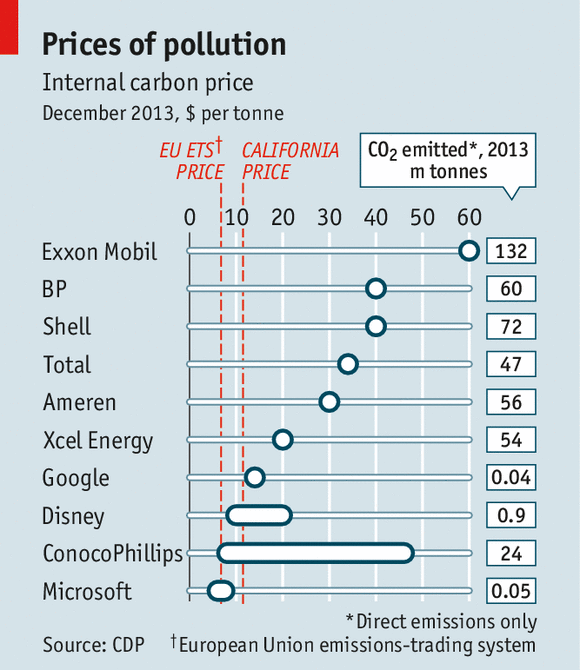
While carbon markets at the governmental level are floundering (think Europe's low cost of carbon and Australia reversing course on legislation to introduce a cap-and-trade scheme), the article from The Economist in the url below shows that most of the innovation on this issue is coming from the private sector. Firms are increasingly developing a cost for carbon that they are then using to plan future projects and investments:
 
"A study by CDP, a research group, asked large firms based or operating in America what tools they had for managing risk; 29 said they used an internal carbon price. Anecdotally, more apply such a price but did not mention it as a risk-mitigation measure."
 
Because firms are doing this on a firm-by-firm basis and they range across vastly different industries, the prices they are allowing for a ton of carbon vary widely—primarily because carbon is relevant to their operations in different ways:
 
"The prices range from $6-7 a tonne of carbon dioxide at Microsoft to $60 a tonne at Exxon Mobil. … As a rule, those whose assets have a long productive life and which might be affected by green policies far into the future (such as oil companies) use higher prices than consumer-goods firms whose products are mainly influenced by current policies."
 
The companies are pushing ahead with this for two basic reasons: first, although it is hard to understand why they think so based on recent performance, firms anticipate politicians will eventually get their act together and impose a carbon price:
 
"For many companies the aim is to prepare themselves for future environmental legislation. AEP, a power supplier, says it uses the system because 'it assumes a price of carbon…will begin in the US by roughly 2020.' Delta Air Lines says it uses a price for evaluating flights to Europe 'in anticipation of compliance with EU ETS.'"
 
Second, it allows firms, such as ConocoPhillips and Disney (see: Strategic CSR – Carbon tax), to better understand the present value of future projects and investments:
 
"ConocoPhillips, an oil firm, requires that capital projects worth over $75m calculate the cost of emissions based on a price of between $8 and $46 a tonne, depending on the life of the project. The forecast value of a new oilfield would be: estimated output multiplied by the estimated future oil price minus development costs and carbon emissions. … Disney, a media conglomerate, goes further still. It invests in schemes to offset or reduce carbon emissions and charges the cost of these to business units in proportion to how much they contribute to the company's overall emissions. In effect, this works like an internal carbon tax."
 
The result of these varied approaches is a range of prices among firms. As the article notes, however, the surprising (and encouraging) thing is how high some of the prices are—much higher than any of the failing government experiments:
 
"The market price of carbon is €4.90 ($6.70) per tonne of CO2 in the EU, $11.50 in California. Big oil companies charge $34 or more. That is closer to the 'social cost of carbon'—the damage from an extra tonne of CO2—than to the market price. … the sort of carbon price some companies are using for planning would, if it became a market price, have a much bigger impact than any of the policies that governments are now talking about."
 
The graphic that accompanies the article demonstrates the extent of the differences in internal carbon price among firms:
 
 
Take care
David
 
David Chandler & Bill Werther
 
Instructor Teaching and Student Study Site: http://www.sagepub.com/chandler3e/
Strategic CSR Simulation: http://www.strategiccsrsim.com/
The library of CSR Newsletters are archived at: http://strategiccsr-sage.blogspot.com/


Carbon copy
Some firms are preparing for a carbon price that would make a big difference
December 14, 2013
The Economist
70
 

Wednesday, October 16, 2013

Strategic CSR - Carbon tax

In the absence of meaningful political action to curb carbon emissions, the article in the url below reports that some companies are imposing carbon taxes on themselves. Some of the firms, such as Disney, are surprising in that they normally are the target of CSR activists for their non-CSR-type behavior:
 
“It's not just Disney. Although most of the world's governments have declined to put a price on carbon emissions, a handful of global companies, including Microsoft and Shell, have chosen to act on their own. They have established internal carbon prices in an effort to reduce emissions, promote energy efficiency and encourage the use of cleaner sources of power, just as a government tax or cap-and-trade program would.”
 
The advantage to the firm of doing this is internal pressure toward greater efficiency. At Disney, for example:
 
“Since 2009, when the tax was imposed, the company's engineers have changed thermostat set points, installed light sensors and efficient bulbs, increased the efficiency of chillers, heat exchangers and pumps, and shut down the lights on park icons like Cinderella's Castle and Spaceship Earth when the parks are closed.”
 
And, the revenues generated by the premium that is paid above market prices is collected in what Disney calls the Climate Solutions Fund, which it uses to offset emissions elsewhere in the value chain:
 
“The tax, the price of which depends upon the costs of offsets and the volume needed by Disney to reach its emissions targets, has been set at between $10and $20 a ton and has raised about $35m so far. That has enabled Disney to invest in a variety of certified forest-carbon projects in Inner Mongolia, China, Peru, and the Democratic Republic of the Congo, as well as in Virginia, Mississippi and its home state of California. Taking those carbon offsets into account, Disney's 2012 emissions have been cut in half from a 2006 baseline. The company has set a long-term goal of zero net emissions.”
 
In addition, all three firms are publicly supporting “an international framework that puts a price on CO2,” while also benefitting from the efficiencies created by such an innovative approach to operations. Primarily, however, these firms and others like them will be best placed when the global political class finally gets around to acting (Chapter 1: A Rational Argument for CSR, p16):
 
“Why bother with these voluntary carbon taxes? Partly to prepare for government regulation of emissions, if and when they arrive. Rob Bernard, Microsoft's chief environmental strategist, explains: ‘I think it's likely that over time society is going to move in this direction. It's hard work. We should get to it now.’”
 
Take care
David
 
David Chandler & Bill Werther
 
Instructor Teaching and Student Study Site: http://www.sagepub.com/chandler3e/
Strategic CSR Simulation: http://www.strategiccsrsim.com/
The library of CSR Newsletters are archived at: http://strategiccsr-sage.blogspot.com/
 
 
Disney, Microsoft and Shell opt for self-imposed carbon emissions taxes
By Marc Gunther
March 26, 2013
The Guardian
 

Monday, October 30, 2017

Strategic CSR - Electric cars (I)

The article in the first url below sheds some light on the economics of the electric car:
 
"Electric cars have come a long way. They are no longer ugly, impossibly expensive and impractical, thanks to technological advances that have slashed battery storage from $1,000 per kilowatt-hour in 2010 to $273per kwh last year."
 
In particular, it highlights the extent to which Tesla (and other car companies) have so far relied so heavily on government subsidies – a prop that will soon come to an end:
 
"Nonetheless, … a 75 kwh battery (about 250 miles of range) still adds about $20,000 to a car's cost. So how do the cars sell? Public largess helps a lot. The federal government offers a tax credit of up to $7,500 each for the first 200,000 electric or plug-in hybrid cars a manufacturer sells. Throw in state tax credits, subsidies for recharging infrastructure, relief from gasoline taxes, preferential lanes and parking spots and government fleet purchases, and taxpayers help pay for every electric car on the road."
 
Anecdotal evidence suggests that, when this support is taken away, the cars are not so competitive, at least in terms of the mass market:
 
"When Hong Kong slashed a tax break worth roughly $55,000 fora Tesla in April, its sales ground to a halt. In Georgia, electric vehicle sales plummeted 80%the month aftera$5,000 tax credit was repealed."
 
The future for the market for electric cars, as envisioned by Tesla, also relies on certain assumptions that, while not impossible, are also far from guaranteed:
 
"… such scenarios hinge not just on the cost of batteries but on the price of oil and the efficiency of competing vehicles. [Economists] estimate that if batteries cost $270 per kwh, oil would have to cost more than $300 a barrel in 2020 to make electric and gasoline equally attractive. If battery costs fall to $100, as Tesla Founder Elon Musk has targeted, oil would have to average $90. … in an optimistic scenario, where battery costs fall 10% a year starting now and gasoline begins at $5 a gallon, electric vehicles will be competitive in five years. If battery costs fall just 5% a year and gasoline starts at $2.25, it will take more than 20."
 
At a more fundamental level, the author questions the extent to which electric cars have helped reduce climate change. This is principally because they are recharged at night, which is when electricity is more likely to be generated by coal:
 
"Economists … estimate electric vehicles account for more carbon dioxide per mile than existing cars in the upper Midwest, where coal-fired plants are more prevalent, and more than comparable hybrids in most of the U.S."
 
While I recognize that the oil companies and traditional car companies also get their fair share of government subsidies, it is instructive to realize that electric cars (at least using current technologies) might not be the silver bullet that Elon Musk often suggests. Strategic CSR, of course, argues for a level playing field – remove all subsidies, impose a lifecycle pricing that accounts for all costs incurred during production (in this case, a carbon tax for carbon-based fuel consumption), and allow the market to determine where to invest to optimize returns. In the meantime, we are stuck with government subsidies and, as a result, distorted market outcomes. As the author concludes:
 
"These subsidies have clearly accomplished one goal: They've accelerated innovation when the private market had little incentive to invest. Yet they may not be the most efficient way to combat carbon emissions. A carbon tax, for example, would incentivize conservation and alternative fuels regardless of oil prices."
 
In short, as summarized in a recent report by Morgan Stanley on impact investing:
 
"… the carbon emissions generated by the electricity required for electric vehicles are greater than those saved by cutting out direct vehicle emissions."
 
The article in the second url below suggests additional possible additional harm caused by electric cars -- this time in terms of e-waste:
 
"The number of electric cars in the world passed the 2m mark last year and the International Energy Agency estimates there will be 140m electric cars globally by 2030 if countries meet Paris climate agreement targets. This electric vehicle boom could leave 11m tonnes of spent lithium-ion batteries in need of recycling between now and 2030, according to Ajay Kochhar, CEO of Canadian battery recycling startup Li-Cycle."
 
Take care
David
 
 
Instructor Teaching and Student Study Site: https://study.sagepub.com/chandler4e
Strategic CSR Simulation: http://www.strategiccsrsim.com/
The library of CSR Newsletters are archived at: https://strategiccsr-sage.blogspot.com/
 
 
Electric Cars Are the Future? Not So Fast
By Greg Ip
July 13, 2017
The Wall Street Journal
Late Edition – Final
A2
 
The rise of electric cars could leave us with a big battery waste problem
By Joey Gardiner
August 10, 2017
The Guardian
 

Monday, October 27, 2014

Strategic CSR - Australia

The article in the url below contains a bad headline:
 
"Australia Becomes First Developed Nation to Repeal Carbon Tax."
 
This matters because Australia was "one of the first major countries outside Europe to adopt a carbon price." More importantly, however, it matters because Australia is one of the highest carbon polluting countries, per capita, in the world:
 
"Australia, the world's 12th largest economy, is one of the world's largest per capita greenhouse gas emitters due to its reliance on coal-burning power stations to power homes and industry. In 2011, daily emissions per head amounted to 49.3 kilograms (108 pounds), almost four times higher than the global average of 12.8 kilograms, and slightly ahead of the U.S. figure of 48.2 kilograms."
 
The graphic accompanying the article shows Australia's carbon emissions relative to the rest of the G20—Australia is second only to Saudi Arabia:
 
 
What is also striking is that this decision by Australia runs counter to the global trend which, although achingly inertial, is at least moving in the right direction:
 
"The World Bank in May produced a State and Trends of Carbon Pricing report counting carbon pricing programs in 40 nations and 20 regions worth a collective US$30 billion, while also singling out repeal plans in Australia as one of the biggest international threats to the rollout of similar programs elsewhere, given its example."
 
Australia is not the only carbon bad news story, unfortunately. Both Japan and Canada, for essentially similar local, short-term political considerations, have also taken significant steps away from recent public commitments to lower their emissions:
 
"Japan last year retreated on pledges to cut greenhouse emissions, blaming the shutdown of its nuclear plants in the wake of the 2011 Fukushima nuclear disaster for a decision to release 3% more greenhouse emissions by 2020 instead of a 25% cut on 1990 levels previously promised. … Canada withdrew from the Kyoto protocol in 2011, with the conservative government saying the agreement would unfairly penalize its fossil fuel-reliant economy for failing to meet a promised 6% cut."
 
In short, what was already a slow, incremental process worldwide has just became slower and further away from where we need to be.
 
Take care
David
 
David Chandler & Bill Werther
 
Instructor Teaching and Student Study Site: http://www.sagepub.com/chandler3e/
Strategic CSR Simulation: http://www.strategiccsrsim.com/
The library of CSR Newsletters are archived at: http://strategiccsr-sage.blogspot.com/


Australia Becomes First Developed Nation to Repeal Carbon Tax
By Rob Taylor & Rhiannon Hoyle
July 17, 2014
The Wall Street Journal
Late Edition – Final