The CSR Newsletters are a freely-available resource generated as a dynamic complement to the textbook, Strategic Corporate Social Responsibility: Sustainable Value Creation.

To sign-up to receive the CSR Newsletters regularly during the fall and spring academic semesters, e-mail author David Chandler at david.chandler@ucdenver.edu.

Tuesday, October 19, 2021

Strategic CSR - Religion

For those of you who feel that what we all need is more social media in our lives (and less privacy), the article in the url below is for you:

"Months before the megachurch Hillsong opened its new outpost in Atlanta, its pastor sought advice on how to build a church in a pandemic. From Facebook. The social media giant had a proposition, Sam Collier, the pastor, recalled in an interview: to use the church as a case study to explore how churches can 'go further farther on Facebook.'"

This appears to be a concerted effort by Facebook:

"For months Facebook developers met weekly with Hillsong and explored what the church would look like on Facebook and what apps they might create for financial giving, video capability or livestreaming. When it came time for Hillsong's grand opening in June, the church issued a news release saying it was 'partnering with Facebook' and began streaming its services exclusively on the platform. Beyond that, Mr. Collier could not share many specifics — he had signed a nondisclosure agreement."

The goal, of course, is world domination:

"Now, after the coronavirus pandemic pushed religious groups to explore new ways to operate, Facebook sees even greater strategic opportunity to draw highly engaged users onto its platform. The company aims to become the virtual home for religious community, and wants churches, mosques, synagogues and others to embed their religious life into its platform, from hosting worship services and socializing more casually to soliciting money. It is developing new products, including audio and prayer sharing, aimed at faith groups. … Facebook is shaping the future of religious experience itself, as it has done for political and social life."

And, as Sheryl Sandberg noted, the combination is a "natural":

"'Faith organizations and social media are a natural fit because fundamentally both are about connection,' Ms. Sandberg said. 'Our hope is that one day people will host religious services in virtual reality spaces as well, or use augmented reality as an educational tool to teach their children the story of their faith,' she said."

Of course, there are naysayers with some trifling concerns:

"The collaborations raise not only practical questions, but also philosophical and moral ones. Religion has long been a fundamental way humans have formed community, and now social media companies are stepping into that role. Facebook has nearly three billion active monthly users, making it larger than Christianity worldwide, which has about 2.3 billion adherents, or Islam, which has 1.8 billion. There are privacy worries too, as people share some of their most intimate life details with their spiritual communities."

And, if you haven't already begun to imagine how this could really go wrong, you can consider the compromises (sorry, 'opportunities') the social media platform is posing to the churches it is partnering with:

"Leaders of the Church of God in Christ, a largely African American Pentecostal denomination of roughly six million members worldwide, recently received early access to several of Facebook's monetization features, offering them new revenue streams, said the denomination's social media manager, Angela Clinton-Joseph. They decided to try two Facebook tools: subscriptions where users pay, for example, $9.99 per month and receive exclusive content, like messages from the bishop; and another tool for worshipers watching services online to send donations in real time. Leaders decided against a third feature: advertisements during video streams."

Heaven help us.

Take care
David

David Chandler
© Sage Publications, 2020

Instructor Teaching and Student Study Site: https://study.sagepub.com/chandler5e 
Strategic CSR Simulation: http://www.strategiccsrsim.com/
The library of CSR Newsletters are archived at: https://strategiccsr-sage.blogspot.com/


Facebook Wants to Host Your Virtual Pew
By Elizabeth Dias
July 26, 2021
The New York Times
Late Edition – Final
A12

Thursday, October 14, 2021

Strategic CSR - Carbon offsets

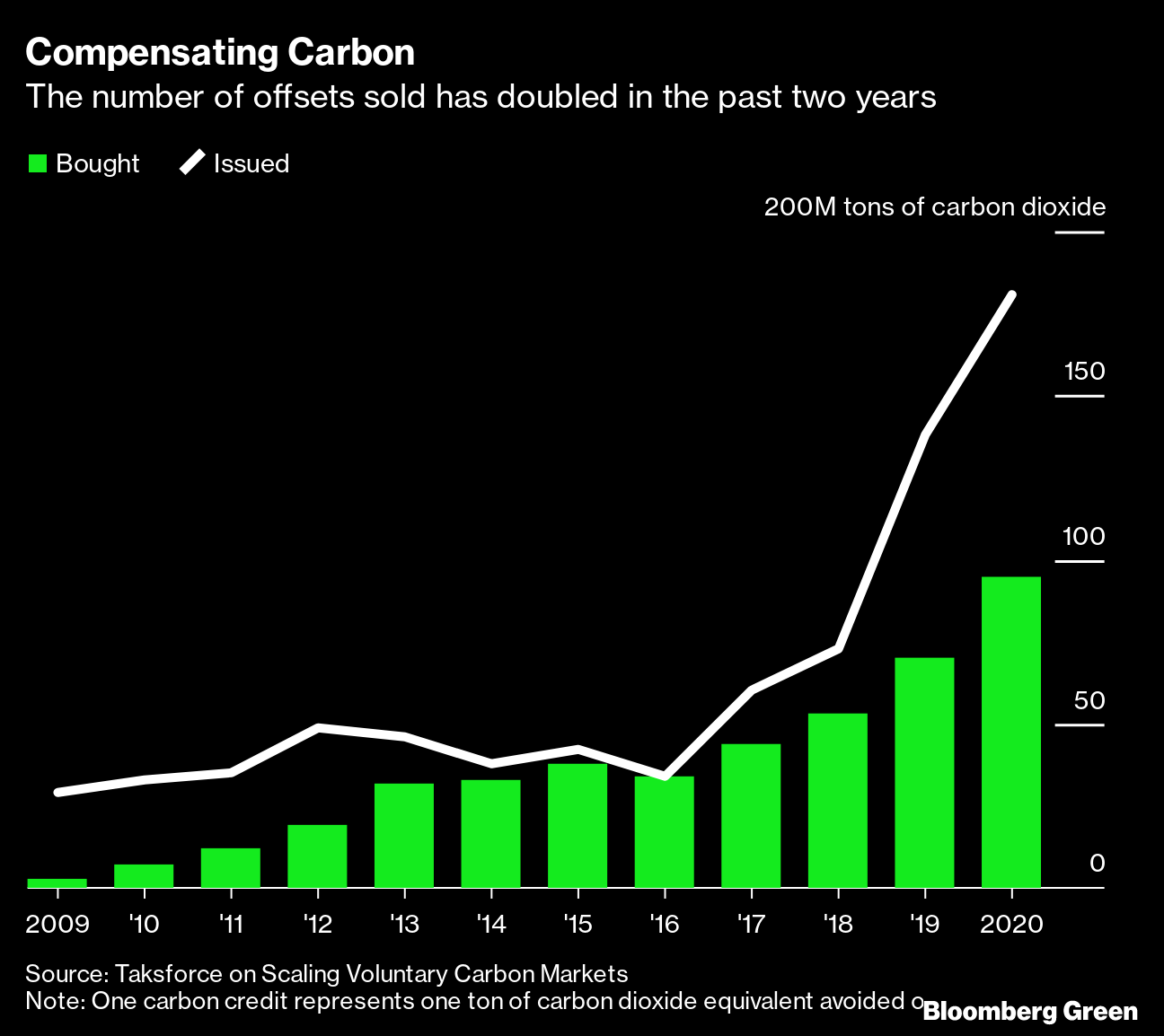
The article in the url below provides an update on how the market for carbon offsets has increased markedly in recent years (including dramatic graphs, like this):

"Such is the exuberance for carbon offsets that the consultancy McKinsey & Co. estimates a voluntary trading market like the one being organized by two financial heavyweights, Mark Carney and Standard Chartered CEO Bill Winters, could be worth as much as $50 billion in 2030, up from just $300 million in 2018. Carney, the former governor of the Bank of England, has put the figure as high as $100 billion by the end of the decade."

For more on this new voluntary market, see here, although many of the same issues with offsets (such as verification and accounting) remain largely unsolved (see Strategic CSR – Trees). In spite of this, three quotes from this article caught my eye. The first emphasizes the woeful inadequacy of the current market for carbon offsets, irrespective of its recent popularity:

"The vast majority of the offsets sold today cost less than $5 for each ton of carbon dioxide removed from the atmosphere. In many cases, the price per ton can be as low as $2."

The second quote shows some of the fascinating challenges with building a market where any offset can be traded on a transparent basis from a common reference point:

"Trees that store away carbon dioxide for five years before being burned in a wildfire are providing a fundamentally different service than a ton of the gas buried deep underground for thousands of years. Climate change is a problem of cumulative amount of greenhouse gases in the atmosphere, and many experts argue that the longer a ton of CO₂ can be stored away, the more valuable it should be. That might make it hard to set a standardized price."

The third quote questions whether the voluntary nature of the proposed market will undermine its chances of achieving its stated goals:

"Buyers and sellers are incentivized to trade numbers on ledgers, but how can the rules incentivize verification? Will all the offsets trading hands in the new market truly lower greenhouse-gas emissions? As one taskforce participant we spoke to put it: Either the taskforce recommends the creation of a global regulator, or it risks the same failure that has met previous attempts."

Take care
David

David Chandler
© Sage Publications, 2020

Instructor Teaching and Student Study Site: https://study.sagepub.com/chandler5e 
Strategic CSR Simulation: http://www.strategiccsrsim.com/
The library of CSR Newsletters are archived at: https://strategiccsr-sage.blogspot.com/


Turning Carbon Offsets into Catnip for Commodities Traders
By Akshat Rathi
June 2, 2021
Bloomberg Businessweek
 

Tuesday, October 12, 2021

Strategic CSR - Interface

Thanks to the late Ray Anderson's pioneering work, his company Interface (and more specifically its carpet tiles, Flor) is something I have noticed whenever it appears in the media (e.g., see Strategic CSR – Ecocide). Although I knew the company was doing good work, however, I recently saw what I think is a first for me – a carbon negative product. To repeat, that is not carbon neutral, but carbon negative. That is, Interface's release of its most recent product/innovation stores more carbon in its production and lifecycle use than it uses:

"This carpeting was a result of four years of intensive research and development, according to Interface. It incorporated a material made from recycled vinyl and processed vegetation; it was infused with a latex created from smokestack exhaust. It was topped and tufted with salvaged nylon. And it had been manufactured in the least environmentally demanding way possible. By Interface's reckoning, the carpeting had a carbon footprint of negative 300 grams per square meter. … carpeting a 10-feet-by-20-feet conference room, say, with these tiles can be seen as the equivalent of pulling roughly 12 pounds of carbon dioxide out of the atmosphere."

The challenge in achieving this is amplified when you think about how dirty carpet making traditionally has been:

"Industrial carpet tile can be thought of as a kind of three-layer sandwich, made from tufting on top, filler in the middle and backing on the bottom. In the mid-1990s, Interface calculated the carbon footprint of these layers and concluded that a square meter of the sandwich was responsible for releasing about 20 kilograms worth of CO2 into the atmosphere. Most of these emissions — probably more than 70 percent — resulted from materials and processing, and a lesser portion from manufacturing, installation and maintenance (all that cleaning and vacuuming over the course of a carpet's life adds up to significant CO2 emissions)."

Of course, I have known the technology exists for carbon sequestration, but the challenge I thought (and the article makes clear still largely exists) is in its commercial application/scaling at the product level. For example, recently there has been a lot of innovation in the production of concrete using carbon-infused materials, but companies are nowhere near carbon neutrality with that, let along carbon negative (see Strategic CSR – Concrete). As such, any discussion about the technology tends to be on a company or societal level. The outcome is also usually storing or injecting the carbon dioxide underground, whereas this process involves storing the carbon in the product itself:

"The company began using recycled components for the backing, filler and yarns, and the factories were refitted with machines that were more efficient. Pushing an Interface product to below zero, at least in carbon terms, was not about a big breakthrough … . It was more like coming up with a recipe involving hundreds, if not thousands, of changes to ingredients and techniques. Over the next two decades, the company learned a couple of things. First, by reducing its emissions and using mostly recycled materials, its tiles could approach carbon neutrality. Second, by obtaining its materials from different sources — and using them in smaller amounts — Interface could further shrink its footprint. The CO2-infused latex, which is sprayed on the carpet's middle layer, was a helpful step. The key adaptation, however, was transforming the backing. Incorporating biomaterials — forestry byproducts and plants rich in absorbed carbon — locked in high levels of carbon and canceled out the emissions related to the rug's materials, production and life cycle. In essence, Interface was creating what we usually call a carbon offset in the lowest layer of its carpet sandwich."

This is the first time I think I have seen a company calculate the carbon footprint of a product and announce that it is negative. For the author, this story revolves around the larger issue of "carbontech," which he defines as:

"… trying to 'embed' large amounts of carbon within commercial merchandise. … Advocates of carbon utilization, or carbontech, as it's also known, want to remake many of the things we commonly use today. But with one crucial difference: No emissions would have been added to the environment through their fabrication."

The article provides multiple examples of different startups trying to develop technologies that will revolutionize some of the dirtiest industries and products we have developed (such as concrete), and also using market-based ideas to hasten the speed with which carbontech is advanced (such as pricing and trading carbon dioxide, rather than treating it as a waste product, at present). The article is also clear that this is not a silver bullet, but should be thought of more as an innovative means to help us transition from our current unsustainable, fossil-fueled economic system to a future (and as of yet undefined) sustainable economic system.

Take care
David

David Chandler
© Sage Publications, 2020

Instructor Teaching and Student Study Site: https://study.sagepub.com/chandler5e 
Strategic CSR Simulation: http://www.strategiccsrsim.com/
The library of CSR Newsletters are archived at: https://strategiccsr-sage.blogspot.com/


Better Living Through CO2
By Jon Gertner
June 27, 2021
The New York Times Magazine
Late Edition – Final
27-33, 61
 

Friday, October 8, 2021

Strategic CSR - Best Buy

The interview in the article in the url below with Hubert Joly (now a lecturer at Harvard Business School; until 2019, he was the CEO of Best Buy) is largely mundane. It is not that I question Joly's sincerity; it is just that he is not saying anything particularly interesting. But, there is a moment of eloquence that I found inspiring. It is in response to a question about re-shaping the culture of an organization – aligning interests across all stakeholders to produce meaningful action. When asked if there are any "specific actions you think companies should take" to produce this result, Joly replies:

"I would start with providing an attractive environment and set of opportunities for their employees. Raising the minimum wage is a very important trend, but it goes beyond pay. It is about benefits, taking care of your employees, including their mental health or their ability to vote. It is about a path to advancement, skills acquisition. It is about offering a growth environment, one where you feel you belong, one where you feel your manager is investing in you, one where you can connect what drives you with your work."

Essentially, he is prioritizing the firm's employees above all other stakeholders, which is consistent with the framework presented in Strategic CSR. I often tell my students – any organization that does not treat its employees as its most important stakeholder is dysfunctional to some degree. All stakeholders are important, and the goal of the firm should be to create value broadly, but it starts with employees. That has to be the path of least resistance toward a successful model of stakeholder capitalism.

The other notable element of the interview is reporting that there are "2 billion pounds of electronics recycled annually by Best Buy."

Take care
David

David Chandler
© Sage Publications, 2020

Instructor Teaching and Student Study Site: https://study.sagepub.com/chandler5e 
Strategic CSR Simulation: http://www.strategiccsrsim.com/
The library of CSR Newsletters are archived at: https://strategiccsr-sage.blogspot.com/


On His To-Do List: Fixing Capitalism
By David Gelles
July 18, 2021
The New York Times
Late Edition – Final
BU5
 

Wednesday, October 6, 2021

Strategic CSR - Juneteenth

The article in the url below is an opinion piece by Kaitlyn Greenidge (the "features director at Harper's Bazaar") about Juneteenth, which was recently declared a federal holiday here in the U.S. Specifically, she discusses the history of Juneteenth and, most notably, how it is a commemoration that should remain confined to Texas:

"Though Juneteenth has recently gained nationwide attention, and just became a federal holiday, it originated as a Texas-specific celebration of the end of slavery. Other states and regions have their own traditions for marking Emancipation: Crucially, these celebrations have different dates from place to place, because freedom was gained through wildly different ways for Black people across this country."

In other words, June 19 (1865) was the day in which slaves in Texas learned of their freedom. While the Emancipation Proclamation was signed by President Lincoln in January, 1863, news spread slowly at the time and took over two years to reach the state. Consequently, the same event is commemorated on different days in different states:

"In New York State, where gradual Emancipation was put into place to ease white fears at the expense of Black comfort, Emancipation Day was celebrated on the 5th of July. … Some Black communities in the North and South have also celebrated Emancipation Day on the 1st of January, because that was when Abraham Lincoln signed the Emancipation Proclamation into law."

Or, perhaps more starkly:

"Juneteenth is not a part of any state's history except Texas. But it is perhaps easier for some white Northerners to tut at the duplicity of white Texas slaveholders than to look at how Black people became free in their own states — as in Massachusetts, through having to sue for their freedom."

Beyond this fact-based history, however, the broader point Greenidge wants to make is about the commodification of the day (and the broader associated struggle), a corruption of the notion of what the day represents that reflects the shallow reality of many corporate promises made in the aftermath of 2020's BLM protests (e.g., here):

"It was with dismay that I realized, a few weekends ago, that Walmart is now selling Juneteenth T-shirts."

In other words, she argues, assigning June 19 as a holiday is a way to alleviate guilt while generating revenue and, perhaps most importantly, avoid the need to deliver more substantive concessions:

"In my most cynical moments, I think that the rush to embrace Juneteenth is about undermining the right to protest of Black people who are alive now. 'Why are they still going on about voting rights and police violence and clean air and health care and schools,' a white politician can say to his non-Black constituents next year, 'when we gave them a day off?'"

The consequences of an event like Juneteenth becoming 'mainstream,' according to the author, is that it loses much of what made it important in the first place:

"But mostly, I am sad because when a holiday becomes co-opted like this, those who can gain a sense of self and solidarity from celebrating it often lose it. The agency that comes from deciding your own traditions … becomes lost to a corporate calendar and a megastore selling you a Juneteenth cookout checklist."

Along similar lines, I have begun to see the wider use of the term pinkwashing, a word that I plan to add to the glossary in the next edition of the book. My definition:

"The adoption and promotion of LGBTQ+ friendly media statements and campaigns by companies without the more substantive commitment of meaningful change. Also associated with the marketing and commodification of the LGBTQ+ cause, again without meaningful progress on substantive issues."

In a broader discussion of pinkwashing in the article in the second url below, which has been around for some time, the accusation is that corporations are deploying this approach more than ever before:

"With the gay pride season coming to a close, here is a question: have you withdrawn money from a multi-coloured gAyTM this summer? Or have you even tucked into your Burger King Pride Whopper? … Celebrating LGBT rights is a fashionable topic in marketing land. Long gone are the days where marketers may have only coyly targeted the LGBT community. In today's marketing, at least for some, even queer products for a straight audience have become mainstream – used to sell anything from fast food to credit cards, clothing to eReaders – but it's not clear whether this is a real "win win" for the market and the LGBT community."

The goal, it is suggested, is the "pink dollar":

"The emergence of AIDS in the 1980s helped to rein in commercial attitudes towards the LGBT community and it wasn't until the second half of the decade that the first few mainstream brands – Absolut Vodka's campaign in The Advocate, for example – started cautiously appearing in gay magazines alongside the community organisations and businesses. It was the 1990s which saw a genuine turnaround. Advertisers openly hailed the 'Dream Market' of urban, well-educated, double-income gay and lesbian couples."

All of this, of course, is a gamble by corporations that such transparent efforts to co-opt certain 'causes' will pay off commercially. Given the transparency, if corporations do benefit from such marketing efforts, it will be either because we don't care enough to point out the hypocrisy, or we don't care enough to notice in the first place.

Take care
David

David Chandler
© Sage Publications, 2020

Instructor Teaching and Student Study Site: https://study.sagepub.com/chandler5e 
Strategic CSR Simulation: http://www.strategiccsrsim.com/
The library of CSR Newsletters are archived at: https://strategiccsr-sage.blogspot.com/


Emancipation Goes Corporate
By Kaitlyn Greenidge
June 20, 2021
The New York Times
Late Edition – Final
SR4

The rise of pride marketing and the curse of 'pink washing'
By Stephen Dahl
August 26, 2014
The Conversation

Thursday, September 30, 2021

Strategic CSR - Jeans

The article in the url below is a review of a new book, Unraveled, by Maxine Bédat. The book highlights the devastating amount of waste (and overall harm) generated by the global clothing and fast fashion industry. This particular book explores the industry's supply chain using the example of a pair of jeans – how they are made and find their way to consumers across the world. As the review notes, however, the punchline is not necessarily news – there is now a growing library of books that take a similar approach to highlighting the mess we are getting ourselves into:

"In [highlighting 'the pretty awful reality' of the global fashion supply chain, the book] joins Lucy Siegle's To Die For: Is Fashion Wearing Out the World?, Elizabeth Cline's Overdressed: The Shockingly High Cost of Cheap Fashion and, most recently, Dana Thomas's Fashionopolis: The Price of Fast Fashion and the Future of Clothes (along with documentaries like The True Cost)."

Beyond the great harms that are identified in the review, however, it is the final four paragraphs that caught my attention. The writing is tight and the points damning, but the idea that our concern about sustainability has become part of the problem is what I took away:

"Because now, much in the way a sale price tag can seduce us into thinking we should buy a garment we might otherwise pass up, the fact that a dress is made from, say, recycled polyester or orange peel has become part of its allure.

Just as the opportunity to recycle an old garment becomes part of the rationale for replacing it, because in doing so you will not be adding to your closet — even though, as Ms. Bédat makes clear, you will still be adding to the volume of clothes in the world, which adds to the problem. Personal math and public math don't always equate.

And one of the unforeseen, ironic results of the genuinely valuable conversation and consciousness raising that books like 'Unraveled' have spurred is that sustainability itself has been transformed into a selling point.

That may be the most horrifying development of all."

To me, this speaks to the superficiality with which we continue to approach the core problem. Our economic system is unsustainable, so what are we going to do about it? 'Buy more stuff,' even if it is more sustainably produced than before (while still being fundamentally unsustainable), is clearly not the answer. The idea of 'sustainability' can only be 'fashionable' in a society that has completely missed the point. If that is our proposed solution to this existential problem, then all the issues the books quoted above have raised in recent years have clearly fell largely on deaf ears.

Take care
David

David Chandler
© Sage Publications, 2020

Instructor Teaching and Student Study Site: https://study.sagepub.com/chandler5e 
Strategic CSR Simulation: http://www.strategiccsrsim.com/
The library of CSR Newsletters are archived at: https://strategiccsr-sage.blogspot.com/


Jeans Are the Villain of a Horror Story
By Vanessa Friedman
June 3, 2021
The New York Times
Late Edition – Final
D3
 

Tuesday, September 28, 2021

Strategic CSR - Engine No.1

Over the summer, you may have read about the environmental activist investor (Christopher James) who took on Exxon with his hedge fund (Engine No.1) and won 3 board seats, all against the strenuous protests of Exxon's CEO and senior management:

"Mr. James, 51 years old, was an unlikely catalyst for change at an energy giant. After making a name for himself during the dot-com boom and bust, he operated an Illinois coal mine and built storage facilities used by the oil-and-gas companies. Away from work, however, he supported conservationist causes. The Exxon campaign offered a chance to align his personal values with an investment thesis—that the giants of the oil industry would drop in value unless they embraced a transition to renewable energy."

What I found interesting about this story, though, was not the victory itself, but the disconnect between the media portrayal of Engine No.1's three director nominees and the arguments James used to secure their election. The media coverage appeared to suggest that these three directors would convert Exxon's board into a bunch of tree huggers. As the article in the url below makes clear, however, in reality the directors were only successfully elected because they made it clear their goal was to create value for Exxon's shareholders. Rather than a bunch of environmental radicals that wants to turn Exxon upside down, Engine No.1 advanced a goal that was centered purely on the firm's business interests:

"In its December note to Exxon's board, Mr. James's fund called on the company to slash expenses on projects that might lose money when oil and gas prices are low, realign management incentives and develop a plan to invest in renewable energy. 'If we're right on getting Exxon to mitigate these impacts, the stock should go up,' Mr. James said in an interview. 'And maybe Exxon does have a future.'"

It was only Exxon's poor economic performance in recent years (in particular, its inefficient allocation of capital) that made it vulnerable even to these benign arguments; not the fact that it is a fossil fuel company that bases its worth almost completely on assets that will have to remain unexploited if we are to have any hope of preserving the integrity of our environment:

"They chose Exxon as their first big target because it had already drawn the ire of a number of other large shareholders for its lackluster performance and refusal to engage. The Engine team also knew that Exxon was a familiar name to investors of all sizes, assuring the campaign would resonate with many of the company's individual shareholders. Some Exxon investors had also questioned why Exxon hadn't added more directors with industry expertise."

In short, the Exxon campaign was not at all about sustainability and all about shareholder value:

"[On] calls with shareholders, [the] pitch was to steer clear of ideological arguments about climate change. Instead, [Engine No.1] said investors should focus on how much value had been lost. The proposed directors on these calls said the company needed to perform better and had allocated capital poorly over a decade."

As the article notes, the performance of Exxon's stock price in the months following the announcement of Engine No.1's campaign reveals the success of the campaign, and the extent to which shareholders have already benefitted:


Time will tell as to whether the environment will do nearly as well.

Take care
David

David Chandler
© Sage Publications, 2020

Instructor Teaching and Student Study Site: https://study.sagepub.com/chandler5e 
Strategic CSR Simulation: http://www.strategiccsrsim.com/
The library of CSR Newsletters are archived at: https://strategiccsr-sage.blogspot.com/


The Man Who Battled Exxon – and Won
By Justin Baer and Dawn Lim
June 12-13, 2021
The Wall Street Journal
Late Edition – Final
B1-B2
 

Thursday, September 23, 2021

Strategic CSR - Blockchain

The article in the url below is an interesting discussion about the technology underpinning NFTs and cryptocurrencies (i.e., blockchain). In particular, it quotes Mark Cuban (entrepreneur and owner of the Dallas Mavericks NBA team) on how the technology is only just beginning to reach its potential as people become aware of its broader application. One passage, in particular, caught my attention:

"Mr. Cuban then notes, 'But these are just proof of concepts. Not the end game.' I quickly emailed back, 'OK, I get that. Like what?' The floodgates opened. 'NFTs are just one application of smart contracts. Think about textbooks being NFTs. You buy it. Use it. Easily resell it. Publishers get royalty on each sale.'"

He continues:

"'Think how stocks work right now. Most people think they own the stock. They own the right to the stock. It's held in street name. It gets lent out to shorts and they don't collect the [interest] on the borrow. And then of course there is front running and payment for order flow and the fact that a share of stock doesn't truly convey the holder any real ownership rights. If every share or block of shares was an NFT then it all would be transparent.'"

Take care
David

David Chandler
© Sage Publications, 2020

Instructor Teaching and Student Study Site: https://study.sagepub.com/chandler5e 
Strategic CSR Simulation: http://www.strategiccsrsim.com/
The library of CSR Newsletters are archived at: https://strategiccsr-sage.blogspot.com/


Mark Cuban Knows Crypto
By Andy Kessler
May 24, 2021
The Wall Street Journal
Late Edition – Final
A17
 

Tuesday, September 21, 2021

Strategic CSR - Bias vs. Noise

I noticed the article in the url below because of the authors (two of whom are well-known behavioral economists), but I liked the article because of its distinction between bias and noise:

"A bias is any predictable error that inclines your judgment in a particular direction. For instance, we speak of bias when forecasts of sales are consistently optimistic or investment decisions overly cautious."

In contrast:

"Society has devoted a lot of attention to the problem of bias — and rightly so. But when it comes to mistaken judgments and unfortunate decisions, there is another type of error that attracts far less attention: noise."

Both bias and noise are problems, according to the authors, but they are different problems:

"To see the difference between bias and noise, consider your bathroom scale. If on average the readings it gives are too high (or too low), the scale is biased. If it shows different readings when you step on it several times in quick succession, the scale is noisy. … While bias is the average of errors, noise is their variability."

The authors draw on research data to emphasize the scale of the problems that noise creates:

"In a 1981 study, for example, 208 federal judges were asked to determine the appropriate sentences for the same 16 cases. The cases were described by the characteristics of the offense (robbery or fraud, violent or not) and of the defendant (young or old, repeat or first-time offender, accomplice or principal). … The average difference between the sentences that two randomly chosen judges gave for the same crime was more than 3.5 years. Considering that the mean sentence was seven years, that was a disconcerting amount of noise."

They use other, equally stark examples to demonstrate their central point that "wherever there is judgment, there is noise – and more of it than you think." They also apply the lessons of research to business, emphasizing the potential blind spots if noise is ignored:

"A company's hiring decisions could be unbiased overall if some of its recruiters favor men and others favor women. However, its hiring decisions would be noisy, and the company would make many bad choices. Likewise, if one insurance policy is overpriced and another is underpriced by the same amount, the company is making two mistakes, even though there is no overall bias."

Ultimately, they contribute to a highly salient debate that is currently roiling organizations – the degree to which employees are valued for their individuality and encouraged by companies to bring their 'whole selves' to the workplace:

"We celebrate the uniqueness of individuals, but we tend to forget that, when we expect consistency, uniqueness becomes a liability."

Take care
David

David Chandler
© Sage Publications, 2020

Instructor Teaching and Student Study Site: https://study.sagepub.com/chandler5e 
Strategic CSR Simulation: http://www.strategiccsrsim.com/
The library of CSR Newsletters are archived at: https://strategiccsr-sage.blogspot.com/


Bias is a Big Problem. But so is 'Noise'
By Daniel Kahneman, Olivier Sibony, and Cass R. Sunstein
May 17, 2021
The New York Times
Late Edition – Final
A19
 

Thursday, September 16, 2021

Strategic CSR - Philip Morris

Here's a story you may have missed over the summer. As the article in the url below reports, Philip Morris has come a long way in its tobacco journey:

"The chief executive of tobacco business Philip Morris International has called on the UK government to ban cigarettes within a decade, in a move that would outlaw its own Marlboro brand."

The story certainly got my attention, but in a way that, when you start reading, also raises some eyebrows. Not only was the CEO emphatic in his call, but he spoke in the name of the common good and compared cigarettes to other social ills that we are currently working to eradicate:

"Jacek Olczak said the company could 'see the world without cigarettes … and actually, the sooner it happens, the better it is for everyone.' Cigarettes should be treated like petrol cars, the sale of which is due to be banned from 2030, he said."

In reality, this is a great example of a Rational Argument for CSR (Chapter 1) – that is, it is better to be at the table negotiating the solution, rather than have one handed to you. What is that well-known saying, if you are not at the table, you are on the menu (something like that)? This applies to Philip Morris particularly, now that they have finally developed an alternative (or acquired a company that has developed an alternative) to their core product. The only problem (a feature, for Philip Morris) is that the alternative product is equally addictive:

"Government action would end the confusion felt by smokers, some of whom still thought the 'alternatives are worse than cigarettes', Olczak told the Sunday Telegraph. 'Give them a choice of smoke-free alternatives … with the right regulation and information it can happen 10 years from now in some countries. You can solve the problem once and forever.'"

But, wait for it, the best is yet to come:

"Philip Morris International (PMI) recently said it wanted half its turnover to come from non-smoking products as it morphs into a 'healthcare and wellness company' with executive pay tied to its new mission to 'unsmoke the world' by phasing out cigarettes."

Hmmmmmm, a "healthcare and wellness company." Well, full points for gall and irony – not sure Monty Python could have done any better:

"… the company has come under fire from anti-smoking campaigners who accused it of hypocrisy after it launched a £1bn takeover bid for Vectura, a British pharmacy company that makes asthma inhalers."

A tobacco company that also sells asthma inhalers. Brilliant – create the problem, then offer an essential solution. I guess it is easier to take the high road when it is central to your business model:

"Campaigners argue tobacco companies are positioning themselves as part of the solution to a smoke-free world, while continuing to aggressively sell and promote lethal cigarettes. Smoking, including secondhand, kills roughly 8 million people a year, according to the World Health Organization."

Take care
David

David Chandler
© Sage Publications, 2020

Instructor Teaching and Student Study Site: https://study.sagepub.com/chandler5e 
Strategic CSR Simulation: http://www.strategiccsrsim.com/
The library of CSR Newsletters are archived at: https://strategiccsr-sage.blogspot.com/


Tobacco firm Philip Morris calls for ban on cigarettes within decade
By Zoe Wood
July 25, 2021
The Guardian
 

Tuesday, September 14, 2021

Strategic CSR - Evolution

I always read the daily cartoons in the WSJ. Most confirm my belief that the art of capturing the cultural moment in a single image is a dying skill. The cartoon in the url below yesterday, however, appealed on many dimensions. So, in the spirit of 'you have to laugh or you'd cry,' and with an eye to the upcoming COP 26 meeting in Glasgow in early November; for your enjoyment (or despair):
 
 
Take care
David

David Chandler
© Sage Publications, 2020

Instructor Teaching and Student Study Site: https://study.sagepub.com/chandler5e 
Strategic CSR Simulation: http://www.strategiccsrsim.com/
The library of CSR Newsletters are archived at: https://strategiccsr-sage.blogspot.com/


Pepper & Salt
September 13, 2021
The Wall Street Journal
Late Edition – Final
A16
 

Thursday, September 9, 2021

Strategic CSR - Discount rate

The article in the url below engages in a fascinating discussion about the appropriate discount rate that governments should use to determine the costs of implementing a project today that will bear costs and benefits into the future. In other words, discount rates are important because they allow us to understand the value of those future costs (and benefits), and price them accordingly:

"Within the federal government, future costs and benefits are now 'discounted' at an annual rate of 3%—a figure used under the presidencies of both Barack Obama and Donald Trump."

This is not simply a minor bureaucratic issue because a different discount rate produces a different price and, thus, has a big influence on current policy decisions:

"Every year, the federal government makes hundreds of decisions that impose costs on the private sector in exchange for expected benefits. … For example, the Occupational Safety and Health Administration regulates guardrails in workplaces. The installation of guardrails requires upfront costs and ongoing maintenance costs, which may become significantly higher over the years. In exchange, the regulation is meant to reduce fatality rates over many years. The discount rate provides a way to turn the many years of expenses, and greater safety, into a measure of the costs and benefits that can be compared."

Of course, such tradeoffs between immediate costs and potential (largely uncertain) long-term benefits are particularly relevant for addressing issues such as climate change. Not only is this a practical policy issue, however, but a moral issue in that the pollution we emit today will have costs that are largely borne by those in the future:

"But what's the right discount rate? Ever since 2003, an obscure document known as Office of Management and Budget Circular A-4 has served as a kind of constitution for assessing the costs and benefits of regulations. It calls for a 3% rate when trading off social costs, a figure meant to reflect the long-term risk-neutral rate of interest."

As the article explains, however, this figure of 3% is not some number derived from immutable natural or economic laws, but was arbitrarily constructed in 2003 using the 'three-decade average yield on 10-year Treasury securities, after accounting for inflation.' Of course, interest rates change, which suggests the federal government's discount rate should also change:

"Repeating Circular A-4's calculation today yields a discount rate of 2%. Calculations using other interest rates confirm a comparably large decline. Measuring the long-term real rate of interest is difficult, but the evidence is clear that some value less than 3%, likely 2% or less, is warranted."

How much of an impact would moving from a discount rate of 3% to one of 2% mean?

"A discount rate of 2% instead of 3% might seem minor, but it would profoundly affect regulatory choices—sometimes leading to more aggressive measures, sometimes telling regulators to back off. With a 3% discount rate, for example, the benefits of cutting a ton of carbon emissions are $50 (according to a standard number used by the Obama administration). But with a 2% rate, the number jumps to $125. And with that $125 figure, the argument for more ambitious regulation of greenhouse gas regulations from cars, trucks, and power plants suddenly becomes more compelling."

There seems to be some indication that the current administration understands the value of updating the discount rate. The authors of the article clearly think it is a change that should have been made some time ago:

"There is an overwhelming case for using a lower discount rate to evaluate policies that provide costs and benefits over many years, even over many decades. This shift will produce less regulation in some areas and more in others. But the numbers don't lie. To protect the interests of the American people, we should listen to what bond markets are saying loud and clear."

Take care
David

David Chandler
© Sage Publications, 2020

Instructor Teaching and Student Study Site: https://study.sagepub.com/chandler5e 
Strategic CSR Simulation: http://www.strategiccsrsim.com/
The library of CSR Newsletters are archived at: https://strategiccsr-sage.blogspot.com/


The Right Number
By Michael Greenstone and James H. Stock
March 6-7, 2021
The Wall Street Journal
Late Edition – Final
C5
 

Tuesday, September 7, 2021

Strategic CSR - Gender bias

The article in the url makes the case that gender association with firms affects consumer perceptions of those organizations:

"The study, recently published in the Journal of Marketing, finds feminine-sounding brands may be more appealing, because they are often perceived as warmer and thereby associated with traits like trustworthiness, sincerity, friendliness, tolerance and good nature."

The researchers were able to isolate specific variables that predict whether a consumer perceives a brand to be either more masculine or more feminine:

"Women's names, for instance, are longer, and are more likely to end in a vowel sound. In one part of the paper researchers studied how participants reacted to two fictitious brand names—one with feminine linguistic characters and the other with male linguistic characteristics—and found participants often preferred feminine brand names."

The benefit for firms is that the researchers found consumers are more likely to select products associated with feminine brands:

"Participants were 34% more likely to choose a female-named Nimilia YouTube channel than a masculine-named Nimeld YouTube channel. Participants were also three times as likely to choose a Nimilia hand sanitizer than a Nimeld hand sanitizer."

In addition to those made-up names, the researchers applied the same approach to ask consumer perceptions about existing brands:

"The researchers … looked at an index created by the marketing and consulting firm Interbrand, and found 55% of its top brands, including Coca-Cola, Honda and IKEA, had feminine names, 36% of the brands had masculine-sounding names, and 9% of the brands had gender-neutral names."

Take care
David

David Chandler
© Sage Publications, 2020

Instructor Teaching and Student Study Site: https://study.sagepub.com/chandler5e 
Strategic CSR Simulation: http://www.strategiccsrsim.com/
The library of CSR Newsletters are archived at: https://strategiccsr-sage.blogspot.com/


When a Brand Sounds Feminine, Consumers Get a Warm Feeling
By Lisa Ward
May 24, 2021
The Wall Street Journal
Late Edition – Final
R9
 

Thursday, September 2, 2021

Strategic CSR - Dirty work

The article in the url below details a category of jobs that the author terms "dirty work." It is a subject he has studied for multiple years and recently wrote about in the book, Dirty Work: Essential Jobs and the Hidden Toll of Inequality in America. In order to understand this type of work and its consequences, the author has spent a lot of time studying the people who do it:

"… mental health aides and guards who patrol the wards of America's jails and prisons, many of which are rife with brutality and violence; Border Patrol agents who enforce America's inhumane immigration policies; undocumented immigrants who man the 'kill floors' of industrial slaughterhouses, where animals are hacked apart under brutal conditions in order to satisfy the popular demand for cheap meat; and drone operators who carry out 'targeted killings' in America's never-ending wars, which have faded from the headlines even as the number of lethal strikes conducted with little oversight steadily increased under Presidents Barack Obama and Donald Trump."

While he recognizes the moral opacity of the situations these people are in, what is essential to his argument is that he does not absolve the rest of us:

"To the extent they are noticed at all, the people who perform such functions tend to be harshly judged, denounced for their involvement in or proximity to violence. Such judgments are not necessarily wrong, but they obscure an uncomfortable reality: We are all implicated in this dirty work, even if the people who do it are conveniently hidden from us."

The term "dirty work" is established in sociology and captures the idea that, although we may criticize people for doing such work, we are secretly pleased they are doing it, which allows us to adopt a sense of moral superiority as people who would not 'stoop so low':

"Contemporary America runs on dirty work. Some of the people who do this work are our agents by virtue of the fact that they perform public functions, such as running the world's largest penal system. Others qualify as such by catering to our consumption habits — the food we eat, the fossil fuels we burn, which are drilled and fracked by dirty workers in places like the Gulf of Mexico. The high-tech gadgets in our pockets rely on yet another form of dirty work — the mining of cobalt — that has been outsourced to workers in Africa and to foreign subcontractors that often brutally exploit them."

The job of recycling our waste is another example that comes to mind – so easy for us to drop off our trash in the single-stream recycling bin, not even having to sort it, allowing us to feel virtuous without any sense of the risk involved for those who have to do the hazardous work of processing it on our behalf. The point is that the various forms of work that can be classified as "dirty" are plentiful, yet those who do this work are a narrow subset of society:

"Although there is no shortage of it to go around, dirty work in America is not randomly distributed. It falls disproportionately to people with fewer choices and opportunities such as high-school graduates from depressed rural areas, undocumented immigrants, women and people of color. Many of these workers are victims in their own right, susceptible not only to exploitation and physical injury — as is true of so many people in low-status occupations — but also to another, less familiar set of hazards, owing to the unpalatable nature of the jobs they do."

The danger is that by turning the other cheek while others toil to enable the lives we lead, we are condemning them to a life of "moral injury":

"For dirty workers, [the burdens they bear] include stigma, self-reproach, corroded dignity and shattered self-esteem. In some cases, they include 'moral injury,' a term that military psychologists have used to describe the suffering that some soldiers endure after they carry out orders that transgress the values at the core of their identity."

And, the harshest imposition falls on those who enter their positions with the highest intentions of serving others, but end up morally compromised:

"The moral slide … may be particularly unsettling for those who are well intentioned, including the legion of psychiatric aides who work in jails and prisons, which in recent years have effectively become America's largest mental health institutions. As I have reported elsewhere, mental health staff routinely violate medical ethics by standing by while incarcerated people with mental illness are mistreated and abused."

The author's conclusion about what to do about this situation speaks to a level of community and empathy that is increasingly rare in our society:

"What we owe dirty workers is the willingness to see them as our agents and to grapple with our own complicity. We also owe many of them the right to have their stories listened to with respect and curiosity."

Take care
David

David Chandler
© Sage Publications, 2020

Instructor Teaching and Student Study Site: https://study.sagepub.com/chandler5e 
Strategic CSR Simulation: http://www.strategiccsrsim.com/
The library of CSR Newsletters are archived at: https://strategiccsr-sage.blogspot.com/

America's Ethically Troubling Jobs
By Eyal Press
August 15, 2021
The New York Times
Late Edition – Final
SR4-5

See also:
Necessary Evil
By Tamsin Shaw
August 29, 2021
The New York Times Book Review
Late Edition – Final
10
 

Tuesday, August 31, 2021

Strategic CSR - $70,000 (II)

The article in the url below follows up on an encouraging story from 2015 (see Strategic CSR - $70,000):

"Six years ago, Dan Price, the founder and CEO of credit-card processing company Gravity Payments. made waves when he announced that he was raising the firm's minimum salary to $70,000 for his 120 employees. To accommodate the change, Price slashed his own $1 million salary."

Six years later, the results are in:

"In the following years, revenue soared, and staff had many more babies and bought more homes, Price [said]."

And these results are contrary to what many predicted at the time:

"The move inevitably drew skepticism. 'The media in general said we would fail. Or even in some cases, rooted for us to fail,' Price said. But he believes he's proved them wrong: 'It's been over six years and we've had really fantastic results. We've had a 10 times increase in the number of first-time homeowners every year and 70% of our employees were able to pay down debt,' Price said. About a third of his staff reported they were debt-free. 'Our employees had a 10x boom in terms of the number of babies they were having. We went from having between 0-2 babies born per year among the entire team, to over 65 born or announced over the last six years,' he added."

Having survived the COVID pandemic, Price believes the lesson from the exercise is pretty clear:

"His employee-centric business model, which includes unlimited parental leave and unlimited paid time off, has led to more than 300 applications per vacancy this year. 'It gives a little perspective that paying a living wage is a huge factor in keeping and finding employees,' Price said."

Take care
David

David Chandler
© Sage Publications, 2020

Instructor Teaching and Student Study Site: https://study.sagepub.com/chandler5e 
Strategic CSR Simulation: http://www.strategiccsrsim.com/
The library of CSR Newsletters are archived at: https://strategiccsr-sage.blogspot.com/


After this CEO raised his company's minimum wage to $70,000, he said the number of babies born to staff each year grew 10-fold and revenue soared
By Zahra Tayeb
February 15-16, 2020
Business Insider