The CSR Newsletters are a freely-available resource generated as a dynamic complement to the textbook, Strategic Corporate Social Responsibility: Sustainable Value Creation.

To sign-up to receive the CSR Newsletters regularly during the fall and spring academic semesters, e-mail author David Chandler at david.chandler@ucdenver.edu.

Tuesday, November 16, 2021

Strategic CSR - Coffee

This week's newsletters will focus on the coffee industry. Today's newsletter addresses the sustainability (or lack of) of drinking coffee. Specifically, the article in the url below opens with the staggering number of cups we drink every day:

"World-wide, coffee drinkers consume some 2 billion cups of coffee every day; Americans alone drink close to 150 billion cups a year."

What is important about this, however, is the strain coffee puts on our supplies of fresh water:

"According to the Water Footprint Network, which measures fresh water used to produce consumer goods, each cup of coffee requires the equivalent of a 16-minute shower to produce, farm to cup."

As a result, the article argues that there is a greater push for coffee companies to advertise the sustainable nature of their particular coffee beans, and a greater demand among consumers for such coffee. The trouble is that there is also a lot of greenwashing in the industry, particularly around the use of the organic label, which is difficult to obtain and not particularly related to sustainable coffee:

"Many green-minded farmers don't have the time or resources to obtain organic certification. And that certification doesn't cover critical issues such as deforestation and habitat protection. Farming practices vary widely across the 50 or so coffee-growing countries, and unpredictable weather forces farmers to pivot to survive."

Instead, the article offers a more detailed definition of sustainable coffee, but without a clear understanding of how that can be certified and conveyed to consumers willing to pay for the assurance:

"If you want to buy conscientiously, it helps to understand sustainability as a cycle. For farmers to invest in best practices and equipment, they need long-term buy-in from companies willing to pay more for a planet-friendly bean. Money needs to go back into their communities to foster health and education. Roasters, too, need to reduce carbon output. And resources need to go to scientific research."

As a start, the article offers four coffee companies that cover one or more components of this process using benchmark practices.

Take care
David

David Chandler
© Sage Publications, 2020

Instructor Teaching and Student Study Site: https://study.sagepub.com/chandler5e 
Strategic CSR Simulation: http://www.strategiccsrsim.com/
The library of CSR Newsletters are archived at: https://strategiccsr-sage.blogspot.com/


Cool Beans
By Aleksandra Crapanzano
September 25-26, 2021
The Wall Street Journal
Late Edition – Final
D7
 

Thursday, November 11, 2021

Strategic CSR - Anonymity

The article in the url below is interesting because it is tackling online trolls. Specifically, it addresses the idea that allowing anonymity online increases the overall tension and amount of abuse that we see every day on social media:

"In early July, when England's soccer team lost the European Championship final to Italy on its home turf, the crushing defeat was followed by a torrent of racist abuse on social media directed at the team's Black players. … this episode renewed calls for tech companies to enforce identity verification for their users. A petition of the British government demanding that it make 'verified ID a requirement for opening a social media account' has more than 688,000 signatures. 'We have rights to free speech and association, but as real people, not fake people,' wrote Paul Mason, a columnist for The New Statesman."

Instead, the article questions whether online anonymity is even possible:

"After a decade in which online identity came under increasingly centralized control, in which various digital and offline identities were mingled, and during which personal data became a hot global commodity, control over one's identity is starting to look more like a threatened privilege than a right. To exist online is to be constantly asked to show yourself."

More important, however, the article reports research suggesting that anonymity (or, more likely, "pseudonymity" – the use of a pseudonym to mask our real identity) is not as obvious a cause of online abuse as people might think. First, the author reports research suggesting that anonymity online does not produce the behavior that is commonly attributed to it:

"In studies, for example, anonymous actors tend to be more, not less, sensitive to group norms. More than half of victims of online harassment already know their harassers. While there is scant evidence that 'real name' policies mitigate abuse, there is plenty suggesting that asking people to expose more private information can intensify it. Researchers have found that, in some contexts, the most aggressive commenters have been observed to be more likely to reveal their identities."

Second, the author makes the case that, even if being forced to engage online under our true identities would reduce online abuse for some, it would raise the prospect of real-life abuse for other, more vulnerable groups:

"Writing in response to recent calls for the end of anonymity, the journalist Hussein Kesvani reiterated concerns that compelling identifying information from the most vulnerable could leave them worse off. He also pointed to smaller but more universal losses. … Mr. Kesvani, who recently published a book on the online life of young Muslims, said his research subjects described anonymity and pseudonymity as ways to avoid the gazes of their families, to explore beyond their denominational communities and to socialize — in other words, more or less the same reasons any young person might desire privacy, online or off."

Perhaps more controversially, the author also argues that we already adopt different norms and standards of behavior in the many different facets of our real world lives:

"Of course people might want to construct a new identity [online], out of sight of, say, teachers or co-workers. In this context, asking why someone might say or do something online that they wouldn't in person is as absurd as asking if they'd act the same way in front of their closest friends as they would in front of their parents."

And, then there are developing norms within certain communities where even the concept of your 'real' name is complicated:

"In 2014, during a push to enforce a 'real name' policy across its platform, Facebook found itself directly at odds with transgender users, among many others, for whom chosen names were a condition of using the platform safely, or at all."

Evolving technology, however, threatens to render much of this discussion moot, in a way that is not reassuring:

"Today, it's hard to overstate just how thoroughly connected a typical internet user's various identities — legal, chosen, assigned — have become. … Facial-recognition technology threatens to tie together all of our identities, everywhere and always."

In other words, while you might be able to 'mask' your true identity in one forum, the idea that everything is connected and someone always knows who you are, is a reality that does not seem far away.

Take care
David

David Chandler
© Sage Publications, 2020

Instructor Teaching and Student Study Site: https://study.sagepub.com/chandler5e 
Strategic CSR Simulation: http://www.strategiccsrsim.com/
The library of CSR Newsletters are archived at: https://strategiccsr-sage.blogspot.com/


Rethinking the Divide Over Psudonymity Online
By John Herrman
August 1, 2021
The New York Times
Late Edition – Final
ST9
 

Monday, November 8, 2021

Strategic CSR - Natural capital

This four-and-a-half minute video illustrates the inertial nature of many of our systems that challenge those who want to think differently about a problem. Specifically, it discusses the value of natural capital – assigning a dollar value to a natural resource:


In this case, the individual being interviewed (and the group he represents, the Property and Environment Research Center, or PERC) seeks to raise money to bid against corporate interests in the market for natural resources. The main example provided in the video is in Bozeman, Montana, where the state wanted to sell a forest for logging rights. Instead, the local community, which was opposed to the decision and wanted to preserve the forest, raised sufficient funds ($400,000) to outbid the logging company in the auction and secure the forest for the length of the 25-year lease.

What is interesting about the video, however, is that what happened in Bozeman is illegal in much of the U.S. because, and get this, "federal agencies don't consider conservation to be a beneficial public use." In other words, because traditionally the state looked to corporate interests to cultivate natural resources, various legislatures passed laws that make the purchase of such land for conservation purposes illegal. In other words, the winner of the auction has to develop the land, fell the trees, extract the oil, etc., and cannot elect to preserve the resource, even if they are willing to outbid all other suitors in a competitive bidding process.

Sometimes, reality is stranger than fiction. Certainly, it would be difficult to make this stuff up.

Take care
David

David Chandler
© Sage Publications, 2020

Instructor Teaching and Student Study Site: https://study.sagepub.com/chandler5e 
Strategic CSR Simulation: http://www.strategiccsrsim.com/
The library of CSR Newsletters are archived at: https://strategiccsr-sage.blogspot.com/

Thursday, November 4, 2021

Strategic CSR - Urinals

Yesterday, I watched an online lecture by Richard Thaler who is promoting his new book, Nudge: The Final Edition. In introducing the lecture, Thaler defined his area of expertise as "choice architecture." In the process, he listed several examples of good designs and bad designs. The good designs are examples of effective nudges that promote positive choices/behavior, while the bad designs are examples of ineffective nudges that do not have the same options or behavioral results. Among the effective nudges he listed was a fascinating example from The Netherlands:


For those of you who do not see this view often, it is a housefly printed onto the bottom of a urinal. Because it draws the user's attention, they tend to focus more on what they are doing. The results, as explained in the article in the url below, are striking:

"In the early 1990s, the story goes, the cleaning manager at Amsterdam's Schiphol Airport was trying to reduce 'spillage' around urinals. He settled on etching small, photorealistic images of flies on the urinals, right near the drain. The idea was to give people something to aim at."

Why a fly, you ask?

"Flies are small and annoying and a little gross but they're not scary like say, a spider, which might discourage people from using the urinal at all. As Aad Kieboom, the Schiphol Airport manager who oversaw the introduction of urinal flies, [explained that] 'a fly may have unsanitary connotations, but that is exactly why nobody feels guilty aiming at it!'"

And, as I said, the results were pretty amazing:

"And aim they did. Kieboom reported an astonishing 80 percent reduction in urinal spillage after introducing the flies. He estimated this resulted in an 8 percent reduction in total bathroom cleaning costs at the airport. Since then, urinal flies have begun showing up in restrooms all over the world."

Highly effective. What is great about this design, and why Thaler gives it as much prominence as he does in his book, is that there is no compulsion involved and no options are denied, yet the outcome is beneficial. In other words, it is a great example of design and, in Thaler's words, effective choice architecture:

"Take the case of airport urinals. If you're looking to reduce spillage you could, say, institute a policy prohibiting bad aim, and hire attendants to enforce the policy by handing out fines to violators. But this would be expensive and contentious, as well as hugely intrusive into one's bathroom time. The flies do the same work as overbearing restroom attendants without any element of forced coercion. They make it easier for people using the urinals to make the right choice."

For those who are interested, here is an interview with Thaler on NPR about his new book: https://www.npr.org/2021/07/27/1021438772/nudge-vs-shove-a-conversation-with-richard-thaler

Take care
David

David Chandler
© Sage Publications, 2020

Instructor Teaching and Student Study Site: https://study.sagepub.com/chandler5e 
Strategic CSR Simulation: http://www.strategiccsrsim.com/
The library of CSR Newsletters are archived at: https://strategiccsr-sage.blogspot.com/


What's a urinal fly, and what does it have to do with winning a Nobel Prize?
By Christopher Ingraham
October 9, 2017
The Washington Post
 

Tuesday, November 2, 2021

Strategic CSR - Artwash

The article in the url below reviews an art show at MoMA, the Museum of Modern Art in New York City. Specifically, the show is titled Automania and studies the car as a piece of art; it is up until January 2022:

"In 1974 Andy Warhol bought himself a two-tone Rolls-Royce Silver Shadow — brown roof, black doors — custom-ordered from London. It didn't matter that Warhol had no driver's license. For some a car is more than a vehicle, and in 'Automania,' the Museum of Modern Art's engine-revving summer show, the automobile appears as an art object all its own."

For the art critic writing the review, however, while he can appreciate the show's artistic elements, he takes issue with its timing given the current discussion around the car and, more specifically, its fuel source:

"Of course it's the cars that are the main attraction of 'Automania.' Although, in a week when the Intergovernmental Panel on Climate Change confirmed that 'warming from anthropogenic emissions from the pre-industrial period to the present will persist for centuries to millennia,' a show devoted to the personal motorcar feels a bit like one devoted to lethal poisons."

The author's favorite car in the show (1 of only 9 cars actually on display) is the VW Beetle:

"If, however, you asked me which auto says the most about the culture of its time and ours, it's the VW Beetle, parked upstairs, where it's shown with a 1950s film reel from the assembly line. Properly called the Type 1 Sedan, the small, aerodynamic 'people's car,' designed by Ferdinand Porsche in 1938, responded to Adolf Hitler's challenge to German industry to develop an inexpensive ride for a family of four. It would become, after the war, the world's best-selling car, and a motor – quite literally – of West Germany's economic miracle."

But, this reflection causes the author to take MoMA to task for its long-standing relationship with VW:

"In a wall panel the curators mention the Beetle's 'inglorious origins,' though there is more recent VW unpleasantness this show and catalog do not discuss. Over the last decade, MoMA has enjoyed more than a million dollars in support each year from Volkswagen – a company that admitted to equipping 11 million cars with illegal software to cheat emissions testing, and then lying to investigators about the scheme."

Specifically:

"While one VW division was violating the Clean Air Act, another was putting its name on MoMA programming that would boost its civic credentials — notably 'Expo 1: New York,' at MoMA PS1, a Volkswagen-funded ecological showcase from 2013 that in retrospect looks like an egregious act of greenwashing. 'Volkswagen is das Auto, and MoMA is das Museum,' Martin Winterkorn, then its chief executive, said pithily in 2015. He is now facing criminal charges in the U.S. and Germany, though he has long contended that he was unaware of any wrongdoing."

The point, of course, resembles the criticism that has been levelled at the Sackler family (and the museums that have gratefully taken their donations) for their stewardship of Purdue Pharma (and the opioid crisis in the U.S.). The author digs deeper:

"Yet even after one of the largest corporate and environmental scandals in history, Volkswagen's American subsidiary remains MoMA's 'lead partner of education.' It supports PS1's public programming, which took place for nearly a decade in a Volkswagen-branded geodesic dome (finally retiring it in 2020). The museum has a traineeship program known as the VW Fellows, who appear in Volkswagen promotional materials and even get to visit the car plant in Wolfsburg. And Volkswagen of America underwrote the restoration of the Beetle in 'Automania,' which the museum initially acquired in 2002."

But, it is MoMA's attempt to justify its ongoing relationship with VW that pushes the author to refer to a term I had not seen before – artwashing:

"And really, this might all be so much inside-philanthropy, except that the organizers of 'Automania' explicitly discuss polluters' interest in art in the catalog and the museum's online magazine. In both, Kinchin writes about the corporate practice of 'artwashing, a by now well-established branding strategy practiced by the polluting fossil fuel industry.' The curator singles out Shell, which commissioned English artists to make posters of the bucolic English countryside; it also mentions Mobil, whose art philanthropy in the 1970s and 1980s was the subject of Hans Haacke's institutional critique, and recent demonstrations against BP's sponsorship of London museums."

It is the hypocrisy that grates the most:

"For MoMA to criticize Shell, Mobil and BP for 'artwashing,' and then to ignore the criminal polluters still supporting its own museum, takes a real brass neck."

Take care
David

David Chandler
© Sage Publications, 2020

Instructor Teaching and Student Study Site: https://study.sagepub.com/chandler5e 
Strategic CSR Simulation: http://www.strategiccsrsim.com/
The library of CSR Newsletters are archived at: https://strategiccsr-sage.blogspot.com/


At MoMA, Love of Cars Cuts Two Ways
By Jason Farago
August 13, 2021
The New York Times
Late Edition – Final
C11

Thursday, October 28, 2021

Strategic CSR - Recycling

The article in the url below contains some rare positive news on the recycling front. Specifically, it reports on a Maine law, passed over the summer, that seeks to shift the cost of recycling to the companies that produce the packaging:

"Recycling … was a headache for municipal governments even in good times. And, only a small amount was actually getting recycled. Then, five years ago, China stopped buying most of America's recycling, and dozens of cities across the United States suspended or weakened their recycling programs. Now, Maine has implemented a new law that could transform the way packaging is recycled by requiring manufacturers, rather than taxpayers, to cover the cost. Nearly a dozen states have been considering similar regulations and Oregon is about to sign its own version in coming weeks."

The difference is where the burden for funding the recycling lies – not on the commodities market, as previously, but on the firms that previously benefited from the externalized costs of cleaning up the packaging they created:

"Essentially, these programs work by charging producers a fee based on a number of factors, including the tonnage of packaging they put on the market. Those fees are typically paid into a producer responsibility organization, a nonprofit group contracted and audited by the state. It reimburses municipal governments for their recycling operations with the fees collected from producers."

Although these laws are potentially ground-breaking in the U.S., they are not new, or even particularly innovative, when you consider where other countries are on this issue. What they are, however, is effective:

"Nearly all European Union member states, as well as Japan, South Korea and five Canadian provinces, have laws like these and they have seen their recycling rates soar and their collection programs remain resilient. … Ireland's recycling rate for plastics and paper products, for instance, rose from 19 percent in 2000 to 65 percent in 2017. Nearly every E.U. country with such programs has a recycling rate between 60 and 80 percent, according to an analysis by the Product Stewardship Institute. In 2018, the most recent year for which data is available, America's recycling rate was 32 percent, a decline from a few years earlier."

Of course, that does not mean they are popular with the firms that are now being expected to clean up the mess they have been making:

"In Maine, the packaging industry supported a competing bill that would have given producers more oversight of the program. It also would have exempted packaging for a range of pharmaceutical products and hazardous substances, including paint thinners, antifreeze and household cleaning products. One of the industry's main objections to the bill that ultimately passed was that it gave the government too much authority and left the industry with not enough voice in the process."

No doubt, the authors of the bill might have noted that this was the whole point of the exercise, since self-regulation has clearly not been sufficient to produce meaningful action:

"There are concerns that a growing market for plastics could drive demand for oil, contributing to the release of greenhouse gas emissions precisely at a time when the world needs to drastically cut emissions. By 2050, the plastics industry is expected to consume 20 percent of all the oil produced. The oil industry, concerned about declining demand as the world moves toward electric cars and away from fossil fuels, has pivoted toward making more plastic — spending more than $200 billion on chemical and plastic manufacturing plants in the United States. Vast amounts of plastic waste are exported to Africa and South Asia, where they often end up in dumps or in waterways and oceans."


The result is what has become known as extended producer responsibility (EPR) programs for packaging products, and they can be extensive:


"In Maine, packaging products covered by the law make up as much as 40 percent of the waste stream. … [Maine is] requiring producers to cover 100 percent of its municipalities' recycling costs. Oregon, by contrast, will require producers to cover around 28 percent of the costs of recycling, with municipalities continuing to cover the rest."


And, encouragingly, some companies are seeing these legislative efforts as an opportunity to innovate, whereas previously they might have resisted or simply passed on the additional costs to customers:


"Some major consumer-product companies have begun voicing support for policies like these. In 2016, Greenpeace obtained internal documents from Coca-Cola Europe, which depicted extended producer responsibility as a policy that the company was fighting. In a sign of change, this spring, more than 100 multinational companies, including Coca-Cola, Unilever, and Walmart, signed a pledge committing to support E.P.R. policies."


Take care

David


David Chandler

Strategic Corporate Social Responsibility: Sustainable Value Creation (5e)

© Sage Publications, 2020


Instructor Teaching and Student Study Site: https://study.sagepub.com/chandler5e 

Strategic CSR Simulation: http://www.strategiccsrsim.com/

The library of CSR Newsletters are archived at: https://strategiccsr-sage.blogspot.com/


Maine Law Could Help Revive Recycling

By Winston Choi-Schagrin

July 23, 2021

The New York Times

Late Edition – Final

B1, B3

https://www.nytimes.com/2021/07/21/climate/maine-recycling-law-EPR.html


Tuesday, October 26, 2021

Strategic CSR - Methane

Today's newsletter consists primarily of a series of images that appeared in the article in the url below. The first one was taken from a plane flying over a burning crater in the ground:

 
In the article, the caption attached to this image describes it as "Turkmenistan's 'Gates of Hell.'" More specifically, it is a disaster that has been unfolding over decades:


"… a crater 70 meters wide created in a drilling accident, has been burning gas for more than 40 years."


That is a lot of gas and a long period of time and fuels (literally) the focus of the article, which is methane emissions. While methane occurs at a lot lower frequency than carbon dioxide and lasts for less time in the atmosphere, it does much more damage in terms of its heating effects. The United Nations, for example, explains that methane has "a 100-year global warming potential 28-34 times that of CO2.  Measured over a 20-year period, that ratio grows to 84-86 times." Online, there is video of the crater that is able to convey the extent of the disaster much more effectively than a single image (here is a screenshot):


The argument being made about methane emissions in Turkmenistan is supported by satellite images showing how much worse those emissions are from the country than from its neighbors:


As a result of the damage being done by methane in the atmosphere, one of the hopes for the COP26 meeting starting next week is that it will produce a global agreement to reduce these emissions (see here). There is a lot riding on COP26 and the pre-negotiation media/PR is both getting our hopes up, as well as preparing us for potential disappointment.

Take care
David

David Chandler
© Sage Publications, 2020

Instructor Teaching and Student Study Site: https://study.sagepub.com/chandler5e 
Strategic CSR Simulation: http://www.strategiccsrsim.com/
The library of CSR Newsletters are archived at: https://strategiccsr-sage.blogspot.com/


Turkmenistan's Dirty Secret
By Aaron Clark and Matthew Campbell
October 19, 2021
Bloomberg Businessweek
 

Thursday, October 21, 2021

Strategic CSR - Death

The article in the url below explores a topic I have written about previously (see Strategic CSR – Facebook), but continues to fascinate as the amount of data we generate and post online grows exponentially:

"Every minute, people enter more than 3.8 million Google search queries, send more than 188 million emails and swipe through Tinder more than 1.4 million times, all while being tracked by various forms of digital surveillance. We produce so much data that some philosophers now believe personhood is no longer an equation of body and mind; it must also take into account the digital being."

This digital trove is being stored somewhere. The question the article grapples with is, who does it belong to after we die?

"When we die, we leave behind informational corpses, composed of emails, text messages, social media profiles, search queries and online shopping behavior."

Let this statistic sink in for a minute:

"… assuming its continued existence — Facebook could have 4.9 billion deceased users by the century's end."

And, it is not only a question for the present. The article also suggests we have a responsibility to future generations to preserve the data we generate:

"The aggregate data of the dead on social media represents an archive of significant humanitarian value — a primary historical resource the likes of which no other generation has left behind. … Then, in the future, people can use them to learn about the big, cultural moments that played out online, like the Arab Spring and the #MeToo movement."

The article explores the state of the law about privacy in the U.S., for public and private figures, and at the state and federal level:

"In the case of public figures, … their images are protected [at the state level] by posthumous publicity rights for a certain period of time. In California, it's up to 70 years after death; in New York, as of December 2020, it's 40 years post-mortem. … Currently, United States federal law does not recognize the dead's right to privacy."

All questions, of course, that companies like Facebook must be wrestling with, but in private and therefore without any oversight.

Take care
David

David Chandler
© Sage Publications, 2020

Instructor Teaching and Student Study Site: https://study.sagepub.com/chandler5e 
Strategic CSR Simulation: http://www.strategiccsrsim.com/
The library of CSR Newsletters are archived at: https://strategiccsr-sage.blogspot.com/


The Contest Over Our Data After We Die
By Adrienne Matei
July 25, 2021
The New York Times
Late Edition – Final
ST10
 

Tuesday, October 19, 2021

Strategic CSR - Religion

For those of you who feel that what we all need is more social media in our lives (and less privacy), the article in the url below is for you:

"Months before the megachurch Hillsong opened its new outpost in Atlanta, its pastor sought advice on how to build a church in a pandemic. From Facebook. The social media giant had a proposition, Sam Collier, the pastor, recalled in an interview: to use the church as a case study to explore how churches can 'go further farther on Facebook.'"

This appears to be a concerted effort by Facebook:

"For months Facebook developers met weekly with Hillsong and explored what the church would look like on Facebook and what apps they might create for financial giving, video capability or livestreaming. When it came time for Hillsong's grand opening in June, the church issued a news release saying it was 'partnering with Facebook' and began streaming its services exclusively on the platform. Beyond that, Mr. Collier could not share many specifics — he had signed a nondisclosure agreement."

The goal, of course, is world domination:

"Now, after the coronavirus pandemic pushed religious groups to explore new ways to operate, Facebook sees even greater strategic opportunity to draw highly engaged users onto its platform. The company aims to become the virtual home for religious community, and wants churches, mosques, synagogues and others to embed their religious life into its platform, from hosting worship services and socializing more casually to soliciting money. It is developing new products, including audio and prayer sharing, aimed at faith groups. … Facebook is shaping the future of religious experience itself, as it has done for political and social life."

And, as Sheryl Sandberg noted, the combination is a "natural":

"'Faith organizations and social media are a natural fit because fundamentally both are about connection,' Ms. Sandberg said. 'Our hope is that one day people will host religious services in virtual reality spaces as well, or use augmented reality as an educational tool to teach their children the story of their faith,' she said."

Of course, there are naysayers with some trifling concerns:

"The collaborations raise not only practical questions, but also philosophical and moral ones. Religion has long been a fundamental way humans have formed community, and now social media companies are stepping into that role. Facebook has nearly three billion active monthly users, making it larger than Christianity worldwide, which has about 2.3 billion adherents, or Islam, which has 1.8 billion. There are privacy worries too, as people share some of their most intimate life details with their spiritual communities."

And, if you haven't already begun to imagine how this could really go wrong, you can consider the compromises (sorry, 'opportunities') the social media platform is posing to the churches it is partnering with:

"Leaders of the Church of God in Christ, a largely African American Pentecostal denomination of roughly six million members worldwide, recently received early access to several of Facebook's monetization features, offering them new revenue streams, said the denomination's social media manager, Angela Clinton-Joseph. They decided to try two Facebook tools: subscriptions where users pay, for example, $9.99 per month and receive exclusive content, like messages from the bishop; and another tool for worshipers watching services online to send donations in real time. Leaders decided against a third feature: advertisements during video streams."

Heaven help us.

Take care
David

David Chandler
© Sage Publications, 2020

Instructor Teaching and Student Study Site: https://study.sagepub.com/chandler5e 
Strategic CSR Simulation: http://www.strategiccsrsim.com/
The library of CSR Newsletters are archived at: https://strategiccsr-sage.blogspot.com/


Facebook Wants to Host Your Virtual Pew
By Elizabeth Dias
July 26, 2021
The New York Times
Late Edition – Final
A12

Thursday, October 14, 2021

Strategic CSR - Carbon offsets

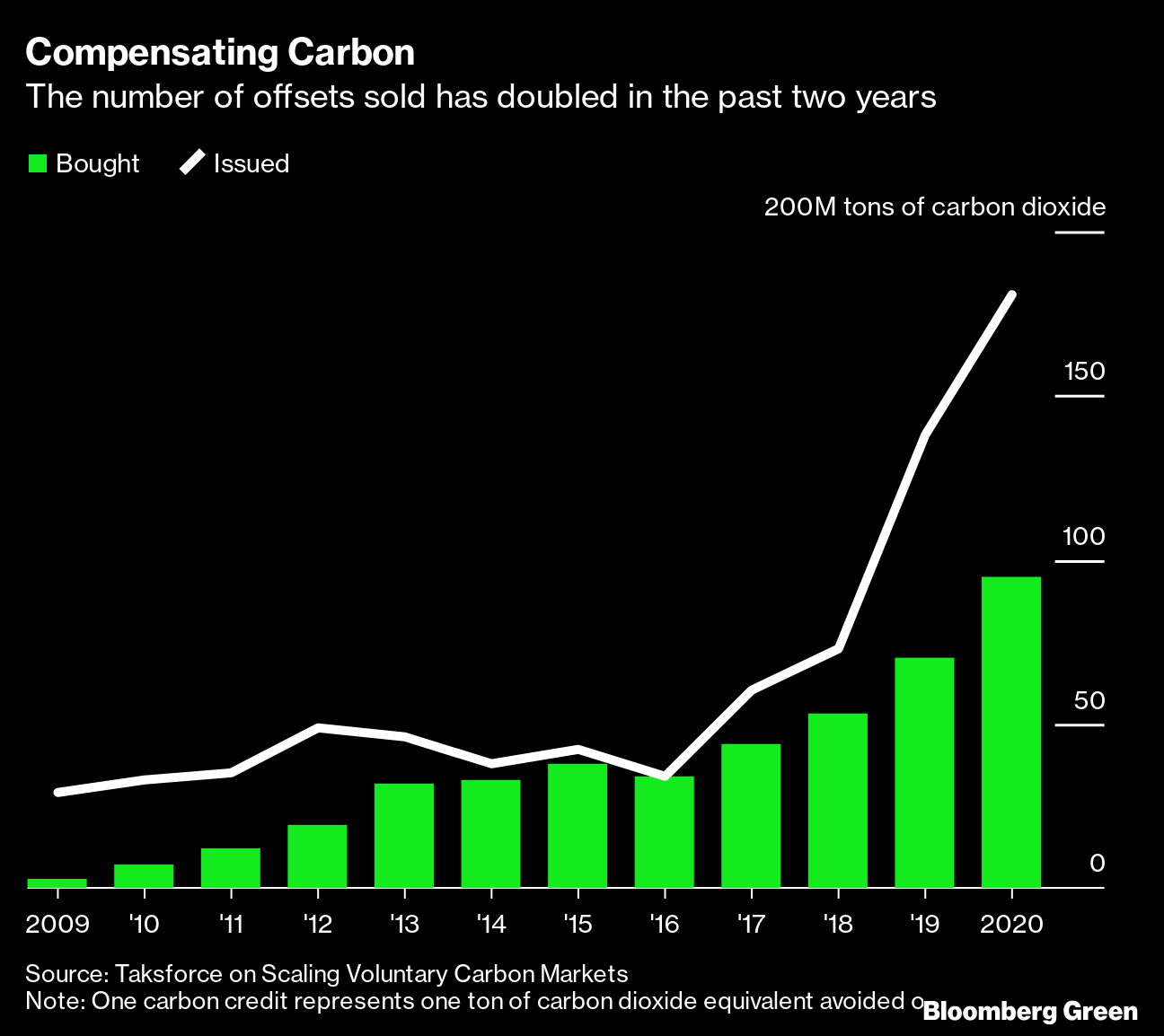
The article in the url below provides an update on how the market for carbon offsets has increased markedly in recent years (including dramatic graphs, like this):

"Such is the exuberance for carbon offsets that the consultancy McKinsey & Co. estimates a voluntary trading market like the one being organized by two financial heavyweights, Mark Carney and Standard Chartered CEO Bill Winters, could be worth as much as $50 billion in 2030, up from just $300 million in 2018. Carney, the former governor of the Bank of England, has put the figure as high as $100 billion by the end of the decade."

For more on this new voluntary market, see here, although many of the same issues with offsets (such as verification and accounting) remain largely unsolved (see Strategic CSR – Trees). In spite of this, three quotes from this article caught my eye. The first emphasizes the woeful inadequacy of the current market for carbon offsets, irrespective of its recent popularity:

"The vast majority of the offsets sold today cost less than $5 for each ton of carbon dioxide removed from the atmosphere. In many cases, the price per ton can be as low as $2."

The second quote shows some of the fascinating challenges with building a market where any offset can be traded on a transparent basis from a common reference point:

"Trees that store away carbon dioxide for five years before being burned in a wildfire are providing a fundamentally different service than a ton of the gas buried deep underground for thousands of years. Climate change is a problem of cumulative amount of greenhouse gases in the atmosphere, and many experts argue that the longer a ton of CO₂ can be stored away, the more valuable it should be. That might make it hard to set a standardized price."

The third quote questions whether the voluntary nature of the proposed market will undermine its chances of achieving its stated goals:

"Buyers and sellers are incentivized to trade numbers on ledgers, but how can the rules incentivize verification? Will all the offsets trading hands in the new market truly lower greenhouse-gas emissions? As one taskforce participant we spoke to put it: Either the taskforce recommends the creation of a global regulator, or it risks the same failure that has met previous attempts."

Take care
David

David Chandler
© Sage Publications, 2020

Instructor Teaching and Student Study Site: https://study.sagepub.com/chandler5e 
Strategic CSR Simulation: http://www.strategiccsrsim.com/
The library of CSR Newsletters are archived at: https://strategiccsr-sage.blogspot.com/


Turning Carbon Offsets into Catnip for Commodities Traders
By Akshat Rathi
June 2, 2021
Bloomberg Businessweek
 

Tuesday, October 12, 2021

Strategic CSR - Interface

Thanks to the late Ray Anderson's pioneering work, his company Interface (and more specifically its carpet tiles, Flor) is something I have noticed whenever it appears in the media (e.g., see Strategic CSR – Ecocide). Although I knew the company was doing good work, however, I recently saw what I think is a first for me – a carbon negative product. To repeat, that is not carbon neutral, but carbon negative. That is, Interface's release of its most recent product/innovation stores more carbon in its production and lifecycle use than it uses:

"This carpeting was a result of four years of intensive research and development, according to Interface. It incorporated a material made from recycled vinyl and processed vegetation; it was infused with a latex created from smokestack exhaust. It was topped and tufted with salvaged nylon. And it had been manufactured in the least environmentally demanding way possible. By Interface's reckoning, the carpeting had a carbon footprint of negative 300 grams per square meter. … carpeting a 10-feet-by-20-feet conference room, say, with these tiles can be seen as the equivalent of pulling roughly 12 pounds of carbon dioxide out of the atmosphere."

The challenge in achieving this is amplified when you think about how dirty carpet making traditionally has been:

"Industrial carpet tile can be thought of as a kind of three-layer sandwich, made from tufting on top, filler in the middle and backing on the bottom. In the mid-1990s, Interface calculated the carbon footprint of these layers and concluded that a square meter of the sandwich was responsible for releasing about 20 kilograms worth of CO2 into the atmosphere. Most of these emissions — probably more than 70 percent — resulted from materials and processing, and a lesser portion from manufacturing, installation and maintenance (all that cleaning and vacuuming over the course of a carpet's life adds up to significant CO2 emissions)."

Of course, I have known the technology exists for carbon sequestration, but the challenge I thought (and the article makes clear still largely exists) is in its commercial application/scaling at the product level. For example, recently there has been a lot of innovation in the production of concrete using carbon-infused materials, but companies are nowhere near carbon neutrality with that, let along carbon negative (see Strategic CSR – Concrete). As such, any discussion about the technology tends to be on a company or societal level. The outcome is also usually storing or injecting the carbon dioxide underground, whereas this process involves storing the carbon in the product itself:

"The company began using recycled components for the backing, filler and yarns, and the factories were refitted with machines that were more efficient. Pushing an Interface product to below zero, at least in carbon terms, was not about a big breakthrough … . It was more like coming up with a recipe involving hundreds, if not thousands, of changes to ingredients and techniques. Over the next two decades, the company learned a couple of things. First, by reducing its emissions and using mostly recycled materials, its tiles could approach carbon neutrality. Second, by obtaining its materials from different sources — and using them in smaller amounts — Interface could further shrink its footprint. The CO2-infused latex, which is sprayed on the carpet's middle layer, was a helpful step. The key adaptation, however, was transforming the backing. Incorporating biomaterials — forestry byproducts and plants rich in absorbed carbon — locked in high levels of carbon and canceled out the emissions related to the rug's materials, production and life cycle. In essence, Interface was creating what we usually call a carbon offset in the lowest layer of its carpet sandwich."

This is the first time I think I have seen a company calculate the carbon footprint of a product and announce that it is negative. For the author, this story revolves around the larger issue of "carbontech," which he defines as:

"… trying to 'embed' large amounts of carbon within commercial merchandise. … Advocates of carbon utilization, or carbontech, as it's also known, want to remake many of the things we commonly use today. But with one crucial difference: No emissions would have been added to the environment through their fabrication."

The article provides multiple examples of different startups trying to develop technologies that will revolutionize some of the dirtiest industries and products we have developed (such as concrete), and also using market-based ideas to hasten the speed with which carbontech is advanced (such as pricing and trading carbon dioxide, rather than treating it as a waste product, at present). The article is also clear that this is not a silver bullet, but should be thought of more as an innovative means to help us transition from our current unsustainable, fossil-fueled economic system to a future (and as of yet undefined) sustainable economic system.

Take care
David

David Chandler
© Sage Publications, 2020

Instructor Teaching and Student Study Site: https://study.sagepub.com/chandler5e 
Strategic CSR Simulation: http://www.strategiccsrsim.com/
The library of CSR Newsletters are archived at: https://strategiccsr-sage.blogspot.com/


Better Living Through CO2
By Jon Gertner
June 27, 2021
The New York Times Magazine
Late Edition – Final
27-33, 61
 

Friday, October 8, 2021

Strategic CSR - Best Buy

The interview in the article in the url below with Hubert Joly (now a lecturer at Harvard Business School; until 2019, he was the CEO of Best Buy) is largely mundane. It is not that I question Joly's sincerity; it is just that he is not saying anything particularly interesting. But, there is a moment of eloquence that I found inspiring. It is in response to a question about re-shaping the culture of an organization – aligning interests across all stakeholders to produce meaningful action. When asked if there are any "specific actions you think companies should take" to produce this result, Joly replies:

"I would start with providing an attractive environment and set of opportunities for their employees. Raising the minimum wage is a very important trend, but it goes beyond pay. It is about benefits, taking care of your employees, including their mental health or their ability to vote. It is about a path to advancement, skills acquisition. It is about offering a growth environment, one where you feel you belong, one where you feel your manager is investing in you, one where you can connect what drives you with your work."

Essentially, he is prioritizing the firm's employees above all other stakeholders, which is consistent with the framework presented in Strategic CSR. I often tell my students – any organization that does not treat its employees as its most important stakeholder is dysfunctional to some degree. All stakeholders are important, and the goal of the firm should be to create value broadly, but it starts with employees. That has to be the path of least resistance toward a successful model of stakeholder capitalism.

The other notable element of the interview is reporting that there are "2 billion pounds of electronics recycled annually by Best Buy."

Take care
David

David Chandler
© Sage Publications, 2020

Instructor Teaching and Student Study Site: https://study.sagepub.com/chandler5e 
Strategic CSR Simulation: http://www.strategiccsrsim.com/
The library of CSR Newsletters are archived at: https://strategiccsr-sage.blogspot.com/


On His To-Do List: Fixing Capitalism
By David Gelles
July 18, 2021
The New York Times
Late Edition – Final
BU5
 

Wednesday, October 6, 2021

Strategic CSR - Juneteenth

The article in the url below is an opinion piece by Kaitlyn Greenidge (the "features director at Harper's Bazaar") about Juneteenth, which was recently declared a federal holiday here in the U.S. Specifically, she discusses the history of Juneteenth and, most notably, how it is a commemoration that should remain confined to Texas:

"Though Juneteenth has recently gained nationwide attention, and just became a federal holiday, it originated as a Texas-specific celebration of the end of slavery. Other states and regions have their own traditions for marking Emancipation: Crucially, these celebrations have different dates from place to place, because freedom was gained through wildly different ways for Black people across this country."

In other words, June 19 (1865) was the day in which slaves in Texas learned of their freedom. While the Emancipation Proclamation was signed by President Lincoln in January, 1863, news spread slowly at the time and took over two years to reach the state. Consequently, the same event is commemorated on different days in different states:

"In New York State, where gradual Emancipation was put into place to ease white fears at the expense of Black comfort, Emancipation Day was celebrated on the 5th of July. … Some Black communities in the North and South have also celebrated Emancipation Day on the 1st of January, because that was when Abraham Lincoln signed the Emancipation Proclamation into law."

Or, perhaps more starkly:

"Juneteenth is not a part of any state's history except Texas. But it is perhaps easier for some white Northerners to tut at the duplicity of white Texas slaveholders than to look at how Black people became free in their own states — as in Massachusetts, through having to sue for their freedom."

Beyond this fact-based history, however, the broader point Greenidge wants to make is about the commodification of the day (and the broader associated struggle), a corruption of the notion of what the day represents that reflects the shallow reality of many corporate promises made in the aftermath of 2020's BLM protests (e.g., here):

"It was with dismay that I realized, a few weekends ago, that Walmart is now selling Juneteenth T-shirts."

In other words, she argues, assigning June 19 as a holiday is a way to alleviate guilt while generating revenue and, perhaps most importantly, avoid the need to deliver more substantive concessions:

"In my most cynical moments, I think that the rush to embrace Juneteenth is about undermining the right to protest of Black people who are alive now. 'Why are they still going on about voting rights and police violence and clean air and health care and schools,' a white politician can say to his non-Black constituents next year, 'when we gave them a day off?'"

The consequences of an event like Juneteenth becoming 'mainstream,' according to the author, is that it loses much of what made it important in the first place:

"But mostly, I am sad because when a holiday becomes co-opted like this, those who can gain a sense of self and solidarity from celebrating it often lose it. The agency that comes from deciding your own traditions … becomes lost to a corporate calendar and a megastore selling you a Juneteenth cookout checklist."

Along similar lines, I have begun to see the wider use of the term pinkwashing, a word that I plan to add to the glossary in the next edition of the book. My definition:

"The adoption and promotion of LGBTQ+ friendly media statements and campaigns by companies without the more substantive commitment of meaningful change. Also associated with the marketing and commodification of the LGBTQ+ cause, again without meaningful progress on substantive issues."

In a broader discussion of pinkwashing in the article in the second url below, which has been around for some time, the accusation is that corporations are deploying this approach more than ever before:

"With the gay pride season coming to a close, here is a question: have you withdrawn money from a multi-coloured gAyTM this summer? Or have you even tucked into your Burger King Pride Whopper? … Celebrating LGBT rights is a fashionable topic in marketing land. Long gone are the days where marketers may have only coyly targeted the LGBT community. In today's marketing, at least for some, even queer products for a straight audience have become mainstream – used to sell anything from fast food to credit cards, clothing to eReaders – but it's not clear whether this is a real "win win" for the market and the LGBT community."

The goal, it is suggested, is the "pink dollar":

"The emergence of AIDS in the 1980s helped to rein in commercial attitudes towards the LGBT community and it wasn't until the second half of the decade that the first few mainstream brands – Absolut Vodka's campaign in The Advocate, for example – started cautiously appearing in gay magazines alongside the community organisations and businesses. It was the 1990s which saw a genuine turnaround. Advertisers openly hailed the 'Dream Market' of urban, well-educated, double-income gay and lesbian couples."

All of this, of course, is a gamble by corporations that such transparent efforts to co-opt certain 'causes' will pay off commercially. Given the transparency, if corporations do benefit from such marketing efforts, it will be either because we don't care enough to point out the hypocrisy, or we don't care enough to notice in the first place.

Take care
David

David Chandler
© Sage Publications, 2020

Instructor Teaching and Student Study Site: https://study.sagepub.com/chandler5e 
Strategic CSR Simulation: http://www.strategiccsrsim.com/
The library of CSR Newsletters are archived at: https://strategiccsr-sage.blogspot.com/


Emancipation Goes Corporate
By Kaitlyn Greenidge
June 20, 2021
The New York Times
Late Edition – Final
SR4

The rise of pride marketing and the curse of 'pink washing'
By Stephen Dahl
August 26, 2014
The Conversation